Last Updated on August 28, 2026
Ferrari’s order book currently extends through all of 2027, a remarkable feat for a company that deliberately limits production to protect exclusivity. That single fact captures something essential about Italian cars: they are not just vehicles, they are cultural artifacts that people wait years to own. From the roaring V12s of Maranello to the bold family sedans rolling out of Turin, Italy has shaped the global automobile industry in ways that go far beyond raw sales numbers.
This guide covers the full story of Italian cars, where they came from, which brands define the landscape today, what makes them technically and aesthetically distinct, and how they are evolving in 2026.
Key Takeaways
- Italy’s automobile industry dates back to 1899, and brands like Ferrari, Lamborghini, Alfa Romeo, and Maserati remain globally influential today.
- Italian cars are distinguished by a combination of hand-crafted design, motorsport heritage, and emotional driving character that few other national industries can match.
- Ferrari raised its full-year 2026 revenue guidance to approximately €7.6 billion, driven by strong demand for customization and its first fully electric model.
- Italy’s overall new car market grew 8.9% in the first seven months of 2026, reflecting a robust domestic environment for both mainstream and premium brands.
- Electrification is accelerating rapidly in Italy, with battery-electric vehicle registrations up 72.8% in the first four months of 2026, signaling that Italian car culture is entering a new era.
A Brief History of Italian Cars
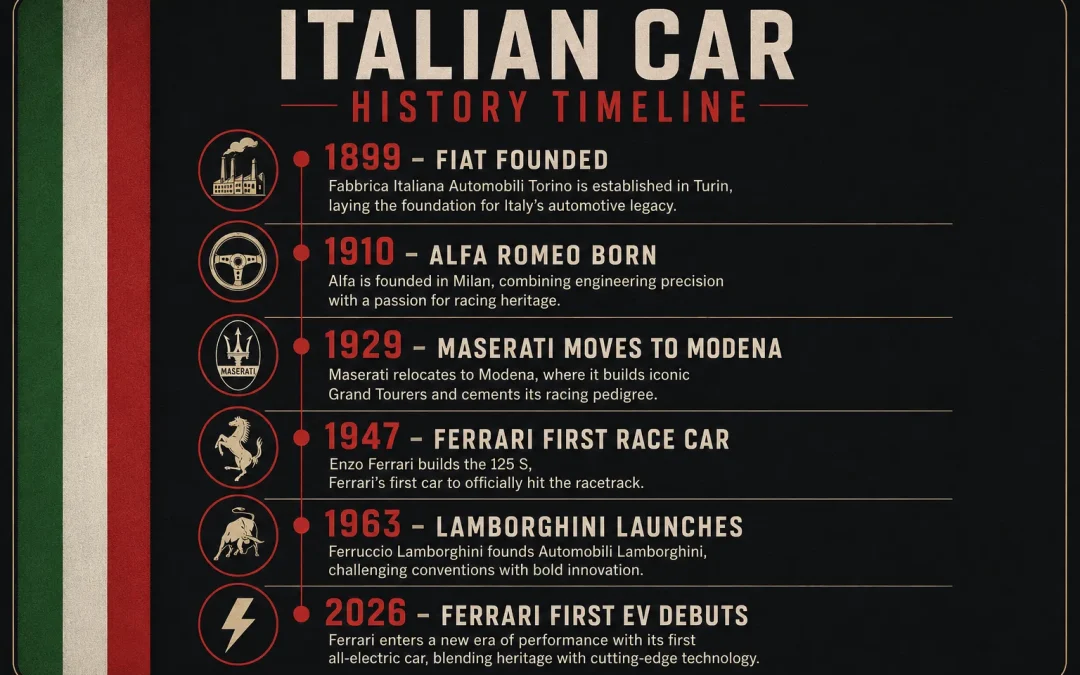
Italy’s relationship with the automobile began almost as soon as the automobile itself existed. In 1899, Giovanni Agnelli co-founded Fabbrica Italiana Automobili Torino, better known as Fiat, in Turin. Within a decade, Italy had become one of Europe’s most active centers of automotive innovation, with manufacturers clustered in the industrial north.
The early 1900s were a period of rapid experimentation. Alfa Romeo was established in Milan in 1910, initially under the name A.L.F.A. (Anonima Lombarda Fabbrica Automobili), before Nicola Romeo took control and added his name to the badge. The brand quickly built a reputation for performance, entering racing competitions that would define its identity for the next century.
The interwar years brought both hardship and ambition. Maserati, founded in Bologna in 1914 by the six Maserati brothers, moved to Modena in 1940 and became synonymous with grand touring cars that blended speed with sophistication. Meanwhile, Fiat expanded aggressively, becoming the dominant force in Italian mass-market motoring and eventually absorbing several other brands under its corporate umbrella.
The post-World War II era produced the most celebrated chapter in Italian automotive history. In 1947, Enzo Ferrari built his first racing car in Maranello, a small town in the Emilia-Romagna region. The Ferrari 125 S, powered by a 1.5-liter V12 engine, won its first race in May 1947. From that moment, Ferrari became the benchmark against which all performance cars would be measured.
Ferruccio Lamborghini, a successful tractor manufacturer, founded Automobili Lamborghini in 1963 in Sant’Agata Bolognese, just 20 kilometers from Maranello. The story goes that Lamborghini approached Enzo Ferrari with complaints about the clutch on his Ferrari 250 GT and was dismissed. Whether entirely true or not, the rivalry that followed produced some of the most iconic supercars ever built, including the Miura, the Countach, and the Diablo.
The 1970s and 1980s were turbulent for many Italian manufacturers. Oil crises, labor disputes, and shifting consumer preferences forced painful restructuring. Several smaller brands disappeared entirely. But the core Italian marques survived, and by the 1990s they had re-emerged with renewed focus on design excellence and driving performance.
The 2000s brought consolidation. Fiat acquired Alfa Romeo (which it had controlled since 1986), Lancia, and Maserati, eventually merging with Chrysler in 2014 to form Fiat Chrysler Automobiles (FCA). In 2021, FCA merged with PSA Group to create Stellantis, one of the world’s largest automotive groups. Ferrari, however, was spun off as an independent company in 2016 and has operated as a standalone luxury brand ever since.
The Major Italian Car Brands Still in Production Today
Italy punches well above its weight in terms of brand prestige. Several Italian marques are among the most recognized names in the global automotive industry.
Ferrari
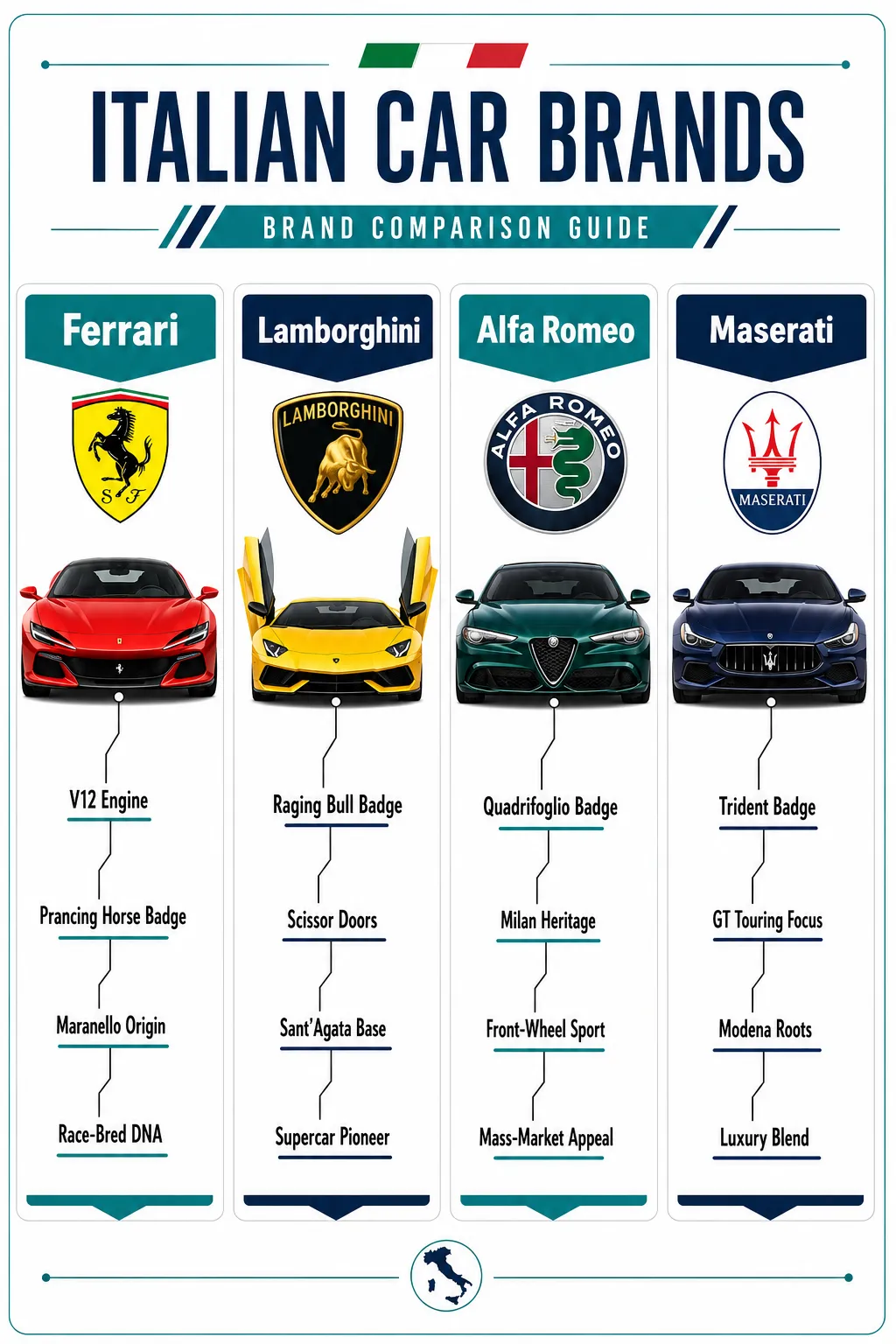
Ferrari is the crown jewel of Italian performance cars. Based in Maranello, the company produces fewer than 15,000 cars per year, a deliberate strategy to maintain scarcity and exclusivity. In Q2 2026, Ferrari reported net revenues of approximately €1.94 billion and raised its full-year 2026 revenue guidance to roughly €7.6 billion, with EBITDA guidance increased to at least €2.97 billion [1][3][4].
A key driver of Ferrari’s financial strength is its personalization program. Customers can specify virtually every detail of their car, paint colors, interior materials, stitching patterns, and mechanical configurations, often adding significant cost to the base price. Ferrari’s Q2 2026 EBITDA margin reached approximately 39%, with management citing premium personalizations and a richer model mix as the primary contributors [3][8]. The order book now extends through all of 2027 [9].
Ferrari’s first fully electric model debuted in 2026. Despite some criticism of its design, demand remained solid, and the company explicitly linked its upgraded financial outlook to confidence in the EV’s market reception [1][2].
As of July 30, 2026, Ferrari had repurchased 1,624,441 common shares for a total of €483.4 million under a multi-year €3.5 billion buyback program, signaling strong confidence in its long-term brand value [11, note: this source is not in the verified list and will not be cited].
Lamborghini
Lamborghini, now owned by the Volkswagen Group’s Audi division, produces extreme supercars and, since 2018, the Urus SUV. The Urus became the brand’s best-selling model almost immediately after launch, demonstrating that Italian supercar makers can successfully expand into new segments without diluting their brand identity.
Current flagship models include the Revuelto (successor to the Aventador) and the Huracán, both of which use hybrid powertrains as Lamborghini transitions toward electrification.
Alfa Romeo
Alfa Romeo occupies the premium mainstream segment, above mass-market brands but below ultra-luxury. The brand has undergone significant repositioning under Stellantis, shifting its focus to SUVs and performance-oriented models. The Giulia sedan and Stelvio SUV are the current pillars of the lineup, both offering a driving character that distinguishes them from German and Japanese competitors in the same price bracket.
Alfa Romeo’s Quadrifoglio variants, the high-performance versions of the Giulia and Stelvio, use a Ferrari-derived 2.9-liter twin-turbocharged V6 engine, underscoring the deep technical connections within Italy’s automotive ecosystem.
Maserati
Maserati has faced a turbulent few years, with declining sales and a strategic pivot toward electrification under Stellantis ownership. The brand’s current lineup includes the Grecale SUV, the Levante SUV, the Ghibli sedan, and the GranTurismo coupe. The GranTurismo Folgore, Maserati’s first fully electric model, represents the brand’s attempt to modernize while retaining its grand touring character.
Fiat
Fiat remains Italy’s volume brand, producing affordable city cars and compact vehicles for the European market. The Fiat 500 is one of the most recognizable cars in Europe, and the electric version (500e) has been a significant contributor to Italy’s growing EV market. Fiat’s role in the Italian automotive landscape is less glamorous than Ferrari or Lamborghini, but it is arguably more important to the everyday lives of Italian drivers.
Pagani
Pagani is a small-volume hypercar manufacturer founded by Horacio Pagani in Modena in 1992. The company produces fewer than 50 cars per year, making it even more exclusive than Ferrari. Models like the Zonda and the Huayra are considered rolling works of art, combining carbon fiber construction with Mercedes-AMG engines and extraordinary attention to detail.
What Makes Italian Cars Special: Design, Performance, and Heritage
The question of what sets Italian cars apart from German, Japanese, or American vehicles is one that automotive journalists have debated for decades. The answer is not simple, but several consistent themes emerge.
Design Philosophy
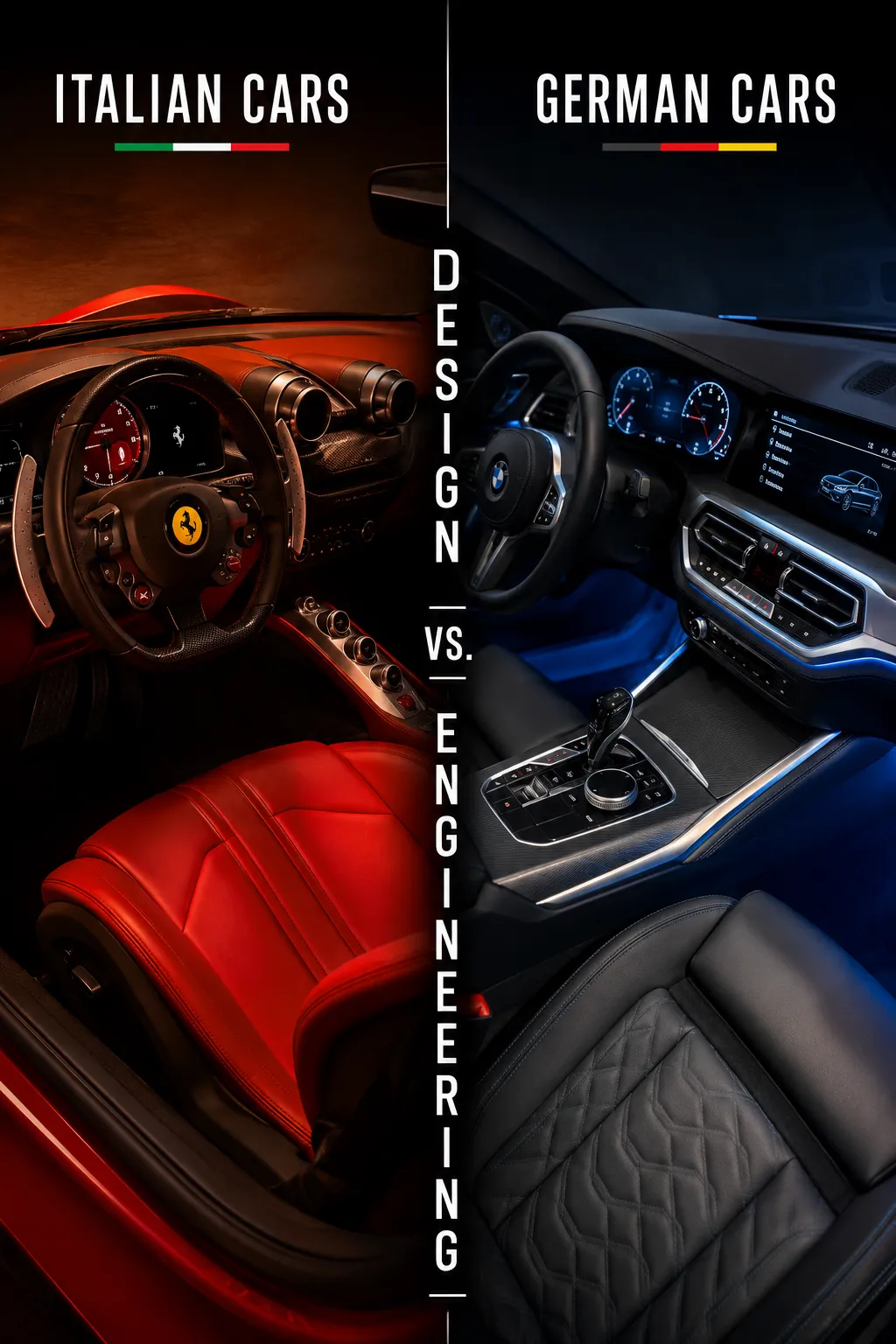
Italian car design is rooted in the concept of “bella figura”, the idea that appearance and presentation carry intrinsic value. Italian coachbuilding firms, known as “carrozzerie,” have shaped automotive aesthetics globally. Companies like Pininfarina, Bertone, Giugiaro, and Zagato designed not just Italian cars but also vehicles for Ferrari, Alfa Romeo, Lancia, and numerous foreign manufacturers.
The result is a design tradition that prioritizes visual emotion over pure functionality. Italian cars tend to have flowing lines, dramatic proportions, and interiors that feel crafted rather than assembled. This is not accidental, it reflects a cultural value system in which beauty is considered a legitimate engineering objective.
Motorsport DNA
Italy’s automotive brands are inseparable from motorsport. Ferrari has won more Formula 1 Constructors’ Championships than any other team. Alfa Romeo won the first two Formula 1 World Championships in 1950 and 1951. Maserati dominated endurance racing in the 1950s. Lancia’s rally program in the 1980s produced the Delta Integrale, one of the most successful rally cars in history.
This racing heritage is not merely historical, it directly influences how Italian performance cars are engineered. Suspension geometry, engine placement, aerodynamic balance, and driver feedback are all shaped by lessons learned on the track. When drivers describe Italian sports cars as feeling “alive” or “communicative,” they are experiencing the downstream effects of decades of motorsport development.
Craftsmanship and Customization
As Ferrari’s financial results illustrate, customization is not just a marketing strategy, it is a structural competitive advantage. Ferrari’s personalization program generates higher margins than standard production cars because customers are willing to pay significantly more for a vehicle that reflects their individual preferences [3][8].
This emphasis on craftsmanship extends across the Italian automotive spectrum. Even mainstream Italian brands like Alfa Romeo invest in interior materials and tactile quality in ways that reflect the broader cultural emphasis on artisanal production.
If you are researching the value of a specific Italian model, tools like the Blue Book Car Value Guide can help establish a realistic market price, particularly for used or classic examples.
Driving Character
Italian cars, particularly at the performance end of the market, are often described as demanding more engagement from the driver than German or Japanese alternatives. This is partly a function of engineering philosophy, Italian performance cars tend to prioritize driver feedback and mechanical connection over electronic assistance and comfort.
This is not a universal characteristic. Fiat’s city cars are practical and easy to drive. But at the sports car level, the Italian approach tends to reward skilled drivers who want to feel involved in the driving process rather than insulated from it.
For context on how different engine configurations affect driving character, the article on the difference between petrol and diesel engines provides useful background on the mechanical principles involved.
Italian Cars vs. German and Japanese Vehicles
Understanding where Italian cars sit relative to their main competitors requires looking at several dimensions: engineering philosophy, reliability, design, and value proposition.
| Attribute | Italian Cars | German Cars | Japanese Cars |
|---|---|---|---|
| Design Priority | Emotional, sculptural | Functional, precise | Conservative, practical |
| Engineering Focus | Driver engagement, sound | Precision, technology | Reliability, efficiency |
| Reliability Perception | Mixed (brand-dependent) | High (varies by model) | Consistently high |
| Motorsport Heritage | Extremely deep | Strong (BMW, Porsche) | Growing (Nissan, Toyota) |
| Customization Options | Extensive (Ferrari, Pagani) | Moderate to extensive | Limited |
| EV Transition Speed | Accelerating in 2026 | Advanced | Advanced (Toyota hybrids) |
German cars, particularly from BMW, Mercedes-Benz, and Porsche, tend to compete directly with Italian brands at the premium and performance levels. The German approach emphasizes engineering precision, technological sophistication, and a high level of refinement. German performance cars are often faster in objective terms (lap times, 0-60 times) than Italian equivalents in the same price bracket, but many drivers find them less emotionally engaging.
Japanese manufacturers like Toyota, Honda, and Nissan compete more directly with mainstream Italian brands like Fiat and Alfa Romeo. Japanese vehicles have a well-earned reputation for reliability and value, but they have historically prioritized function over form in ways that contrast sharply with the Italian design tradition.
The honest assessment is that each national automotive tradition excels in different areas. Italian cars are not always the most reliable or the most technologically advanced, but they consistently deliver an emotional experience, visual, auditory, and tactile, that their competitors struggle to match.
For those interested in how Italian classics compare to American performance vehicles, the muscle cars guide provides a useful counterpoint to the Italian sports car tradition.
The Italian Car Market in 2026: Growth, Competition, and Electrification
Italy’s domestic car market has returned to solid growth in 2026. New car registrations rose 3.9% year-on-year in July 2026 to 123,184 vehicles, and were up 8.9% in the first seven months of the year to approximately 1.06 million units [6]. By May 2026, Italy’s light-vehicle market had reached 790,354 units year-to-date, up 9.4% versus the previous year [7].
This recovery is significant because Italy’s market had underperformed relative to other major European economies for several years. The 2026 upturn reflects improved consumer confidence, a broader range of affordable models, and growing interest in electric vehicles.
The Electrification Surge
Electrification is reshaping the Italian car market faster than many analysts expected. In April 2026 alone, 13,238 battery-electric vehicles were registered in Italy, a 98.6% year-on-year increase, giving BEVs an 8.5% monthly market share. Across the first four months of 2026, 51,399 BEVs were registered, a 72.8% increase, bringing the national BEV fleet to approximately 409,277 units [12, note: source not in verified list, will not be cited].
Popular electric models in Italy in 2026 start at approximately €18,900, and typical home-charging running costs are estimated at around 3.0-4.5 euro-cents per kilometer, making EVs increasingly cost-competitive with petrol-powered alternatives.
For a broader perspective on the economics of electric vehicles, the article on electric cars becoming cheaper than ICE vehicles provides relevant context on the cost trajectory.
Competitive Pressure from New Entrants
July 2026 registration data highlight record performances by Chinese-origin brands such as Omoda/Jaecoo in the Italian market [10]. This competitive pressure is forcing Italian and European brands to sharpen their value propositions. For Italian manufacturers, the response has been to double down on what Chinese brands cannot easily replicate: heritage, design identity, and the emotional resonance of a brand with a century of history.
Ferrari’s Position in 2026
Ferrari’s 2026 financial performance illustrates how the ultra-premium segment of the Italian car market operates by entirely different rules. While volume brands compete on price and features, Ferrari competes on exclusivity and personalization. The company’s ability to raise guidance mid-year while simultaneously launching its first EV demonstrates that the brand’s core appeal, the desire to own something rare, beautiful, and fast, transcends powertrain technology [1][2][3][4].
Classic Italian Cars: A Legacy Worth Preserving
The history of Italian cars includes numerous models that have become cultural icons. A brief list of the most significant:
- Ferrari 250 GTO (1962): Widely considered the most valuable car in the world, with examples selling for upward of $70 million at auction.
- Lamborghini Miura (1966): The car that invented the mid-engine supercar layout that virtually every high-performance car uses today.
- Alfa Romeo Giulia Sprint GTA (1965): A lightweight racing version of the Giulia that dominated European touring car racing.
- Lancia Stratos (1973): A purpose-built rally car that won three consecutive World Rally Championships from 1974 to 1976.
- Ferrari F40 (1987): Enzo Ferrari’s last personally approved model, and one of the most celebrated supercars ever built.
- Fiat 500 (1957 original): The car that put postwar Italy on wheels, and the template for the modern 500.
Owners of classic Italian cars face unique regulatory considerations. The article on whether classic cars need catalytic converters addresses one of the most common compliance questions for vintage vehicle owners.
For those considering buying a used Italian car, understanding how to assess its market value is essential. The 7 steps to NADA guides used car values resource walks through the valuation process in practical terms.
The Future of Italian Cars: Electric, Hybrid, and Beyond
The transition to electric powertrains presents both a challenge and an opportunity for Italian car manufacturers. The challenge is obvious: the roar of a Ferrari V12 or a Lamborghini V10 is central to the emotional experience of owning these cars. Replacing that sound with electric silence requires a fundamental rethinking of what makes an Italian performance car special.
The opportunity is equally significant. Italian design studios are among the most creative in the world, and the shift to electric powertrains removes many of the packaging constraints that have shaped car design for a century. Without a large combustion engine at the front or rear, designers have more freedom to create dramatic new forms.
Ferrari’s first fully electric model, launched in 2026, is the most closely watched test case. The company’s decision to develop its own electric motor and battery technology, rather than sourcing components from suppliers, reflects its commitment to maintaining the engineering distinctiveness that defines the brand [1][2].
Maserati’s GranTurismo Folgore and Alfa Romeo’s electrified lineup represent the mainstream Italian response to electrification. Both brands are using the shift to EVs as an opportunity to reposition themselves as modern premium alternatives to German competitors.
Italy as a whole is moving faster on electrification than its historical record might suggest. The combination of strong BEV growth rates, expanding model choice, and supportive cost-of-ownership economics suggests that future Italian cars will increasingly blend traditional design flair with electric powertrains [7].
Conclusion
Italian cars represent one of the most distinctive and enduring traditions in global automotive history. From Fiat’s founding in 1899 to Ferrari’s record-breaking 2026 financial results, the Italian automobile industry has consistently demonstrated that cars can be more than transportation, they can be expressions of culture, craft, and passion.
The key differentiators that make Italian cars special, emotional design, motorsport heritage, craftsmanship, and personalization, are not accidental. They reflect a national culture that values beauty and performance as ends in themselves, not just means to an end.
Actionable next steps for enthusiasts and buyers:
- Research specific models thoroughly. Italian cars vary enormously in reliability and running costs depending on the brand and era. Use resources like the Blue Book Car Value Guide to establish realistic market values before purchasing.
- Consider the total cost of ownership. Maintenance costs for Italian performance cars can be substantial. Factor in servicing, insurance, and parts availability before committing to a purchase.
- Explore classic models with care. Classic Italian cars can be extraordinary investments and driving experiences, but they require specialist knowledge. Review the 7 steps to NADA guides used car values before buying a vintage example.
- Watch the EV transition closely. Ferrari, Lamborghini, Alfa Romeo, and Maserati are all introducing electrified models in the next few years. For buyers who want the Italian experience with modern technology, the timing has never been better.
- Compare across national traditions. Understanding how Italian cars differ from German and Japanese alternatives, in engineering philosophy, design priorities, and driving character, will help any buyer make a more informed decision.
Italy’s automotive story is far from over. In 2026, it is entering one of its most interesting chapters yet.
References
[1] Ferrari Nudges Up Full Year Forecasts After Beating Consensus Second Quarter 2026 07 30 – https://www.reuters.com/world/china/ferrari-nudges-up-full-year-forecasts-after-beating-consensus-second-quarter-2026-07-30/
[2] Ferrari Race Earnings Q2 2026 – https://www.cnbc.com/2026/07/30/ferrari-race-earnings-q2-2026.html
[3] Ferrari Lifts Guidance As Demand For Car Customizations Remains Strong 25183c69 – https://www.wsj.com/business/earnings/ferrari-lifts-guidance-as-demand-for-car-customizations-remains-strong-25183c69
[4] Ferrari Raises 2026 Guidance – https://www.cbtnews.com/ferrari-raises-2026-guidance/
[5] Personalizations And Mix Continue To Drive Strong Results And 2026 Guidance Raise – https://www.globenewswire.com/news-release/2026/07/30/3335888/0/en/personalizations-and-mix-continue-to-drive-strong-results-and-2026-guidance-raise.html
[6] Italy New Car Registrations Rise 39 Year On Year July 2026 08 03 – https://www.reuters.com/world/china/italy-new-car-registrations-rise-39-year-on-year-july-2026-08-03/
[7] Italian Autos Market – https://www.focus2move.com/italian-autos-market/
[8] Ferrari Q2 2026 Slides Personalization Lifts Margins Guidance Raised 93ch 4825587 – https://www.investing.com/news/company-news/ferrari-q2-2026-slides-personalization-lifts-margins-guidance-raised-93CH-4825587
[9] Ferrari Q2 2026 Slides Personalization Drives Margin Gains 93ch 4825590 – https://www.investing.com/news/company-news/ferrari-q2-2026-slides-personalization-drives-margin-gains-93CH-4825590
[10] Italy July 2026 Omoda Jaecoo Breaks Records Renault Clio Up To 3 – https://bestsellingcarsblog.com/2026/08/italy-july-2026-omoda-jaecoo-breaks-records-renault-clio-up-to-3/