Last Updated on November 6, 2026
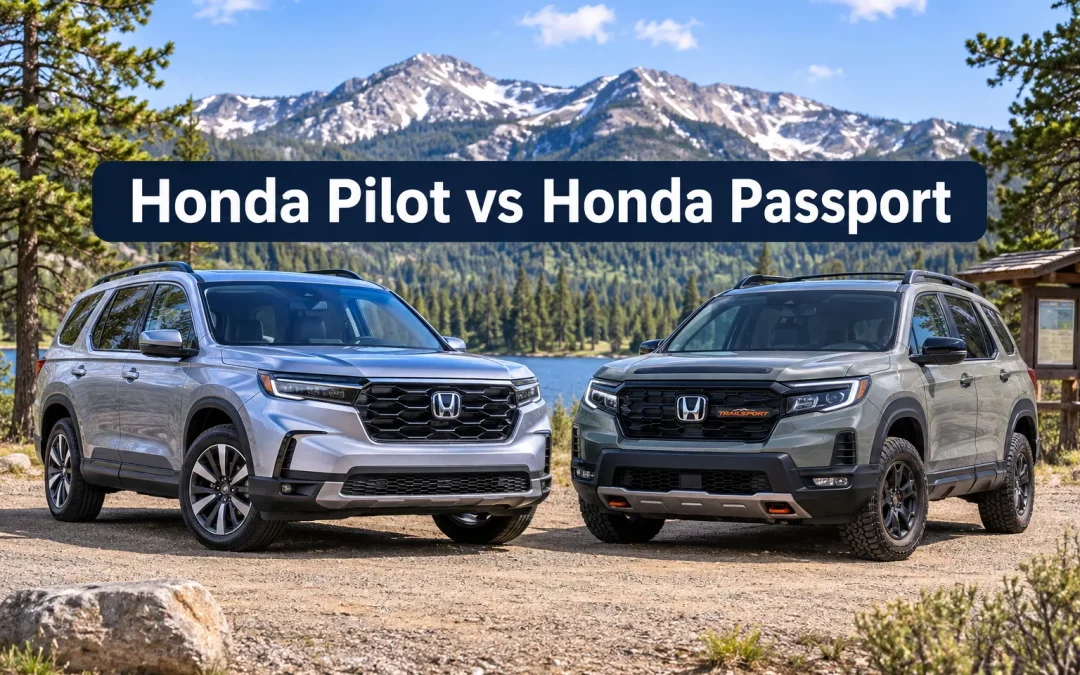
A used Honda Pilot and a used Honda Passport share the same bones, the same V6 engine family, and nearly the same price range on dealer lots. Yet one is built to haul seven or eight people to soccer practice, and the other is built to haul two kayaks down a dirt road. That difference matters more than most buyers realize until they are standing in a driveway trying to decide.
This guide breaks down Honda Pilot vs Honda Passport: Which Used Honda SUV Fits Family Towing, Cargo, and Daily Driving? by comparing seating, towing hardware, cargo access, fuel economy, parking practicality, and used-market pricing signals so you can match the right SUV to your actual life, not just the badge on the tailgate.
Key Takeaways
- The Pilot seats up to eight across three rows; the Passport is strictly a two-row, five-seat SUV [1][2].
- Towing capacity is nearly identical when comparing an AWD Pilot to the Passport, but a front-wheel-drive Pilot falls behind both [3].
- Both SUVs share closely related V6 performance, though the Pilot runs slightly newer engine tuning [4][5].
- The Passport offers more usable two-row cargo space, while the Pilot wins on total cargo volume thanks to its third row folding flat [6][7].
- Most families should lean Pilot; buyers who want a rugged, adventure-styled daily driver without a third row should lean Passport [8].
Seating and Family Capacity: The Core Divide
The single biggest decision point in the Honda Pilot vs Honda Passport: Which Used Honda SUV Fits Family Towing, Cargo, and Daily Driving? debate comes down to seats. The Pilot is a genuine three-row SUV, seating seven in most trims and up to eight when equipped with a second-row bench [1]. The Passport drops the third row entirely, sticking with a two-row, five-passenger layout [2].
For families with more than three kids, or households that regularly carpool, this settles the question before you even look at a spec sheet. A used Pilot can flex into a minivan-adjacent role for carpools, grandparent trips, and team transport. The Passport simply cannot, no matter the trim.
That said, fewer seats is not automatically a downside. Two-row-only buyers who never need extra capacity often prefer the Passport’s shorter overall footprint and tighter turning radius for daily errands and tighter parking spots.
If you’re also weighing other three-row competitors against the Pilot, it’s worth reading how it stacks up in Honda Pilot vs Toyota Highlander vs Subaru Ascent: Best Used Three-Row SUV for Families and Towing.
Towing Capacity and Towing-Ready Hardware
Towing is where the Passport quietly surprises shoppers. Properly equipped, the Passport’s towing capacity matches the all-wheel-drive Pilot and actually beats a front-wheel-drive Pilot configuration [3]. That makes the Passport a legitimate option for buyers who want to tow a small trailer, boat, or camper without stepping up to a truck.
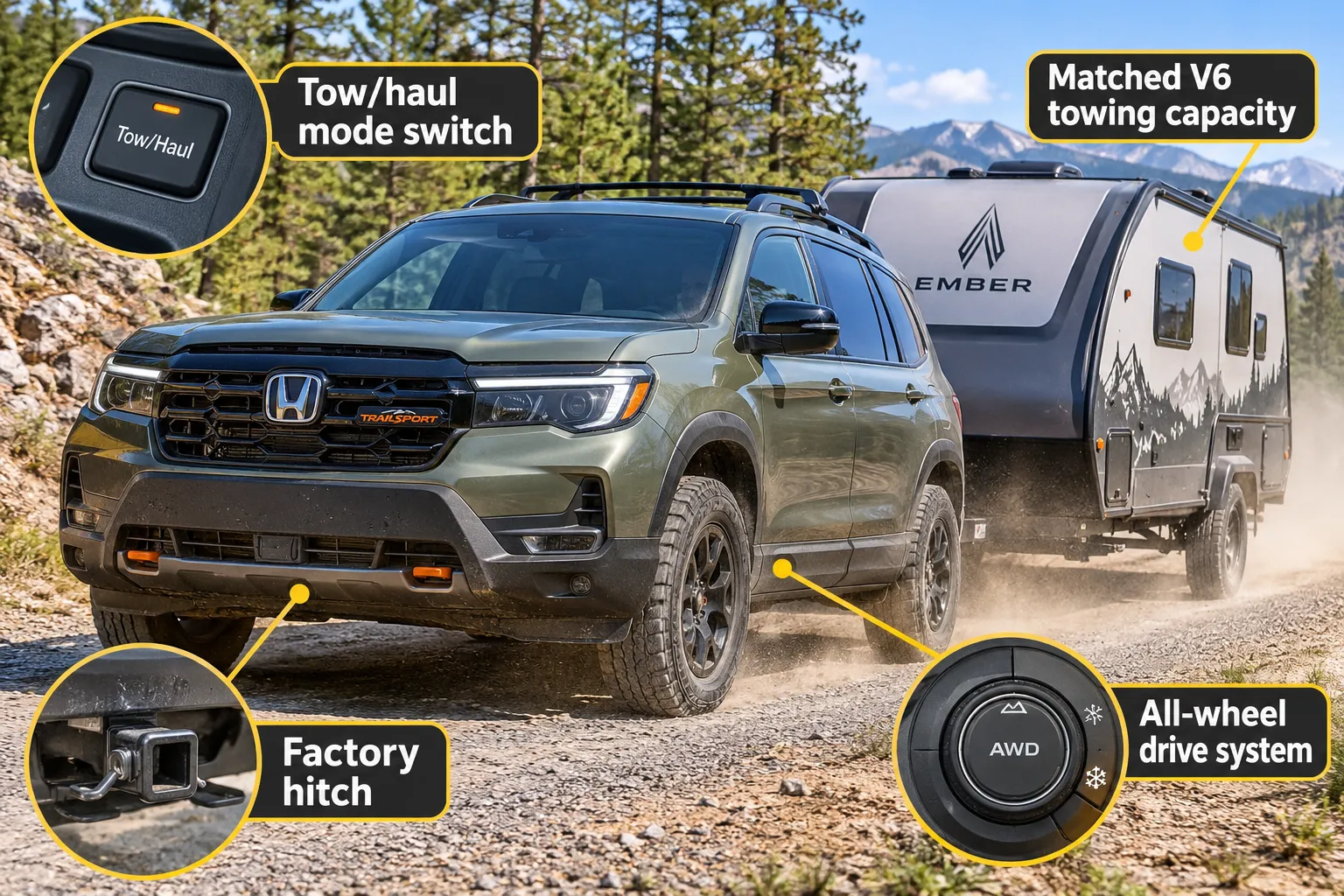
Both models offer factory towing hardware across certain trims, including a proper hitch receiver, wiring harness, and a tow/haul driving mode that adjusts transmission behavior under load [3][9]. When shopping used, confirm the exact trim and drivetrain, since towing figures shift noticeably between FWD and AWD versions of the Pilot in particular.
Pull quote: “An AWD Pilot and a Passport tow nearly the same load, the real gap shows up only in front-wheel-drive Pilot trims.”
If towing is central to your decision, it’s worth reviewing general towing fundamentals for 5th wheels and travel trailers before settling on a trim level, and comparing gas-powered towing capability against what diesel power means for towing, fuel economy, and resale if you’re also considering a larger tow vehicle.
Powertrain and Daily Driving Comfort
Both SUVs use closely related V6 engines delivering similar horsepower and torque figures, which is why performance often feels nearly identical behind the wheel [4][5]. The Pilot, however, benefits from slightly newer engine tuning refinements that show up in smoother power delivery and marginally better efficiency in recent model years [4].
On daily driving comfort, the Pilot edges ahead overall. Reviewers consistently note that the Pilot’s longer wheelbase and additional length translate into a steadier ride, quieter cabin, and more composed highway manners for family duty [8]. The Passport still drives confidently, but it leans slightly firmer and sportier, which fits its “adventurous” positioning rather than pure comfort-first family hauling.
For buyers cross-shopping reliability across brands before committing to either Honda, the broader list of most reliable used cars to buy in 2026 is a useful sanity check.
Cargo Space and Practicality
Cargo numbers tell two different stories depending on how you measure. The Passport offers generous two-row cargo space, since every cubic foot behind the front seats is dedicated to storage rather than a folding third row [6]. That makes it excellent for gear-heavy trips, bikes, coolers, camping bins, without needing to fold anything down.
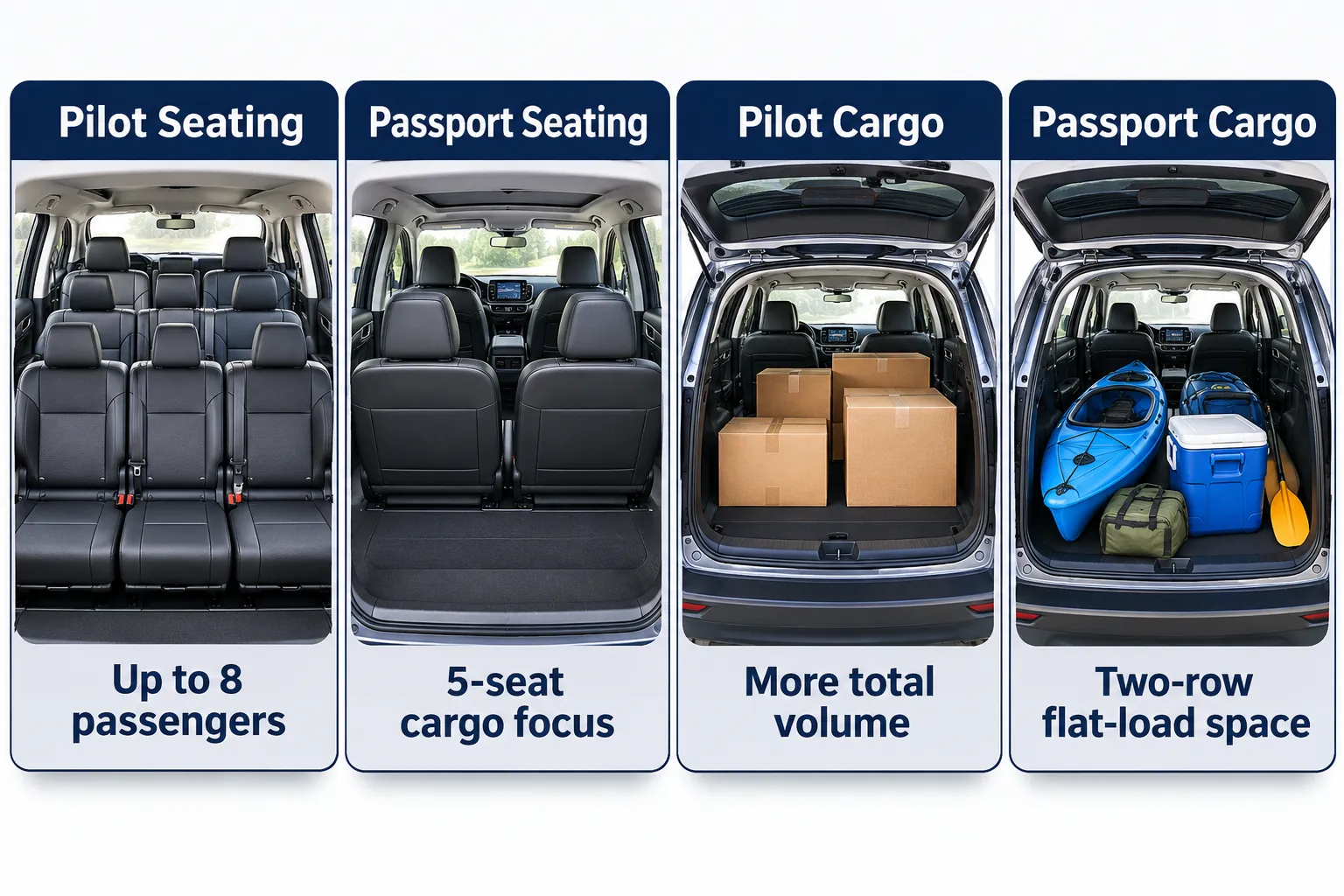
The Pilot, on the other hand, wins on total cargo volume once the second and third rows are folded flat [7]. With all seats down, the Pilot swallows more total cubic feet than the Passport, making it the better choice for occasional big hauls like furniture runs or bulk supply trips, even though its cargo area is split by a third-row footprint when seats are in use.
| Feature | Honda Pilot | Honda Passport |
|---|---|---|
| Seating | Up to 8, three rows [1] | 5, two rows [2] |
| Towing (AWD) | Matches Passport [3] | Matches AWD Pilot [3] |
| Cargo behind row 2 | Smaller due to row 3 | Larger, two-row focus [6] |
| Max cargo, seats folded | Higher total volume [7] | Lower than Pilot |
| Daily ride comfort | Slightly favored [8] | Firmer, sportier feel |
Off-Pavement Capability and TrailSport Trims
Honda has leaned into adventure styling with TrailSport trims on both models, adding all-terrain tires, revised suspension tuning, and rugged exterior cues [9][10]. This is where the Passport’s personality really shows: Motor Trend and other outlets position the Passport as the more “adventurous” of the two, better suited to buyers who want light off-roading and trailhead access without sacrificing daily usability [8].
The Pilot’s TrailSport trim closes some of that gap, but the Passport’s shorter wheelbase and tighter approach angles still give it a slight edge off pavement. For shoppers who split time between commuting and weekend trail access, this is a meaningful differentiator beyond raw specs.
Fuel Economy and Parking Practicality
Fuel economy between the two is close, with only minor differences attributable to the Pilot’s slightly updated engine tuning and the Passport’s marginally different gearing and curb weight [4][5]. Neither SUV should be considered a fuel-economy standout; both are mainstream V6 crossovers built for capability rather than maximum mpg.
Parking practicality favors the Passport slightly. Its shorter overall length and tighter turning radius make it easier to maneuver in dense urban garages, tight suburban driveways, and crowded parking lots. The Pilot’s extra length, needed for that third row, costs a bit of agility in exchange for capacity.
Used-Market Pricing Signals
New-vehicle pricing patterns from Honda and major pricing guides give useful signals for used buyers. Kelley Blue Book data shows the Pilot and Passport sit in similar price bands when new, with trim level and drivetrain driving most of the spread rather than the model name itself [4][5]. That pattern typically carries into the used market: a loaded Passport TrailSport can cost close to, or more than, a base Pilot, simply because of equipment differences rather than any inherent value gap between the nameplates.
Edmunds’ feature-by-feature breakdowns confirm that trim selection affects towing hardware, all-wheel-drive availability, and infotainment tech on both models [6][7], so used shoppers should verify exact build sheets rather than assuming all Pilots or all Passports are equal.
Certified pre-owned Passport buyers also get documented support for towing-ready configurations, which matters if resale value or warranty coverage on towing components is a priority [9][10].
For readers comparing Honda’s SUV lineup against other three-row rivals before finalizing a used purchase, the Pilot vs Highlander vs Ascent comparison provides additional context on where the Pilot sits competitively.
Expert Verdict: Which Fits Most Buyers?
Automotive reviewers largely converge on the same conclusion when weighing Honda Pilot vs Honda Passport: Which Used Honda SUV Fits Family Towing, Cargo, and Daily Driving?. Motor Trend’s direct comparison frames the Pilot as the better fit for most families, citing the extra seating flexibility and overall cargo capacity once rows are folded [8]. The Passport is framed as the right call specifically for buyers who do not need a third row and want a more adventure-oriented two-row SUV with strong towing numbers in AWD form [8].
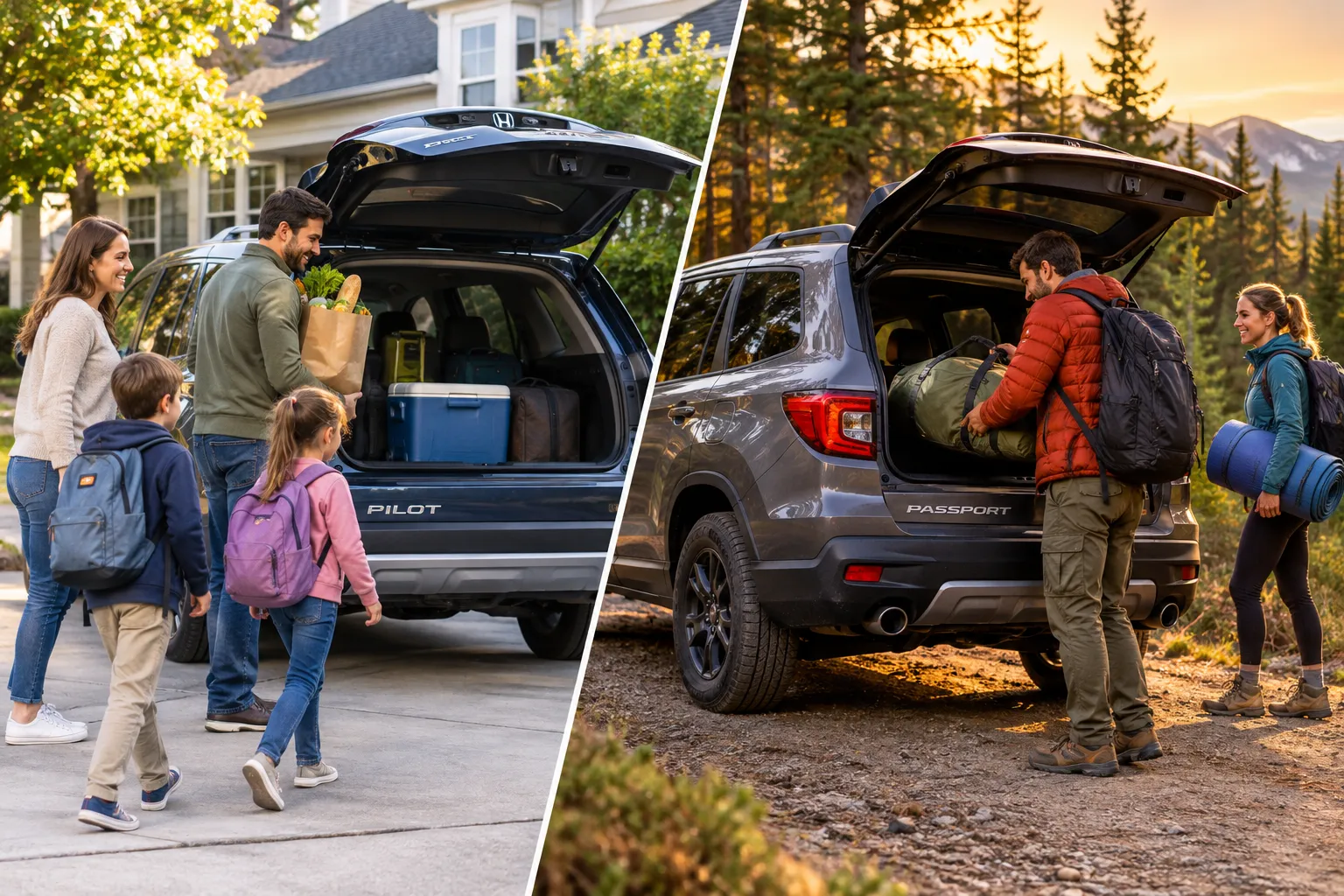
In practical terms: if you regularly carry more than five people, the decision is already made for you, buy the Pilot. If you are a couple, small family, or outdoor-focused household that never needs that third row, the Passport delivers nearly identical towing performance, a more compact footprint, and a slightly more rugged personality for less perceived compromise.
Implications for Used-SUV Shoppers Focused on Towing and Cargo
Used buyers chasing towing capability and cargo flexibility should prioritize drivetrain and trim over badge. An AWD Passport or AWD Pilot will outperform a FWD version of either model for towing, so confirm drivetrain before comparing listings [3]. Shoppers who need maximum folded cargo volume should favor the Pilot, while those who want generous unfolded two-row space should favor the Passport [6][7].
It also pays to inspect for factory towing hardware specifically, since not every trim year includes a hitch and wiring from the factory. Verifying this against the window sticker or build sheet avoids costly aftermarket installs later.
Buyers weighing a Honda three-row or two-row SUV against other used vehicle categories entirely, including RV-adjacent options for family trips, may also want to browse used rental RV options as a comparison point for larger family hauling needs.
Conclusion
The Honda Pilot vs Honda Passport: Which Used Honda SUV Fits Family Towing, Cargo, and Daily Driving? question ultimately comes down to one variable: how many seats you actually need. The Pilot wins for larger families, carpool duty, and maximum folded cargo space. The Passport wins for couples and smaller households who want strong towing numbers, a tighter parking footprint, and a more adventure-styled daily driver.
Before buying used, confirm the exact trim, drivetrain, and factory towing package on any listing, since these details shift both performance and resale value more than the model name alone. Test drive both back to back if possible, the seating and cargo differences become obvious the moment you sit in the third row, or notice there isn’t one.
References
- Specifications. hondainfocenter.com.
- 2025 Honda Passport Specifications En. honda.ca.
- Towing Capacity. hondainfocenter.com.
- Pilot. kbb.com.
- Passport. kbb.com.
- Features Specs. edmunds.com.
- Features Specs. edmunds.com.
- Honda Passport vs. Pilot Pros Cons Comparison. motortrend.com.
- Passport 2025. caranddriver.com.
- Compare. automobiles.honda.com.