
Last Updated on October 8, 2026
A used SUV that looks perfect in photos can still cost you $3,000 more than its sticker price over five years of ownership. That gap usually comes from three blind spots: a reliability score nobody checked, a tow rating that applied to a different trim, and insurance or fuel costs that were never modeled against a monthly budget. Learning how to choose a used SUV: reliability, cargo space, towing, fuel economy, and hidden ownership costs all factored in together is the only way to avoid that outcome, and it starts with treating the purchase like a scored evaluation rather than a gut-feeling decision.
This guide builds a simple scoring system you can use on any compact, midsize, or three-row SUV, paired with inspection questions and a model-selection worksheet you can fill out before you ever sign paperwork.
Key Takeaways
- Reliability should be the first filter, not an afterthought. Compact SUVs like the Honda CR-V and Toyota RAV4, midsize leaders like the Toyota 4Runner, and large/three-row standouts like the Toyota Land Cruiser consistently score highest in 2026 reliability data.
- Cargo space and towing numbers on a brochure are starting points, not guarantees; always verify trim-specific payload and tow ratings together, since tongue weight eats directly into passenger and cargo capacity [10].
- SUVs and minivans post an average reliability score of 46 versus 44 for pickup trucks, reinforcing that family SUVs are generally a safer reliability bet than light trucks right now.
- Fuel and electricity costs can differ by $5,000 to $8,500 over five years between efficient hybrids or EVs and larger combustion SUVs, which is often a bigger swing than the purchase price difference [10].
- Certified pre-owned (CPO) SUVs cost roughly 4-5% more upfront but bundle inspections and extended warranties that frequently save thousands in unexpected repairs [1][3].
Reliability First: How to Choose a Used SUV by Segment Scores
Reliability has to be the primary filter because it is the variable that most directly predicts your future repair bills. The 2026 segment data is unusually clear about which models lead each size class. Among subcompact SUVs, the Honda HR-V tops the list with an 8.4 reliability score, while the Honda CR-V leads compact and small SUVs at 8.0. In the midsize class, the Toyota 4Runner sits at the top with 8.1, and for large and three-row SUVs, the Toyota Land Cruiser leads with an 8.7 score. If you need a three-row family hauler specifically, Consumer Reports survey data cited by CarEdge names the Kia Sorento Hybrid as the most reliable three-row option currently on the market.
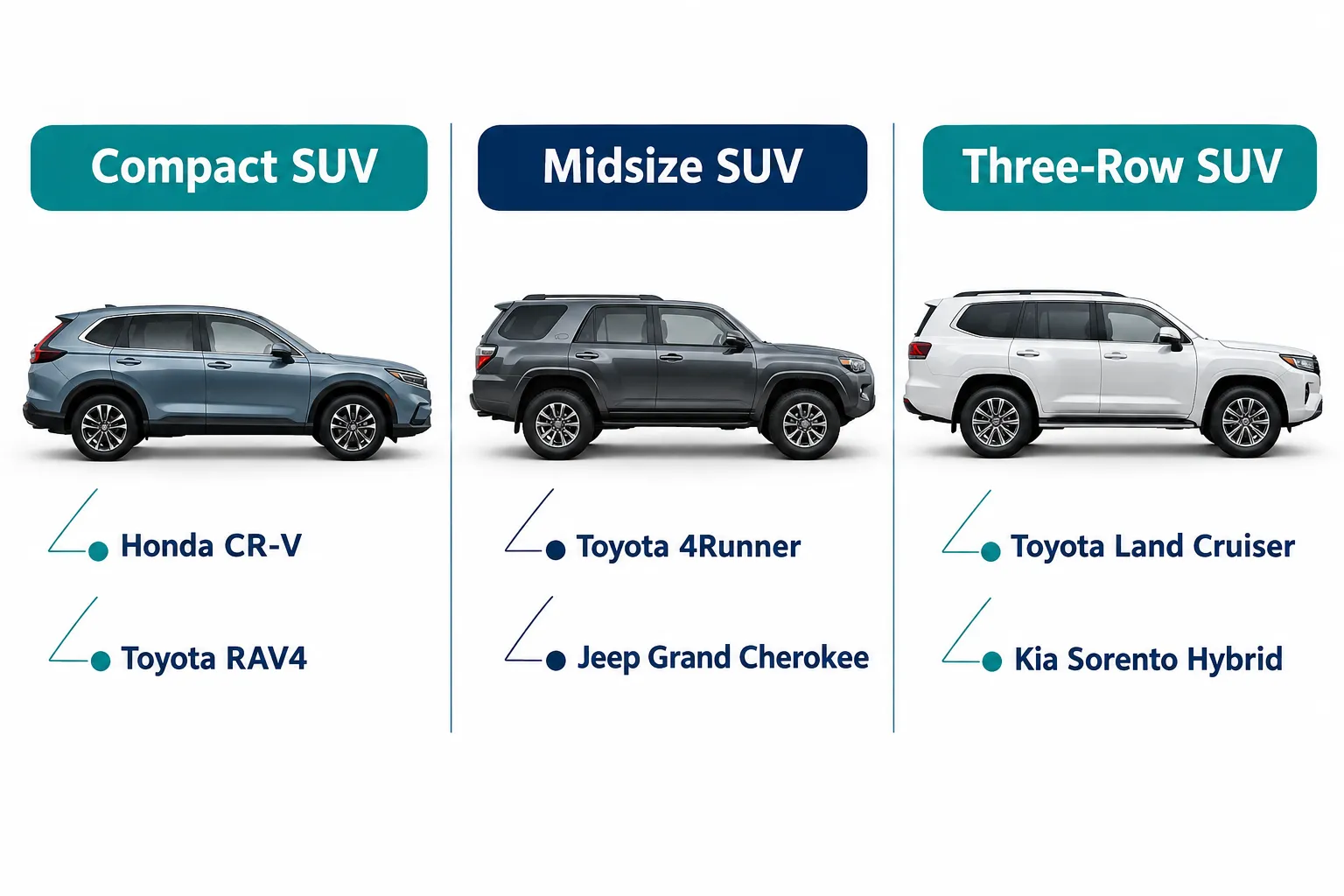
It helps to understand why SUVs as a category are performing well right now. Consumer Reports’ 2026 reliability report puts the average SUV and minivan reliability score at 46, ahead of pickup trucks at 44, which tells buyers that family-oriented SUVs are, on average, a lower-risk category than trucks in the current market. Brand-level rankings reinforce this pattern, with the Honda Passport, Lexus NX Hybrid, Subaru Crosstrek, Mazda CX-5, and Toyota RAV4 Hybrid appearing near the top of multiple 2026 crossover reliability tables [6][7].
Reliability Scorecard by Segment
Use this simple point system as the first section of your worksheet. Assign points before you even look at a specific listing.
| Segment | Top Reliability Pick (2026 data) | Score | Points (out of 10) |
|---|---|---|---|
| Subcompact SUV | Honda HR-V | 8.4 | 9 |
| Compact/Small SUV | Honda CR-V | 8.0 | 9 |
| Midsize SUV | Toyota 4Runner | 8.1 | 9 |
| Large/Three-Row SUV | Toyota Land Cruiser | 8.7 | 10 |
| Three-Row Hybrid | Kia Sorento Hybrid | Top-rated | 8 |
For compact used SUVs specifically, multiple 2026 buyer’s guides continue to call the Toyota RAV4 and Honda CR-V “perennial favorites” for reliability and long-term value, with typical pricing for well-kept 2022-2023 examples landing in the roughly $25,000,$29,000 range [1][8]. The UK’s Warrantywise 2026 Reliability Index independently backs this up, ranking the RAV4 fourth overall across all vehicle types with a 79.9/100 score, making it the highest-ranked SUV in that top-10 list [5]. If you are also weighing sedans or hatchbacks against SUVs, it’s worth cross-checking candidates against The 15 Best Used Cars to Buy in 2026 before narrowing down to body style.
Other dependable midsize names worth noting: the Jeep Grand Cherokee averages 81/100 in J.D. Power’s 2024-2026 Quality & Reliability cycle, making it one of the steadier mainstream midsize choices when service records show consistent maintenance [2]. The Lexus NX Hybrid scores around 68/100 predicted reliability with 88/100 owner satisfaction, while the Subaru Crosstrek and Mazda CX-5 post reliability scores of 75/100 and 84/100 respectively [7].
Pull quote: Reliability data should narrow your shortlist before price does, a cheaper SUV with a weak reliability score is rarely cheaper over five years.
Scoring Cargo Space, Towing Capacity, and Fuel Economy for Your Used SUV
Once reliability has trimmed your list to two or three models, the next layer of how to choose a used SUV: reliability, cargo space, towing, fuel economy, and hidden ownership costs comes down to matching the vehicle to your actual use case, not the spec sheet’s best-case scenario.
Cargo Space: Measure, Don’t Guess
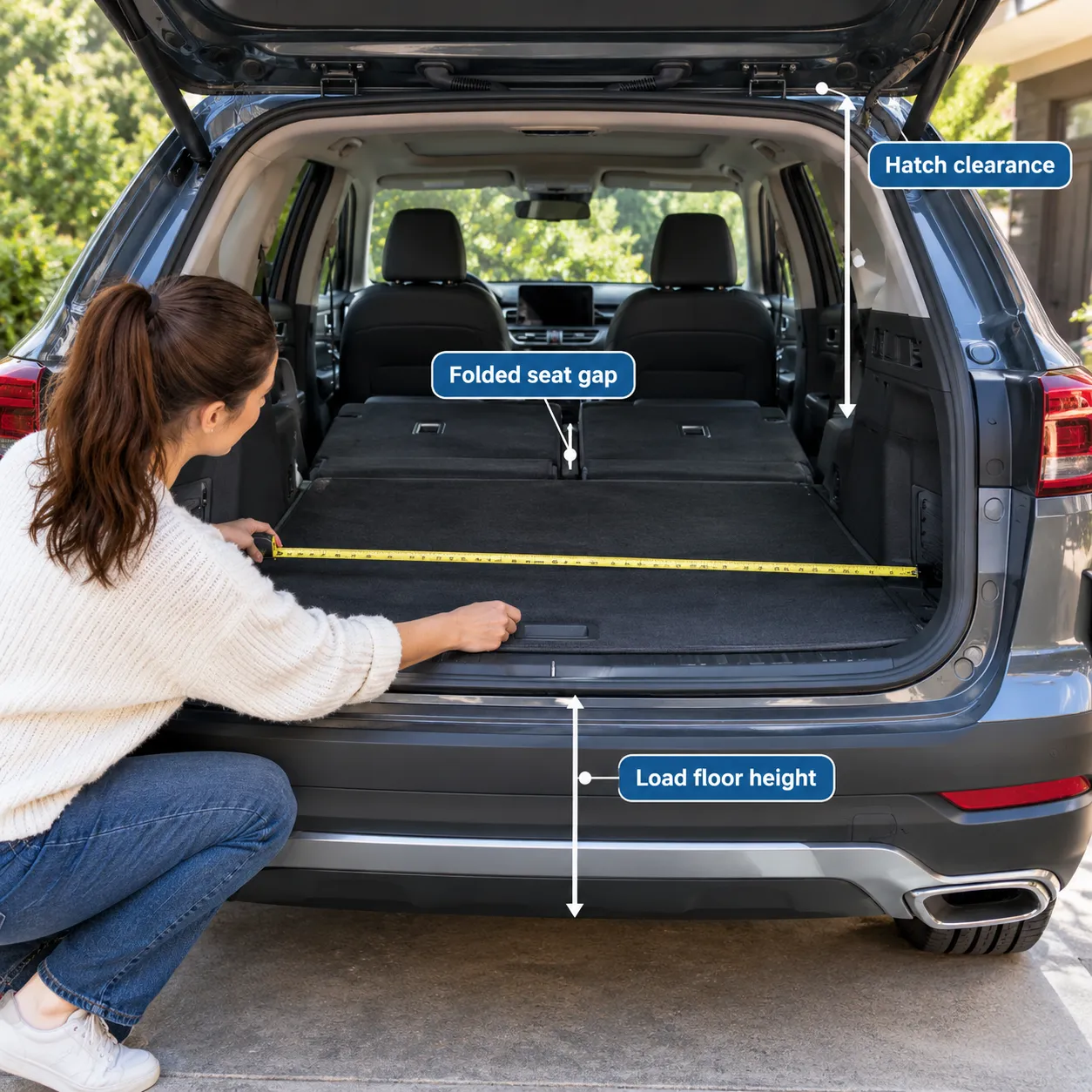
Brochure cargo figures describe an empty box with the seats folded flat and no cargo organizers installed. Real life rarely looks like that. Buyer’s guides for 2026 recommend starting with a clear use case: how many passengers ride regularly, whether you haul strollers, sports gear, or pet crates, and then physically testing the seat-folding mechanism, the height of the rear hatch opening, and whether the load floor sits flat once seats are down [1]. A six-inch difference in hatch height or a seat that folds at an angle instead of flat can turn a “30 cubic feet” SUV into a frustrating daily hauler.
Cargo and Interior Checklist
- Fold the second and third rows yourself; check for a flat load floor, not a stepped one.
- Open and close the power tailgate (if equipped) multiple times to confirm smooth operation.
- Test every seat motor, including heated/ventilated seats and memory settings.
- Check the infotainment screen, backup camera, and any surround-view cameras for lag or dead pixels.
- Confirm HVAC blows cold and hot evenly across all rows.
Electronic failures on these systems are one of the most underestimated repair categories on used SUVs, and guides consistently flag that repairs to power tailgates, seat motors, and infotainment units can meaningfully raise total ownership cost if they fail after warranty expires [1]. This is particularly relevant on higher-trim and luxury models such as the Acura RDX or BMW X3, which offer near-luxury features at mainstream used prices but carry more complex, costlier-to-fix electronics once out of warranty [1][8].
Towing: Match the Trim, Not the Headline Number
If towing a trailer, boat, or camper is part of your plan, the single most important rule is to check the tow rating and payload for the exact trim and configuration you are buying, not the maximum number advertised for the model line as a whole [1][10]. A base trim and a tow-package trim of the same SUV can have tow ratings that differ by 1,000-2,000 pounds.
Payload matters just as much as the tow figure. A commonly cited example: an SUV rated to tow 5,000 pounds with a 500-pound tongue weight effectively loses 500 pounds of payload capacity for passengers and cargo, since tongue weight is carried by the vehicle itself [10]. That means a family of five with camping gear and a loaded cargo box could already be close to the payload limit before the trailer is even hooked up. Always add tongue weight plus passenger weight plus cargo weight and compare that total against the door-sticker payload rating, not just the tow number.
For buyers who regularly tow larger trailers or travel trailers, it’s worth reviewing broader towing fundamentals in Tips For Towing An RV alongside the SUV-specific tow rating.
Large SUVs built for towing duty stand out in recent reliability and quality studies. The Chevrolet Tahoe is cited as the top-ranked large SUV in recent J.D. Power studies, and the Toyota Land Cruiser’s 8.7 reliability rating makes it a strong choice for buyers who need three rows plus serious towing capability without taking on a less-proven large SUV [4].
Fuel Economy and Powertrain: The Five-Year Math
Powertrain choice has an outsized effect on long-term cost. A 2026 SUV buyer’s guide comparing EVs and combustion SUVs over five years of 12,000 miles of annual driving found that electric picks like the Hyundai Ioniq 5 and Kia EV6 cost roughly $2,000 in electricity on residential charging, while comparable combustion SUVs averaged $7,000,$10,500 in gasoline over the same period [10]. Hybrid and efficient gas models land in the middle: the Honda CR-V Sport Touring AWD and Toyota Corolla Cross Hybrid show roughly $5,000 in five-year fuel costs, with total cost of ownership estimates in the low-$40,000 range once purchase price, insurance, and maintenance are included [10].
Cargo, Towing, and Fuel Economy Scoring Table
| Factor | What to Check | Points (out of 10) |
|---|---|---|
| Cargo usability | Flat load floor, hatch height, seat fold angle | ___ |
| Towing match | Trim-specific tow rating and payload, not max advertised | ___ |
| Fuel/energy cost | 5-year fuel or electricity cost vs. your mileage | ___ |
| Powertrain fit | Hybrid/EV vs. gas based on commute and climate | ___ |
Add these to your reliability score from the previous section to get a running total for each candidate SUV.
Hidden Ownership Costs, Inspection Checklist, and Your Used SUV Selection Worksheet
The purchase price is only one line item. Insurance, maintenance, and depreciation often separate two seemingly similar used SUVs by thousands of dollars over five years, and this is the layer most buyers skip when they evaluate how to choose a used SUV: reliability, cargo space, towing, fuel economy, and hidden ownership costs as a complete package.
Insurance and Segment Cost Gaps
Insurance data from 2026 buyer guidance shows full-size SUVs and luxury crossovers can carry premiums roughly 30-45% higher than compact alternatives, even when both are purchased used [3]. That gap alone can offset a lower purchase price on a bigger SUV within two or three years. Five-year total cost of ownership models built on 12,000 miles per year, $3.50 per gallon fuel, and industry-average insurance and maintenance consistently show small crossovers and hybrids undercutting larger SUVs on running costs across 60,000 miles [10]. If you are estimating what a vehicle is really worth to you versus its asking price, pairing this with The Complete Guide to Used Car Valuation: NADA, KBB & Fair Market Pricing helps you negotiate from an informed baseline, and the broader used car resources on this topic cover financing and title considerations that apply equally to SUVs.
Certified Pre-Owned: A Risk-Reduction Shortcut
Certified pre-owned SUVs are consistently highlighted as a smart way to cut risk. Recent analyses show CPO units typically cost about 4-5% more than comparable non-certified used models but include manufacturer-backed extended warranties, multipoint inspections, and reconditioning that can save thousands of dollars in unexpected repairs [1][3]. Toyota, Honda, Acura, and Kia are cited for particularly strong CPO programs, and some manufacturers have offered sub-2% APR financing on CPO inventory through mid-2026, which can meaningfully lower total financing cost compared to a standard used-car loan [3].
The Pre-Purchase Inspection: Non-Negotiable Steps
Before committing to any used SUV, run through this sequence:
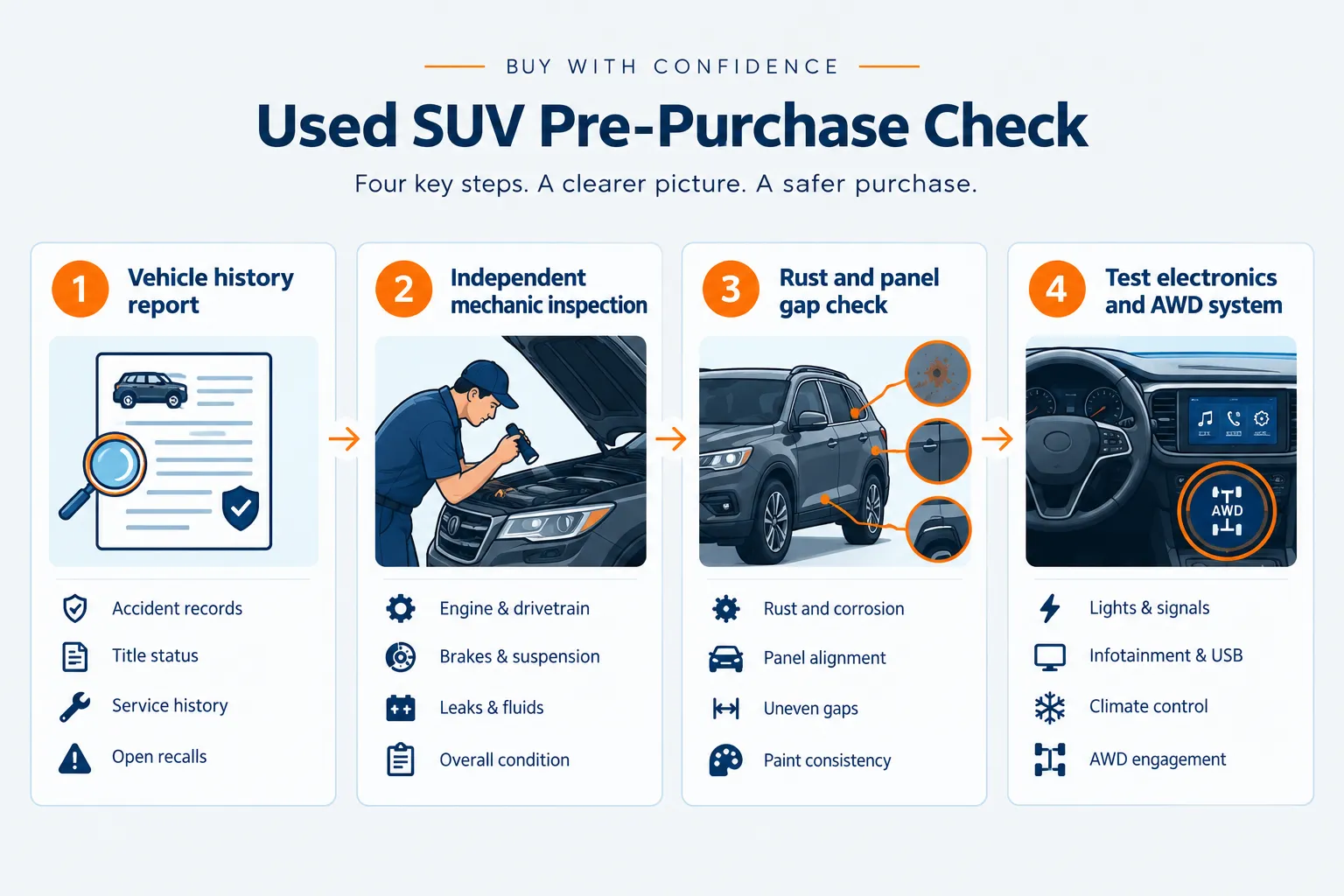
- Pull a full vehicle history report through a service like Carfax or AutoCheck to check for flood damage, branded titles, and gaps in service records [3][9].
- Book an independent pre-purchase inspection, typically $100,$150, that specifically covers suspension and all-wheel-drive components, not just engine and brakes [3][9].
- Check timing belt or chain service history, along with transmission fluid changes and brake work. Deferred maintenance in these areas is common on SUVs and can quickly erase any savings from a lower purchase price [9].
- Inspect the exterior for rust, mismatched paint, and uneven panel gaps, which can indicate prior collision repair that wasn’t disclosed [1].
- Test every electronic feature in person: HVAC across all rows, driver-assist systems (lane keep, adaptive cruise), infotainment responsiveness, and all cameras [1].
Inspection Questions to Ask the Seller or Dealer
- Does the tow package on this specific VIN match the advertised tow rating, or is that number for a different trim?
- Can you provide service records for the last three oil changes, the transmission fluid, and the timing belt or chain, if applicable?
- Has this vehicle ever been in an accident, and if so, is there a repair invoice available?
- Is this SUV certified pre-owned, and if so, what does the warranty specifically cover and for how long?
- What is the current payload rating on the door sticker, and how does that compare to passenger plus cargo plus trailer tongue weight for my situation?
If you’re trading in a vehicle as part of this purchase, it’s also worth reviewing 4 Tips For Getting The Most Money For Your Used Truck for trade-in negotiation tactics that apply just as well to SUVs, and if the SUV is being purchased for business use, How Much Is a Company Car Worth? outlines cost considerations relevant to fleet or work-vehicle budgeting.
Your Model-Selection Worksheet
Score each SUV you’re considering across these five categories, 1 to 10 points each, for a maximum of 50 points:
| Category | SUV A | SUV B | SUV C |
|---|---|---|---|
| Reliability score (segment data) | |||
| Cargo usability (measured, not brochure) | |||
| Towing match (trim-specific tow + payload) | |||
| Fuel/energy cost over 5 years | |||
| Hidden costs (insurance, CPO status, inspection findings) | |||
| Total (out of 50) |
Anything scoring 40 or above across this worksheet represents a strong, lower-risk candidate. Scores in the low 30s or below suggest you should either negotiate harder on price to offset the added risk or move on to the next candidate on your list.
Conclusion
Choosing a used SUV well means refusing to let a clean exterior or a low price distract from the four variables that actually determine your ownership experience: reliability, cargo usability, towing accuracy, and the true five-year cost of fuel, insurance, and maintenance. Start with segment-level reliability data to build your shortlist, verify cargo and towing specs against your real-world needs rather than brochure numbers, and run the full inspection sequence, history report, independent mechanic, rust and panel check, electronics test, before any purchase. Fill out the worksheet above for every SUV on your list, compare the totals side by side, and let the numbers, not the showroom lighting, make the final call.
References
[1] cars – https://www.cars.com/research/suv/ [2] Most Reliable Suvs – https://www.edmunds.com/suv/articles/most-reliable-suvs/ [3] The 10 Best Used Suvs To Buy In 2026 Expert Rankings Real World Value And U S Market Insights – https://www.carvira.com/the-10-best-used-suvs-to-buy-in-2026-expert-rankings-real-world-value-and-u-s-market-insights/ [4] The Most Reliable Suvs You Can Buy In 2026 – https://www.autoblog.com/suvs/the-most-reliable-suvs-you-can-buy-in-2026 [5] Most Reliable Suvs – https://www.theaa.com/cars/advice/best-cars/most-reliable-suvs [6] The Most Reliable New Suv For 2026 Is Not A Toyota – https://www.autoblog.com/features/the-most-reliable-new-suv-for-2026-is-not-a-toyota [7] The Most Reliable Suvs And Crossovers – https://caredge.com/guides/the-most-reliable-suvs-and-crossovers [8] Best Used Suv – https://www.cargurus.com/research/articles/best-used-suv [9] 10 Best Used Suvs Under 25000 In 2026 – https://www.automotiveaddicts.com/117379/10-best-used-suvs-under-25000-in-2026 [10] Best Suv 2026 Buyers Guide – https://theweeklydriver.com/2026/04/best-suv-2026-buyers-guide/