
Last Updated on September 1, 2026
More than 556 people lost their lives in U.S. boating accidents in 2024 alone, and the majority of those deaths were preventable [11]. Understanding boating safety laws is not just a legal obligation. It is the single most powerful tool a boat operator has to protect everyone on the water. Whether someone is a first-time kayaker or a seasoned powerboat captain, the rules have changed in 2026, and staying current matters more than ever.
This guide breaks down federal and state requirements, international updates, required safety equipment, operator licensing, and the practical steps every boater needs to take before leaving the dock.
Key Takeaways
- The U.S. Coast Guard recorded 3,887 boating accidents in 2024, with 556 deaths, the fewest fatalities in over a decade, showing that stricter laws and education work [11]
- Every U.S. boater must carry Coast Guard-approved safety equipment, including life jackets, fire extinguishers, and sound-producing devices
- Canada introduced major new licensing rules in 2026, requiring all motorized pleasure craft with 10 horsepower or more to hold a valid vessel licence [4]
- State boating safety laws vary widely, knowing local rules before launching is essential
- A pre-departure safety checklist is one of the simplest and most effective ways to prevent accidents
Why Boating Safety Laws Exist: The Numbers Behind the Rules
The case for strong boating safety laws is written in accident data. According to the U.S. Coast Guard, the period from 2016 through the mid-2020s saw 5,085 boating deaths, 20,049 injuries, and 34,079 recorded accidents across American waterways [9]. These are not abstract statistics. Each number represents a real person, a real family, and in most cases, an incident that proper training or equipment could have prevented.
The good news is that the trend is moving in the right direction. In 2024, the United States recorded the fewest boating fatalities in more than a decade [11]. Experts credit this improvement to a combination of stricter enforcement, expanded operator education programs, and better public awareness of water safety rules.
The leading causes of boating accidents include:
- Operator inattention
- Operator inexperience
- Improper lookout
- Excessive speed
- Alcohol use
Alcohol remains a top contributor to fatal boating accidents. Under federal law, operating a vessel while intoxicated (BWI) is illegal and carries penalties similar to driving under the influence on land.
“In 2025 alone, the Coast Guard Auxiliary saved more than 180 lives and $6.9 million in property, a direct result of safety programs and compliance with federal rules.” [9]
The U.S. Coast Guard’s Boating Safety program publishes a Boating Safety Circular each season, and the Spring 2026 issue serves as the most current consolidated federal guidance for recreational boaters [1]. Reviewing it is a practical first step for any boat owner.
Federal Boating Safety Laws: What Every U.S. Boater Must Know
Federal boating safety laws apply to all navigable U.S. waters. They set the minimum standard. States can add stricter rules on top of these, but no state can go below them.
Required Safety Equipment Under Federal Law
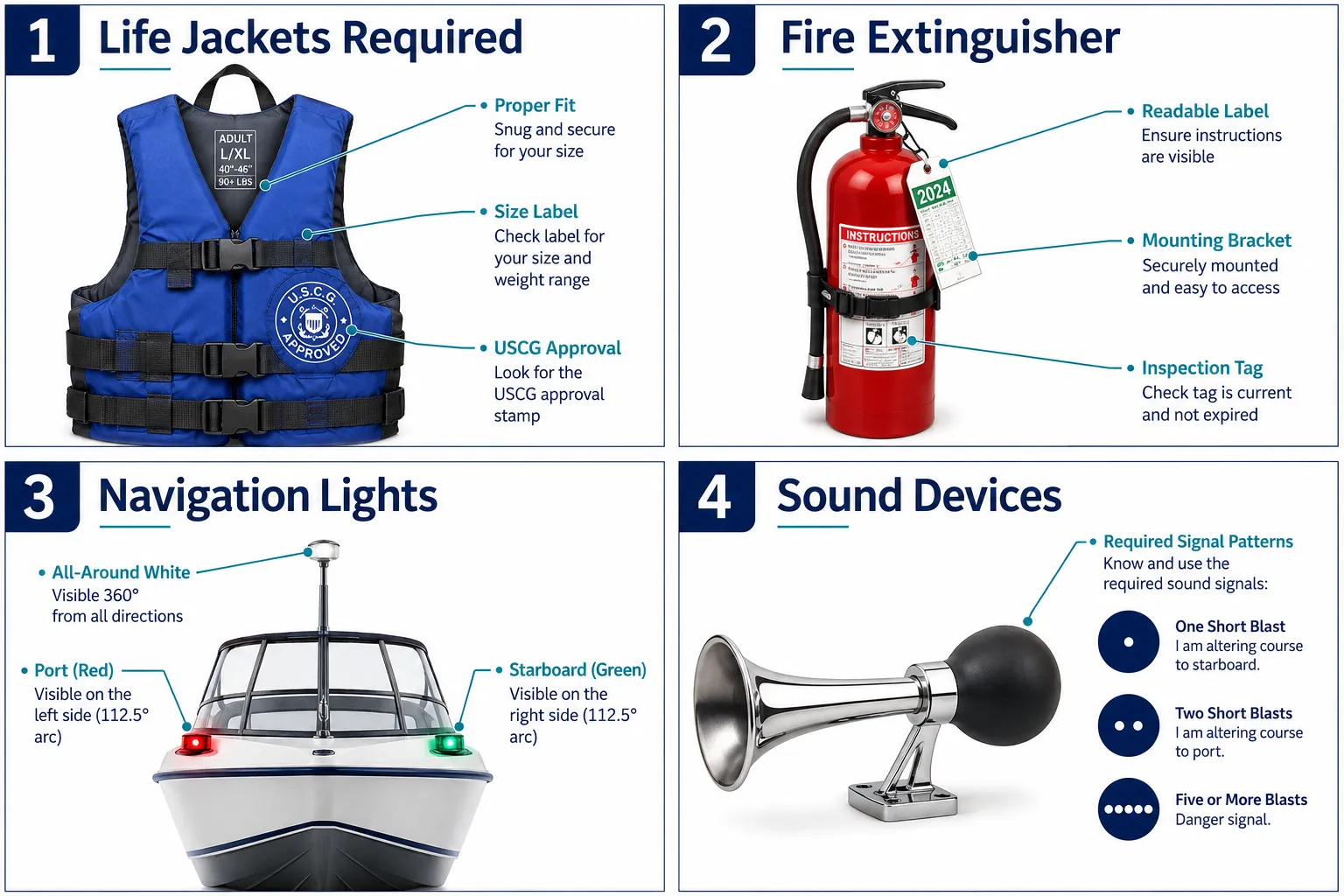
The U.S. Coast Guard requires specific equipment on every recreational vessel. The exact requirements depend on the size and type of boat, but the core list applies broadly.
| Equipment | Who Needs It | Key Requirement |
|---|---|---|
| Personal Flotation Devices (PFDs) | All vessels | One USCG-approved wearable PFD per person; throwable device on boats 16 ft+ |
| Fire Extinguisher | Motorized boats | At least one B-I rated extinguisher; more for larger vessels |
| Visual Distress Signals | Boats on coastal waters, Great Lakes | Approved flares or electronic signals for day and night use |
| Navigation Lights | All vessels operating at night or in low visibility | Proper colored lights per COLREGS rules |
| Sound-Producing Device | All vessels | Horn or whistle audible for at least one half mile |
| Backfire Flame Arrestor | Gasoline-powered inboard engines | Must be Coast Guard-approved and properly installed |
| Ventilation System | Boats with enclosed engine compartments | Natural or powered ventilation to prevent fuel vapor buildup |
Life jackets save lives. The Coast Guard reports that in most fatal drowning incidents, the victim was not wearing a PFD. Children under 13 are required by law in most states to wear a life jacket at all times while underway.
For boaters interested in improving on-water safety beyond the basics, resources like Boost Boat Safety: Installing a Watersports Mirror on Your Center-Console offer practical upgrades that complement legal requirements.
Vessel Registration and Documentation
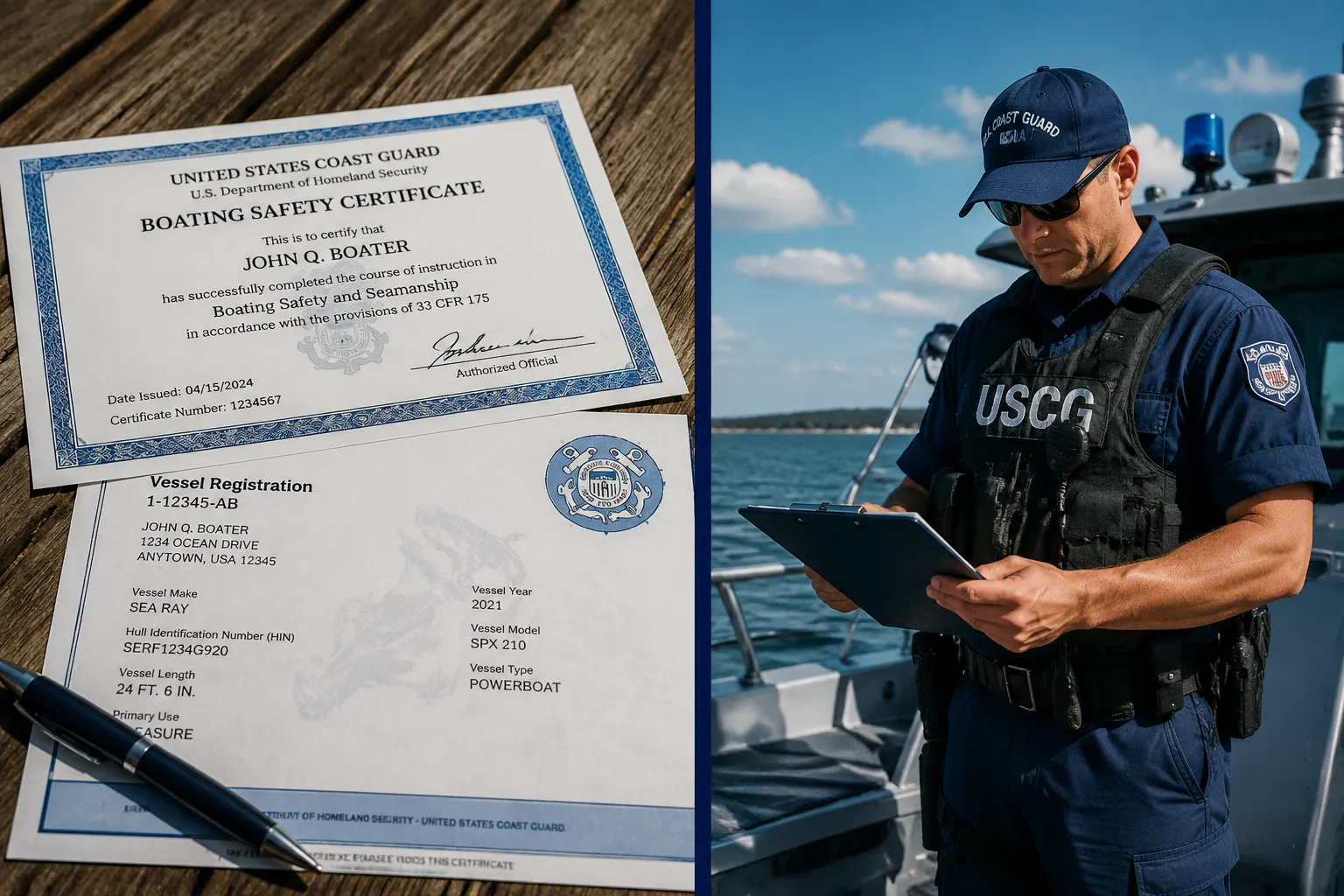
All motorized boats in the U.S. must be registered in the state where they are primarily used. Registration numbers must be displayed on both sides of the bow. Boats used in interstate or international waters may also need federal documentation through the Coast Guard’s National Vessel Documentation Center.
Registration fees and renewal periods vary by state. Keeping registration current is a basic legal requirement, and a common reason boaters receive citations during on-water enforcement stops.
State Boating Safety Laws: Where Things Get More Complex
Federal rules set the floor. State boating safety laws build the walls and the ceiling. Every state has its own set of regulations covering operator education, speed limits, no-wake zones, age restrictions, and more.
Operator Education Requirements
Most U.S. states now require boaters, especially younger operators, to complete an approved boating safety course before operating a motorized vessel. Requirements vary by state and by the age of the operator.
Florida, for example, has specific rules about who needs a boating safety identification card. Anyone born on or after January 1, 1988, must complete an approved course and carry proof of completion. For a detailed breakdown of Florida’s requirements, see Navigating Florida’s Waters: Do You Need A Boating Safety Card.
Florida has also seen significant legislative activity in recent years. New rules have reshaped how boaters interact with law enforcement and access waterways. The article on Florida’s Boating Landscape Transformed: New Laws and Freedom for Boaters covers these changes in depth.
Common state-level boating safety law categories include:
- Minimum operator age: Many states set a minimum age for solo operation of a motorized boat
- Speed limits: Enforced in marked zones, near swim areas, and in harbors
- No-wake zones: Areas where boats must travel at idle speed to prevent wake damage and hazards
- Alcohol enforcement: All states have BWI laws; many have zero-tolerance rules for operators under 21
- Mandatory reporting: Accidents resulting in death, injury, or significant property damage must be reported to state authorities
Boating Safety Laws by Region
Boaters who travel across state lines need to pay close attention. A rule that is optional in one state may be mandatory in the next. For example, boaters exploring Boating Lakes in Colorado will find altitude-specific considerations and state regulations that differ from coastal states.
Always check the specific regulations for every body of water before launching. State boating agencies publish current rules online, and the Coast Guard’s boating safety portal [2] provides links to state resources.
2026 Regulatory Updates: What Has Changed This Year
Boating safety laws are not static. In 2026, several significant changes have taken effect around the world. Boaters need to know what is new.
Canada’s New Vessel Licensing Rules
Canada made one of the biggest changes to recreational boating compliance in years. As of 2026, all pleasure craft with one or more motors totaling 10 horsepower (7.5 kW) or more must hold a valid vessel licence [4]. This is a major expansion from previous rules.
Key details of the new Canadian regime include [4]:
- Licence validity: Five years per renewal cycle
- Cost: $24 per licence as of January 1, 2026, with annual inflation indexing
- Change reporting: Owners must report changes of name, address, or ownership within 30 days (reduced from 90 days)
- Legacy licences: Lifetime licences issued before 1985 must be renewed by December 31, 2026
- Penalties: Failure to register or display the licence number can result in a $250 fine
- Future expansion: Wind-powered craft over 8 meters will face similar rules starting in 2027
Canadian boaters should track expiry dates carefully. The phased implementation schedule means different licences expire at different points between March 31, 2026 and December 31, 2026 [4].
Spain’s New Operator Qualification Rules
Spain tightened its recreational boating safety laws significantly. Under Royal Decree 1188/2025, from October 1, 2026, anyone renting any recreational vessel in Spain must hold the appropriate nautical licence. This includes small boats that were previously exempt from the requirement. A transitional period allowed rental companies and users to adapt before sanctions apply [13].
Environmental Compliance in European Waters
International environmental rules are increasingly affecting leisure boats operating in European waters. In 2026 [3]:
- New NOx and SOx Emission Control Areas (ECAs) are in force in the Norwegian Sea
- Norway introduced strict zero-direct-CO2 and CH4 emission requirements for vessels entering Geirangerfjord and Nærøyfjord
- The EU’s Sustainable Transport Investment Plan explicitly includes recreational craft for the first time
- Updated 2026 Recreational Safety Guidelines under the Recreational Craft Directive tighten design and safety requirements
Boaters planning trips to European waters should review these rules before departure.
Kuwait’s Digital Tracking Requirements
Kuwait updated its maritime regulations in June 2026 to allow recreational vessels to sail 24/7. However, new compliance requirements came with that freedom. Vessels must [14]:
- Adhere to designated sailing areas
- Keep Automatic Identification System (AIS) equipment activated at all times
- Obtain a QR code via the Environment Public Authority’s “Sahl” application before entering Kuwait Bay
This is an example of the growing trend toward digital tracking and geofencing in recreational boating compliance worldwide.
Pre-Departure Safety Checklist: Boating Safety Laws in Practice
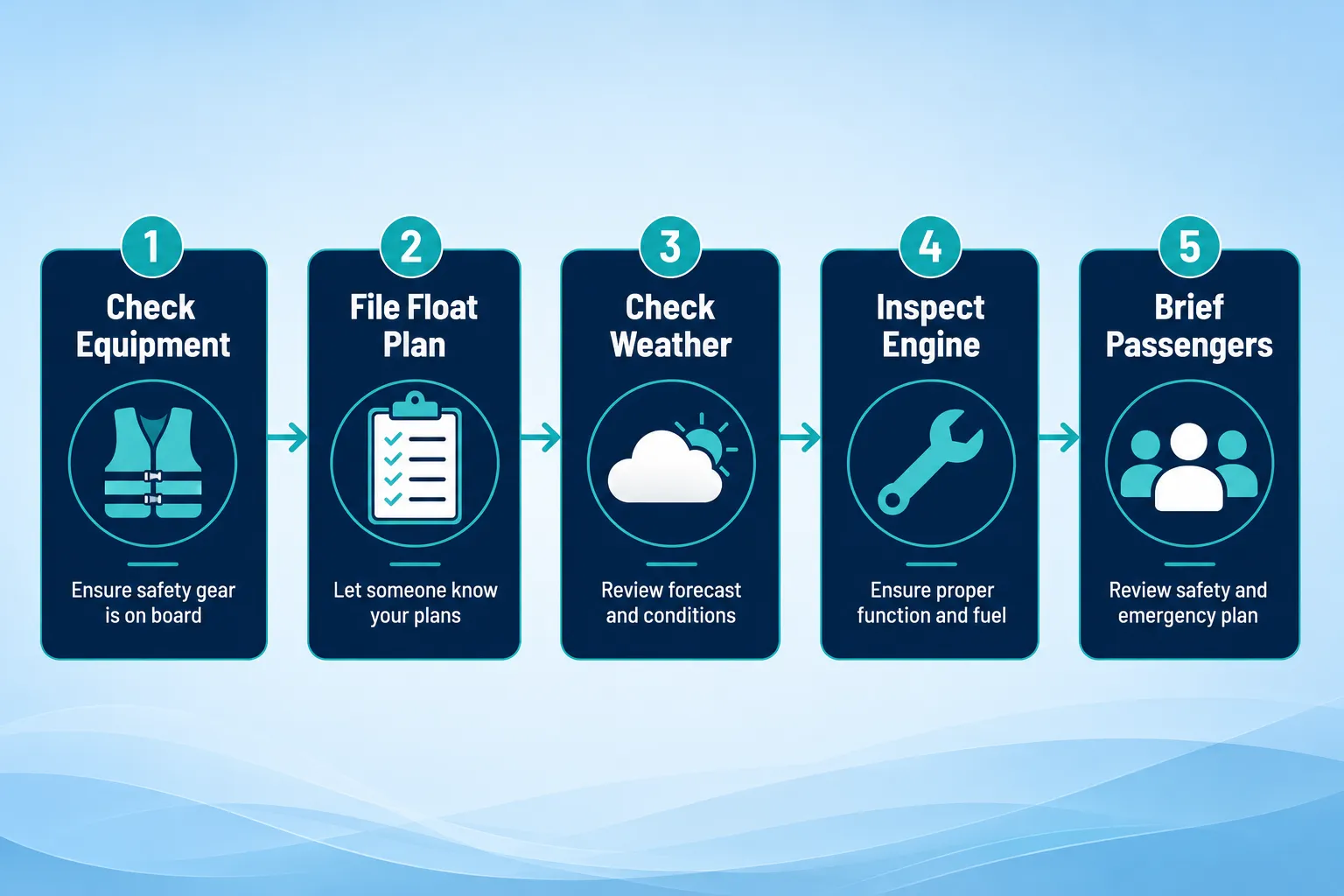
Knowing the law is only half the job. Applying it before every trip is what actually keeps people safe. A pre-departure checklist turns legal requirements into a practical habit.
The Essential Pre-Departure Checklist
1. Check All Required Equipment Verify that all federally and state-required safety gear is on board, in good condition, and accessible. Check PFD sizes for all passengers, including children. Inspect fire extinguisher charge levels. Test navigation lights.
2. File a Float Plan A float plan is not legally required in most states, but it is one of the most important safety habits a boater can develop. Leave a written plan with a trusted person on shore. Include the boat description, intended route, number of passengers, and expected return time. If the boat does not return on time, that person knows to call for help.
3. Check the Weather Never rely on the morning forecast alone. Check marine weather forecasts from the National Weather Service immediately before departure. Conditions on open water can change fast.
4. Inspect the Engine and Fuel System Check fuel levels and look for leaks. Sniff the bilge for fuel vapors before starting the engine. Run the blower for at least four minutes before starting a gasoline-powered inboard engine.
5. Brief All Passengers Tell everyone on board where the life jackets are and how to put them on. Point out the location of the fire extinguisher and flares. Assign a responsible adult to take over if the operator becomes incapacitated.
6. Verify Registration and Documentation Keep current registration, operator certification, and any required licences on board. Coast Guard and state enforcement officers can stop any vessel for a safety inspection at any time.
“The single most effective thing a boater can do to comply with boating safety laws is complete a pre-departure checklist before every single trip, not just the first one of the season.”
For boaters who store their vessel seasonally, proper maintenance is also part of legal compliance. Equipment that is not maintained may fail inspections. The Complete Guide to Winterizing Your Boat in 5 Steps covers how to protect a boat during the off-season so it is ready and compliant when spring arrives.
Boating Safety Education: Courses, Certifications, and Resources
Operator error is the leading cause of boating accidents in the United States [2]. Education directly addresses this problem. The Coast Guard and its partners offer a range of training options for boaters at every level.
Approved Boating Safety Courses
The National Association of State Boating Law Administrators (NASBLA) approves boating safety courses that meet federal and state standards. Approved courses are available online and in person. Completing one is required in many states and strongly recommended everywhere.
Benefits of completing an approved course:
- Satisfies state operator education requirements
- May qualify for a discount on boat insurance
- Builds practical knowledge of navigation rules, weather reading, and emergency procedures
- Reduces accident risk significantly
The Coast Guard Auxiliary offers free vessel safety checks and public education programs. In 2025, the Auxiliary saved more than 180 lives and $6.9 million in property through its programs [9]. Boaters can request a free courtesy vessel examination to verify their boat meets all legal requirements before an enforcement officer does.
The Role of Technology in Boating Safety
Modern boats increasingly come equipped with technology that supports compliance and safety. Gyroscopic stabilization systems, AIS transponders, and digital chart plotters all contribute to safer operation. Understanding how these systems work adds another layer of protection. For a deeper look at one emerging technology, the article on Smooth Sailing: The Rise of Gyros and Attitude Control in Modern Boating explains how stabilization technology is changing the on-water experience.
Enforcement and Penalties: What Happens When Boating Safety Laws Are Violated
Boating safety laws are enforced by multiple agencies. On federal waters, the U.S. Coast Guard has primary authority. On state waters, state and local marine patrol officers handle enforcement. In many areas, both agencies operate simultaneously.
Common Violations and Their Consequences
Operating Without Required Equipment Missing or expired safety equipment can result in a warning, a citation, or in serious cases, being ordered off the water. Fines vary by state and by the severity of the violation.
Boating While Intoxicated (BWI) BWI is a federal offense and a crime in every state. Penalties include fines, jail time, loss of boating privileges, and in cases involving injury or death, felony charges.
Reckless Operation Operating a vessel in a manner that endangers life or property is illegal. This includes excessive speed in no-wake zones, wake jumping near swimmers, and inattentive operation.
Failure to Report an Accident Operators involved in accidents resulting in death, injury requiring medical treatment beyond first aid, or property damage over a set threshold (usually $2,000) are legally required to file an accident report with state authorities. Failure to report is itself a violation.
Underage Operation Allowing a minor to operate a vessel in violation of state age or education requirements can result in fines for the boat owner.
Coast Guard Safety Inspections
The Coast Guard and state officers can board any vessel on navigable U.S. waters for a safety inspection without a warrant. This is a standard part of maritime law enforcement. Boaters who keep their equipment current and their paperwork in order have nothing to fear from these stops.
Boating Safety for Specific Activities and Vessel Types
Different types of boating come with their own specific rules and risks.
Personal Watercraft (PWC)
Jet skis and other personal watercraft are subject to all standard boating safety laws plus additional state-specific rules. Many states require PWC operators to be at least 16 years old and to complete a boating safety course. Speed restrictions and no-wake zone rules apply to PWCs just as they do to larger boats.
Towing Activities (Waterskiing, Wakeboarding, Tubing)
Towing activities require an observer on board in addition to the operator in most states. The observer’s job is to watch the person being towed and signal the operator. A ski-down flag must be displayed when a skier is in the water.
Sailing Vessels
Sailboats are subject to navigation rules and must carry required safety equipment. Under the International Regulations for Preventing Collisions at Sea (COLREGs), sailing vessels generally have right of way over powered vessels, but there are important exceptions. Sailors should know these rules thoroughly.
Commercial and Mixed-Use Waterways
Recreational boaters sharing waterways with commercial traffic face additional risks. A joint safety report from the U.S. Coast Guard and American Waterways Operators highlights the importance of traffic management and risk awareness in mixed-use waterways [7]. Recreational boaters should give commercial vessels a wide berth and understand that large vessels cannot stop or maneuver quickly.
Conclusion: Taking Action on Boating Safety Laws in 2026
The data is clear. Boating safety laws save lives. The record low fatality count in 2024 [11] proves that when boaters take compliance seriously, the results show up in the statistics. But laws only work when people follow them.
Here are the most important next steps for every boater in 2026:
- Verify current registration and licensing. Check expiry dates. If operating in Canada, confirm compliance with the new 2026 licensing rules [4].
- Complete or renew a boating safety course. Find a NASBLA-approved course online or in person. Many states require it; all states benefit from it.
- Conduct a full equipment audit. Go through the federal required equipment checklist. Replace anything expired, missing, or non-compliant.
- Use a pre-departure checklist every time. Print one out and keep it on the boat. Make it a habit, not an afterthought.
- Know local rules. Before launching on any body of water, check the specific state and local regulations. Rules change, and ignorance is not a legal defense.
- File a float plan. Every trip. Every time.
Boating is one of the most rewarding outdoor activities available. With the right knowledge, the right equipment, and a genuine respect for boating safety laws, every trip can be both enjoyable and safe. The water is waiting, go prepared.
References
[1] USCG Boating Safety – https://www.uscgboating.org/
[2] Accident Statistics – https://uscgboating.org/statistics/accident_statistics.php
[3] Marine Industry News Apr 2026 – https://theboatdb.com/blog/marine-industry-news-apr-2026
[4] Minister of Transport and Leader of the Government in the House of Commons Announces Changes to Make Boating Safer for Canadians – https://www.canada.ca/en/transport-canada/news/2026/01/minister-of-transport-and-leader-of-the-government-in-the-house-of-commons-announces-changes-to-make-boating-safer-for-canadians.html
[6] Statistics – https://www.uscgboating.org/statistics/
[7] USCG AWO Annual Safety Report – https://www.americanwaterways.com/sites/default/files/USCG-AWO%20Annual%20Safety%20Report.pdf
[9] In the Coast Guard’s Latest Issue of Proceedings: Recreational Boating Safety – https://www.news.uscg.mil/maritime-commons/Article/4551087/in-the-coast-guards-latest-issue-of-proceedings-recreational-boating-safety/