
Last Updated on September 11, 2026
In 2024, the United States recorded its lowest number of boating deaths in more than 50 years, yet accidents themselves actually went up. That single fact tells you everything about why boating accident statistics matter: numbers alone do not tell the whole story. A closer look at who dies, when, and why reveals patterns that any boater can learn from.
The Coast Guard verified 3,887 reportable recreational boating incidents in 2024. Those incidents caused 556 deaths, 2,170 injuries, and about $88 million in property damage.[2][5][8] Behind every one of those numbers is a real person, a real boat, and a real lesson. This article breaks down the latest boating accident statistics, walks through real 2026 incidents that made headlines, and shows what boaters can do differently on the water.
Key Takeaways
- 2024 had the fewest boating deaths in over 50 years, 556 total, even though the number of incidents rose slightly from the year before.[3][5][8]
- Open motorboats and small boats under 16 feet are involved in the most deaths, and most of those deaths are drownings, not blunt trauma.[3]
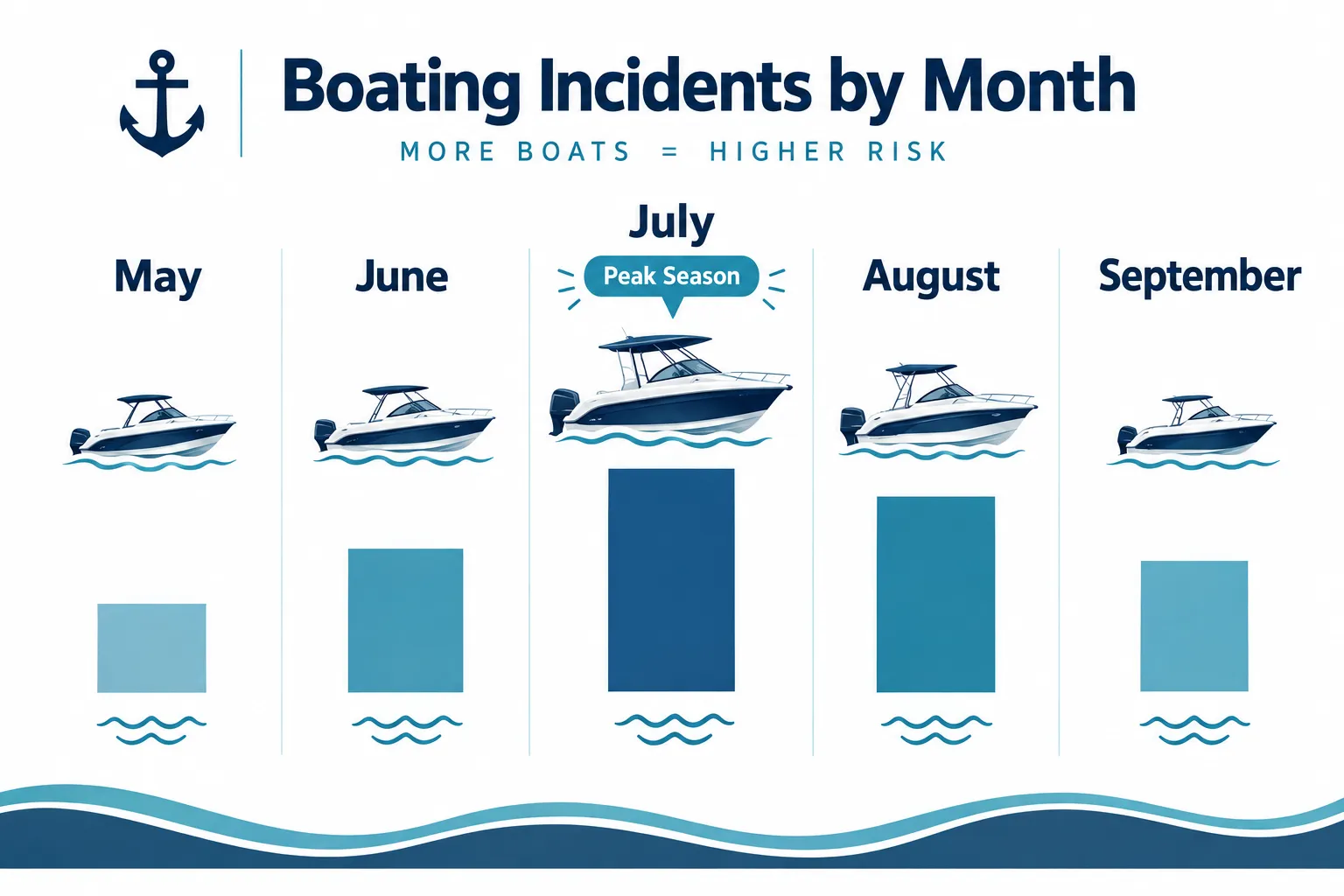
- Summer is the danger zone. May through September accounted for 377 of the 556 deaths recorded in 2024, with July the deadliest single month.[3]
- Life jackets and sobriety remain the biggest variables. Many 2026 fatal incidents involved no life jacket worn or alcohol use.[3]
- State risk varies widely, Minnesota ranks as the safest boating state, while Nevada and other high-traffic states rank far more dangerous.[10]
The 2024 Boating Accident Statistics: A Record Low for Deaths
The most recent full-year national report comes from calendar year 2024. It is still the newest official data set as of late 2026, since the Coast Guard’s next annual release, covering 2025, is not scheduled until mid-October 2026.[1][9] Until then, safety groups are piecing together the picture using state data and individual case reports.
Here is what the 2024 numbers actually show:
| Measure | 2024 | 2023 | Change |
|---|---|---|---|
| Reported incidents | 3,887 | ~3,845 | Up 1.1% |
| Deaths | 556 | 564 | Down 1.4% |
| Injuries | 2,170 | ~2,125 | Up 2.1% |
| Property damage | ~$88 million | , | , |
| Fatality rate per 100,000 registered vessels | 4.8 | 4.9 | Down slightly |
Source: [3][5][8]
Notice the pattern. Incidents went up, but deaths went down. That means more people got into trouble on the water, but fewer of them died from it. Safety advocates and industry groups point to years of investment in boater education, enforcement, and life jacket promotion as the reason.[5][7] The 4.8 deaths per 100,000 registered recreational vessels in 2024 continues a long downward slide that has held steady for decades, even as boat ownership and time spent on the water remain high.[3][5]
“Fewer boating deaths does not mean fewer close calls. It means more people are surviving accidents they should not have been in to begin with.”
That distinction matters. A boater who understands current boating safety, laws, and compliance requirements is far more likely to survive an incident than one who does not.
What Kind of Boats and Months Are Most Dangerous
Not all boats carry the same risk, and not all months are equally dangerous. The 2024 boating accident statistics break this down clearly, and the pattern has repeated for years.
Open motorboats carry the heaviest death toll
Open motorboats, the classic small runabout with no cabin, were involved in about 47% of all reported incidents and 46% of all deaths in 2024, which works out to 255 deaths.[3] These boats are common, affordable, and easy to operate, which is exactly why so many people are on them. But they also offer little protection if something goes wrong.
Boat size matters just as much as boat type. Boats under 16 feet accounted for 217 deaths in 2024. Of those, 164 were drownings, about 76% of all small-boat deaths.[3] Small boats flip and swamp more easily than larger vessels. When that happens, survival depends almost entirely on whether the people onboard are wearing a life jacket.
Summer turns dangerous fast
| Month | Incidents | Deaths |
|---|---|---|
| July | 905 | 115 |
| June | , | 78 |
| August | , | 68 |
Source: [3]
July 2024 was the worst month on record for every measure: 905 incidents, 115 deaths, and 557 injuries.[3] June and August followed close behind. Combined, the five months from May through September accounted for 377 of the year’s 556 deaths.[3] That is more than two-thirds of all boating deaths packed into less than half the year.
Why does summer carry so much risk? More boats on the water, more holiday weekends, more alcohol at gatherings, and more people swimming near boats all add up. Anyone planning a lake trip should think carefully about crowding and timing, resources like finding boating near me can help identify quieter, less congested waters during peak season.
Real Incidents Behind the Boating Accident Statistics in 2026
National numbers can feel abstract. Real cases make the risks concrete. Several 2026 incidents show how the patterns in official boating accident statistics play out in real life.
Barnegat Bay, New Jersey: channel markers and nighttime navigation
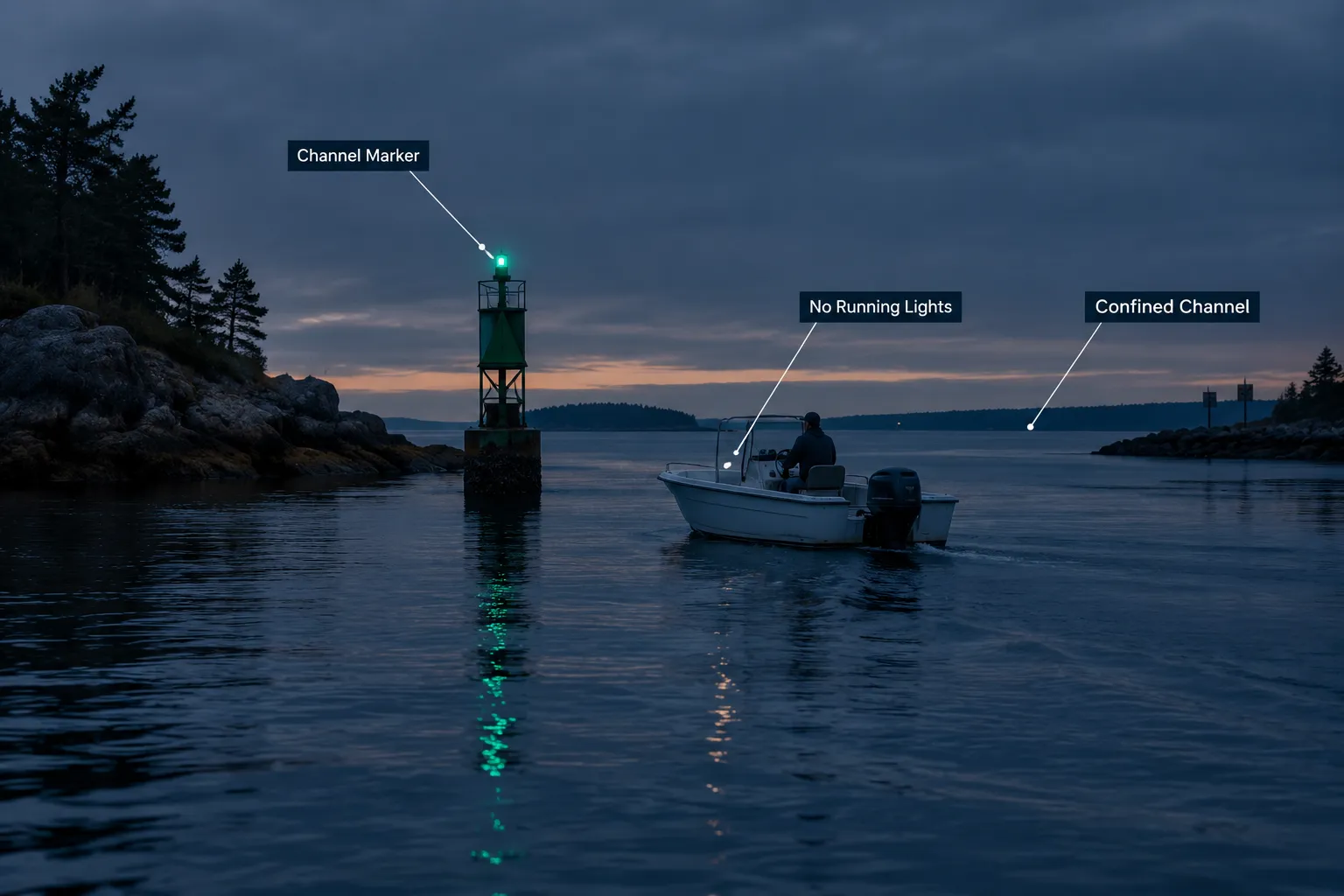
Along New Jersey’s Barnegat Bay, there have been three deadly crashes into channel markers since Memorial Day 2026, resulting in four deaths, including two children killed in a July 19 collision.[4] Local authorities and safety advocates are pointing to a familiar set of causes: poor nighttime visibility, failure to recognize markers, excessive speed in narrow channels, and alcohol use while operating in tight waterways.[4]
This is a textbook case of a preventable accident. Boaters who slow down in marked channels, use proper running lights, and stay sober behind the wheel dramatically reduce this kind of risk. If you are ever unsure whether conditions are safe, it helps to review guidance on whether it is safe to drive a boat at night before heading out after dark.
Lake Shasta, California: rescue attempts gone wrong
In Northern California, a July 2026 drowning at Lake Shasta over the Independence Day weekend claimed the life of a man who was trying to help youths on a personal watercraft. It was the fourth water-related death at the lake since June 2026.[6] This cluster shows how quickly a rescue attempt by an unprotected bystander can turn into a second tragedy, especially during high-traffic holiday weekends when boats and personal watercraft mix in the same busy water.[6]
New York Harbor: speed, capacity, and criminal liability
An August 10, 2026 case in New York Harbor shows the legal side of reckless boating. A speedboat driver was federally charged after a vessel capsized near the Statue of Liberty, killing two people, including a baby. Prosecutors are using the case to send a clear message: high speed in crowded sightseeing areas, ignoring safety briefings, and exceeding passenger capacity can lead to criminal charges, not just fatalities.
Cases like these are a reminder that boating accidents are not always just bad luck. Investigations, like the ongoing search efforts after a boat sank near Everett, Washington, often reveal specific, avoidable decisions that led to disaster.
Which States Are Safest and Most Dangerous for Boaters
Where you boat matters almost as much as how you boat. A 2026 America’s Boating Safety Index, built from Coast Guard accident rate data, ranks states from safest to most dangerous.[10]
Safest state: Minnesota, with roughly 6.70 accidents and 1.04 deaths per 100,000 registered vessels.[10]
Most dangerous overall: Nevada, according to the index.[10]
Also elevated risk: Florida, California, Alaska, and Colorado all show higher accident and death rates per 100,000 registered vessels.[10]
| Risk Level | Example States | Why |
|---|---|---|
| Lower risk | Minnesota | Calmer inland lakes, strong boater education culture |
| Higher risk | Florida, California | Dense boating traffic, complex coastal waters |
| Higher risk | Alaska, Colorado | Cold-water conditions, remote rescue access |
| Higher risk | Nevada | High per-capita accident and death rates |
Source: [10]
This does not mean Minnesota lakes are risk-free or that every Florida boater will crash. It means the underlying conditions, traffic density, water temperature, coastline complexity, and rescue response times, stack the odds differently from state to state. Boaters heading to unfamiliar waters, including popular inland destinations like boating lakes in Illinois, should research local conditions and regulations before launching. States like Florida have also recently changed their rules; the transformation of Florida’s boating laws is a good example of how quickly local regulations can shift.
The Common Threads: Life Jackets, Alcohol, and Weather
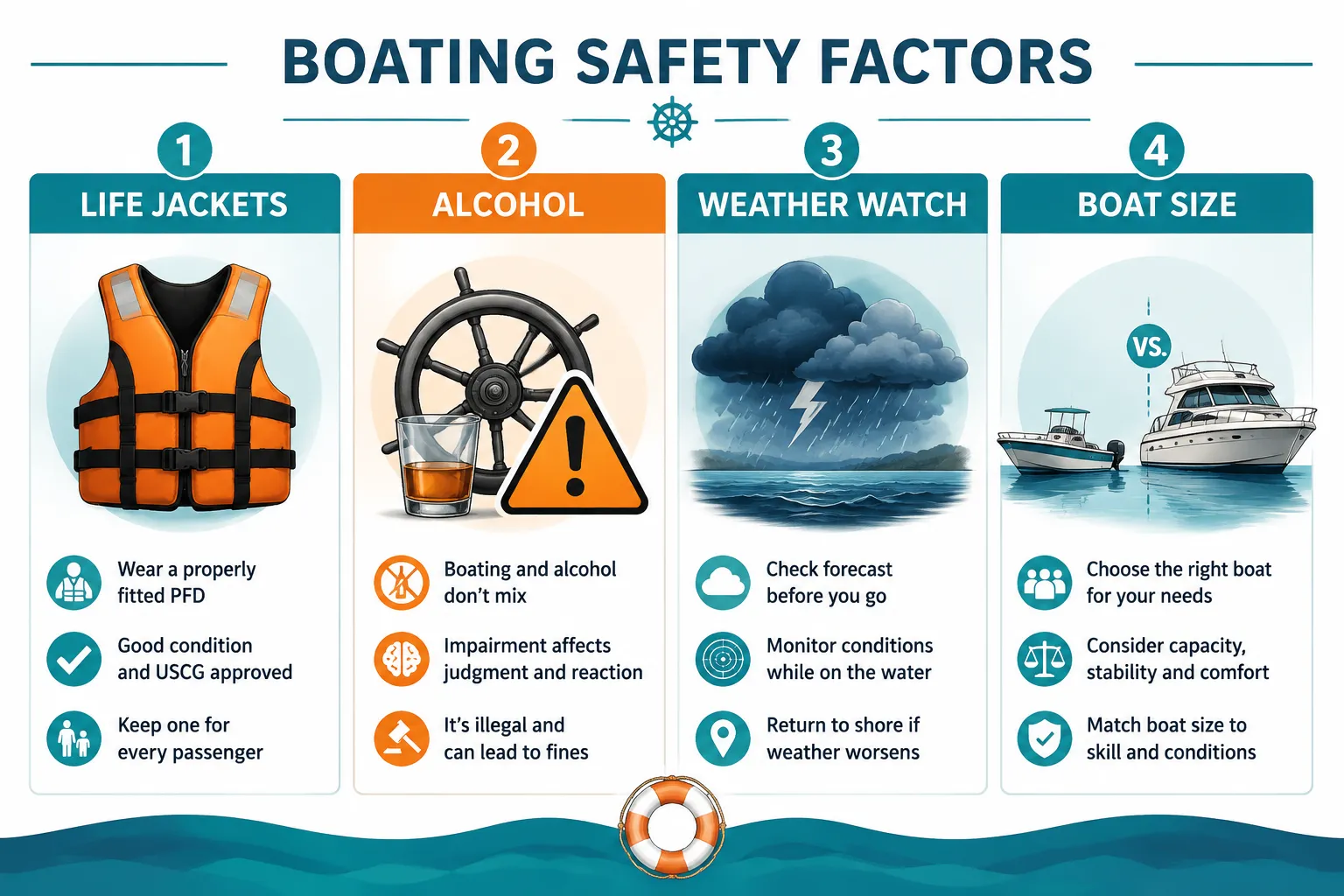
Strip away the individual stories, and three factors show up again and again in fatal boating accident statistics: no life jacket, alcohol involvement, and sudden weather changes.
Life jackets save lives, but many people still skip them
Small boat drownings dominate the fatality numbers, and most of those drowning victims were not wearing a life jacket at the time. State-level fatal incident tracking shows a recurring pattern: falls overboard, capsizing, flooding, and people leaving the boat, frequently on small open boats and kayaks, with “No” listed under life jacket worn far too often.[3]
A simple habit, wearing a properly fitted life jacket every time the boat is moving, is still one of the single biggest factors separating a scary moment from a fatality.
Alcohol keeps showing up in fatal cases
Impaired boating remains a top enforcement priority nationwide. Agencies routinely note that alcohol use is present in a meaningful share of fatal incidents, particularly on small boats during busy holiday weekends.[3] Just like driving a car, operating a boat under the influence slows reaction time exactly when quick decisions matter most, avoiding a channel marker, reacting to a wake, or responding to a sudden squall.
Weather can turn deadly in minutes
Storms on open water develop fast, and boats without cabins offer no shelter. Sudden squalls have capsized boats with tragic results, including cases involving children who were not wearing life jackets when a storm hit without warning. The lesson from these events is consistent: check the forecast before leaving the dock, watch the sky constantly, and head to shore the moment conditions shift, do not wait to see if the storm passes.
“The boats involved in the worst accidents are rarely broken. The habits around them are.”
Boaters who upgrade their equipment can also reduce risk. Features like stabilizing gyro and attitude control systems help larger boats handle rough water more predictably, while simple additions like a watersports mirror for better visibility reduce blind-spot accidents around swimmers and towed riders.
How to Use Boating Accident Statistics to Boat Safer
Numbers only help if they change behavior. Here is a simple checklist built directly from what the data and real 2026 incidents show.
- Wear a life jacket every time, especially on boats under 16 feet, where most drowning deaths happen.[3]
- Slow down near channel markers, particularly at night or in unfamiliar waterways, after multiple 2026 fatal marker collisions.[4]
- Avoid alcohol while operating any boat. Impaired operation continues to appear in fatal incident reports.[3]
- Watch the weather constantly and head in early if storm clouds build, since conditions on open water can shift in minutes.
- Respect passenger limits and speed in crowded areas, especially around swimmers, personal watercraft, and sightseeing zones.
- Know your local risk level. Boating in high-traffic states like Florida or California calls for extra caution compared to calmer inland lakes.[10]
- Plan rescues carefully. Bystanders jumping in to help someone in trouble should use a flotation device rather than swimming out unprotected.[6]
Before any trip, it also helps to double-check the basics of the boat itself. A quick review of tips for shopping for a boat or a checklist of small boat essentials can catch missing safety gear before it becomes a problem on the water.
Conclusion
The 2024 boating accident statistics tell a story of real progress: fewer deaths than at any point in over 50 years, even as more boats hit the water and more incidents were reported.[3][5][8] But the 2026 cases from Barnegat Bay, Lake Shasta, and New York Harbor prove the same old risks are still costing lives, missing life jackets, alcohol, speed, bad weather, and unfamiliar water.
The pattern is clear and repeats every single year. Small open boats carry the most risk. Summer months, especially July, are the most dangerous stretch on the calendar. States with heavy boat traffic and complex water carry higher fatality rates. And the presence or absence of a life jacket often decides who survives and who does not.
Every boater can act on this today. Check the life jackets before leaving the dock. Check the forecast one more time. Skip the drink until the boat is back at the marina. Slow down near markers and crowded swim areas. These are small choices, but the statistics show they are exactly the choices that separate a good day on the water from a tragedy.
References
[1] Accident Statistics – https://uscgboating.org/statistics/accident_statistics.php
[2] uscgboating – https://www.uscgboating.org/
[3] Boating Accident Statistics – https://www.stand-up-paddling.org/en/boating-accident-statistics/
[4] 3xyfihzsyfescdwtmjurac – https://newjersey.news12.com/2026/07/27/boat-crash-along-barnegat-bay-is-the-third-this-summer-to-take-a-life/3xyFihzSyFEscDWTMjurac
[5] Recreational Boating Statistics – https://mraa.com/recreational-boating-statistics/
[6] usatoday – https://www.usatoday.com/story/news/nation/2026/07/10/fourth-fatality-lake-shasta-summer-water-risks/90870998007/
[7] Recreational Boating Facts – https://www.safeboatingcouncil.org/resources/recreational-boating-facts/
[8] 3e7945a – https://content.govdelivery.com/accounts/USDHSCG/bulletins/3e7945a
[9] Index – https://uscgboating.org/statistics/index.php
[10] Boating Safety Index – https://boatbooker.com/blog/boating-safety-index/