Last Updated on October 5, 2026
A 2025 industry study found that most car sellers check a single online valuation tool, see a number, and expect a dealer to match it almost exactly. That expectation causes more frustration at the sales desk than almost anything else in the used car business. The gap between a Kelley Blue Book estimate and the check a dealer actually writes can run into the thousands, and neither side is technically wrong.
Understanding Kelley Blue Book Car Value vs Dealer Trade-In Offers: How to Estimate Your Vehicle’s Real Price means accepting that there is no single “real” number for any used vehicle. There are several numbers, each built for a different purpose, and your job as a seller is to know which one applies to your situation. This guide breaks down private-party, trade-in, instant-buy, and retail values, then gives you a practical appraisal checklist so you can estimate your car’s true worth before you ever sit down at a dealership.
Key Takeaways
- Kelley Blue Book publishes several distinct values, trade-in, private-party, and instant cash offer, and comparing the wrong pair leads to unrealistic expectations [1].
- Dealer trade-in offers factor in reconditioning costs, resale risk, and local auction trends, not just market averages, which is why they often land below KBB’s trade-in range [4][6].
- Guaranteed instant cash offers trade a lower price for certainty and speed, while private-party sales typically pay the most but demand the most work [2][3].
- A documented multi-source estimate, built from mileage, condition, options, title history, and local demand, gives you stronger footing to negotiate than a single printout.
- Treat any online estimate as a negotiation starting point, not a guaranteed sale price, since dealers are not contractually bound to honor it [5][9].
Breaking Down the Four Core Valuation Types
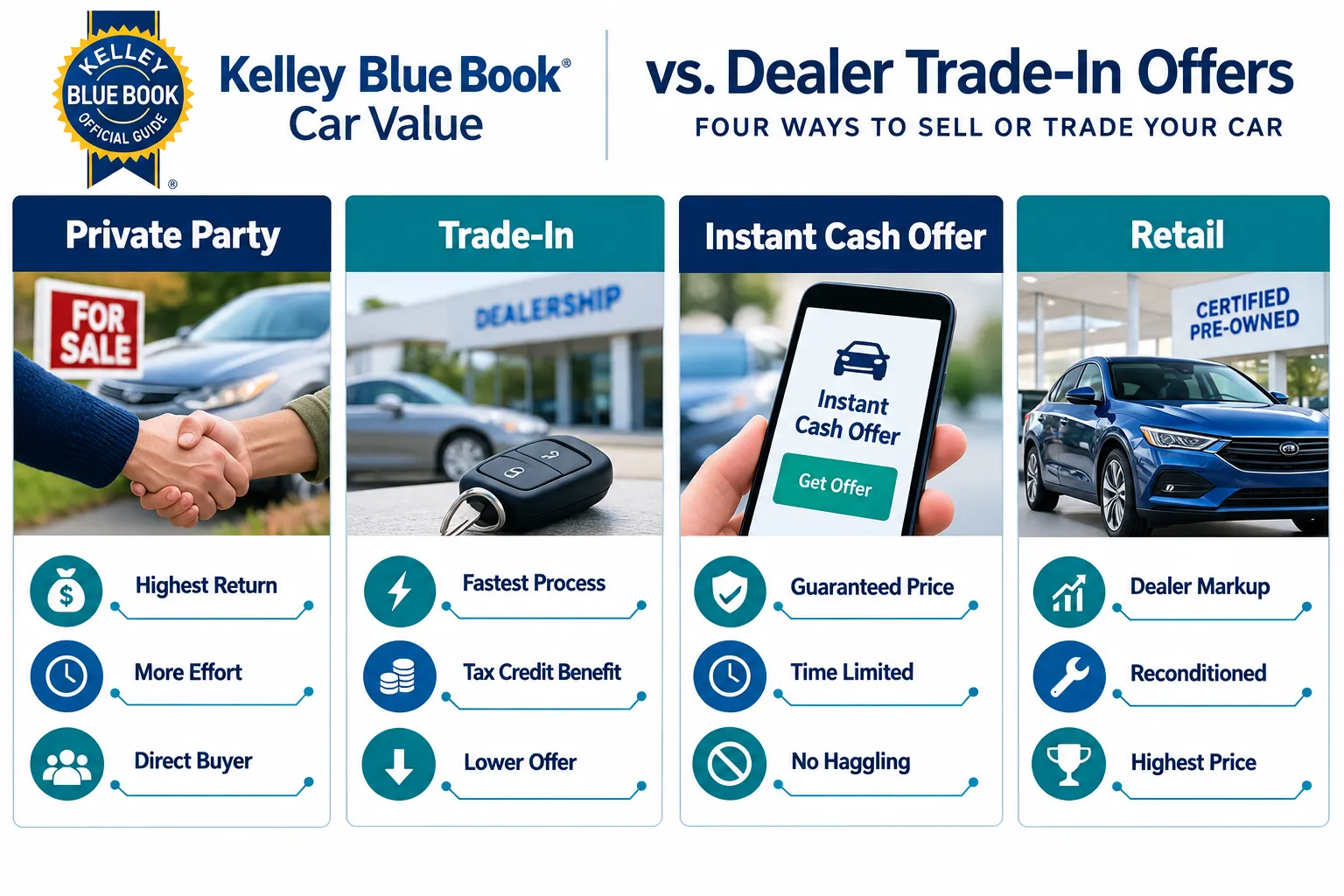
Before comparing offers, you need to know exactly what each number measures. Kelley Blue Book itself separates vehicle worth into multiple categories, and conflating them is the single biggest reason sellers feel shortchanged [1].
Private-Party Value
This is what you could reasonably expect to receive selling directly to another consumer, through a listing site or word of mouth. It reflects the highest realistic price for most vehicles because there is no dealer markup, no reconditioning margin, and no resale risk built into the number. The tradeoff is time. You handle photos, listings, test drives, negotiations, paperwork, and the possibility of flaky buyers. For a deeper walkthrough of how these figures get calculated, see this guide on finding the value of your car.
Trade-In Value
Trade-in value estimates what a dealer might offer when you roll your old car into the purchase of a new one. It sits below private-party value by design because the dealer must recondition the vehicle, market it, hold it in inventory, and absorb risk if it does not sell quickly. KBB publishes this as a range based on your car’s condition rating, not a single guaranteed figure [1].
Instant Cash Offer
An Instant Cash Offer (ICO) is a guaranteed, time-limited price generated after you answer condition questions online and often complete a brief in-person verification. Unlike a general trade-in estimate, an ICO is a binding number a participating dealer agrees to pay, typically valid for seven days [2][3]. It usually lands close to, or sometimes above, a vague trade-in guess because the dealer has already locked in the terms and removed uncertainty from their side.
Retail Value
Retail value is what a dealer charges a buyer for that same vehicle after reconditioning, inspection, and markup. It is the top of the pricing chain and explains why a car bought for a trade-in price can reappear on the same lot days later for several thousand dollars more.
| Valuation Type | Who Pays It | Typical Relative Price | Effort Required |
|---|---|---|---|
| Private-Party | Individual buyer | Highest | High |
| Instant Cash Offer | Dealer (guaranteed) | Mid to high | Low |
| Trade-In | Dealer (estimate) | Mid to low | Very low |
| Retail | Dealer markup to buyer | Highest (not what you receive) | None (you are not the seller here) |
Why KBB’s Numbers and Dealer Offers Rarely Match
The core tension in Kelley Blue Book Car Value vs Dealer Trade-In Offers: How to Estimate Your Vehicle’s Real Price comes down to two different pricing philosophies. KBB builds its values from aggregated market data: recent sales, listing prices, auction results, and regional trends [1][8]. Dealers price from a risk management perspective, asking how much reconditioning will cost, how fast the car will move at auction or on their lot, and how much margin they need to protect against a vehicle that sits unsold.
Analysis of late-2025 and 2026 trade-in data shows that offers handed out at the dealership counter frequently run meaningfully below what the same car would fetch in a private-party sale, sometimes by a significant margin depending on the vehicle segment [10]. This is not necessarily a sign of a lowball scheme. It reflects the dealer’s actual cost structure: transportation, detailing, mechanical inspection, warranty reserves, and the simple fact that a used car sitting on a lot for 60 days costs money every single day.
“A Kelley Blue Book number is a strong starting point for a conversation, not a contract a dealer is obligated to honor.” [5]
There is also a structural wrinkle worth knowing: many dealerships do not plug your VIN directly into KBB’s consumer-facing tool to generate their counteroffer. Instead, they often rely on their own wholesale and auction data, dealer management system history, or proprietary valuation platforms, even while displaying a KBB-branded number on the sales floor for consumer comfort [6]. Some dealer groups now use KBB’s business-to-business tools to manage inventory pricing and appraisals internally, which is a different system than the public KBB.com value you check at home [7]. That disconnect explains why two tools showing the “same” brand name can still produce different numbers for your exact car.
How Heavily Sellers Rely on KBB, and Why That’s Risky Alone
Consumer research into the 2025 car buyer journey found that a large share of sellers check only one valuation source before walking into a dealership, and Kelley Blue Book remains the most commonly cited reference point [1]. That reliance is understandable. KBB is well known, free to use, and fast. But leaning on a single number creates two problems.
First, condition self-assessment is subjective. Most people rate their own car’s condition higher than a trained appraiser would, which inflates the expected value before any negotiation even starts [4]. Second, a single tool cannot capture every local market swing. A truck that is in high demand in one region because of local industry or weather patterns might be only average-demand two states away.
Financial commentary following the 2025 Car Buyer Journey study has pushed back on the idea that any one site hands you the definitive number, cautioning that KBB figures should be treated as a benchmark among several, not a final verdict [9]. The safer approach is triangulation: compare KBB against at least one other independent source, plus real local listings, before deciding your number is accurate. For a broader framework on separating sticker numbers from what a car is actually worth to you, see this breakdown of value vs price.
Kelley Blue Book Car Value vs Dealer Trade-In Offers: Reading the Real Gap
So how big is the gap in practice? While exact figures shift by make, model, and market, the consistent pattern across 2026 reporting is that trade-in offers land below both the KBB private-party estimate and below what a documented Instant Cash Offer might produce for the same vehicle [4][10]. A few structural reasons drive this gap every single time:
- Reconditioning costs. Tires, brakes, detailing, and minor repairs come out of the dealer’s margin before the car ever reaches the lot.
- Auction risk. If a trade-in does not fit the dealer’s retail lineup, it often gets wholesaled at auction, where the dealer absorbs transport and seller fees.
- Carrying cost. Every day a vehicle sits unsold ties up capital and lot space, so dealers build a buffer into their offer.
- Negotiation room. Dealers typically start on the low end of a range so there is room to move up if you push back, especially if you have a documented competing offer.
This is exactly where an Instant Cash Offer can outperform a vague trade-in guess. Because ICOs are generated from your car’s actual condition answers and are time-bound and guaranteed, they remove much of the dealer’s uncertainty, and in turn, sometimes remove the lowball buffer too [2][3]. If your goal is a fast, no-hassle sale and you want a number you can actually hold a dealer to, comparing a KBB Instant Cash Offer against a traditional trade-in quote is one of the most useful single steps you can take.
A Practical Appraisal Checklist for Your Vehicle’s Real Price
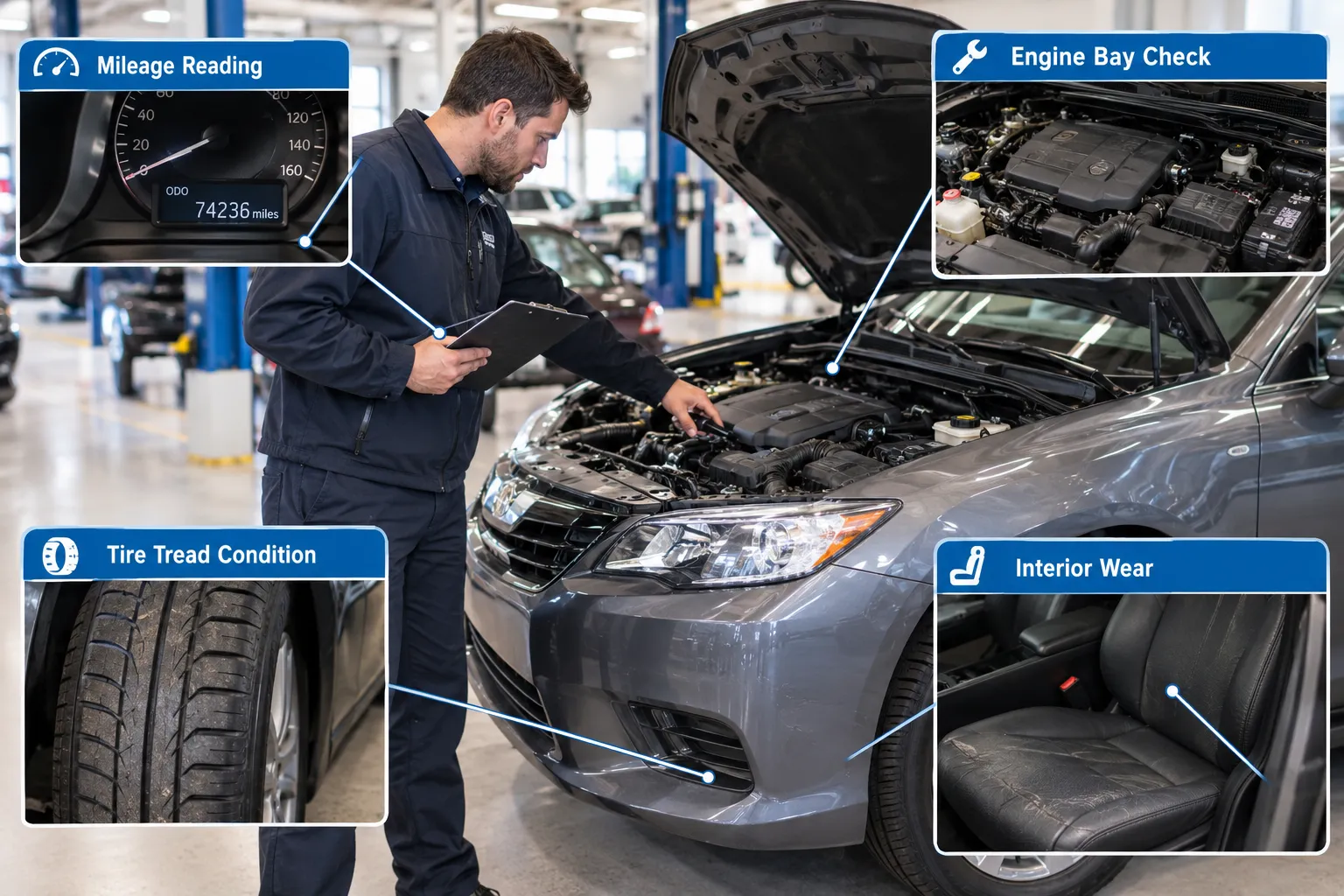
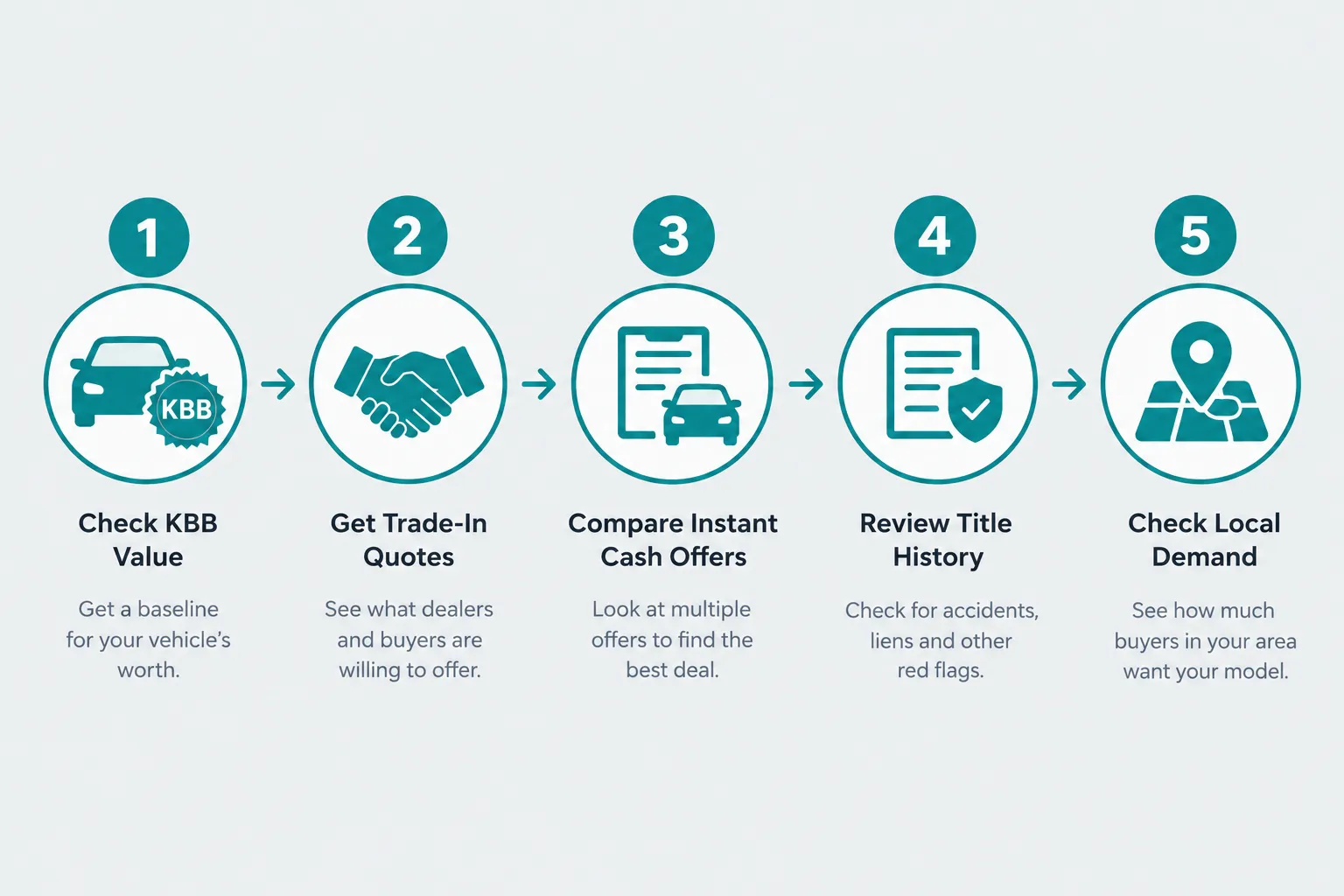
Before accepting any number, dealer or online, walk through this checklist. It mirrors what professional appraisers evaluate and gives you leverage grounded in specifics rather than guesswork.
1. Mileage
Pull your exact odometer reading, not a rounded estimate. Compare it against the average annual mileage for your vehicle’s age (roughly 12,000 to 13,000 miles per year is typical). Mileage significantly above that average pushes value down; well below it can push value up.
2. Condition, Honestly Rated
Walk around the car and check for:
- Paint chips, dents, and rust spots
- Windshield cracks or chips
- Tire tread depth and wear pattern
- Interior wear on seats, dash, and carpet
- Warning lights or recent mechanical issues
Be brutally honest here. Overrating condition is the single most common reason online estimates feel disconnected from real offers.
3. Options and Trim Level
Note every factory option: sunroof, navigation, premium audio, leather, towing package, advanced safety features. These can meaningfully shift value, especially on trucks and SUVs, but only if you document them accurately when entering your VIN or trim details into a valuation tool.
4. Title History and Records
Pull a title history report and gather maintenance records. A clean title with documented service history supports a higher appraisal. A branded title (salvage, flood, lemon buyback) can cut value dramatically, regardless of how the car looks or drives. If you want a deeper walkthrough on checking these details before a purchase or sale, this guide on how to check used car value before buying covers the process step by step.
5. Local Demand
Search active listings for your exact year, make, model, and trim within a 50 to 100 mile radius. If similar vehicles are scarce locally, that scarcity can push your real-world price above the national average. If your market is flooded with similar listings, expect downward pressure regardless of what a national tool shows.
6. Timing and Seasonality
Convertibles, trucks, and SUVs often swing in value seasonally. Selling a 4×4 truck right before winter, or a convertible in early spring, typically captures stronger demand than selling out of season.
Using Multi-Source Valuation as Negotiation Leverage
The strongest sellers in 2026 are not the ones who trust a single printout. They are the ones who walk in with three data points: a KBB range, a competing instant offer, and a handful of comparable local listings. This combination does two things. It shows the dealer you have done your homework, and it gives you a documented floor to negotiate from rather than a vague feeling that your car is “worth more.”
Negotiation guides published this year consistently recommend treating any online valuation as a conversation starter, then asking the dealer directly what factors are pulling their number below the published range [5]. If they cite reconditioning costs or market saturation, ask for specifics. Vague answers are a signal there may be room to negotiate upward.
It is also worth remembering that dealer-side valuation tools have evolved. Many dealerships now use KBB’s business-focused inventory platforms to shape their appraisal strategy and capture trade-ins more competitively, particularly when they need specific vehicles for their lot [7]. That means a dealer actively short on, say, mid-size SUVs, might beat their own stated range if your vehicle fills a gap in their current inventory. Asking what they are short on costs nothing and sometimes unlocks a better number.
If you are cross-shopping brands as part of a broader buying or trading decision, it also helps to understand how resale value differs across manufacturers; this comparison of Volkswagen, Kia, and Mazda value positioning shows how brand reputation feeds into long-term resale strength. And if your current vehicle is being swapped out for something with towing capability, this breakdown of why a Jeep makes a strong tow vehicle is a useful companion read while you plan your next purchase.
What to Expect Through Late 2026
Looking ahead, industry commentary suggests the gap between published valuation ranges and actual dealer offers is likely to persist rather than close, since it is rooted in structural cost differences, not a temporary market quirk [4][10]. What is changing is transparency. More platforms are pushing guaranteed, time-bound offers like KBB’s Instant Cash Offer specifically because sellers have grown frustrated with vague ranges that do not translate into real checks [2][3]. Expect more dealers to lean on these guaranteed-offer tools as a trust-building feature, even as traditional trade-in negotiation at the sales desk continues much as it always has.
This is a forward-looking expectation based on current trends, not a guarantee, but sellers who get comfortable comparing guaranteed offers against general estimates now will be better positioned no matter how the tools evolve.
Conclusion
There is no single magic number that represents your car’s “real” price. Kelley Blue Book’s private-party, trade-in, and instant cash offer values each answer a different question, and dealer counteroffers are built from a risk-based formula that rarely matches a market-based estimate exactly. The practical path forward is straightforward: pull multiple valuations, document your car’s mileage, condition, options, title history, and local demand honestly, then walk into any negotiation with numbers you can defend rather than a single printout you hope a dealer will honor.
Start by generating your KBB trade-in range and an Instant Cash Offer side by side, cross-check them against a handful of local private-party listings, and bring your documentation with you. That combination turns a guessing game into a negotiation you can actually win.
References
[1] Values – https://www.kbb.com/faq/values/ [2] kbb – https://www.kbb.com/faq/ico/ [3] Instant Cash Offer – https://www.kbb.com/instant-cash-offer/ [4] Is Kbb Trade In Value Reliable – https://www.amerifreight.net/blog/is-kbb-trade-in-value-reliable [5] Kelley Blue Book Negotiation Guide – https://rcmor.com/kelley-blue-book-negotiation-guide/ [6] Why Do Dealers Not Use Kbb – https://carfaxdeals.com/blog/why-do-dealers-not-use-kbb [7] b2b.kbb – https://b2b.kbb.com/ [8] Car Values – https://www.kbb.com/car-values/ [9] 10157009 Does Kelley Blue Book Really Give You The Best Value For Your Car – https://www.savingadvice.com/articles/2025/05/27/10157009_does-kelley-blue-book-really-give-you-the-best-value-for-your-car.html [10] 4893822488558 Trade In Offers Handed Out At The Dealership Counter Are Running Meaningfully Below What The Exact Same Car Would Fetch In A Private Party Sale Valuation Data Shows – https://www.newsbreak.com/news/4893822488558-trade-in-offers-handed-out-at-the-dealership-counter-are-running-meaningfully-below-what-the-exact-same-car-would-fetch-in-a-private-party-sale-valuation-data-shows