Last Updated on September 29, 2026
A 6.5% price jump on a single trim can quietly erase years of “value brand” reputation. That is exactly what happened to Volkswagen in 2026, when several core models climbed in price while Kia and Mazda largely held their ground. For anyone comparing Volkswagen vs Kia vs Mazda to find the best value in 2026 for budget-conscious car buyers, the sticker price is only the opening chapter. Reliability records, depreciation curves, common repair costs, and used-market pricing brackets tell a much fuller story about which brand actually protects a buyer’s wallet over five, seven, or ten years of ownership.
This guide breaks down all three brands side by side, using current 2026 pricing data, incentive structures, and reliability trends to answer a question every budget-conscious shopper is asking right now: which brand actually stretches a dollar the furthest?
Key Takeaways
- Kia wins on upfront price. The 2026 Kia K4 starts as low as $23,535, undercutting Volkswagen’s Jetta and matching or beating most Mazda3 trims.[8]
- Volkswagen raised prices across its 2026 lineup, with the Jetta, Taos, Golf GTI, and Atlas all seeing increases between 2.9% and 6.5% year-over-year.[3]
- Mazda leans on reliability, not discounts. The Mazda3 earns a 4.2 out of 5 reliability score, which can lower long-term repair costs even with a higher starting price.[6]
- Volkswagen’s real value shows up in incentives, including lease deals as low as $279 a month and up to $12,500 in EV price cuts on select models.[1][4][13]
- The “best” brand depends on the buyer’s budget bracket, new-car shoppers, lease-focused shoppers, and used-car shoppers each land on a different winner.
Volkswagen vs Kia vs Mazda: Which Brand Offers the Best Value in 2026 on Sticker Price
Sticker price is where most budget-conscious shoppers start, and it is also where the three brands diverge the most sharply in 2026. Volkswagen has pushed prices upward across nearly its entire lineup, partly in response to tariff-related cost pressures.[3] The 2026 Jetta now starts at $25,270 with destination, up from $23,720 in 2025, a 6.5% increase.[3] The compact Taos SUV climbed from $26,420 to $27,975 (5.9%), the Golf GTI jumped from $33,670 to $35,865 (6.5%), and even the larger Atlas rose from $39,625 to $40,785 (2.9%).[3] Volkswagen’s own configurator lists the Jetta S at $23,995, the Tiguan at $30,805, and the Atlas SE FWD at $39,310, confirming that Volkswagen’s “budget” trims now sit noticeably above where Kia’s comparable models land.[5][12][14]
Kia, by contrast, is doubling down on aggressive entry pricing. The redesigned 2026 K4 compact sedan and hatchback starts at $23,535 according to Kelley Blue Book, with the loaded GT-Line Turbo topping out at $29,635.[8] A separate review pegs the K4’s starting price closer to $24,990, with the GT-Line Turbo at $28,890.[11] Either way, the K4 undercuts the Jetta’s real-world pricing and comes in well below the Golf GTI, which starts near $34,590 MSRP and lands around $35,865 with destination fees included.[10][12]
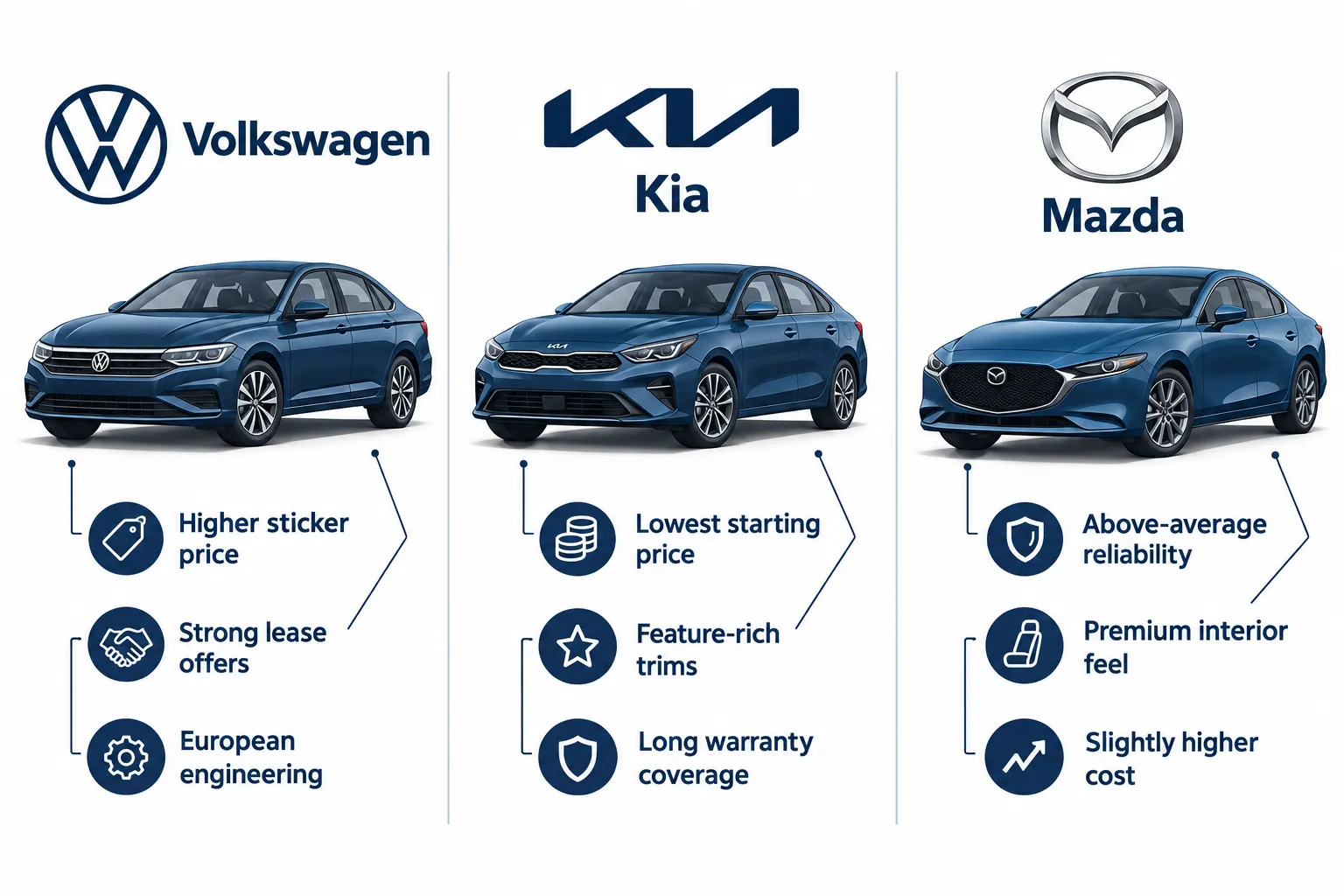
Mazda occupies the middle ground on paper, typically pricing the Mazda3 close to Kia’s compact offerings but slightly above the K4’s most aggressive trims. Mazda does not compete purely on sticker price, though, its value proposition is built on what happens after the sale, which is covered in the next section.
2026 Starting Price Snapshot
| Model | Brand | Approximate 2026 Starting Price | Year-Over-Year Change |
|---|---|---|---|
| Jetta S | Volkswagen | $23,995,$25,270 (w/ destination) | +6.5% |
| Taos S | Volkswagen | $27,975 | +5.9% |
| Golf GTI | Volkswagen | $35,865 | +6.5% |
| Atlas SE FWD | Volkswagen | $39,310,$40,785 | +2.9% |
| K4 | Kia | $23,535,$24,990 | Aggressive entry pricing |
| K4 GT-Line Turbo | Kia | $28,890,$29,635 | Feature-rich, still under GTI |
| Mazda3 | Mazda | Mid-pack pricing | Backed by reliability data |
For buyers who want to see a broader range of budget-friendly new and used options across brands, it is worth reviewing options for used cars under $20,000 before locking in a decision on any single manufacturer.
Reliability, Common Repairs, and Depreciation: The Long-Term Value Test
Sticker price only tells half the story. The real cost of ownership shows up over years of oil changes, brake jobs, and unexpected repairs, and this is where the Volkswagen vs Kia vs Mazda comparison gets more interesting for budget-conscious buyers thinking beyond the first three years.
Mazda’s biggest advantage is reliability. Owner-reported data compiled by Kelley Blue Book gives the current-generation Mazda3 an above-average reliability score of 4.2 out of 5.[6] That number matters because reliability scores correlate directly with how often a car needs unscheduled repairs, and how expensive those repairs tend to be. A car that rarely visits the shop for anything beyond routine maintenance effectively “pays back” some of its higher purchase price over time.
“For cost-conscious buyers planning to keep a car well past the warranty period, a strong reliability profile can offset a higher sticker price compared with rivals.”
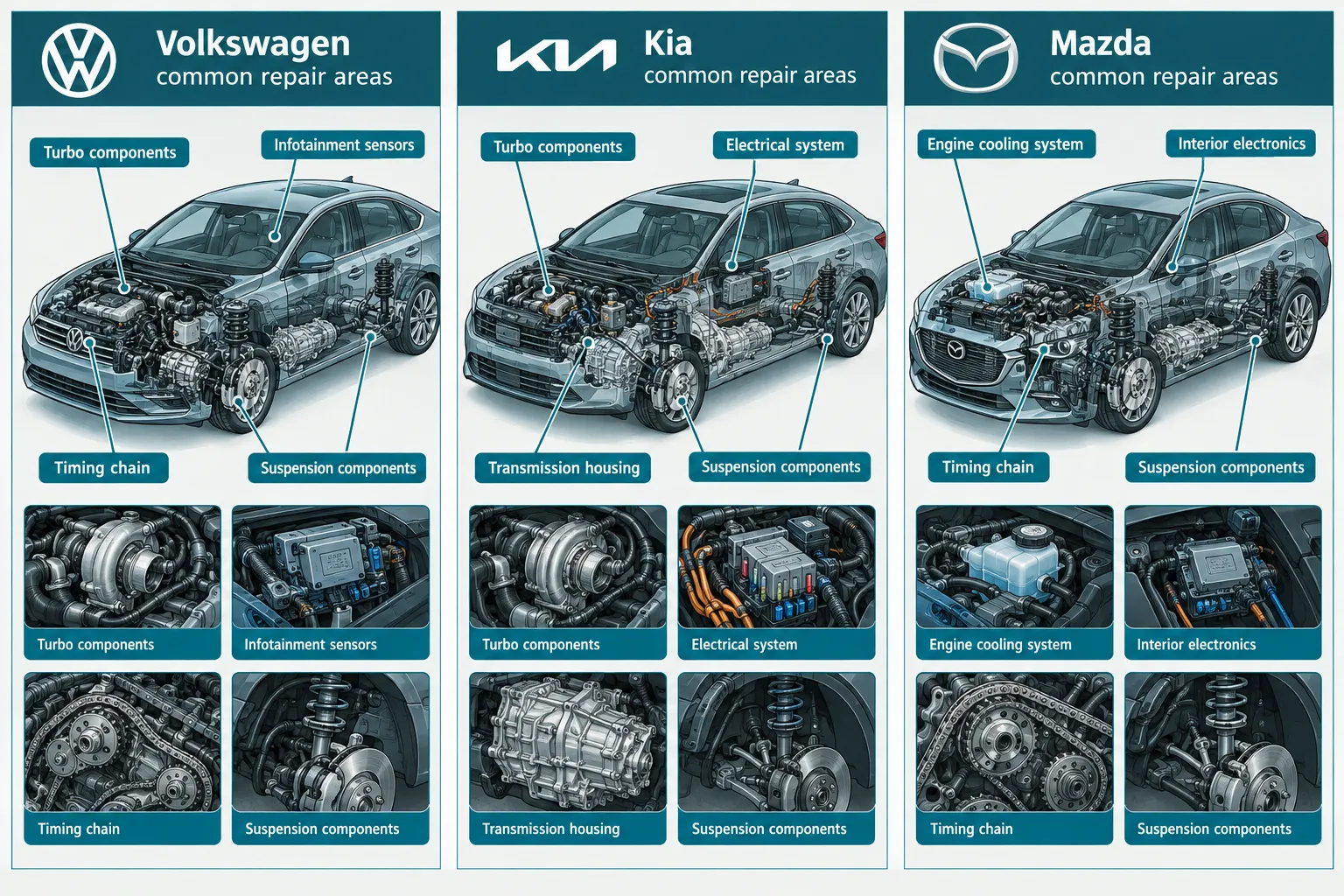
Volkswagen and Kia each carry their own reputations in this category. Kia has built a decade-long track record of improving quality scores and backs many models with long warranty coverage, which reduces the financial risk of early ownership even if long-term reliability data is still developing for newer nameplates like the K4.[8][11] Volkswagen vehicles, meanwhile, are often praised for driving dynamics and cabin quality but have historically carried a reputation for more electronics-related repair visits, particularly around infotainment systems and turbocharged engine components, a pattern that matters most once a vehicle rolls past its factory warranty window.
How Common Repairs Shape Total Cost of Ownership
- Volkswagen: Turbocharged engines and advanced infotainment systems can mean pricier diagnostic and repair bills once out of warranty.
- Kia: Generally lower-cost parts and wide dealer network availability help keep routine repair costs manageable.
- Mazda: Fewer reported issues overall translate into fewer surprise repair bills, according to KBB’s reliability data.[6]
Depreciation follows a similar pattern. Vehicles with strong reliability reputations, like the Mazda3, tend to hold resale value better because used-car buyers trust them more. Kia’s aggressive new-car pricing can sometimes work against it on the used side, a lower starting MSRP means there is less room for the car to “fall” in value, but it also means used Kias are often priced very competitively, which is good news for second-owner budget shoppers. Volkswagen’s used values are more mixed; the brand’s higher new-car pricing means steeper dollar-amount depreciation, but the well-known driving appeal of models like the Golf GTI helps some trims hold value better than the brand’s mainstream sedans and SUVs.
Buyers who want extra protection against repair-cost surprises, regardless of which of these three brands they choose, should also look into certified used cars and how their warranties work before signing a used-vehicle contract.
Volkswagen vs Kia vs Mazda: Which Brand Offers the Best Value in 2026 at Every Budget Level
The honest answer to which brand offers the best value in 2026 depends heavily on how a buyer plans to pay for the car, cash, loan, or lease, and how long they intend to keep it. Breaking the comparison into budget brackets makes the decision much clearer.
Under $25,000: New Car Shoppers
At this price point, Kia is the clear leader. The 2026 K4’s starting price of roughly $23,535 to $24,990 puts a modern, tech-equipped compact sedan within reach of buyers who might otherwise be shopping strictly used inventory.[8][11] Volkswagen’s Jetta starts higher at $23,995 to $25,270, and while it is close, Kia typically wins on standard features and warranty coverage at this exact price tier.[3][5]
$25,000,$35,000: Feature-Focused Buyers
This bracket is where Mazda becomes more competitive. Mazda3 trims in this range come with a refined interior and strong reliability backing, while the Volkswagen Taos and Tiguan sit at the upper end of this bracket after 2026 price increases.[3][12] Kia’s GT-Line Turbo K4, priced near $28,890 to $29,635, remains a strong contender here too, especially for buyers who want turbocharged performance without stepping into Volkswagen’s Golf GTI pricing.[8][10][11]
$35,000 and Up: Performance and SUV Shoppers
Here, the Volkswagen Golf GTI (from $35,865) and Atlas (from $40,785) compete against larger Mazda SUVs and Kia’s upper trims.[3][10] Volkswagen’s driving character and cabin refinement can justify the premium for enthusiast buyers, but budget-focused shoppers in this range should pay close attention to incentives, since this is where Volkswagen’s deals matter most.
Leasing and Incentive-Driven Buyers
This is Volkswagen’s strongest bracket. National offers in September 2026 included a Jetta Sport FWD lease at $279 a month, Taos S FWD and Tiguan S FWD leases at $299 a month, and cash bonuses such as $2,000 on the Jetta and $6,000 on the all-electric ID.4.[1][13] Separately, Volkswagen has been reported cutting prices by as much as $12,500 on certain EVs, alongside the ID.4 lease-or-purchase bonus running between September 1 and November 2, 2026.[4][13] For a buyer who is comfortable leasing or timing a purchase around a promotional window, Volkswagen can become the cheapest monthly payment of the three brands, even though its base MSRP is the highest.[1]
Volkswagen is also expanding its lower-cost EV lineup globally. The ID. Cross electric SUV has opened orders in Germany starting at roughly €36,525 (about $42,000), with a lower-priced Trend variant expected around €27,995 (about $32,000).[15] In China, the jointly developed ID. AURA T6 starts near 129,900 yuan (about $19,240).[7] These are not all available in every market yet, but they show Volkswagen’s clear intent to compete on EV pricing more directly against Kia and Mazda going forward.[7][15]
Mazda’s incentive strategy is more targeted. Rather than broad lease deals, Mazda has advertised up to $5,000 off its plug-in hybrid CX-70 SUV, a move that can make a premium electrified SUV cost-competitive with mainstream gas SUVs from Kia and Volkswagen.[9] It is a smaller-scale approach than Volkswagen’s incentive blitz, but it targets buyers specifically interested in electrified efficiency without going fully electric.
Quick Reference: Best Value by Buyer Type
| Buyer Type | Best Brand | Why |
|---|---|---|
| Lowest possible new-car price | Kia | K4 starts near $23,535, undercutting Jetta and most Mazda3 trims [8] |
| Long-term ownership, minimal repairs | Mazda | 4.2/5 reliability rating reduces surprise repair costs [6] |
| Lease shoppers and EV buyers | Volkswagen | Deep lease deals and up to $12,500 in EV price cuts [1][4] |
| Turbocharged performance on a budget | Kia | GT-Line Turbo K4 undercuts Golf GTI pricing significantly [8][10] |
| Electrified SUV shoppers | Mazda | $5,000 incentive on CX-70 PHEV [9] |
Whichever brand a buyer leans toward, comparing financing terms carefully matters as much as the sticker price. Shoppers researching parts availability and DIY maintenance costs across these three brands may also find it useful to compare where DIY mechanics save the most on parts between RockAuto, AutoZone, and O’Reilly, since long-term repair costs are a major factor in total value.
Where Each Brand Falls Short
No brand wins across every category, and budget-conscious buyers should go in with clear eyes about the trade-offs.
- Volkswagen’s downside: Higher base MSRPs across nearly the entire 2026 lineup mean cash buyers or those unable to access lease deals pay more upfront.[3] The value proposition depends heavily on catching the right incentive window.
- Kia’s downside: The K4 is a new generation, meaning long-term reliability data is still developing compared with the more established Mazda3.[8][11] Aggressive pricing is attractive now, but resale performance over five-plus years is less proven.
- Mazda’s downside: Strong reliability comes at a moderate price premium compared with Kia’s most aggressive trims, and Mazda’s incentive activity is narrower and more selective than Volkswagen’s broad lease and EV discounts.[6][9]
Conclusion: Choosing Between Volkswagen, Kia, and Mazda in 2026
There is no single universal winner in the Volkswagen vs Kia vs Mazda comparison for best value in 2026, the right choice depends on how a buyer defines “value.” For the lowest possible purchase price on a new car, Kia’s K4 lineup is the strongest starting point, thanks to aggressive pricing that undercuts both Volkswagen and most Mazda3 trims.[8][11] For buyers planning to keep a vehicle for a decade or more and wanting to minimize repair bills, Mazda’s reliability track record makes it the safer long-term bet.[6] For shoppers who lease, finance through manufacturer promotions, or are eyeing an EV, Volkswagen’s incentive-driven pricing can turn its highest-MSRP models into some of the cheapest monthly payments on the market.[1][4][13]
The practical next step is straightforward: decide first whether the goal is the lowest sticker price, the lowest lifetime repair cost, or the lowest monthly payment through a lease or incentive. That single decision points clearly toward Kia, Mazda, or Volkswagen, respectively. From there, compare specific trims, check current regional incentives before visiting a dealership, and request a vehicle history or reliability report on any used model under consideration. Budget-conscious buyers who match their priorities to the right brand, rather than chasing sticker price alone, are the ones most likely to come out ahead in 2026.
References
[1] Deals Incentives – https://www.kbb.com/volkswagen/deals-incentives/ [2] Volkswagen – https://www.kbb.com/volkswagen/ [3] Volkswagen Raises Prices In Wake Of Tariff Deal – https://www.kbb.com/car-news/volkswagen-raises-prices-in-wake-of-tariff-deal/ [4] Tag:reuters.com,2026:newsml Mt1usdaynetn91987986007 – http://rmb.reuters.com/rmd/rss/item/tag:reuters.com,2026:newsml_MT1USDAYNETN91987986007?channel=xsp076 [5] Models – https://www.vw.com/en/models.html [6] Mazda3 – https://www.kbb.com/mazda/mazda3/ [7] Volkswagens Newest Ev Runs Chinese 164700889 – https://finance.yahoo.com/technology/articles/volkswagens-newest-ev-runs-chinese-164700889.html [8] kbb – https://www.kbb.com/kia/k4/ [9] mazdausa – https://www.mazdausa.com/ [10] Volkswagen Golf Gti 2026 – https://www.cars.com/research/volkswagen-golf_gti-2026/