Last Updated on August 28, 2026
Nearly 2.7 million certified pre-owned vehicles are sold in the United States every year, yet many buyers still walk onto a dealership lot without knowing what separates a certified used car from any other pre-owned vehicle on the lot. That gap in knowledge costs shoppers real money, either by paying too much for a certification badge they do not fully understand, or by skipping it entirely and missing out on protections worth thousands of dollars.
In 2026, the certified used car market is shifting fast. Supply is tightening, manufacturers are restructuring their programs, and electric vehicles are entering CPO inventories in growing numbers [9]. Whether shopping for a family sedan, a commuter car, or a first vehicle, understanding how certified used cars work is one of the smartest moves a buyer can make before signing anything.
Key Takeaways
- Certified used cars go through a formal multi-point inspection and come with a manufacturer-backed or dealer-backed warranty that regular used cars do not include.
- CPO vehicles typically cost more than non-certified used cars, but the added warranty coverage, roadside assistance, and peace of mind often justify the price difference.
- Major programs like GM’s CarBravo and Mercedes-Benz’s extended EV warranties are reshaping the CPO landscape in 2026.
- Knowing how to compare CPO programs, read warranty terms, and negotiate financing can save buyers significant money.
- Tools like vehicle history reports, certified dealer networks, and used car valuation guides help shoppers find the best certified used car deals available.
What Are Certified Used Cars and How Do They Differ From Regular Used Cars
A certified used car, also called a certified pre-owned (CPO) vehicle, is a used car that has passed a formal inspection process and comes with a warranty backed by either the manufacturer or the dealership [1]. That is the core difference between a CPO vehicle and a standard used car.
When someone buys a regular used car, they are buying it largely as-is. The seller may disclose known problems, but there is no standardized inspection requirement, no warranty obligation, and no guarantee about the car’s history or condition. The buyer takes on most of the risk.
A certified used car flips that equation. Before a vehicle earns a CPO label, it must meet specific eligibility requirements and pass a detailed inspection. If problems are found, they must be fixed before the car can be sold as certified [2].
The Two Main Types of CPO Programs
There are two broad categories of certified used car programs:
Manufacturer-Certified Programs These are run by the automaker itself, think Toyota Certified Used Vehicles, Ford Blue Advantage, or BMW Certified Pre-Owned. The manufacturer sets the inspection standards, backs the warranty, and trains the dealerships that can sell certified vehicles. These programs tend to offer the strongest protections and the most consistent standards [1].
Dealer-Certified Programs These are created and managed by individual dealerships or dealer groups, not the manufacturer. Standards vary widely between dealers. The warranty is backed by the dealer, not the automaker, which means coverage depends on the financial health and policies of that specific dealership [2].
For most buyers, manufacturer-certified programs offer better protection and more reliable coverage than dealer-certified alternatives.
Eligibility Requirements: Age, Mileage, and Condition
Not every used car qualifies for CPO status. Most manufacturer programs set strict limits:
| Requirement | Typical CPO Standard |
|---|---|
| Vehicle age | Usually 5 to 7 years old or newer |
| Mileage | Typically under 60,000 to 80,000 miles |
| Condition | Must pass a multi-point inspection |
| History | Clean title, no major accident damage |
| Ownership | Often limited to 1 or 2 previous owners |
These requirements exist to protect the integrity of the certification. A car that is too old or has too many miles is harder to warranty at a reasonable cost, and the manufacturer’s reputation is tied to every vehicle that carries its CPO badge.
Core Benefits of Buying Certified Used Cars
The most obvious benefit of a certified used car is the warranty. But the full picture includes several layers of protection and added value that go beyond just the paperwork.
Warranty Coverage Explained
CPO warranties typically come in two parts:
1. Powertrain Warranty This covers the most expensive components, the engine, transmission, and drivetrain. Powertrain warranties on CPO vehicles often extend the original factory coverage, sometimes adding two to five years beyond what the original owner received [2].
2. Bumper-to-Bumper (Comprehensive) Warranty Some programs include a limited bumper-to-bumper warranty that covers a broader range of components, including electronics, air conditioning, and suspension parts. These are usually shorter in duration than powertrain warranties but offer wider coverage [1].
A strong CPO warranty can save a buyer thousands of dollars if a major repair is needed in the first year or two of ownership. A transmission replacement alone can cost between $3,000 and $7,000 at an independent shop.
Multi-Point Inspection: What Gets Checked
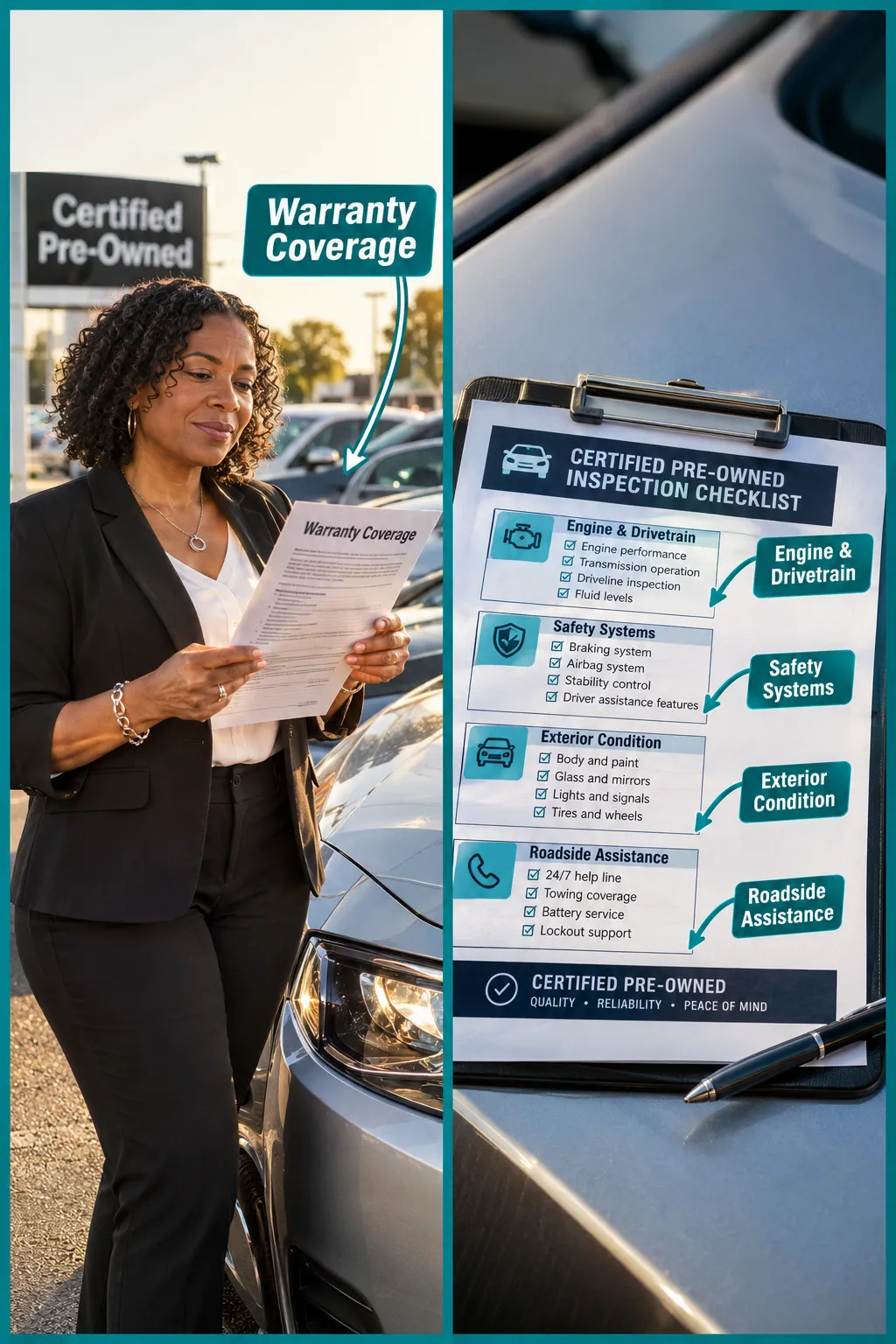
Every legitimate CPO program requires a multi-point inspection before a vehicle is certified. The number of inspection points varies, some programs check 100 points, others check 150 or more. Common areas covered include:
- Engine performance and fluid levels
- Transmission and drivetrain function
- Brakes, tires, and suspension components
- Electrical systems and battery health
- Interior condition and safety features
- Exterior body panels and paint condition
- Air conditioning and heating systems
- Safety systems including airbags and seatbelts
Any item that fails inspection must be repaired or replaced before the vehicle can be sold as certified. This gives buyers a much higher baseline of confidence than they would have with a standard used car purchase [2].
Roadside Assistance and Additional Perks
Many CPO programs bundle in roadside assistance, which typically includes:
- 24-hour towing service
- Emergency fuel delivery
- Lockout assistance
- Flat tire service
- Jump-start service
Some programs also include a free vehicle history report, a limited exchange period (allowing a return within a few days if the buyer changes their mind), and special financing rates through the manufacturer’s finance arm [1].
Vehicle History Reports
Most reputable CPO programs provide a vehicle history report, often through CARFAX or AutoCheck, as part of the certification process [7]. This report shows:
- Accident history
- Number of previous owners
- Service and maintenance records
- Title status (clean, salvage, rebuilt)
- Odometer readings over time
Having this information upfront removes one of the biggest uncertainties in buying a used car.
How Certified Used Car Programs Are Evolving in 2026
The CPO market in 2026 is not the same as it was just a few years ago. Three major forces are reshaping how certified used cars are bought and sold: supply constraints, program restructuring, and the rise of electric vehicles in CPO inventories.
GM’s CarBravo Restructuring
One of the biggest changes in the U.S. CPO market in 2026 is General Motors’ restructuring of its CarBravo program, effective June 2, 2026. GM announced changes designed to streamline how Chevrolet, Buick, GMC, and Cadillac certified vehicles are sold under the CarBravo umbrella [9].
The restructuring focuses on improving the certified buying experience across GM’s dealer network, with updated inspection standards and a clearer distinction between manufacturer-certified and dealer-certified inventory. For shoppers, this means it is more important than ever to confirm exactly which level of certification a specific GM vehicle carries before purchasing [9].
Mercedes-Benz Extended EV Warranties
Mercedes-Benz has been expanding its certified used car programs in Europe to include electric vehicles. Through its “Junge Sterne” (Young Stars) program, Mercedes-Benz is offering a five-year guarantee on certified used EVs through September 30, 2026 [4]. This is a significant development because EV battery health is one of the biggest concerns buyers have about used electric vehicles.
Extended battery warranties on certified used EVs give buyers a level of protection that simply does not exist in the standard used car market. As more EVs age out of their initial ownership cycles, CPO programs that include strong battery coverage will become increasingly valuable. For more context on where EV pricing is heading, see this analysis of electric cars becoming cheaper than ICE vehicles.
Tightening Supply and Its Impact on Deals
CPO supply has been under pressure for several years, and 2026 continues that trend. Fewer lease returns and lower new car sales during previous years have reduced the pool of vehicles eligible for certification [6]. When supply is tight, certified used car prices tend to stay elevated.
This means buyers in 2026 need to be more strategic. Acting quickly when a good CPO deal appears, being flexible on color or trim level, and expanding the search radius to nearby markets can all help shoppers find better value in a constrained inventory environment [6].
Electric Vehicles Entering CPO Programs
As the first wave of mass-market EVs ages past the five-year mark, more electric vehicles are now eligible for CPO certification. Programs from manufacturers like Tesla, Hyundai, and Kia are beginning to include certified used EV options with battery health guarantees.
For buyers considering a used EV, a CPO designation with explicit battery coverage is especially important. Battery replacement costs can exceed $10,000 on some models, making the warranty protection far more valuable than on a traditional combustion vehicle.
Are Certified Used Cars Worth the Extra Cost
This is the question every smart shopper asks. The honest answer: it depends on the specific vehicle, the program, and the buyer’s situation, but for many people, the answer is yes.
The Price Premium
Certified used cars typically cost more than non-certified equivalents. The premium varies by brand, vehicle age, and market conditions, but buyers can generally expect to pay anywhere from a few hundred to a few thousand dollars more for a CPO vehicle compared to a similar non-certified used car [2].
That premium buys:
- Warranty coverage for major repairs
- Documented inspection results
- Vehicle history transparency
- Roadside assistance
- Potentially lower financing rates
When the Premium Is Worth It
The CPO premium makes the most financial sense when:
The vehicle is just out of factory warranty. A car that is three to four years old and just past its original bumper-to-bumper coverage benefits most from CPO certification. Without it, the next owner absorbs all repair risk immediately.
The vehicle is a luxury or high-tech model. Repairs on luxury vehicles and cars with advanced technology systems are expensive. CPO coverage on a BMW, Mercedes, or Audi can save far more than the premium paid.
The buyer is financing the purchase. Many manufacturer CPO programs offer special low-APR financing rates that are not available on non-certified used cars. In 2026, some programs have offered CPO financing at rates significantly below standard used car loan rates, which can offset the higher purchase price over the life of the loan [2].
The buyer wants peace of mind. For buyers who are not mechanically inclined or who cannot easily absorb a large unexpected repair bill, the psychological value of a warranty is real and legitimate.
When It May Not Be Worth It
The CPO premium is harder to justify when:
- The vehicle still has significant factory warranty remaining
- The buyer is very mechanically knowledgeable and plans to do their own maintenance
- The non-certified vehicle is priced so much lower that the savings exceed the likely cost of repairs
- The dealer-certified program has weak or unclear terms
Before deciding, it helps to know what the car is actually worth. The used car value guide at Nada Book Info and the Blue Book Car Value Guide are useful starting points for understanding fair market pricing on any specific model.
What to Check Before Buying a Certified Used Car
A CPO badge does not mean a buyer should skip their own due diligence. Here is a practical checklist of what to verify before signing.
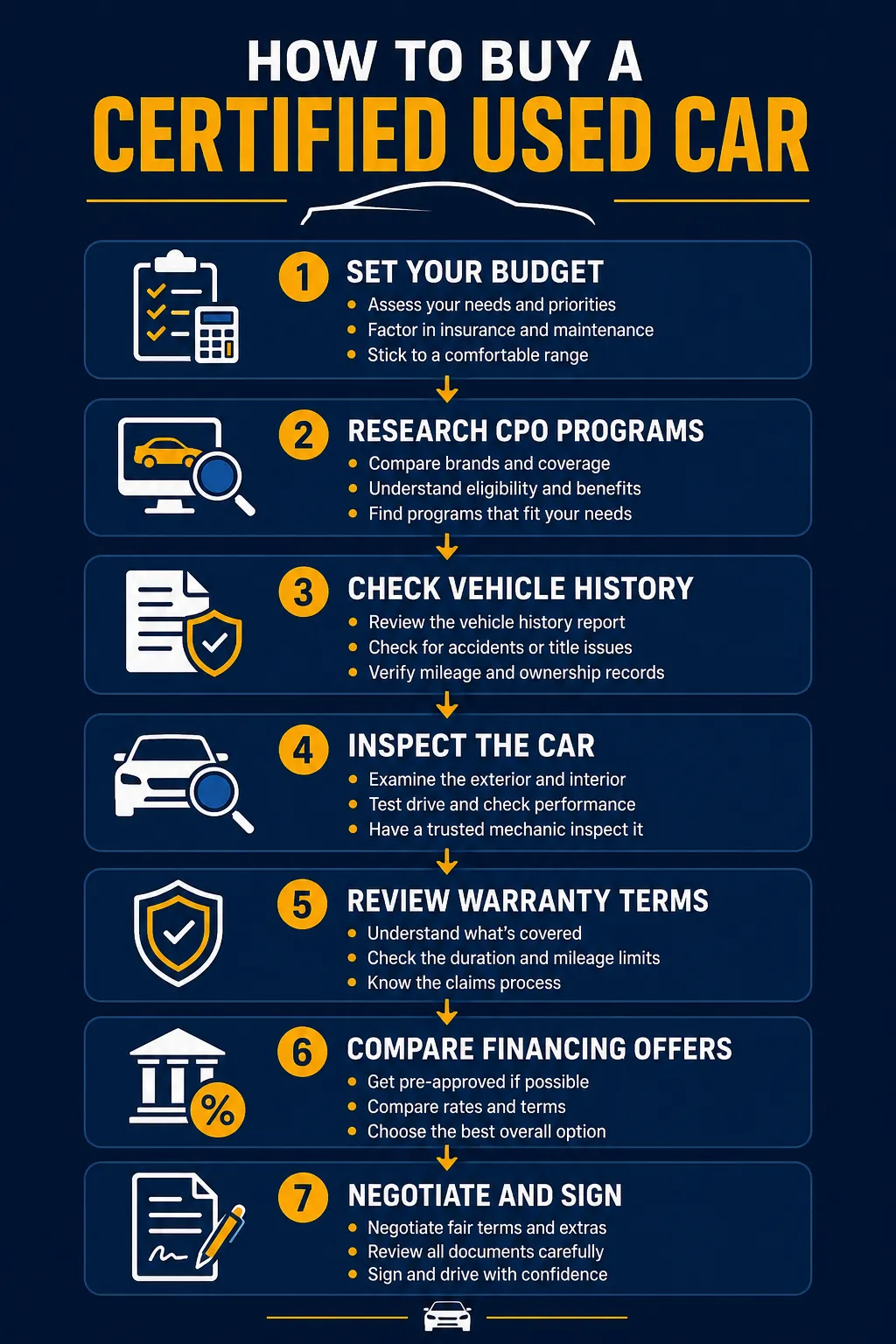
Step 1: Confirm the Certification Type
Ask directly: is this a manufacturer-certified vehicle or a dealer-certified vehicle? Request documentation that proves the manufacturer’s certification, not just the dealer’s word. The certification paperwork should come from the automaker, not just the dealership’s own branded materials [1].
Step 2: Read the Warranty Documents Carefully
Do not assume all CPO warranties are the same. Key questions to ask:
- How long does the warranty last (in years and miles)?
- What is covered, powertrain only, or comprehensive?
- What is the deductible per repair visit?
- Is the warranty transferable if the car is sold again?
- Where can warranty repairs be performed, only at franchised dealers, or at any licensed shop?
Step 3: Review the Inspection Report
Ask for a copy of the actual inspection report, not just a summary. This document should list every item checked, its condition, and any repairs made. If the dealer cannot or will not provide this, that is a red flag [2].
Step 4: Run an Independent Vehicle History Check
Even though most CPO programs provide a history report, running an independent check through a service like CARFAX adds an extra layer of confidence [7]. History reports can sometimes miss incidents, so cross-referencing two sources is smart.
Step 5: Get a Pre-Purchase Inspection
For higher-priced CPO vehicles, consider paying for an independent pre-purchase inspection (PPI) by a trusted mechanic. This costs roughly $100 to $200 and can reveal issues that the manufacturer’s inspection may have missed or downplayed.
Step 6: Compare Financing Options
Do not automatically accept the dealer’s financing offer. Compare the manufacturer’s CPO financing rate against rates from banks and credit unions. For a deeper look at how used car financing works, the used car loan guide covers the key mechanics of auto loan terms, interest calculations, and what to watch for.
Step 7: Negotiate
CPO vehicles are not immune to negotiation. The certification fee, accessories, and even the vehicle price itself can often be negotiated. In a market with tightening supply, leverage may be limited, but it is always worth asking [10].
How to Find Certified Used Cars Near You With the Best Deals
Finding the right certified used car requires using the right tools and knowing where to look.
Online Marketplaces and Manufacturer Sites
The most efficient starting point is an online search across major platforms:
- Autotrader has a dedicated certified cars section that filters by manufacturer CPO programs, making it easy to compare certified inventory across multiple brands [1].
- Edmunds offers a certified cars search tool with detailed program information for each manufacturer, including warranty terms and inspection standards [2].
- Cars.com provides CPO listings with program details and dealer ratings [10].
- CARFAX lists certified used car deals with history reports included [7].
Most manufacturer websites also have dealer locators that show certified inventory at franchised dealerships in a specific area.
Using NADA Guides to Evaluate Pricing
Before making any offer, knowing the fair market value of a specific CPO vehicle is essential. The 7 steps to NADAguides used car values walks through exactly how to use NADA’s valuation tools to understand what a vehicle is worth in the current market. Combining a NADA value check with Edmunds’ True Market Value gives a solid pricing baseline before negotiating.
Expanding the Search
When local certified inventory is limited, which is increasingly common in 2026 due to supply constraints, expanding the search radius makes sense. Many dealers will arrange transport for a certified vehicle purchased from out of state, sometimes at a modest fee. The savings on the right vehicle can easily outweigh the transport cost.
Timing the Purchase
CPO deals tend to be most available at certain times:
- End of month and end of quarter: Dealers are motivated to meet sales targets and may offer better terms.
- Model year changeovers: When new model year vehicles arrive, dealers are more motivated to move older certified inventory.
- Holiday weekends: Many manufacturers run special CPO financing promotions around holidays like Memorial Day, Labor Day, and year-end.
Checking Manufacturer Financing Promotions
Manufacturer finance arms regularly run special APR promotions on CPO vehicles. In 2026, some programs have offered rates well below standard used car loan averages for qualified buyers. These promotions change monthly, so checking the manufacturer’s website directly, or asking the finance manager what current CPO incentives are available, is always worthwhile [2].
Certified Used Cars vs. Other Used Vehicle Options
It helps to understand how CPO vehicles fit into the broader landscape of used vehicle purchases.
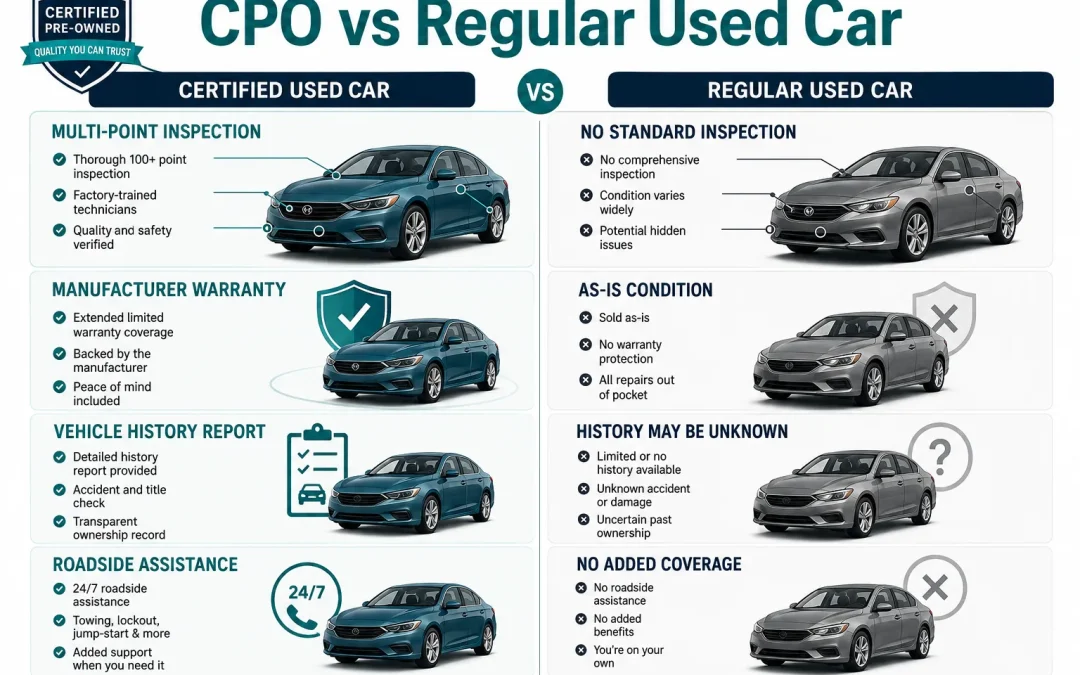
CPO vs. Regular Used Cars: A Side-by-Side View
| Feature | Certified Used Car | Regular Used Car |
|---|---|---|
| Inspection | Formal multi-point inspection required | No standard requirement |
| Warranty | Manufacturer or dealer warranty included | Sold as-is in most cases |
| Vehicle History | Report typically provided | Buyer must request separately |
| Roadside Assistance | Often included | Not included |
| Price | Higher (certification premium) | Lower upfront cost |
| Financing Rates | Special low APR often available | Standard used car rates apply |
| Risk Level | Lower for buyer | Higher for buyer |
CPO vs. Extended Warranties on Regular Used Cars
Some buyers consider purchasing a third-party extended warranty on a non-certified used car as an alternative to buying CPO. This can work, but there are important differences:
- Third-party warranties vary widely in quality and reliability. Some have many exclusions.
- The cost of a third-party warranty added to a non-certified used car may equal or exceed the CPO premium.
- Manufacturer CPO warranties are backed by the automaker, which is generally more financially stable than a third-party warranty company.
If considering a third-party warranty route, researching the warranty provider thoroughly is essential. The wholesale RV warranties guide offers useful context on how extended warranty terms and exclusions work across vehicle categories, many of the same principles apply to used car warranties.
CPO vs. Buying New
For buyers on the fence between a new car and a certified used car, the math often favors CPO:
- New cars depreciate rapidly in the first two to three years, sometimes losing 20 to 30 percent of value.
- A CPO vehicle that is two to three years old has already absorbed that initial depreciation.
- The CPO warranty bridges the gap between the remaining factory coverage and the extended CPO terms.
The result is a vehicle that is nearly as reliable as a new car, protected by a strong warranty, and priced significantly lower.
Top Certified Used Car Programs to Know in 2026
Different manufacturers run very different CPO programs. Here is a brief overview of some of the most notable programs available in 2026:
Toyota Certified Used Vehicles
Toyota’s program is widely regarded as one of the strongest in the industry. Vehicles must be 6 years old or newer with under 85,000 miles. The program includes a 12-month/12,000-mile comprehensive warranty and a 7-year/100,000-mile powertrain warranty from the original sale date [1].
BMW Certified Pre-Owned
BMW’s CPO program covers vehicles up to 5 years old with under 60,000 miles. It includes a 1-year unlimited mileage warranty extension, 24-hour roadside assistance, and trip interruption coverage [2].
GM CarBravo (Chevrolet, Buick, GMC, Cadillac)
Following the June 2026 restructuring, CarBravo continues to serve as GM’s unified certified used car platform. The program covers vehicles across all four GM brands with a 172-point inspection and powertrain warranty coverage [9].
Mercedes-Benz Certified Pre-Owned (Junge Sterne)
Mercedes-Benz’s European program, Junge Sterne, is notable for its extended EV battery warranty through September 2026, offering five-year coverage on certified used electric vehicles, a meaningful protection for buyers concerned about battery degradation [4].
Honda Certified Used Vehicles
Honda’s program covers vehicles up to 5 years old with under 80,000 miles, with a 7-year/100,000-mile powertrain warranty and a 182-point inspection [1].
Common Mistakes to Avoid When Buying Certified Used Cars
Even experienced car buyers make avoidable mistakes in the CPO process. Here are the most common ones:
Assuming all CPO programs are equal. They are not. A dealer-certified vehicle from an independent lot is very different from a manufacturer-certified vehicle. Always confirm which type of certification applies [2].
Not reading the warranty deductible terms. Some CPO warranties have a $0 deductible. Others charge $100 or more per repair visit. Over time, this adds up significantly.
Ignoring the mileage cap on warranty coverage. A 5-year warranty sounds great until a buyer realizes it expires at 60,000 miles, and the car already has 55,000 miles on it. Always check both the time and mileage limits.
Skipping the independent inspection. Even certified vehicles can have issues that passed the manufacturer’s inspection. An independent mechanic’s eyes on the car before purchase adds a valuable second opinion.
Not comparing financing options. Accepting the first financing offer without shopping around is one of the most common and costly mistakes in any vehicle purchase.
Overlooking transferability. If there is any chance of selling the car before the warranty expires, a transferable warranty adds resale value. Not all CPO warranties transfer to a second owner.
Conclusion
Certified used cars offer a compelling middle ground between the high price of a new vehicle and the uncertainty of a standard used car purchase. The combination of a formal inspection, manufacturer-backed warranty, vehicle history transparency, and roadside assistance creates a significantly lower-risk buying experience, and in many cases, the added cost is well justified by the protection it provides.
In 2026, the CPO landscape is evolving with GM’s CarBravo restructuring, Mercedes-Benz’s extended EV warranties, and growing electric vehicle inventory entering certified programs. Buyers who understand these changes are better positioned to find strong value in a market where supply remains tight.
Actionable next steps for buyers:
- Decide on a budget and identify two or three vehicles of interest, then check whether manufacturer CPO programs exist for those models.
- Use NADA and Kelley Blue Book valuation tools to establish fair market pricing before visiting any dealership. The 7 steps to NADAguides used car values is a practical starting point.
- Search certified inventory on Autotrader, Edmunds, Cars.com, and CARFAX to compare pricing and program terms across dealers [1][2][10][7].
- Read the full warranty document, not just the summary, before making any offer.
- Get pre-approved for financing from a bank or credit union before visiting the dealership, then compare that rate against the manufacturer’s CPO financing offer.
- If the vehicle passes all checks, negotiate on price, deductible terms, and any add-on products the dealer may try to include.
A certified used car purchased with proper research and preparation is one of the smartest vehicle purchases a buyer can make. The key is knowing exactly what the certification covers, and holding dealers accountable to delivering on every promise that badge represents.
References
[1] Certified Cars – https://www.autotrader.com/certified-cars
[2] Certified Cars – https://www.edmunds.com/certified-cars/
[4] Vehicles – https://gebrauchtwagen.mercedes-benz.de/vehicles?referrer=home&language=en-GB
[6] Certified Pre Owned Supply Memory Shortage – https://www.assurant.com/news-insights/articles/certified-pre-owned-supply-memory-shortage
[7] Used Car Deals – https://www.carfax.com/deals/used-car-deals
[9] 0303 Car Bravo – https://news.gm.com/home.detail.html/Pages/topic/us/en/2026/mar/0303-car-bravo.html
[10] cars – https://www.cars.com/cpo/