Last Updated on October 9, 2026
A motorcycle that has changed hands six times in four years is not a bargain. It is a red flag. Vehicle-history researchers now flag that exact pattern as a classic “flipper bike,” a machine quietly passed between buyers who never wanted to keep it long enough to find out what was wrong with it.[6] That single statistic sums up why private-party motorcycle buying in 2026 demands a disciplined process rather than a gut feeling.
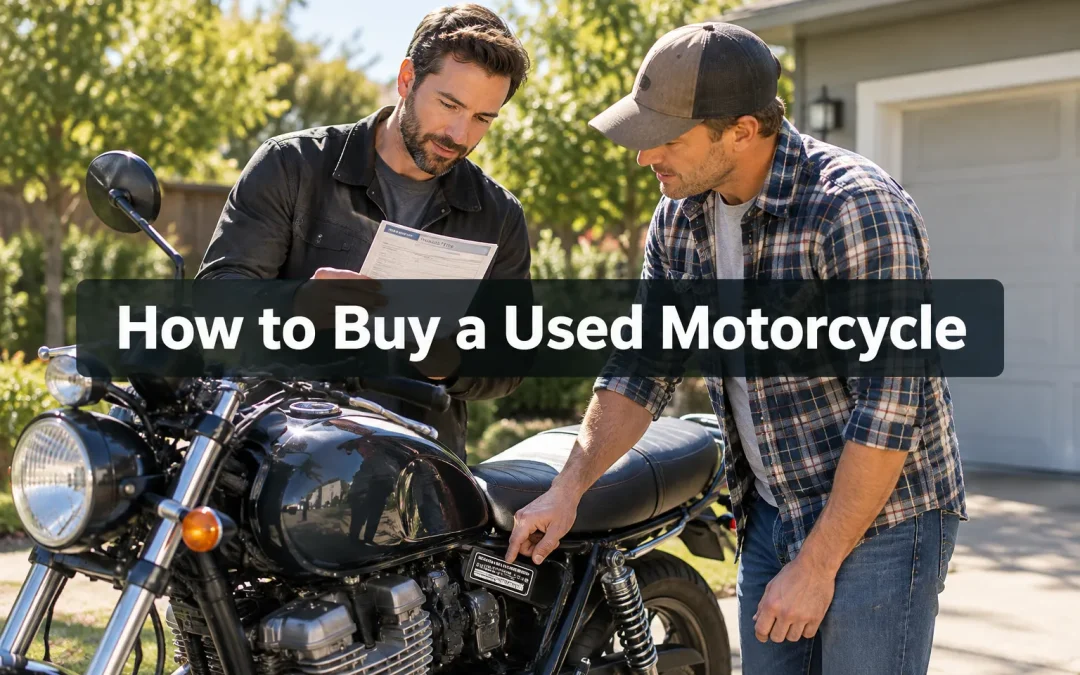
Learning how to buy a used motorcycle from a private seller means treating title checks, inspection, test ride, and negotiation as four connected steps, not four separate errands. Skip one, and the others lose their value. A clean-looking bike with a washed title is still a liability. A great price on a machine with a cracked frame is no deal at all. This guide walks through the exact sequence experienced buyers use, from VIN verification and lien checks to cold starts, service records, tire condition, suspension health, and the paperwork that finalizes the sale.
Key Takeaways
- Verify the title and VIN before discussing price, mismatched names, altered VINs, or brands like “SALVAGE” and “REBUILT” are serious warning signs.[3][10][15]
- Run a free NMVTIS or NHTSA-based VIN check to uncover title brands, theft records, and open recalls before meeting the seller.[6][10][12]
- Inspect the bike cold, checking frame welds, forks, tires, chain, and brakes, since a warmed-up engine can hide starting problems and top-end noise.[3][7][13][14]
- Confirm insurance and licensing, then test ride a pre-agreed route to check starting, braking, clutch feel, and gear shifts.[4][7][8][13]
- Negotiate from data, not emotion, use valuation guides and your inspection notes to justify an offer typically 10 to 15% below asking price.[7][13][14]
- Never hand over full payment until the signed title is in your hands, and always document the deal with a detailed bill of sale.[1][3][11]
Title Checks and VIN Verification: The First Step in How to Buy a Used Motorcycle From a Private Seller
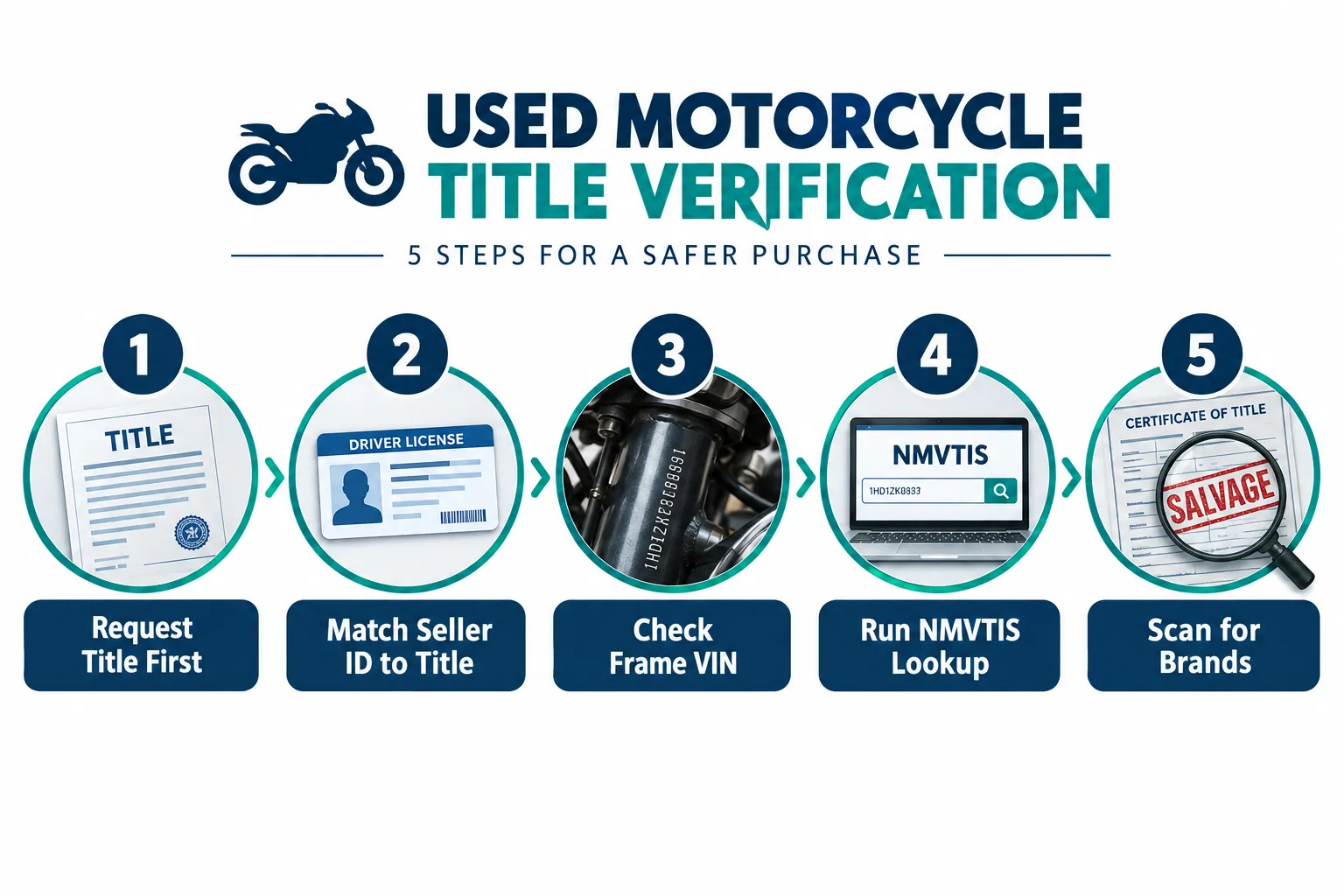
Most buyers want to talk price first and worry about paperwork later. That order is backwards. Current best practice is to ask the seller for the title before any serious money conversation happens, because a motorcycle legally cannot be sold or insured without a clean title in the current owner’s name.[3][15] If a seller hesitates, claims the title is “at the bank” or “with a friend,” or cannot produce it at all, that hesitation alone is reason enough to walk away.[4][9][10][14]
Once you have the title in hand, run through this verification sequence:
- Match the name. Confirm the seller’s name on the title matches their government-issued photo ID exactly.[3][12][15]
- Match the VIN. Locate the VIN stamped on the steering head or frame and compare it character-by-character to the VIN printed on the title. Any mismatch is a dealbreaker.[3][12][15]
- Scan for brands. Look for stamped or printed words such as “SALVAGE,” “REBUILT,” or “DUPLICATE.” These brands affect insurability, resale value, and safety history.[3][10][15]
- Check the transfer history. A title packed with multiple owners in a short window is a strong signal of a flipper bike or hidden problem history.[6]
Before you ever meet the seller in person, run the VIN through an online lookup tool that draws on NMVTIS and NHTSA data. These tools reveal title brands, theft reports, and open recalls, giving you a documented head start on red flags.[6][10][12] As of October 2026, checking for active safety recalls has become standard due diligence rather than an optional extra, since recalls can involve critical systems like brakes, fuel lines, or frames and are typically repaired at no cost once you know to ask.[10][12]
This same discipline applies beyond motorcycles. If you are also shopping for other powersports vehicles, the ownership paperwork and VIN verification steps are similar; our breakdown of what an ATV is and how it differs from a UTV covers how title and classification issues can trip up buyers of off-road machines too.
Lien checks matter just as much as title brands. A VIN history report or a call to the state DMV can confirm whether a lender still has a financial claim on the bike. If a lien exists, the seller must pay it off and obtain a lien release before the title can legally transfer to you. Buying a motorcycle with an active lien you don’t know about can leave you owning a machine the bank can repossess.
How to Inspect a Used Motorcycle From a Private Seller Before You Buy
Inspection should always start with a cold engine. A bike that has been idling for twenty minutes before you arrive can mask hard starting, excessive smoke, or top-end knocking that would otherwise be obvious.[3][7][13][14] Politely but firmly ask the seller not to start the motorcycle before you get there, and watch the first startup closely.
Work through the bike systematically rather than jumping around:
Frame and structure
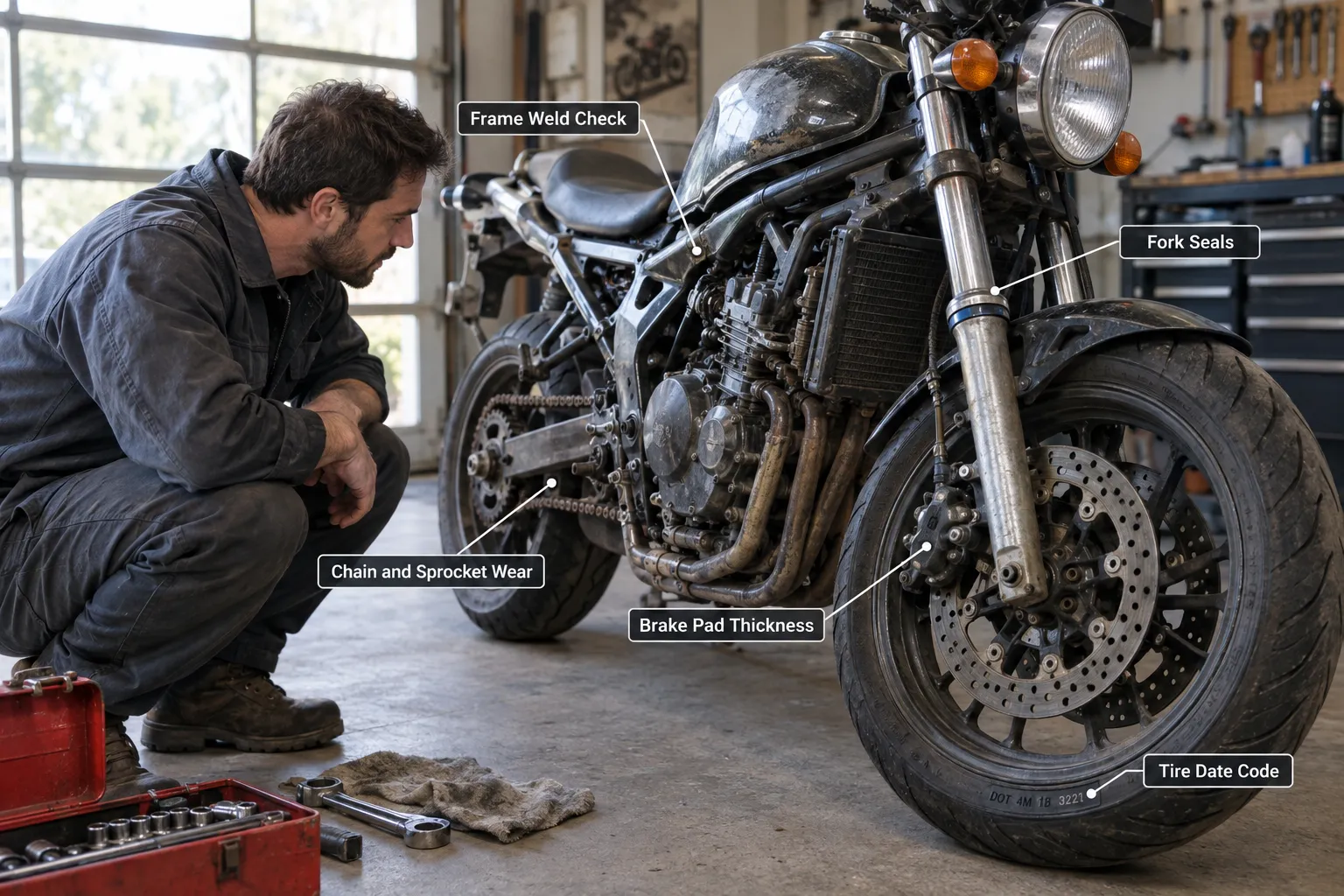
- Inspect the frame and steering head for cracks, fresh paint, or weld marks that suggest prior crash repair.[3][7][13]
- Check for straight alignment between the front wheel and the rest of the bike, a bent frame rarely rides true.
Suspension and controls
- Examine the forks for oil leaks, pitting on the chrome, and straight travel when you press down on the front end.[3][7][13][14]
- Check the rear shock for leaks and confirm it compresses and rebounds smoothly.
Drivetrain and brakes
- Look at chain and sprocket wear; a stretched chain or hooked sprocket teeth mean replacement costs soon.[3][7][13][14]
- Measure brake pad thickness and inspect rotors for deep grooves or heavy rust.[3][7][13][14]
Tires and charging system
- Read the tire date code molded into the sidewall. Tires older than five to six years can be unsafe regardless of remaining tread depth.[3][7][13][14]
- With the engine running, check that the charging system is holding voltage: headlight, turn signals, and brake light should all stay bright and steady without flickering or dimming at idle.
Documentation
- Ask for service records. A seller with organized maintenance receipts, oil-change stickers, and valve-adjustment history is far more trustworthy than one who shrugs and says “it’s always run fine.”[5][8][9]
- Compare the odometer reading you see in person against the listing and any history report. Inconsistencies can signal tampering or an instrument-cluster swap.[5][8][10]
If the bike has been sitting in storage for an extended period, pay extra attention to fuel system corrosion, perished rubber lines, and battery condition. For buyers thinking ahead about their own storage setup once the purchase is done, our guide to winterizing your motorcycle garage space covers how proper storage protects the very systems you’re inspecting today.
Test Ride Checklist: Confirming the Bike Rides as Good as It Looks
A motorcycle that starts cleanly and looks mechanically sound still needs to prove itself on the road. Before you swing a leg over, confirm the seller’s permission in writing or by text message, and make sure you are both licensed and carrying your own insurance coverage for the ride.[4][7][8][13] This protects both parties if something goes wrong.
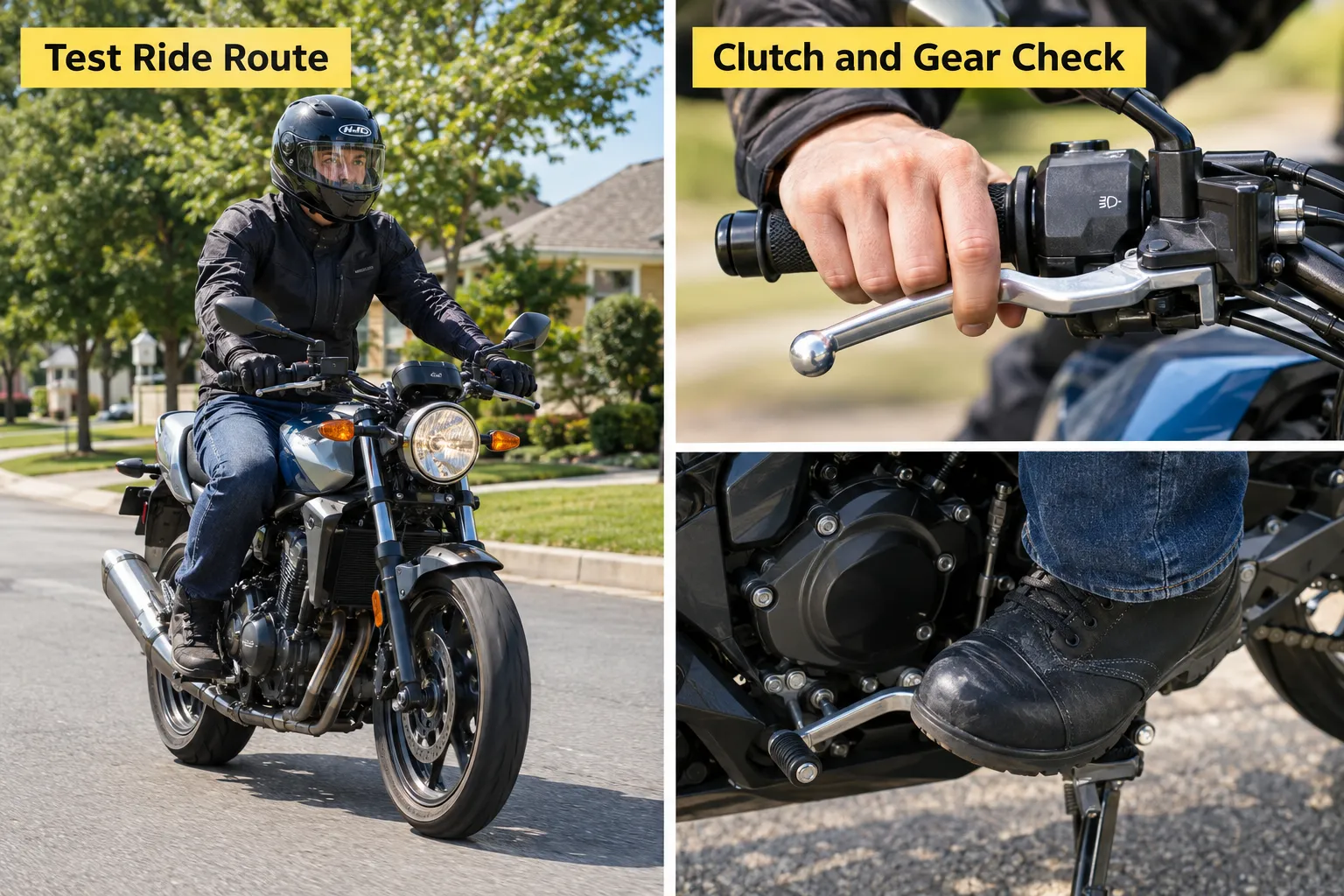
Agree on a short, specific route in advance, ideally a loop that includes a straightaway, a stop sign, and a low-speed turn. Riding beyond your comfort zone on an unfamiliar bike is how accidents happen, so keep the test within your skill level.[4][7][8][13]
During the ride, pay attention to:
| What to Check | What You’re Listening or Feeling For |
|---|---|
| Starting | Clean start with no excessive cranking or smoke |
| Idle | Steady RPM without surging or stalling |
| Acceleration | Smooth power delivery with no hesitation or backfire |
| Clutch | Engages progressively, not grabby or slipping |
| Gear shifts | Clean transitions through all gears, no false neutrals |
| Braking | Firm lever feel, no pulsing or grinding |
| Low-speed turns | Stable, no unusual vibration or pulling to one side |
Listen carefully for knocking, rattling, or clunking sounds that weren’t apparent at idle.[7][8][13] Any grinding noise under braking or a clutch that slips under load should be treated as a serious negotiation point or a reason to pass entirely.
Negotiation Strategies for How to Buy a Used Motorcycle From a Private Seller: Title Checks, Inspection, Test Ride, and Negotiation
Negotiation works best when it is backed by numbers, not emotion. Before you make an offer, establish a baseline value using Kelley Blue Book, NADA Guides, and a handful of comparable local listings for the same year, make, model, and mileage.[10][13][14] Adjust that baseline up for documented maintenance and desirable modifications, and down for anything your inspection turned up.
Private sellers typically price their motorcycles 15 to 25% below dealership retail, which already gives you room to work with.[7][11][14] A common and reasonable opening move is to offer roughly 10 to 15% below the asking price, then use your specific inspection findings as leverage rather than vague complaints.[7][14] Saying “the tires are six years past their date code and the rear brake pads are near minimum, so I’d like to come in at this number” lands far better than simply asking for a discount.
This same data-driven approach applies across vehicle categories. If you’re weighing a motorcycle purchase against a used car, it helps to see how valuation and condition affect pricing elsewhere, our looks at resale value and reliability for used Subaru models and strategies for getting the most money out of a used truck both show how documented condition and market comparables drive the final number, whether you’re buying or selling.
A few negotiation habits worth keeping:
- Lead with facts, not insults. Point to specific findings, not general negativity about the bike.
- Know your walk-away number before you arrive. Decide your maximum price in advance so emotion doesn’t creep in.
- Be willing to leave. Sellers who sense genuine interest but no desperation tend to move faster on price.
- Bundle small asks. A helmet, cover, or spare key thrown in can sometimes close a price gap without either side losing face.
Bill of Sale, Payment Safety, and Finalizing the Title Transfer
Once you and the seller agree on a number, the transaction itself needs the same discipline as the inspection. Avoid carrying large amounts of loose cash to the meeting. Cashier’s checks, verified bank wires, or a reputable escrow service are safer and leave a paper trail.[1][3][11] Most importantly, never hand over full payment until the title has been properly signed over to you.[1][3][11]
A written bill of sale protects both parties and should include:
- Full names and addresses of buyer and seller
- The motorcycle’s VIN
- Exact odometer reading at time of sale
- Purchase price and date of transaction
- Deposit amount, if any, and whether it is refundable
- Pickup date and signatures from both parties[1][3][11][13][14]
Recording the precise odometer reading matters because it documents mileage at the moment of sale and discourages later disputes.[1][3][13][14] Keep a copy for your own records, even after the title transfer is complete.
Every state has its own deadline for title transfer and may require notarization. Visit the DMV promptly with the signed title and bill of sale to avoid late fees or ownership disputes down the road.[3][10][13][15] If you are new to comparing ownership paperwork across vehicle types, the title-transfer rules outlined in our Mercedes-Benz G-Class buying guide illustrate how similar documentation principles apply whether you’re buying a two-wheeler or a four-wheeler.
Finally, think about personal safety during the meeting itself. Arrange to meet during daylight hours in a public, well-lit location, and bring a friend along if possible.[4][9][10][14] Be alert to sellers who refuse to show identification, dodge questions about the VIN, or price the bike suspiciously far below market value, these are classic signals of possible theft, title washing, or odometer fraud.[3][6][10][14]
Frequently Asked Questions
Is it safe to buy a motorcycle without seeing the title first? No. A seller who cannot produce the title before discussing price is a significant risk. The title confirms legal ownership and reveals any brands like salvage or rebuilt status.[3][15]
What is a “flipper bike” and why does it matter? A flipper bike is one that has changed owners repeatedly in a short time, often around six transfers in four years. This pattern can hide mechanical problems or title issues that previous owners discovered and quickly resold.[6]
How much should I offer below the asking price? A common starting point is 10 to 15% below the listed price, adjusted based on your inspection findings and comparable local listings.[7][13][14]
Do I need my own insurance to test ride a private-seller motorcycle? Yes. Confirm you are licensed and carry valid insurance before riding, and get the seller’s permission in writing or by text beforehand.[4][7][8][13]
What documents do I need after the deal is done? Keep a signed bill of sale with the VIN, price, odometer reading, and both signatures, then visit the DMV promptly to complete the title transfer according to your state’s deadline.[1][3][13][15]
Conclusion
Buying a used motorcycle from a private seller rewards patience and punishes shortcuts. The riders who end up happy with their purchase are the ones who verified the title and VIN before talking price, inspected the bike cold rather than warmed up, rode a planned test route with insurance in place, negotiated from documented facts, and insisted on a proper bill of sale before handing over payment. Each step protects the one before it, a clean title means nothing if the frame is cracked, and a great price means nothing if the title turns out to be fraudulent.
Before your next meeting with a private seller, print a simple checklist covering VIN verification, cold-start inspection points, your test-ride route, and your walk-away price. Bring it with you, follow it in order, and you’ll be far less likely to fall for a flipper bike, a mismatched title, or a seller who’s hoping you won’t ask the right questions.
References
[1] Mic Buying Selling Used Motorcycle Guide(mobile) – https://mic.org/downloads/MIC_Buying-Selling_Used_Motorcycle_Guide(Mobile).pdf [3] Buying A Used Motorcycle From A Private Seller – https://yourbillofsale.com/guides/buying-a-used-motorcycle-from-a-private-seller/ [4] Buy Used Motorcycle Safely From Owner – https://carinterior.alibaba.com/buyingguides/buy-used-motorcycle-safely-from-owner [5] How To Buy A Used Motorcycle – https://www.motorcyclelegalfoundation.com/how-to-buy-a-used-motorcycle/ [6] Motorcycles – https://titlepull.com/vehicles/motorcycles [7] How To Buy A Used Motorcycle – https://motorcycledictionary.com/blog/how-to-buy-a-used-motorcycle [8] How To Buy Used Motorcycle – https://www.harley-davidson.com/us/en/content/expert-advice/how-to-buy-used-motorcycle.html [9] Guide To Buying A Used Motorcycle – https://motoress.com/rider/guide-to-buying-a-used-motorcycle/ [10] Motorcycle Buying Guide – https://www.valuepenguin.com/motorcycle-buying-guide [11] Mic Buying Selling Used Motorcycle Guide(mobile) – https://mic.org/downloads/MIC_Buying-Selling_Used_Motorcycle_Guide(Mobile).pdf [12] Motorcycles – https://titlepull.com/vehicles/motorcycles [13] How To Buy A Used Motorcycle – https://motorcycledictionary.com/blog/how-to-buy-a-used-motorcycle [14] Guide To Buying A Used Motorcycle – https://motoress.com/rider/guide-to-buying-a-used-motorcycle/ [15] Buying A Used Motorcycle From A Private Seller – https://yourbillofsale.com/guides/buying-a-used-motorcycle-from-a-private-seller/