
Last Updated on October 21, 2026
A 200-watt solar panel sounds impressive on a store shelf. It means almost nothing until you know how many watt-hours your refrigerator, laptop, and CPAP machine actually burn through in a day. That mismatch between marketing numbers and real appliance math is why so many boondockers end up with dead batteries on day three of a trip, even after spending thousands of dollars on panels.
Proper RV solar panel sizing for boondocking: battery capacity, daily watt-hours, inverter loads, and generator backup all have to be calculated together, not purchased piece by piece based on whatever is on sale. This guide walks through the actual math, using real appliance loads instead of guesswork, so you can build a system sized for how you actually camp.
Key Takeaways
- Start with your daily watt-hour (Wh) consumption, not panel wattage, appliances determine your real power budget [1].
- Lithium battery banks sized for 2 to 3 days of autonomy are now the standard for boondocking setups [2].
- Most boondocking rigs need 400 to 800 watts of solar to replace daily consumption, while heavy full-time users often exceed 2,000 watts [3][4].
- Inverter sizing should match your highest simultaneous AC load, with 2,000 to 3,000 watts covering most boondocking needs [3].
- Hybrid backup, pairing solar with a generator or portable power station, is replacing generator-only setups for most 2026 boondockers [5].
Why Daily Watt-Hours Beat Panel Wattage Every Time
Solar panel boxes advertise peak wattage, but that number only applies under perfect lab conditions. Real sizing starts with a different question: how many watt-hours does your rig consume in a 24-hour period?
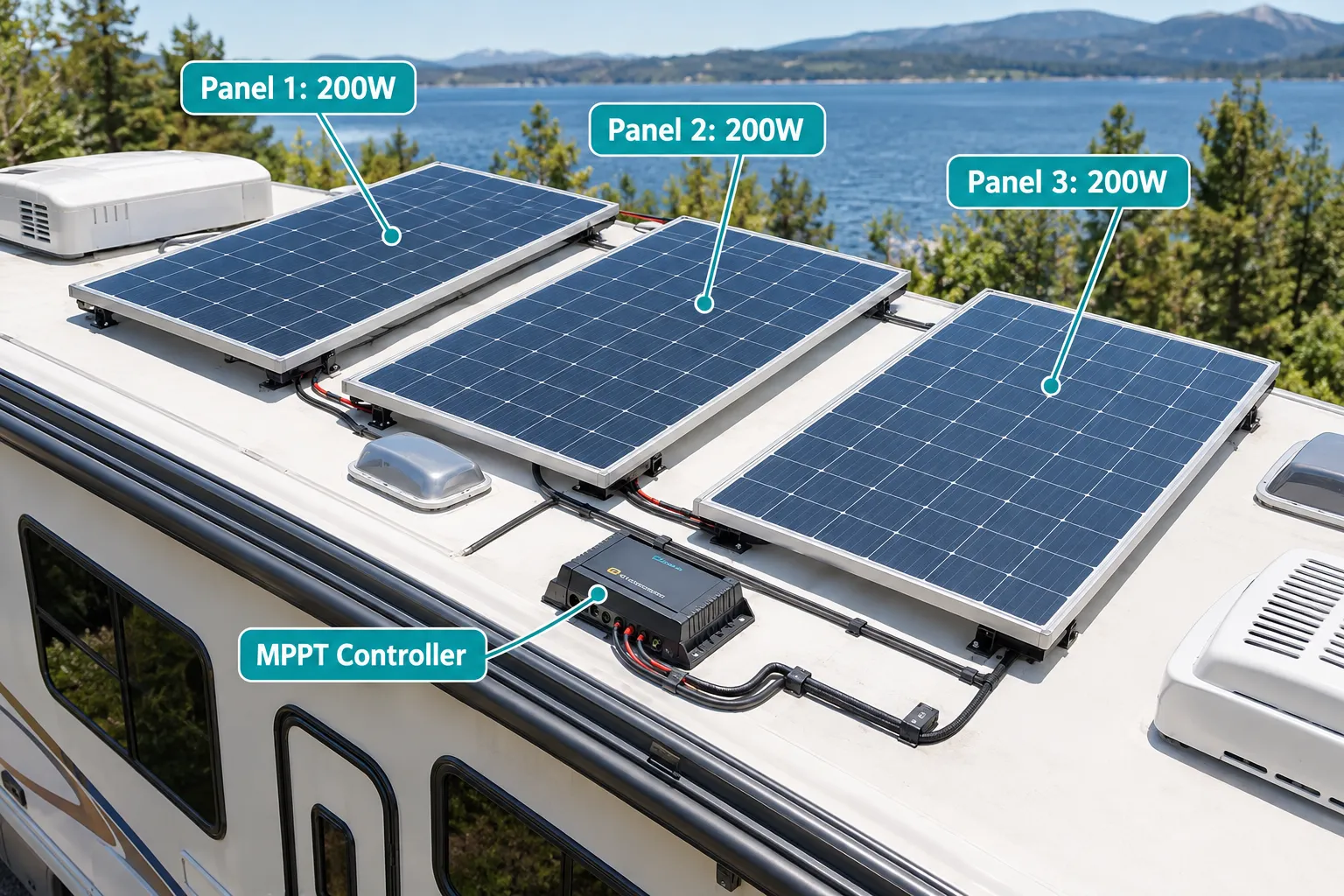
Add up every device you run, refrigerator, lights, water pump, laptop, phone chargers, CPAP, fans, and multiply each by its wattage and daily hours of use. A 12-volt compressor fridge pulling 50 watts for 8 cumulative hours a day uses 400 Wh. A laptop charging for 3 hours at 65 watts adds 195 Wh. These numbers stack up fast, and they are the real foundation of RV solar panel sizing for boondocking: battery capacity, daily watt-hours, inverter loads, and generator backup planning [1][6].
Industry calculators updated through October 2026 all converge on the same formula: daily Wh divided by peak sun hours (PSH), with a loss factor of 20 to 25 percent applied for wiring, temperature, and panel angle inefficiencies [6][7]. If your rig consumes 1,200 Wh per day and your location averages 5 peak sun hours, you need roughly 300 watts of solar just to break even, before accounting for losses. With a 25 percent derate, that climbs closer to 375 watts [7].
For those still deciding on a rig layout before building out a solar system, reviewing reasons you should buy a small RV can help clarify how much roof space and battery room you will actually have to work with.
Battery Capacity: Sizing for Autonomy, Not Just Daily Use
Solar panels only work when the sun cooperates. Battery capacity is what carries you through cloudy days, shaded canyons, and overnight use. The current consensus favors sizing battery banks for 2 to 3 days of autonomy rather than a single day’s worth of power [2].
Lithium iron phosphate (LiFePO4) batteries have become the default chemistry for boondocking because they allow a much deeper usable discharge than lead-acid, often 90 to 100 percent of rated capacity compared to the 50 percent ceiling on older lead-acid banks [2][3]. That means a 200Ah lithium battery effectively delivers close to double the usable power of a 200Ah lead-acid battery of the same size.
To calculate battery bank size:
- Determine daily Wh consumption.
- Multiply by desired days of autonomy (2 to 3 is standard).
- Divide by battery voltage (commonly 12V) to get amp-hours needed.
- Add a buffer of 10 to 15 percent for temperature and aging losses.
A rig using 1,200 Wh per day with 2 days of autonomy needs roughly 2,400 Wh, or about 200Ah at 12 volts. Many boondockers now run dual 100Ah or single 200Ah lithium banks to hit that target [2][3].
For readers looking to keep their whole rig efficient, not just the power system, simple maintenance tips to make your RV AC colder is worth a look since AC units are often the single biggest draw on any battery bank.
Mapping Watt-Hours to Solar Wattage: 2026 Consensus Ranges
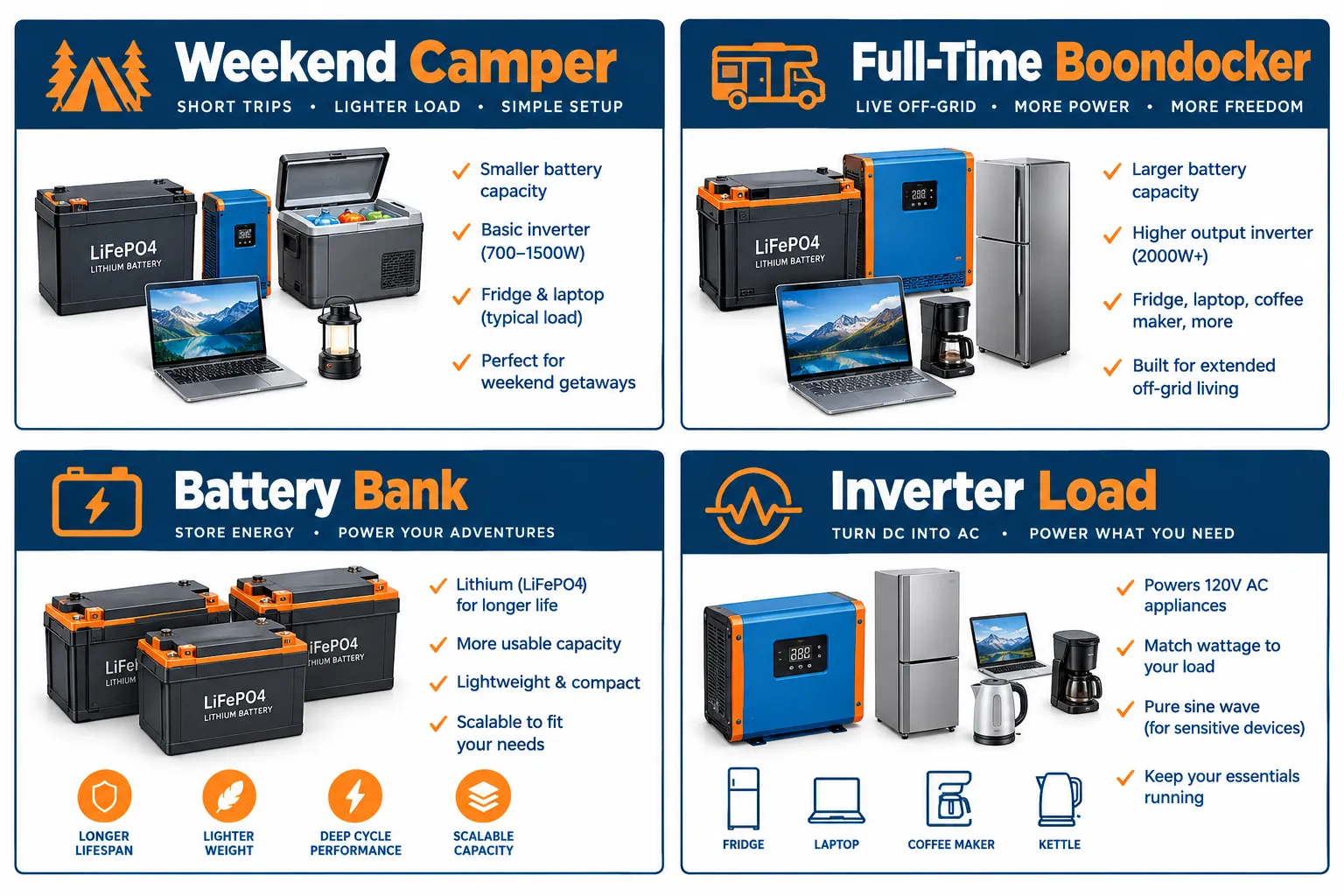
Once you know your daily Wh need and your battery bank size, the next step is matching solar wattage to replenish that bank within a single sunny day. The 2026 consensus ranges break down roughly like this:
| Daily Usage Profile | Daily Wh Need | Recommended Solar Wattage |
|---|---|---|
| Light weekend camper | 300-600 Wh | 100-200 watts |
| Moderate boondocker | 800-1,500 Wh | 400-600 watts |
| Heavy boondocker (AC, induction cooking) | 1,500-3,000 Wh | 800-1,200 watts |
| Full-time off-grid, multiple devices | 3,000+ Wh | 2,000+ watts |
These ranges reflect real-world testing and calculator data gathered through late 2026, factoring in average peak sun hours and system losses [3][4][7]. Heavy full-time users running residential refrigerators, induction cooktops, and multiple laptops regularly install more than 2,000 watts of rooftop or portable solar combined with large lithium banks exceeding 400Ah [4].
“Size for your worst sunny day, not your best one.” That single principle separates boondockers who run comfortably for a week from those who are constantly chasing sun angles with portable panels.
If you are weighing whether a bigger rig with more roof space makes sense for a larger solar array, 3 bedroom RVs can give a sense of what larger floor plans offer in terms of available mounting surface and storage for battery banks.
Inverter Loads: Matching Equipment to Real AC Demand
The inverter converts your battery’s DC power into the AC power that runs blenders, microwaves, coffee makers, and laptop chargers. Undersizing the inverter is one of the most common and expensive mistakes in a boondocking power system.
Inverter sizing should be based on your highest simultaneous AC load plus a safety margin, not your average draw. A microwave alone can spike to 1,200 to 1,500 watts, and running it alongside a coffee maker or hair dryer can push demand well past 2,000 watts in a short burst [3]. Because of this, 2,000 to 3,000 watt pure sine wave inverters have become the standard choice for boondocking rigs that want to run normal household appliances without hesitation [3].
Key inverter sizing considerations:
- Continuous rating should exceed your largest expected simultaneous load by at least 20 percent.
- Surge rating matters for motors and compressors, which draw 2 to 3 times their running wattage on startup.
- Pure sine wave inverters are required for sensitive electronics like CPAP machines and laptops, avoiding the buzzing or damage that modified sine wave units can cause.
Those planning RV upgrades on a tight budget should also weigh inverter cost against other improvements. The guide on RV upgrades on a budget outlines where dollars stretch furthest, and a right-sized inverter is consistently one of the better returns on investment for off-grid comfort.
Generator and Power Station Backup: The Hybrid Shift
Even a well-sized solar array has limits during extended cloudy stretches or in heavily shaded campsites. This is where backup power comes in, and the strategy here has shifted noticeably through 2026.
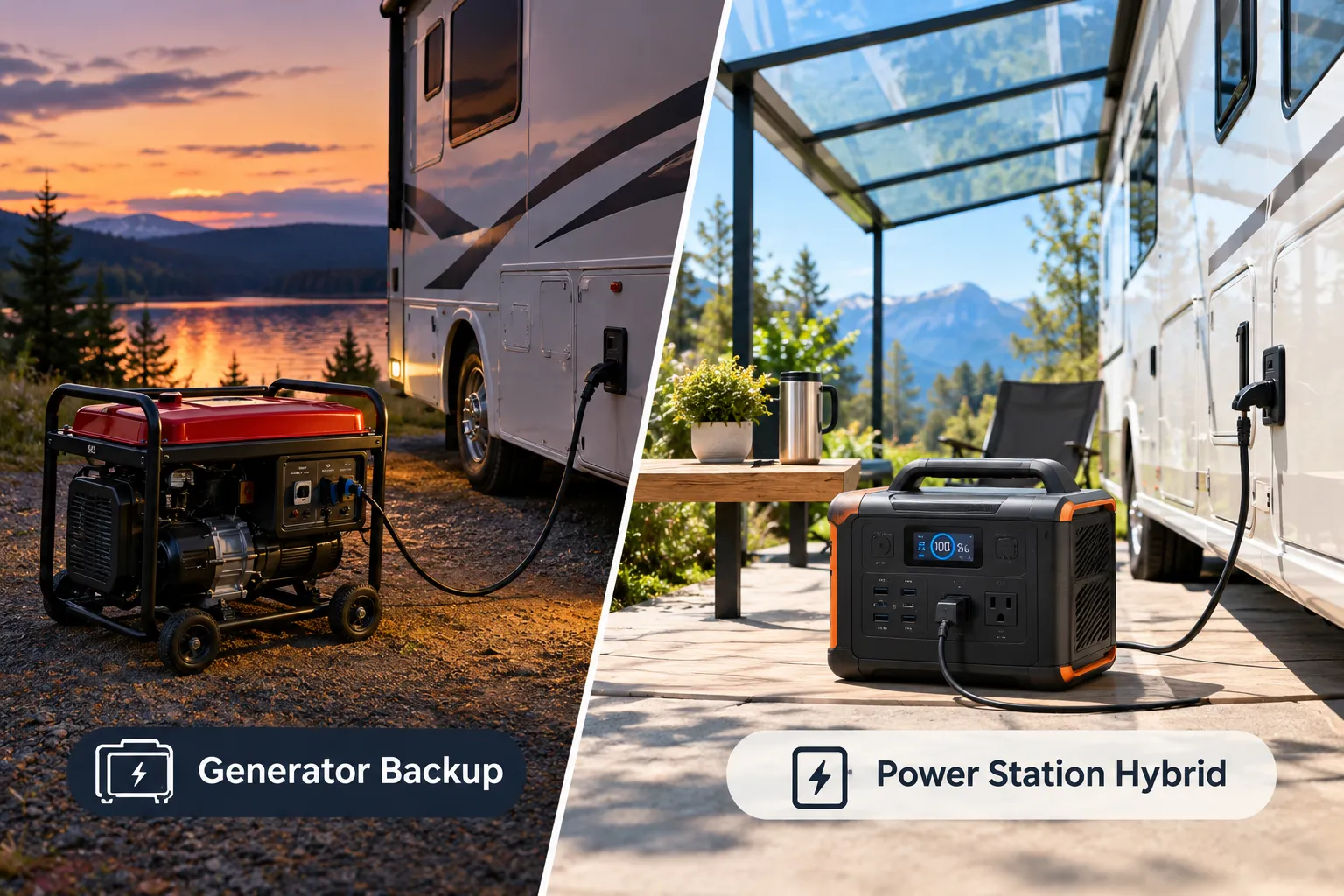
Traditional gas generators are no longer the default backup. Instead, boondockers are increasingly pairing solar with portable power stations that recharge from solar, a generator, or shore power interchangeably, a “hybrid” approach that reduces generator runtime to emergency use only [5]. This shift is driven by noise restrictions at many public lands campsites, fuel availability concerns, and the falling cost of large lithium power stations.
A practical hybrid backup strategy looks like this:
- Primary power: Solar array sized to daily Wh needs with 2-3 days of battery autonomy.
- Secondary buffer: A portable power station (1,000-3,000 Wh capacity) for high-draw appliances or cloudy-day gaps.
- Emergency backup: A small inverter generator (2,000-3,500 watts) used only when the battery bank drops below a set threshold, such as 20 percent state of charge [5].
This layered approach avoids running a generator daily while still providing a reliable fallback for extended stays. For those weighing which rig style suits this kind of power setup best, best RVs for boondocking breaks down chassis and layout options that accommodate larger battery banks and solar arrays [8].
It is also worth avoiding common pitfalls that sabotage otherwise well-sized systems. The article on RV mistakes that cost you thousands covers electrical and battery errors that can shorten the life of an expensive lithium bank long before its rated cycle count is reached.
Example Setups: Weekend Camper vs. Full-Time Boondocker
To ground the math, here are two sample builds reflecting real consumption patterns rather than marketing bundles.
Weekend Camper Example
- Appliances: LED lights, water pump, phone and laptop charging, occasional 12V fridge
- Daily Wh estimate: 500 Wh
- Battery bank: 100Ah lithium (1,200 Wh usable)
- Solar: 200 watts
- Inverter: 1,000-1,500 watts
- Backup: Small 500-1,000 Wh power station
Full-Time Boondocker Example
- Appliances: Residential-style fridge, induction cooktop, laptop, CPAP, Starlink, occasional AC use
- Daily Wh estimate: 2,800 Wh
- Battery bank: 400Ah lithium (minimum, sized for 2 days autonomy)
- Solar: 1,000-1,200 watts
- Inverter: 3,000 watts pure sine wave
- Backup: 2,000-3,000 Wh portable power station plus a 2,000-3,500 watt inverter generator for emergencies
These numbers align with current calculator outputs and real-world system reports from 2026 [4][6][7]. Note how the full-time setup more than quadruples the weekend setup’s solar wattage, a direct result of appliance choices, not brand preference.
Cost and Seasonal Considerations for 2026 Boondocking Solar
Component costs have continued to shift through 2026, with lithium battery prices falling while high-output flexible panels remain a premium option. Budget-conscious boondockers often start with rigid panels and a mid-size lithium bank, then expand wattage later as needs grow [3].
Seasonal and location effects also matter more than most buyers expect. “Real PSH”, the actual usable peak sun hours after accounting for tree cover, cloud cover, and seasonal sun angle, can run 20 to 40 percent lower than nameplate averages for a region, especially in fall and winter months [7]. Boondockers heading to cooler destinations should size generously. The guide to top cold weather RVing destinations is a useful companion resource for understanding how shorter daylight hours affect both heating loads and solar recovery time.
Conclusion
Sizing a solar system around appliance math instead of marketing claims is the single biggest factor separating a boondocking setup that works from one that leaves you running to the nearest RV park for a recharge. Start by logging actual daily watt-hour use, size the battery bank for 2 to 3 days of autonomy using lithium chemistry, match solar wattage to real peak sun hours with a loss buffer, size the inverter to your highest simultaneous AC load, and layer in a hybrid backup rather than relying on a generator alone.
Next steps: track your actual appliance usage for one full day before buying anything, use that number to run the Wh-to-wattage formula above, and build your battery bank first, it is the foundation everything else depends on. For further reading on getting the most from your rig’s existing systems, check out cheap and easy RV hacks for low-cost efficiency wins that reduce your daily power draw before you even add a single watt of solar.
References
- Complete Rv Solar Setup. offgridbenchmark.com.
- Boondocking Solar Battery Sizing. generatorchecker.com.
- Rv Solar Panels Batteries Inverters 2026. pickrv.com.
- Off Grid Rv Solar Calculator. camperupgrade.com.
- Best Portable Power Station Setup Full Time Rv Boondocking. ankersolix.com.
- Rv Boondocking Solar System Guide. sungoldsolar.com.
- Rv Solar Panel Size Calculator. sungoldsolar.com.
- Best Rvs for Boondocking. rvivy.com.
rv solar panels, boondocking, battery capacity, lithium batteries, daily watt-hours, inverter sizing, generator backup, off-grid RV power, solar panel sizing, portable power station, RV electrical systems, peak sun hours


