Last Updated on October 22, 2026
Nearly half of all micromobility deaths tracked between 2017 and 2022 involved e-scooters, even though they made up a smaller share of total devices on the road [1]. That single statistic should stop any urban commuter from treating “scooter or bike” as a coin-flip decision. The choice carries real financial and physical consequences, and the right answer depends heavily on your commute, your city streets, and how much risk you are willing to accept.
This guide breaks down Electric E-Scooters vs E-Bikes for Urban Riders: Cost, Safety, and Where Each Makes More Sense using current pricing data, injury statistics, and real-world commuting scenarios, from campus trips to grocery runs to weekend RV park excursions.
Key Takeaways
- E-scooters typically cost less upfront and fold for easy storage, making them ideal for trips under 3 to 5 miles [2][3].
- E-bikes offer longer range (30 to 60 miles versus 10 to 30 miles for scooters) and better stability on rough roads [3].
- Injury data shows e-scooters account for a disproportionate share of emergency room visits and head injuries compared to e-bikes [1][4].
- A representative commuter e-bike runs about $3,395 over five years, or roughly $0.28 per mile with regular use [5].
- Cities are tightening e-scooter rules while expanding protected lanes that benefit both vehicle types [6].
Upfront Cost and Ownership Expenses Compared
The purchase price gap between these two vehicle types is real, but it narrows once you factor in total cost of ownership. Entry-level urban e-scooters often sell for hundreds of dollars less than comparable e-bikes, giving budget-conscious riders an easy entry point [5][7].
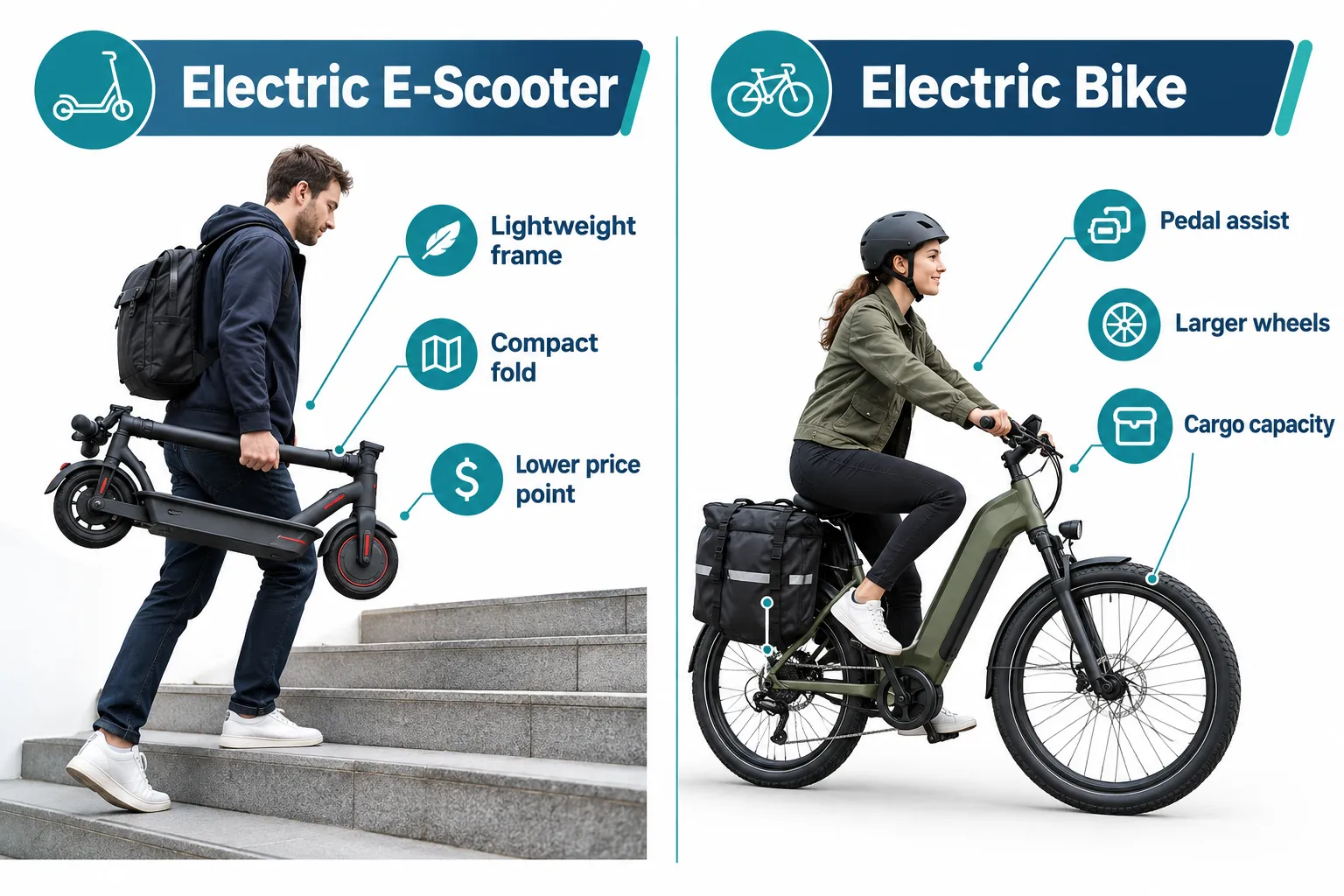
E-bikes ask for a bigger check at checkout, but they can pay that back over time. One 2026 cost analysis estimates a representative commuter e-bike costs about $3,395 across five years once you include the purchase price, basic maintenance, charging, and accessories, roughly $680 per year or $0.28 per mile with regular use [5]. That math improves further for riders who use the e-bike to replace car trips or transit passes [5][7].
E-scooters, meanwhile, often carry hidden costs tied to shorter component lifespans. Small wheels and lighter frames wear faster under daily urban abuse, and battery packs on budget scooters frequently need replacing sooner than e-bike batteries [5][7]. If you are weighing a bigger investment in a bicycle-class vehicle, our Electric Bike Buying Guide covering classes, range, battery life, safety, and total cost in 2026 breaks down exactly where that money goes.
| Factor | E-Scooter | E-Bike |
|---|---|---|
| Typical upfront price | Lower | Higher |
| Component lifespan | Shorter | Longer |
| Range per charge | 10-30 miles | 30-60 miles |
| Best for | Short hops | Daily commuting |
Safety Data: Why Injury Patterns Differ So Much
The safety gap between these two vehicle types is not a matter of opinion, it shows up consistently across national datasets. A US injury analysis covering 2017 to 2022 found about 360,800 emergency room visits tied to e-bikes, e-scooters, and hoverboards combined. Of those, roughly 169,300 (about 47 percent) involved e-scooters, while only about 53,200 (about 15 percent) involved e-bikes [1]. Among 233 micromobility-related deaths in that same window, nearly half, about 111, involved e-scooters, usually from collisions with motor vehicles or sudden loss of control at speed [1].
More recent UK figures reinforce the trend rather than reversing it. In 2025, there were 1,377 collisions involving e-scooters, up from 1,312 the year before, resulting in 1,477 casualties, 10 deaths (all riders), and more than 480 estimated serious injuries after adjusting for reporting changes.
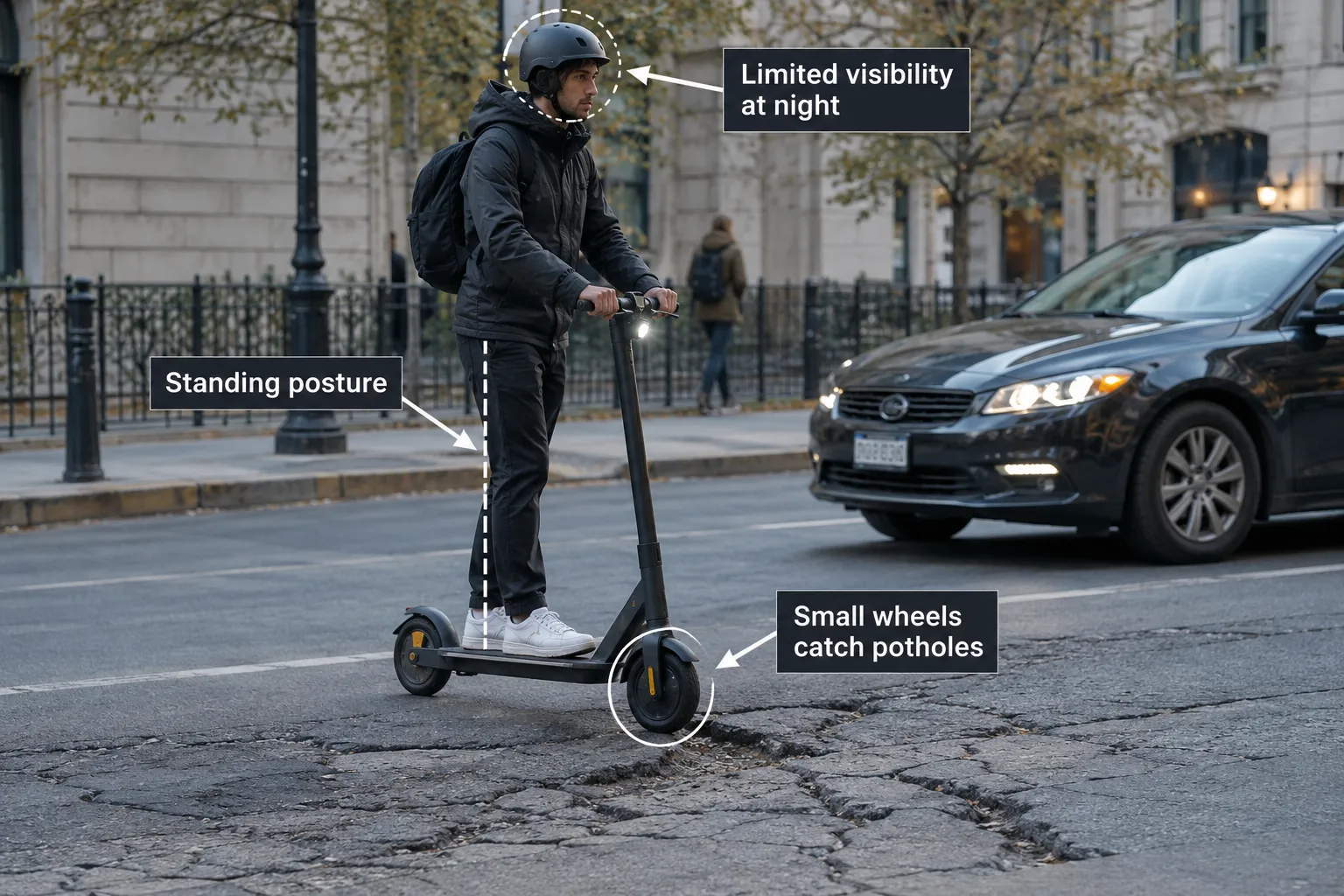
What kind of injuries show up most often? Head injuries, including traumatic brain injury, make up roughly 28 to 40 percent of e-scooter injuries requiring treatment, with fractures to the lower arm and wrist accounting for another 25 to 31 percent [4]. Collisions between e-scooters and motor vehicles account for 8 to 19 percent of e-scooter casualties, a slightly higher share than comparable bicycle crashes [4].
“Larger wheels, a seated posture, and bicycle-like handling make e-bikes more forgiving in wet conditions and at higher commuting speeds, whereas scooters are better reserved for smooth pavements at moderate speeds.”, synthesis of 2026 micromobility safety analyses [8][9]
Public perception lines up with the hard numbers. A 2025 Irish national survey found e-scooters were viewed as the most dangerous transport mode among adults, rated riskier than motorcycles, and reported that about 24 percent of regular e-scooter users had already been in a collision, while 32 percent had a near-miss [10]. Polish road-safety monitoring recorded more than 1,500 e-scooter-user injuries and 11 fatalities in a single recent year.
If you ride any two-wheeled vehicle regularly, protective gear matters regardless of which mode you choose. For riders who also spend time on motorcycles, it is worth reviewing smart AR motorcycle helmets and safety tech explained for 2026, since crash-detection features are increasingly relevant across micromobility categories too.
Legal Regulations and Where Infrastructure Is Headed
Rules governing e-scooters and e-bikes vary by city, but the broad direction for 2026 is consistent: cities are tightening scooter restrictions while expanding protected infrastructure that benefits both vehicle types [6]. Expect to see stricter enforcement of speed limits, sidewalk riding bans for scooters, and growing helmet encouragement or outright mandates [6].
Protected micromobility lanes, speed management zones, and clearer legal classification for e-scooters and e-bikes are being cited repeatedly in international road-safety briefs as the most effective levers for reducing casualties [6]. That infrastructure push matters practically: e-bikes benefit more immediately because their size and speed profile fit more naturally into expanded bike lane networks, while scooters still face patchwork rules on where they can legally operate [3][8].
Range, Speed, and Everyday Practicality for Urban Riders
Range comparisons make the practical gap obvious. Typical commuter e-bikes cover 30 to 60 miles per charge with pedal assist, and some models reach close to 70 miles. Mainstream e-scooters cover around 10 to 30 miles and become heavy and awkward to push once the battery dies [3].
Top speeds often land in a similar legal band, roughly 15 to 20 mph for many city-legal models of both types, but the riding experience differs sharply. Bigger bicycle wheels and a seated position make e-bikes feel noticeably more stable and controllable at urban speeds, especially over potholes, tram tracks, and rough pavement [3][8][9]. Scooters demand better balance from the rider and are far more sensitive to surface defects, a real concern on older city streets.
Electric E-Scooters vs E-Bikes for Urban Riders: Matching the Vehicle to the Trip
This is where Electric E-Scooters vs E-Bikes for Urban Riders: Cost, Safety, and Where Each Makes More Sense really comes down to specifics rather than general preference. Different trip types call for different tools.
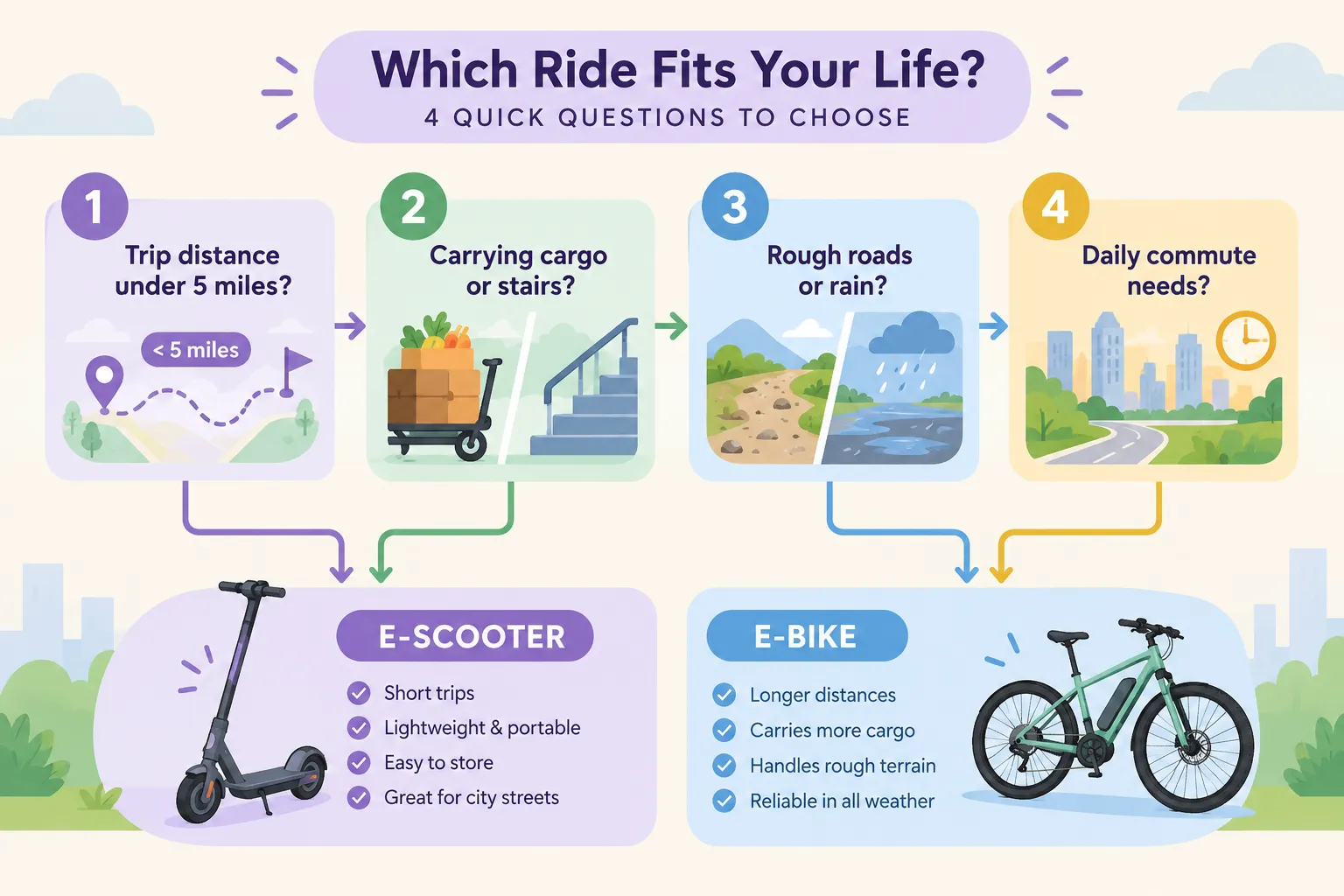
Choose an e-scooter when:
- Your trip is roughly 3 to 5 miles or shorter [2][3][7]
- You need to fold it and carry it up stairs or onto a train [2][7]
- You live in a small apartment with limited storage [3][7]
- Your route is mostly smooth, dense inner-city pavement [8][9]
Choose an e-bike when:
- Your daily commute exceeds 5 miles or includes mixed terrain [3][8]
- You need to carry groceries, a laptop bag, or gear [3][8]
- You ride in rain, wind, or variable weather [8][9]
- You want to keep moving under pedal power even if the battery runs low [3]
Campus Travel and Short-Hop Commuting
College campuses are almost a textbook case for e-scooters. Distances between buildings are short, storage space in dorms is tight, and folding frames slide easily into a closet or under a desk [2][7]. Students juggling multiple short trips a day often find the lower price point and portability outweigh the shorter range.
Daily Urban Commuting and Mixed-Surface Routes
For riders commuting five, eight, or ten miles each way, the math flips. E-bikes carry you farther, handle potholed streets with more composure, and let you arrive without being drenched or exhausted, since pedal assist does the heavy lifting [3][8]. If you are also weighing whether a two-wheeled electric vehicle makes more financial sense than driving, our Electric Bike Buying Guide on classes, range, battery life, safety, and total cost in 2026 walks through the comparison against car ownership costs.
RV Trip Excursions and Weekend Getaways
Here is an angle many commuting guides skip: RV travelers increasingly pack folding e-scooters for campground runs to the shower house or camp store, since scooters tuck into tight storage bays that larger bikes cannot fit [2][7]. E-bikes, on the other hand, make more sense for RVers who want to explore surrounding trails or towns several miles from the campsite, thanks to their range and stability on gravel or unpaved roads. If your RV setup also depends on reliable onboard power for charging these devices, it is worth checking our guide to RV electrical system problems and troubleshooting before a long trip.
Garage Storage and Home Charging Setup
Wherever you keep either vehicle, charging and storage safety deserve attention. Lithium battery packs need ventilated, dry storage away from flammable materials, whether that is a garage, a hallway closet, or an RV bay. Families setting up a dedicated charging and storage space at home may find our garage workshop safety ideas for families useful for keeping batteries and chargers away from kids and clutter.
Cost Per Mile: Which Vehicle Wins Over Time
Breaking total ownership cost down to a per-mile basis helps cut through marketing claims. The e-bike example above lands around $0.28 per mile over five years of regular use once purchase price, maintenance, charging, and accessories are factored in [5]. E-scooters often start cheaper per mile in year one simply because the purchase price is lower, but that advantage can shrink or disappear if components wear out faster and need earlier replacement [5][7].
The practical takeaway: a rider who uses a scooter occasionally for short hops will likely see lower lifetime cost than someone commuting daily. A rider using either vehicle for a regular five-mile commute, five days a week, should run the numbers on both options rather than assuming the cheaper sticker price wins long-term.
Conclusion
The decision between these two micromobility options is not about which vehicle is objectively “better”, it is about matching the tool to the trip. E-scooters win on affordability, portability, and short hops under five miles, especially for campus travel, last-mile transit connections, and compact RV storage. E-bikes win on safety margin, range, weather resilience, and cargo capacity, making them the stronger choice for daily commuting and mixed-terrain routes.
Given the injury data showing e-scooters involved in a disproportionate share of emergency room visits and fatalities [1][4], safety-conscious commuters with longer or rougher routes should lean toward an e-bike. Riders with short, predictable urban hops and tight storage constraints can reasonably choose an e-scooter, provided they wear a helmet and stay off poorly maintained pavement.
Next steps: map your actual daily trip distances before buying either vehicle, check your city’s current micromobility regulations, and if you are leaning toward an e-bike, review a detailed buying guide covering classes, range, battery life, and total cost before making a purchase.
References
- USA Today. usatoday.com.
- Electric Scooter vs. Ebike Which Is Better for Commuting. zwheel.com.
- E Bike vs. Electric Scooter for Commuting the Honest Comparison. aventon.com.
- 20250214 Presentation – E-scooter Safety ECHS Sandt. connect.ncdot.gov.
- Are Electric Bikes Worth IT. electricbikesparadise.com.
- Road Safety on Two Wheels. bmv.de.
- Best Ebike Scooter Deals. cnet.com.
- Ebike vs. Electric Scooter Which Is Better for Commuting Safety. himiwaybike.com.
- E Bike vs. Electric Scooter Safety. isinwheel.com.
- New Research Highlights Current E Scooter Usage and Safety Concerns. rsa.ie.