
Last Updated on September 28, 2026
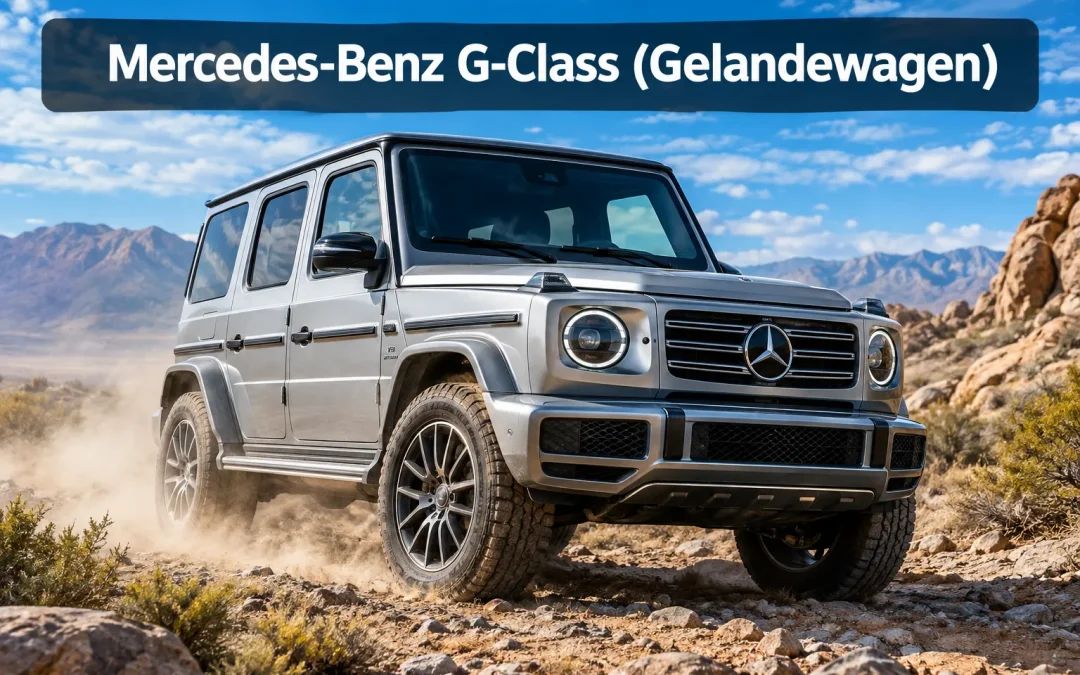
A brand-new Mercedes-Benz G-Class routinely sells for tens of thousands over sticker, yet the vehicle underneath the badge still rides on a ladder-frame chassis engineered in the 1970s for military use. That contradiction, a battlefield-bred truck reborn as a six-figure status symbol, is the single most important thing to understand before you sign a check. This Mercedes-Benz G-Class (Gelandewagen) Buying Guide: New vs Used, Off-Road Capability, and True Ownership Costs breaks down what you are actually paying for, what it costs to keep, and whether the badge premium survives contact with a service invoice.
Key Takeaways
- New G-Class supply remains tight through 2025-2026, pushing many transaction prices above MSRP, especially on AMG G63 variants [1][9].
- Used G-Class values have stayed unusually high because demand consistently outpaces the limited number of vehicles Mercedes builds each year [1][10].
- Five-year ownership costs on a baseline G-Class run well into six figures once depreciation, insurance, fuel, and maintenance are combined [2][3].
- The G-Class keeps genuine off-road hardware, three locking differentials and low-range gearing, that most rivals dropped years ago [7][10].
- Military-derived Timber Wolf and Silver Wolf variants confirm the platform’s rugged engineering pedigree beyond the luxury dealership floor [5].
Why the G-Class Still Commands a Waiting List
Mercedes has kept the G-Class in continuous production since 1979, and the current W463-generation body has changed remarkably little in silhouette since its 2018 redesign. What has changed is demand. Reports through 2025 and into 2026 describe dealer allocations that sell out before vehicles physically land in showrooms, with certain AMG G63 configurations commanding markups well past the window sticker [1]. That scarcity is not an accident of supply chains alone; Mercedes intentionally limits G-Class production volume to protect the model’s exclusivity, and that strategy has worked almost too well for buyers hoping to pay list price.
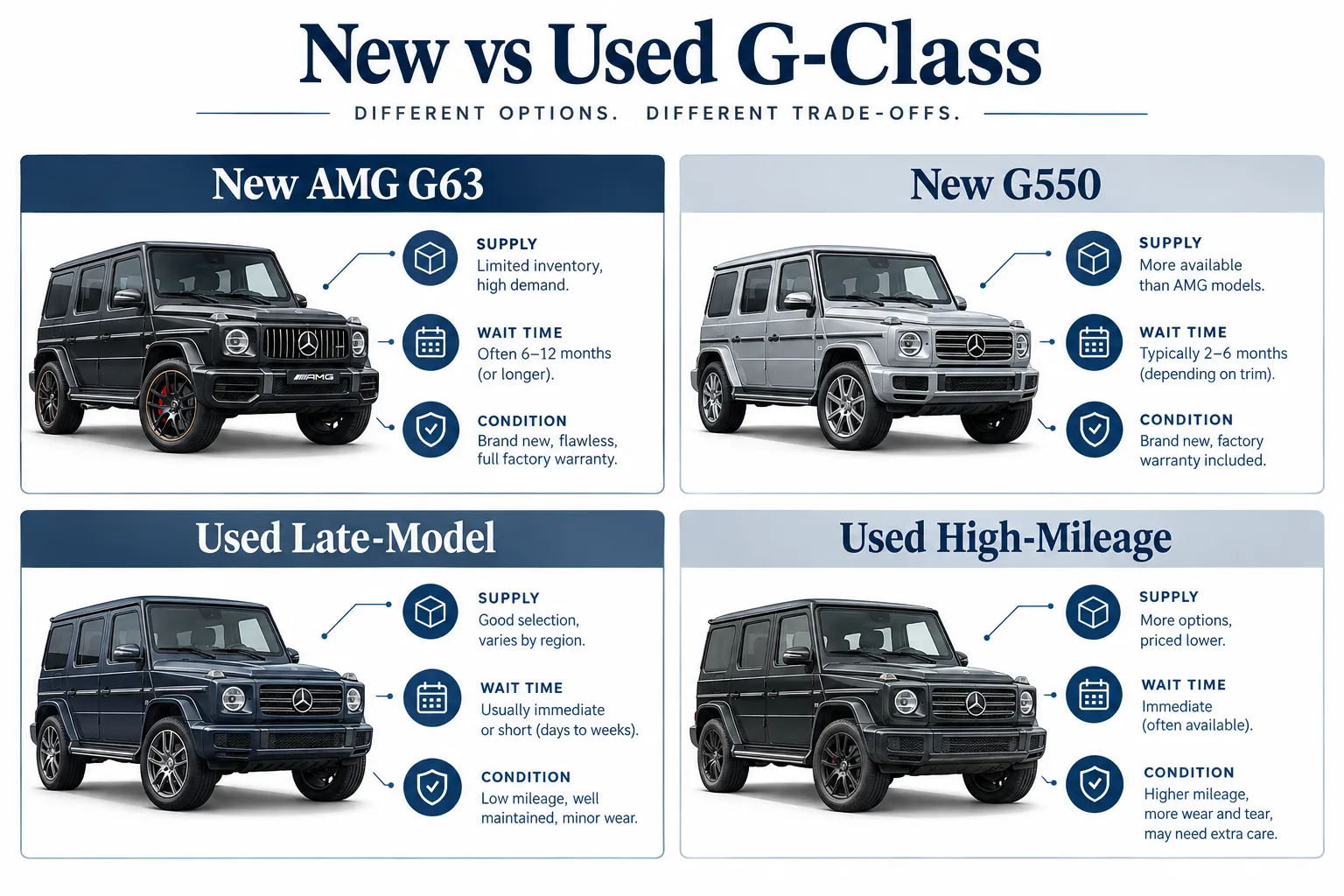
The lineup for 2025 and 2026 centers on the G550 as the “base” luxury off-roader and the AMG G63 as the performance flagship, with electrified hybrid assistance now standard across most trims and a fully electric G580 sold alongside the combustion range [6][9]. Pricing for the new AMG G63 has continued climbing into the 2026 and projected 2027 model years, reinforcing a pattern where each redesign cycle pushes the top-end G further from mainstream luxury SUV territory and closer to bespoke, low-volume exotic pricing [9].
Mercedes-Benz G-Class (Gelandewagen) Buying Guide: New vs Used, Pricing Reality
Anyone building a realistic budget needs to separate the sticker price from the transaction price. Kelley Blue Book’s Fair Purchase Price data consistently shows G-Class buyers paying close to, at, or above MSRP, with negotiation room far thinner than on nearly any other Mercedes-Benz product [3][6]. That is the opposite of typical luxury SUV shopping, where incentives and dealer discounts are standard.
Used pricing follows the same logic. Because Mercedes restricts annual output, the used market never gets flooded with excess inventory, so three- and four-year-old G-Class trucks often retain a startling percentage of their original value. Cargurus’ ownership research on the model notes that this scarcity-driven resale strength is one of the defining traits separating the G-Class from other body-on-frame luxury SUVs, most of which depreciate on a far steeper curve [10].
For a side-by-side sense of how new and used pricing typically compare:
| Factor | New G-Class | Used G-Class (3-5 years old) |
|---|---|---|
| Transaction price vs. MSRP | Often at or above sticker [3] | Frequently near original MSRP due to strong resale [10] |
| Wait time | Allocation-limited, can span months [1] | Available faster, but inventory is thin |
| Warranty coverage | Full factory warranty | Limited or expired; extended coverage recommended |
| Modification risk | None | Higher, check for aftermarket widebody kits |
| Negotiation leverage | Minimal [6] | Moderate, depending on mileage and condition |
If you are cross-shopping the G-Class against other used luxury or performance vehicles to understand how depreciation curves differ by brand, the Mazda Used Cars 2026 pricing and reliability breakdown offers a useful contrast in how mainstream models lose value versus a scarcity-driven icon like the G-Wagen. And before making any offer, cross-check the number against a trusted valuation reference like a Blue Book car value guide rather than relying solely on a dealer’s quoted figure.
Off-Road Capability: What Sets the G-Class Apart
Strip away the quilted leather and the G-Class is still, mechanically, a serious off-roader. It retains a rigid ladder-frame chassis, a low-range transfer case, and three driver-selectable locking differentials, front, center, and rear, a combination almost no other luxury SUV on sale still offers [7][10]. Independent road tests through 2025 consistently highlight this trait: reviewers note that despite the cabin’s Range Rover-grade luxury, the G-Class drives and behaves like a genuine expedition vehicle the moment those lockers engage [7].
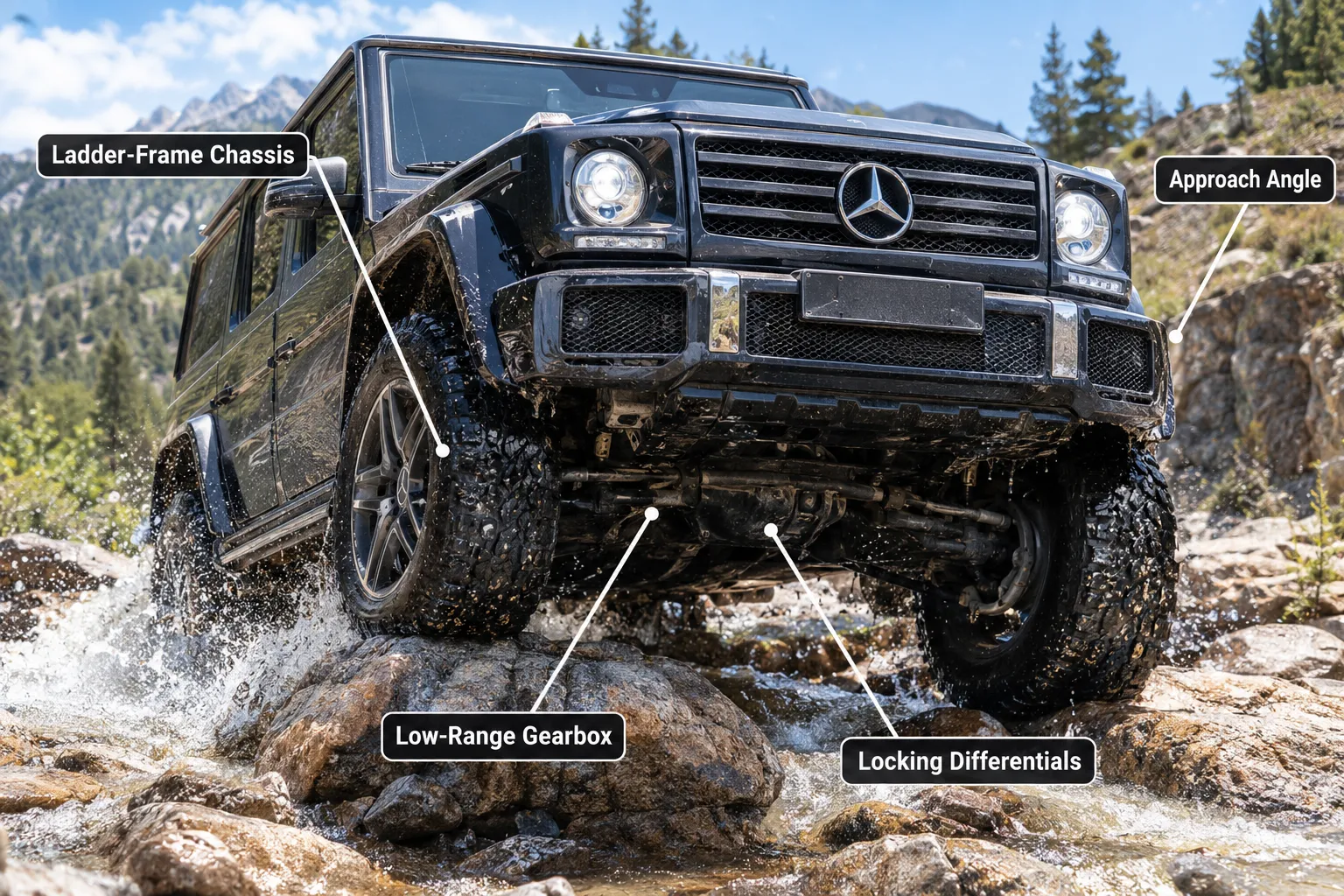
That mechanical seriousness comes with tradeoffs. Expert reviews describe a driving character that stays noticeably truck-like on pavement, a tall center of gravity, firm low-speed ride, and steering that feels deliberate rather than sporty, even in AMG form [7]. This is the core tension buyers must accept: the G-Class was never designed primarily as a comfortable daily cruiser, and its on-road manners are the price paid for genuine trail capability.
That capability is not marketing fluff. Rheinmetall’s Timber Wolf and Silver Wolf tactical vehicles are built on the W464 G-Class platform specifically because military planners wanted its proven off-road durability, armor compatibility, and drivetrain robustness for defense applications [5]. When a chassis is trusted for battlefield logistics vehicles, that says more about its structural pedigree than any showroom brochure could.
For buyers who plan to actually use that capability rather than just admire it in a driveway, it is worth comparing notes with owners who push vehicles hard over rough routes. The mindset guide in 24 RV road trip preparation ideas covers pre-trip vehicle checks that translate directly to serious off-pavement G-Class use.
True Ownership Costs: Maintenance, Insurance, and Depreciation
This is where the G-Class mythology meets spreadsheet reality, and the numbers are sobering.
Edmunds’ Cost to Own analysis for the G-Class projects total five-year ownership costs that stack depreciation, financing, insurance, fuel, maintenance, repairs, and taxes into a figure that runs well into six figures for a baseline model, even before options [2]. Kelley Blue Book’s parallel 2025 cost-to-own data for both the standard G-Class and the AMG G-Class confirms that maintenance and repair costs sit meaningfully above the luxury SUV average, driven partly by the vehicle’s complex four-wheel-drive hardware and partly by Mercedes’ premium parts and labor rates [3][4].
“The G-Class is not just an expensive vehicle to buy, it is an expensive vehicle to keep, with insurance and maintenance costs that scale sharply once you step into AMG performance trims.”
Break the true cost of ownership into its major components:
- Depreciation: Softer than most luxury SUVs thanks to limited production, but still the single largest cost bucket over five years [2][10].
- Insurance: AMG G63 variants carry noticeably higher premiums than the G550 due to higher replacement cost and performance risk profile [4].
- Maintenance and repairs: Complex four-wheel-drive systems, locking differentials, and low production volume combine to keep parts and labor costs above the segment average [3][4].
- Fuel: Both G550 and AMG G63 return well below average fuel economy for their size class, adding meaningfully to annual running costs.
- Financing: High transaction prices mean larger loan balances and higher total interest paid over a typical loan term.
Owners planning to handle basic maintenance items themselves to offset dealer labor rates should understand where parts sourcing makes sense. The comparison in RockAuto vs AutoZone vs O’Reilly Auto Parts for DIY mechanics is written for RV and truck owners but applies directly to G-Class owners looking to save on routine wear items like filters, fluids, and brake components rather than paying full dealer rates for everything.
Military Roots and Special Derivatives: The Timber Wolf Connection
The G-Class’s civilian success sometimes obscures how much of its DNA still traces back to defense applications. Rheinmetall’s newly unveiled Timber Wolf and Silver Wolf vehicles use the W464 G-Class chassis as their foundation, adapted with reinforced protection and mission-specific equipment for military logistics and reconnaissance roles [5]. This is not a marketing tie-in; it reflects a genuine engineering relationship between Mercedes-Benz’s commercial-vehicle heritage and modern tactical vehicle programs.
For buyers weighing whether the G-Class’s off-road reputation is earned or inflated, this military validation matters. A platform selected by defense contractors for durability under extreme stress is, by definition, over-engineered relative to typical suburban use, which explains both its trail capability and its higher-than-average repair costs when something inside that robust hardware does eventually need attention.
Used G-Class Buying Guide: What to Check Before You Sign
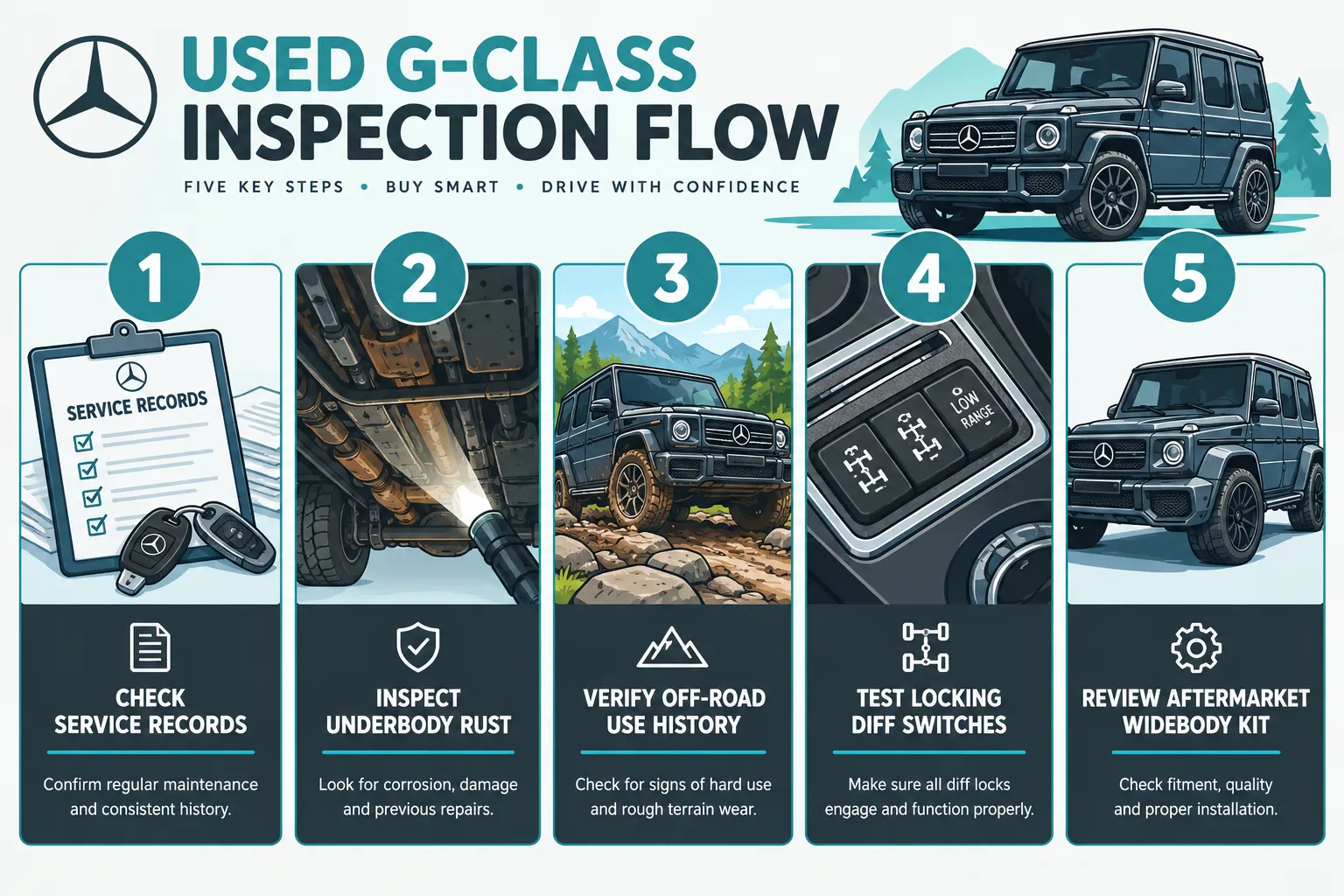
Buying used shifts the risk profile in ways new-car shoppers do not face. Cargurus’ dedicated G-Class buying guide flags several recurring issues that used-vehicle shoppers should investigate before committing [10]:
- Service history completeness. Because maintenance is expensive, gaps in the service record often mean deferred work that will surface later.
- Underbody and frame condition. Ladder-frame vehicles used off-road can hide rust or impact damage that a surface-level inspection misses.
- Evidence of genuine off-road use versus garage-queen status. Both extremes carry risk, one from wear, the other from long dormancy issues like seal deterioration.
- Locking differential function. Test all three lockers; repairs to this system are specialized and costly.
- Aftermarket widebody kits and modifications. A booming aftermarket scene offers dramatic widebody conversions and lift kits, but modified trucks can complicate warranty claims, insurance valuations, and resale, since buyers cannot always verify what mechanical changes accompanied the cosmetic ones [10].
That last point deserves extra weight. A heavily modified G-Class might look more aggressive in photos, but it introduces uncertainty about suspension geometry changes, tire clearance issues, and whether the modification shop did quality work. Unless you can verify the installer and inspect the work firsthand, a stock or lightly modified example is the safer used purchase.
Buyers who want a broader framework for evaluating any high-mileage performance or luxury vehicle before purchase may also find value in how many miles you can realistically put on a classic-style car, since the same durability logic, mileage versus maintenance quality, applies directly to a used G-Class evaluation. Collectors specifically interested in the G-Class as a long-term hold rather than a daily driver might also enjoy the perspective in profiles of famous classic car collectors, many of whom prize exactly this kind of scarcity-driven, mechanically distinctive vehicle.
Electrification and the “Baby G-Class”: What Is Coming
Mercedes has already brought a fully electric G580 to market, running alongside the combustion G550 and AMG G63 [6][9]. Reporting through 2025 and 2026 also points toward a smaller, more affordable “baby G-Class” positioned to extend the nameplate’s boxy design language to a lower price point, alongside continued electrification of the broader lineup [1][8]. None of this is officially finalized in every detail, and specifics remain speculative in parts of the coverage, but the direction is consistent: Mercedes intends to keep expanding G-Class variants both up and down the price ladder while leaning further into electrified powertrains.
The G-Class has also found itself in unusual public-relations spotlights recently, from reported drone-defense testing applications to high-profile celebrity ownership of electric G-Class models, both of which keep the nameplate firmly in cultural conversation well beyond typical automotive coverage [1][8]. That visibility is part of why resale values stay firm; the G-Class benefits from a level of brand recognition that few other off-road-capable SUVs can match.
If you are weighing a G-Class purchase against other 2026 model-year options across categories and budgets, the broader context in Best Cars to Buy in 2026: Complete Buyer’s Guide by Budget and Category is a useful reference point for understanding where the G-Class sits relative to other premium SUV choices this year.
Conclusion
The G-Class rewards buyers who understand exactly what they are signing up for: a vehicle with real, military-validated off-road hardware wrapped in a body that has become a global status symbol, priced accordingly on both the new and used market. This Mercedes-Benz G-Class (Gelandewagen) Buying Guide: New vs Used, Off-Road Capability, and True Ownership Costs comes down to a few practical next steps. First, decide whether you need the G-Class’s locking-differential off-road capability or simply want its image, that answer should drive your trim choice more than anything else. Second, budget for the full five-year cost of ownership, not just the purchase price, since insurance, maintenance, and fuel add up quickly on this platform. Third, if buying used, insist on complete service records and a professional inspection before touching a modified example. Do that homework, and the G-Class can be a genuinely satisfying long-term ownership experience rather than an expensive lesson in badge-driven impulse buying.
References
[1] Mercedes G Class – https://www.carscoops.com/tag/mercedes-g-class/ [2] Cost To Own – https://www.edmunds.com/mercedes-benz/g-class/2024/cost-to-own/ [3] Cost To Own – https://www.kbb.com/mercedes-benz/g-class/2025/cost-to-own/ [4] Cost To Own – https://www.kbb.com/mercedes-benz/mercedes-amg-g-class/2025/cost-to-own/ [5] Mercedes G Class Gets A Military Makeover In Rheinmetalls New Timber Wolf And Silver Wolf 22648 – https://united24media.com/world/mercedes-g-class-gets-a-military-makeover-in-rheinmetalls-new-timber-wolf-and-silver-wolf-22648 [6] kbb – https://www.kbb.com/mercedes-benz/g-class/2025/ [7] 2025 Mercedes Benz G Class Road Test And Review – https://www.autoweb.com/2025-mercedes-benz-g-class-road-test-and-review [8] News – https://auto.hindustantimes.com/new-cars/mercedesbenz/gclass/news [9] Amg G 63 – https://www.edmunds.com/mercedes-benz/g-class/2026/amg-g-63/ [10] Mercedes Benz G Class Buying Guide – https://www.cargurus.com/research/articles/mercedes-benz-g-class-buying-guide