Last Updated on September 25, 2026
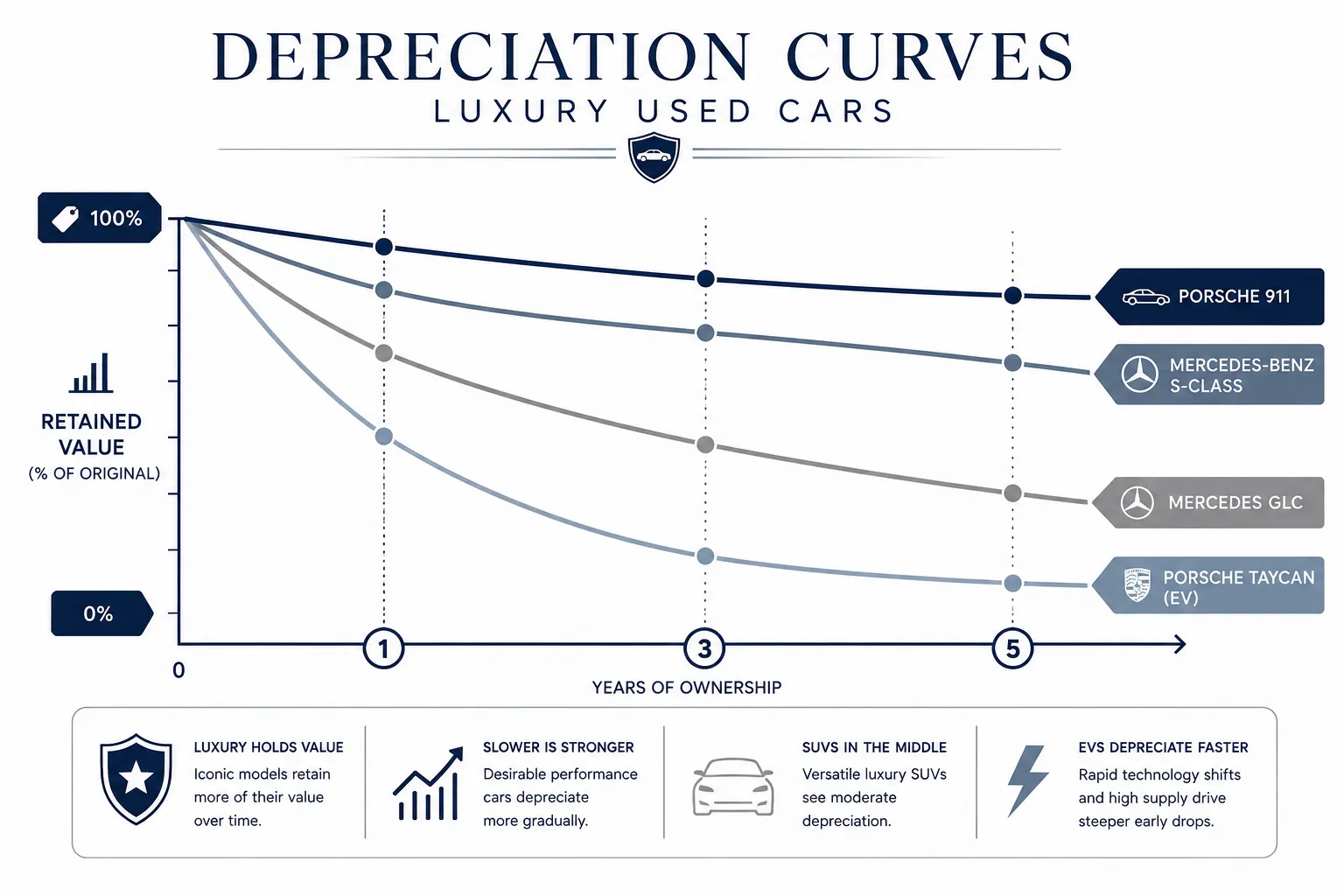
A used Porsche 911 can lose less value in five years than a new Mercedes-Benz GLC loses in three. That single fact explains why shopping for Porsche and Mercedes-Benz used cars in 2026 requires a completely different mindset than shopping for a mainstream sedan. These two German brands sit at the top of the luxury pyramid, yet their ownership math could not be more different depending on the model you choose.
This guide breaks down exactly how Porsche and Mercedes-Benz depreciate, what real maintenance bills look like once the factory warranty expires, and which specific models let you enjoy the badge without the financial hangover.
Key Takeaways
- The Porsche 911 is the strongest resale performer in the luxury segment, while the Porsche Taycan depreciates far faster because it is an EV competing against rapidly improving newer electric models.[1][3]
- Mercedes-Benz vehicles lose roughly 46% of their value over five years on average, with 2023 model-year cars currently sitting in the “sweet spot” for buyers.[5]
- The Mercedes-Benz S-Class holds its percentage value better than most Mercedes models, but the dollar loss is enormous because the starting price is so high.[2][9]
- The Mercedes-Benz GLC, the brand’s best-selling SUV, depreciates close to 48% over five years, making it a strong buy once it clears the steepest drop-off years.[7]
- Maintenance costs on both brands rise sharply after the factory warranty ends, but naturally aspirated engines and simpler trims tend to cost far less than turbocharged, air-suspension, or high-tech infotainment variants.
Understanding Depreciation Curves: Porsche and Mercedes-Benz Used Cars in 2026
Depreciation is the single biggest hidden cost of luxury car ownership, and it is not the same across every model. Buying Porsche and Mercedes-Benz used cars in 2026 means understanding two very different depreciation stories happening under one shared “German luxury” umbrella.
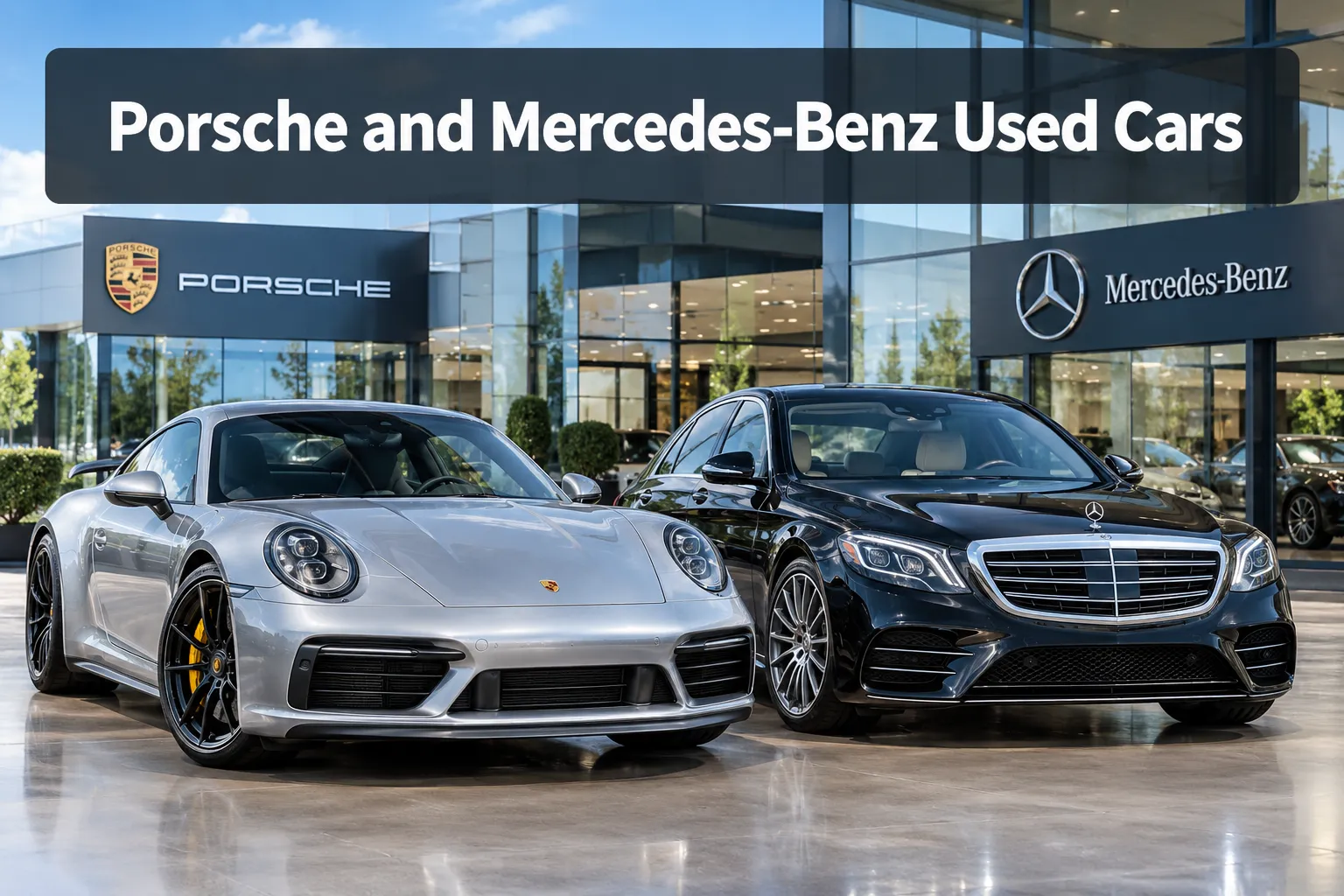
Porsche, as a brand, is famous for defying the normal rules of car finance. Industry resale-value rankings consistently place Porsche near the top of the luxury sports car category, largely on the strength of the 911.[1][6] Buyers treat the 911 almost like a collectible asset rather than a depreciating appliance, and that demand keeps used prices firm even at higher mileage.
Mercedes-Benz tells a more typical luxury-brand story. Across the lineup, Mercedes vehicles lose an average of about 46% of their original value after five years, and analysts currently point to 2023 model-year cars as the best value window for used buyers because the steepest early drop has already happened but the car is still relatively current.[5]
The General Depreciation Timeline for Luxury Cars
Both brands roughly follow this broader luxury-car curve, though Porsche’s strongest models soften the early drop:
| Ownership Stage | Typical Value Loss |
|---|---|
| Year 1 | 20% to 30% |
| Years 2 through 5 | 15% to 20% per year |
| After Year 5 | Stabilizes near 10% annually |
This pattern is well documented across the luxury segment.[7] The practical takeaway: the freshest used cars lose value the fastest, while a five- or six-year-old luxury car has already absorbed most of its depreciation shock and tends to hold steadier from that point forward.
Model-by-Model: Where the Spread Really Shows
Not every Porsche or Mercedes model depreciates the same way, and the gap between the best and worst performers inside each brand is wider than most shoppers expect.
Porsche’s internal spread:
- 911, the strongest value retainer in the lineup, buoyed by enthusiast demand and limited production runs.[1][6]
- Cayenne and Panamera, depreciate noticeably faster than the 911. These are still capable luxury vehicles, but as SUVs and four-door grand tourers, they compete in a much larger, more price-sensitive used market.[1]
- Taycan, Porsche’s electric sedan, and the brand’s biggest depreciation outlier. Even with the Porsche badge, EVs across the industry are losing value quickly as battery technology and range improve year over year, and the Taycan is not immune.[3]
Mercedes-Benz’s internal spread:
- S-Class, retains a relatively good percentage of its value compared to other Mercedes models, but because the S-Class starts at such a high price point, the actual dollar loss is massive.[2][9] Real-world used listings, including examples from international markets, show six-figure original prices dropping into a fraction of that within a few years.[9][10]
- GLC, the volume seller for the brand, and it depreciates close to industry-average luxury SUV rates, around 48% over five years.[7]
If you want a broader look at which vehicles across the entire market resist depreciation best, this comparison of cars that hold their value and actually go up is a useful companion read before committing to a luxury purchase.
“The badge does not guarantee the resale check. The model does.”
Maintenance and Repair Costs for Used Porsche and Mercedes-Benz Vehicles
Depreciation only tells half the story. The other half shows up in the repair shop invoice, and this is where many first-time luxury buyers get an unpleasant surprise.
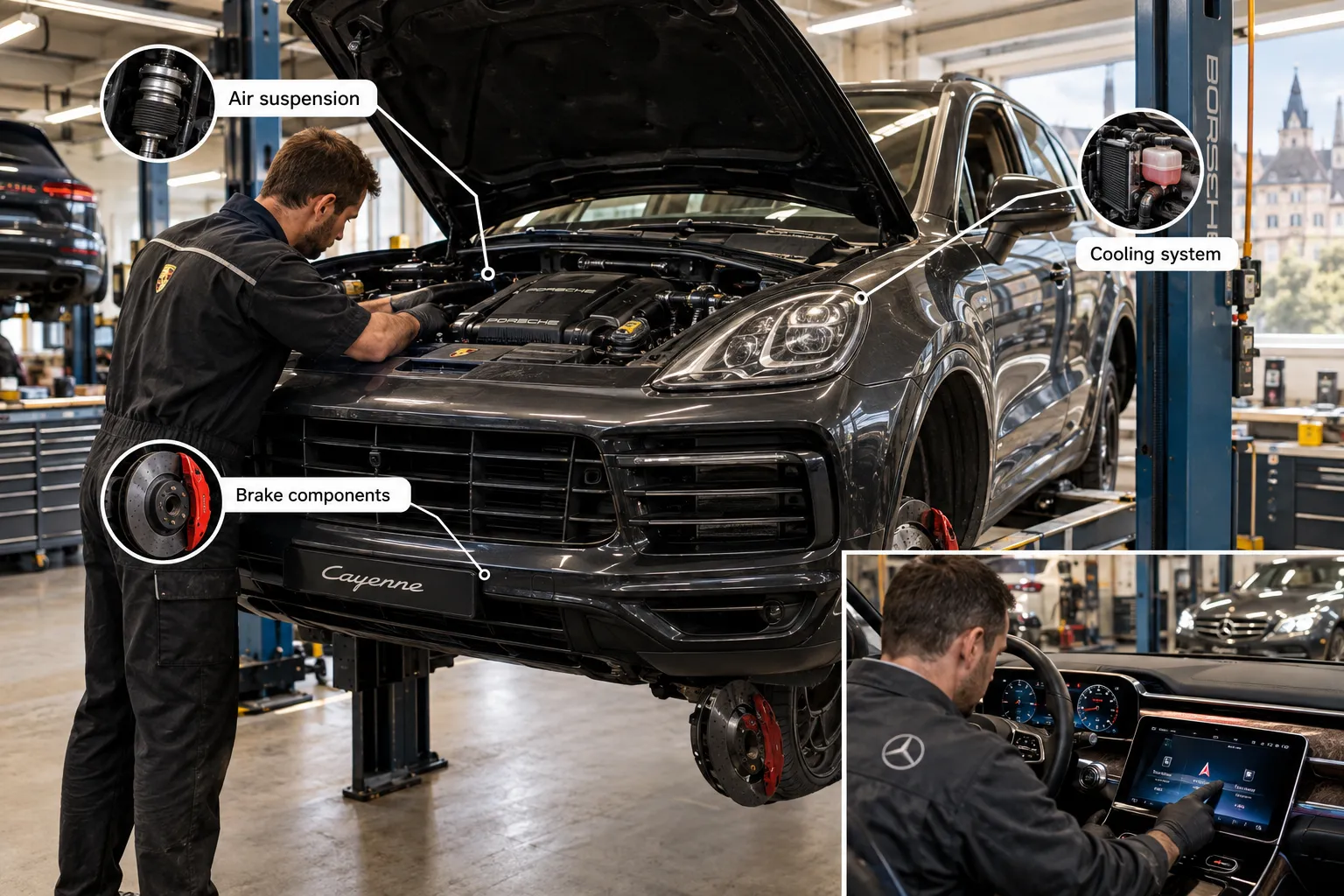
Both brands build engineering-heavy vehicles with more sensors, more electronics, and more specialized parts than a typical mainstream car. That complexity is part of what makes them feel special to drive, but it also means routine maintenance costs more, and unexpected repairs cost significantly more once the factory warranty period ends.
What Drives the Bills Up
- Air suspension systems, Common on Cayenne, Panamera, S-Class, and GLC trims. These systems are comfortable but expensive to repair when air struts or compressors fail.
- Turbocharged and hybrid powertrains, More seals, more sensors, more potential failure points than a simple naturally aspirated engine.
- Advanced infotainment and driver-assist tech, S-Class and newer Mercedes models pack in touchscreens, cameras, and radar systems that are costly to diagnose and replace.
- Specialized fluids and parts, Both brands often require brand-specific fluids, filters, and diagnostic tools that independent shops may not stock, pushing owners toward dealer service.
- Brake and tire costs, Sports-oriented Porsche models use performance tires and larger brakes that wear faster and cost more to replace than standard rubber.
Which Models Tend to Be Gentler on the Wallet
Within each brand, some models are noticeably easier to live with financially:
- The base 911 Carrera with the standard naturally aspirated flat-six is generally simpler and cheaper to maintain than turbocharged S or Turbo variants.
- Non-air-suspension trims of the Cayenne and GLC avoid one of the most expensive potential repair categories entirely.
- Mid-generation E-Class models strike a reasonable balance between luxury feel and parts availability, since the platform has been in production long enough for independent specialists to service it affordably.
- Avoid the newest, most tech-loaded S-Class trims if budget is a concern; the sheer volume of electronics multiplies the number of things that can eventually need attention.
For buyers cross-shopping outside the German luxury space entirely, it can help to compare against more budget-friendly ownership experiences, such as those covered in the guide to the most reliable cheap cars under $15,000 or the broader best cars to buy in 2026 by category and budget.
Certified Pre-Owned: A Buffer Worth Considering
Both Porsche and Mercedes-Benz run certified pre-owned (CPO) programs that extend warranty coverage and include multi-point inspections. For buyers nervous about surprise repair bills, a CPO purchase adds a real financial cushion during the first year or two of ownership. It is worth reviewing the general mechanics of these programs in this complete guide to certified used cars, warranties, and finding the best deals before comparing brand-specific CPO terms.
Luxury Buying Guide: Best Porsche and Mercedes-Benz Used Cars in 2026 for Value and Low Hassle
With depreciation and maintenance patterns in mind, here is how to actually shop for Porsche and Mercedes-Benz used cars in 2026 without overpaying or getting stuck with an expensive project car.
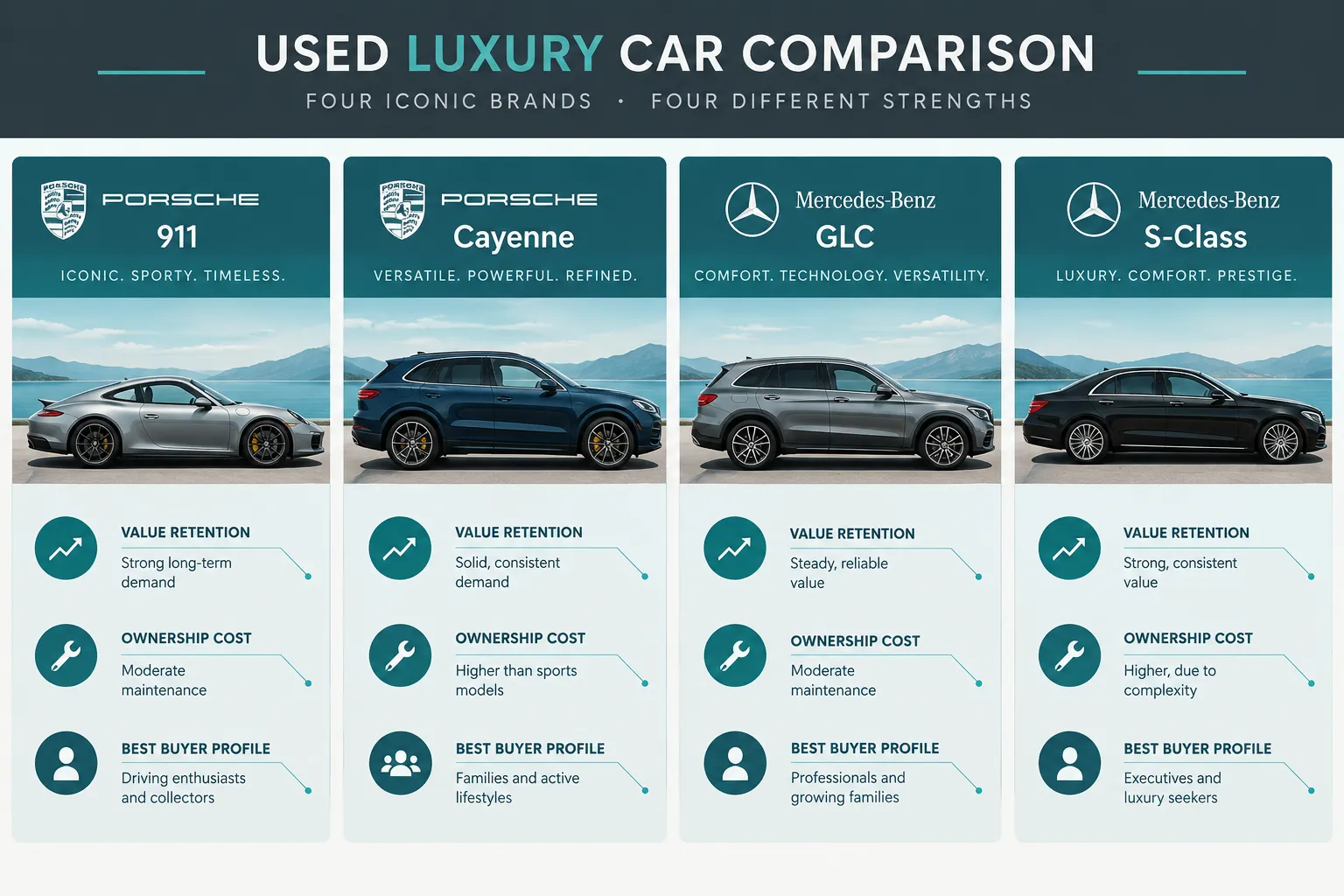
Best Overall Value Picks
| Model | Why It Balances Prestige and Cost |
|---|---|
| Porsche 911 (base Carrera, 5-6 years old) | Strongest resale in the segment, simpler engine than turbo trims |
| Porsche Cayenne (non-air-suspension trim) | SUV practicality with fewer expensive failure points |
| Mercedes-Benz GLC | Mainstream luxury SUV pricing after the steepest depreciation years pass |
| Mercedes-Benz E-Class (mid-generation) | Long production run means better parts availability and independent shop support |
| Mercedes-Benz S-Class (3-5 years old) | Percentage retention is solid, and buying used avoids the worst of the dollar loss[2][9] |
Models to Approach Carefully
- Porsche Taycan, Great to drive, but its depreciation curve mirrors the wider EV market. Buyers should expect the used price to keep sliding as newer, longer-range electric models launch.[3]
- Newest, top-trim S-Class variants, Beautiful cars, but the electronics load makes long-term repair costs harder to predict.
- High-mileage Panamera, Depreciates fast and combines a complex powertrain with a large, heavy body, which can mean costly suspension and transmission work down the line.
Practical Shopping Checklist
- Confirm service history. Ask for dealer or specialist records covering timing components, suspension work, and any electronic module replacements.
- Get a pre-purchase inspection from a brand specialist, not a generalist mechanic. Porsche and Mercedes-Benz have unique failure patterns that independent inspectors familiar with the brand will catch faster.
- Target the 3-to-6-year-old sweet spot. This window captures much of the depreciation discount while still offering modern safety and infotainment tech, mirroring the “2023 sweet spot” pattern seen across the Mercedes lineup.[5]
- Compare trim-level options, not just model names. A base Cayenne and a Cayenne Turbo GT are financially different vehicles to own, even though they share a nameplate.
- Check extended warranty availability before the factory coverage lapses, especially on air-suspension or hybrid-equipped vehicles.
- Budget separately for tires and brakes on performance-oriented Porsche trims; these wear items are consumed faster than on a typical sedan.
If you are still weighing a luxury purchase against a broader used-car search, the complete guide to buying and selling cars covers negotiation tactics and paperwork steps that apply just as much to a six-figure Porsche as to an economy sedan. Shoppers browsing listings directly may also find it useful to review this Autotrader USA shopping guide for tips on filtering search results by trim and history report availability.
Conclusion
The badge on the hood tells you almost nothing about what a used luxury car will actually cost to own. The model, trim, and drivetrain tell you everything. Porsche’s 911 remains the rare exception in the depreciation world, holding value in a way few other cars manage, while the Taycan reminds buyers that even a strong brand cannot fully protect an EV from the fast-moving electric market.[1][3] Mercedes-Benz follows a more predictable luxury curve, with the S-Class softening the percentage loss and the GLC settling into a reasonable value zone once the earliest depreciation years have passed.[2][5][7]
The smartest move for 2026 buyers is simple: target vehicles three to six years old, avoid the most electronics-heavy or air-suspension-dependent trims unless a warranty backs them, and always get a brand specialist to inspect before signing. Do that, and it is entirely possible to drive a genuine Porsche or Mercedes-Benz without the ownership costs that scare most people away from the segment.
References
[1] Luxury Sports Cars – https://www.iseecars.com/resale-value/luxury-sports-cars [2] Luxury Large Cars – https://www.iseecars.com/resale-value/luxury-large-cars [3] Luxury Electric Cars – https://www.iseecars.com/resale-value/luxury-electric-cars [4] Luxury Cars – https://www.iseecars.com/resale-value/luxury-cars [5] Mercedes – https://www.mydepreciation.org/calculators/mercedes [6] Resale Value – https://www.iseecars.com/resale-value [7] Depreciation – https://caredge.com/mercedes-benz/depreciation [8] Which Luxury Cars Are Holding Value In 2026 – https://www.focus2move.com/which-luxury-cars-are-holding-value-in-2026/ [9] 2jto51g0 – https://www.carwale.com/used/gurgaon/mercedes-benz-s-class/2jto51g0/ [10] Max6elvx – https://www.carwale.com/hi/used/bangalore/mercedes-benz-s-class/max6elvx/
Porsche used cars, Mercedes-Benz used cars, luxury car depreciation, luxury car maintenance costs, Porsche 911 resale value, Mercedes S-Class depreciation, Porsche Taycan value, certified pre-owned luxury cars, luxury car buying guide 2026, GLC depreciation, luxury SUV ownership costs