Last Updated on September 18, 2026
A three-year-old Kia Telluride now holds its value better than several luxury SUVs half its age, and that single fact is rewriting the playbook for anyone shopping the used market this year. Kia is no longer the budget afterthought it was a decade ago. It builds one of the most awarded midsize SUVs in America, a genuinely competitive minivan, and an EV lineup that is expanding faster than almost any other mainstream brand.
This guide breaks down Kia Cars in 2026: Models, Pricing, Reliability Scores, and the Best Used Kia Deals so you can shop with confidence whether you want a brand-new K4 off the lot or a lightly used Sportage Hybrid with years of warranty coverage still attached.
Key Takeaways
- Kia’s 2026 lineup spans compact sedans, three-row SUVs, a hybrid crossover, a minivan, and a growing electric vehicle family led by the EV3, EV6, and EV9.
- Reliability has improved noticeably in recent model years, with the Telluride and Carnival earning strong marks from J.D. Power, though results still vary by model and year [3][10].
- Kia’s longer powertrain warranty coverage means used models still under warranty carry real financial value, not just a lower sticker price.
- The best used Kia deals right now cluster around 2021 to 2023 model years, where depreciation has been steep but reliability data is already solid.
- Kia continues to close the reliability gap with sibling brand Hyundai, though the two brands trade places depending on the ownership timeline studied [2][9].
The Full 2026 Kia Lineup: Models and Categories
Kia organizes its 2026 U.S. lineup into a handful of clear categories, and understanding them makes comparison shopping far easier. The brand’s official full-line brochure breaks the range into sedans, SUVs, a minivan, and electrified vehicles, a structure that has stayed consistent even as individual nameplates evolve [8].
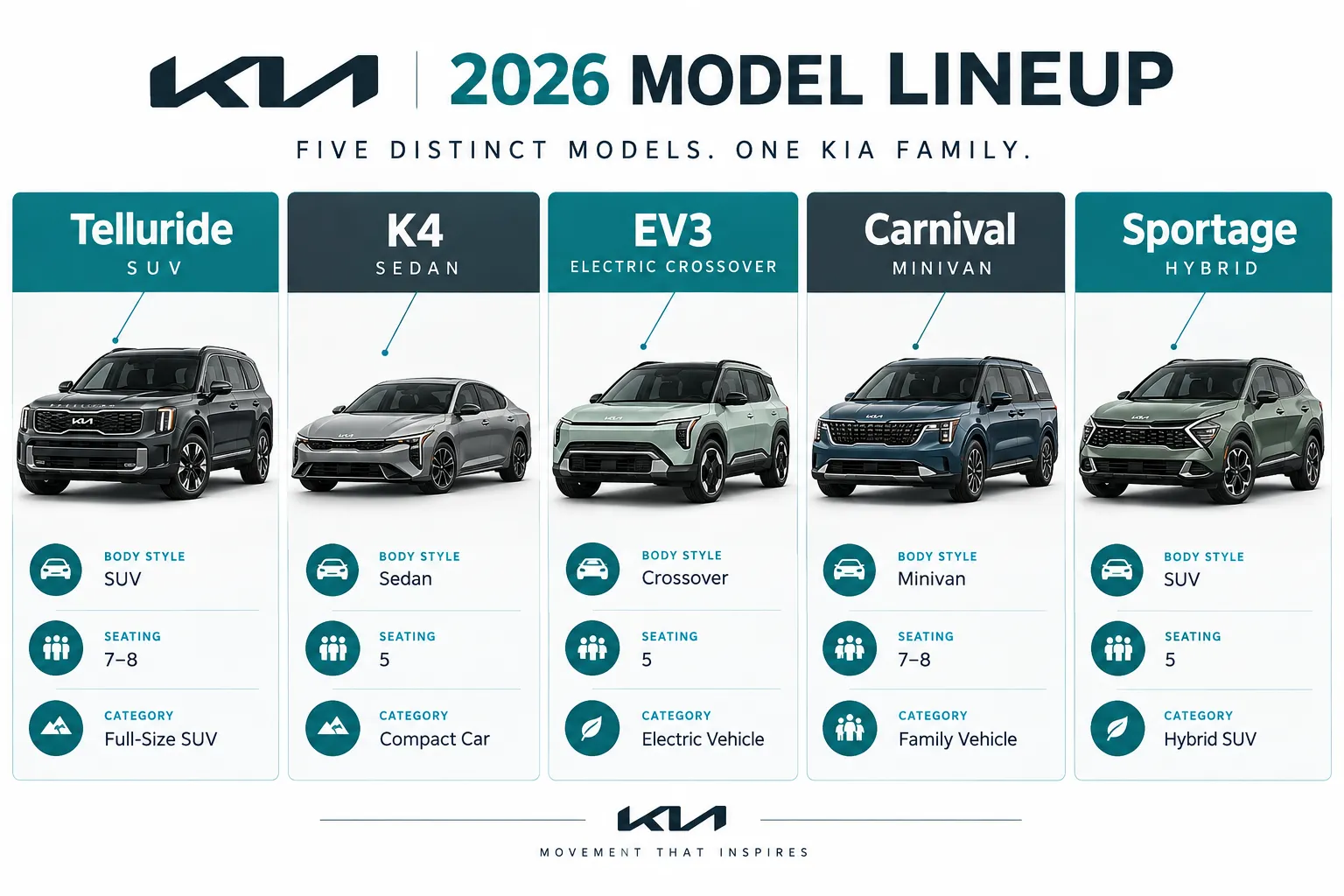
On the sedan side, the Forte continues as an entry-level option while the redesigned K4 replaces the older Forte-adjacent naming structure with a more modern, tech-forward compact sedan aimed squarely at younger buyers and daily commuters. The K5 remains Kia’s midsize sedan, competing with the Honda Accord and Toyota Camry, and it is now available with hybrid powertrains in select trims.
The SUV lineup is where Kia does its heaviest lifting. The Seltos and Soul cover the subcompact segment, the Sportage anchors the compact class with both gas and hybrid variants, and the Sorento slots in as a value-focused midsize three-row option. At the top sits the Telluride, Kia’s flagship three-row SUV and one of its most decorated products in recent years [3].
The Carnival minivan continues to blur the line between minivan and SUV with its bold styling, while the electrified side of the lineup has expanded rapidly with the EV3, EV6, and EV9 covering compact, midsize, and three-row electric segments respectively.
New and Notable Nameplates for 2026: K4, EV3, and Expanded Hybrids
Three additions define this year’s lineup story. The K4 sedan brings sharper styling and more standard technology to the compact segment, positioning itself as a legitimate alternative to the Civic and Corolla rather than a budget also-ran. Expert reviews have noted its roomy cabin and competitive infotainment as standout traits for the price point.
The EV3 is arguably the more significant launch. It brings Kia’s electric architecture down into a smaller, more affordable crossover body style, filling the gap below the EV6 and giving buyers who were priced out of the EV6 or EV9 a legitimate entry point into Kia’s electric ecosystem.
Hybrid availability has also expanded meaningfully. The Sportage Hybrid has matured into one of the more reliable and well-reviewed compact hybrid SUVs on the market, and Kia has continued to push hybrid powertrains further into the K5 and Sorento lineups, reflecting a broader industry shift toward electrified options that do not require charging infrastructure.
Kia Cars in 2026: Pricing Guide by Model
Pricing is where the 2026 lineup shows real spread, from budget-friendly compacts to well-equipped three-row electrics. The table below reflects starting MSRP ranges based on official pricing as of mid-September 2026 and industry pricing trackers [6][8].

| Model | Category | Starting MSRP Range (Approx.) |
|---|---|---|
| Forte / K4 | Compact Sedan | $19,000 to $25,000 |
| K5 | Midsize Sedan | $25,000 to $32,000 |
| Seltos | Subcompact SUV | $23,000 to $30,000 |
| Sportage / Sportage Hybrid | Compact SUV | $27,000 to $37,000 |
| Sorento | Midsize 3-Row SUV | $33,000 to $44,000 |
| Telluride | Full-size 3-Row SUV | $37,000 to $52,000 |
| Carnival | Minivan | $34,000 to $47,000 |
| EV3 | Compact Electric SUV | $34,000 to $42,000 |
| EV6 | Midsize Electric SUV | $43,000 to $56,000 |
| EV9 | 3-Row Electric SUV | $56,000 to $73,000 |
“Kia’s pricing strategy has shifted from purely value-driven to value-plus-content, packing more standard safety and tech features into base trims than most competitors offer.” This positioning is echoed across expert reviews from outlets like Car and Driver and KBB, which consistently point to strong feature-per-dollar value as Kia’s core selling point.
Anyone cross-shopping new Kia pricing against the broader market should also review this complete buyer’s guide by budget and category to see how these price points stack up against rival brands before making a final decision.
Kia Cars in 2026: Reliability Scores and Quality Rankings
Reliability is the piece of the puzzle that has changed the most for Kia over the past several model years. Brand-level rankings from consumer research groups have shown Kia climbing steadily, moving away from the bottom tiers where the brand once sat and into the middle-to-upper range of mainstream manufacturers [1][5][7].
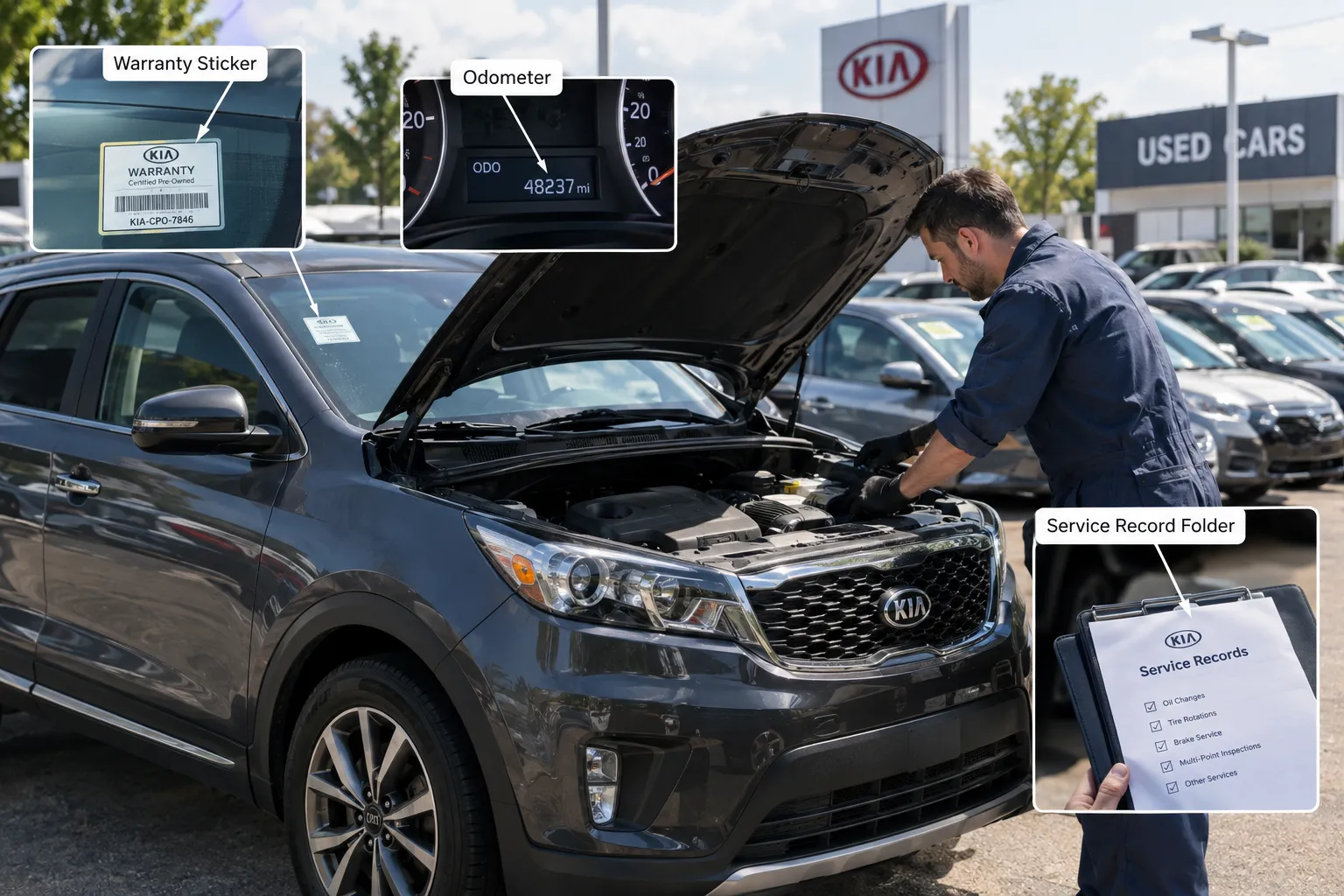
That climb is not uniform across every model, and it is important not to treat “Kia” as a single reliability score. Some nameplates consistently outperform the brand average, while others lag behind. This is exactly why model-specific research matters more than a single brand badge when you are deciding between Kia Cars in 2026: Models, Pricing, Reliability Scores, and the Best Used Kia Deals on your shortlist.
Model-Specific Reliability: Telluride, Carnival, K5, Sportage Hybrid
The Telluride has become something of a reliability and satisfaction benchmark for Kia. J.D. Power data consistently places it near the top of its segment for overall owner satisfaction and quality scoring, a remarkable outcome for a vehicle that launched relatively recently in Kia’s modern era [3].
The Carnival tells a similar story. As a minivan competing against long-established nameplates like the Honda Odyssey and Toyota Sienna, it has earned respectable quality marks that suggest Kia’s engineering discipline extends beyond its SUV lineup [10].
The K5 sits in a slightly more mixed position. Reliability reporting on the K5 has shown solid marks in several categories, though owner-reported issues in specific model years have kept it from matching the Telluride’s near-flawless reputation [4]. Buyers considering a K5, especially a used one, should pay closer attention to specific model-year reliability data rather than assuming uniform performance across every year of production.
The Sportage Hybrid rounds out the standout group. Its hybrid powertrain has proven durable in early ownership data, and it benefits from the broader improvements Kia has made to its compact SUV platform in recent redesign cycles.
Kia vs. Hyundai and Other Competitors
Because Kia and Hyundai share so much engineering, corporate structure, and even factory floor space, comparisons between the two brands are inevitable and genuinely useful. Comparative reliability analyses generally find that Hyundai tends to edge ahead in early-ownership reliability metrics, while Kia has shown stronger performance in longer-term durability studies that track vehicles further into their ownership lifecycle [2][9].
In practical terms, that means a brand-new Hyundai might report fewer initial issues in its first year, but a Kia from the same era may hold up comparably or better once it reaches the five-year and beyond mark. Against non-Korean mainstream competitors like Honda, Toyota, and Ford, Kia now generally sits in a competitive middle tier rather than trailing the pack, a significant shift from where the brand stood a decade ago [1][5].
Why Kia’s Warranty and Depreciation Curve Create the Best Used Kia Deals
Here is the part most shoppers overlook: Kia’s warranty coverage is longer than the industry standard, and that coverage transfers with the vehicle in many cases. That combination, paired with typical new-car depreciation curves, creates a genuine sweet spot in the used market that few other brands can match at the same price point.
New vehicles lose the steepest percentage of their value in the first two to three years of ownership. For most brands, that depreciation simply reflects a car getting older. For Kia, it often means a buyer can pick up a vehicle that still has years of factory powertrain coverage remaining, at a price that has already absorbed the steepest part of the depreciation curve. In effect, you are buying a like-new ownership experience at a meaningfully discounted price.
This dynamic is especially strong on models that have already proven their reliability chops, like the Telluride and Carnival. Because those vehicles already carry strong reliability reputations, the risk that typically accompanies buying used is reduced, while the financial upside of avoiding first-year depreciation remains fully intact.
If you are new to evaluating used vehicle value and depreciation curves in general, it is worth reviewing how to find the true value of your car before negotiating a used Kia purchase, since dealer asking prices do not always reflect actual market value.
Best Used Kia Deals by Model Year
Based on where depreciation curves and reliability data currently intersect, several specific model years stand out as particularly strong used-buying opportunities:
- 2021 to 2022 Telluride, Already past the steepest depreciation drop, with strong reliability scores and likely remaining powertrain warranty coverage for buyers who purchase before mileage limits are reached [3].
- 2022 to 2023 Sportage Hybrid, A newer hybrid platform with a reasonable amount of depreciation already absorbed, offering fuel efficiency without the higher price tag of a brand-new unit.
- 2021 to 2022 K5, Attractive pricing, though buyers should specifically check model-year-level reliability reports rather than assuming uniform quality across the generation [4].
- 2022 to 2023 Carnival, Strong owner satisfaction scores and a body style that resists depreciation better than many traditional minivans thanks to its SUV-like styling and features [10].
- 2020 to 2021 Sorento, A solid three-row option for buyers who want SUV space without Telluride pricing, especially once major depreciation has already occurred.
When comparing these used options against buying new, it helps to think in terms of total ownership cost rather than sticker price alone. A used Telluride with two years of warranty coverage remaining and a proven reliability record may cost significantly less than a new K5 while offering more space and a comparable ownership risk profile.
Shoppers weighing a used SUV against financing a brand-new vehicle should also consider protection products carefully. For example, understanding whether you should buy gap insurance from the dealer can prevent overpaying for coverage that may already be available more cheaply elsewhere, an especially relevant consideration on financed used purchases where loan balances can exceed vehicle value early in the term.
First-time buyers navigating any of these choices, new or used, will also benefit from a broader look at budgeting and model selection in this complete guide to buying your first car, which covers financing basics that apply just as well to a used Kia as to any other brand.
Electrification Strategy: EV3, EV6, and EV9 in 2026
Kia’s electric strategy has moved from a single flagship model to a genuine three-tier lineup. The EV6 established Kia’s credibility in the EV space with strong range and fast-charging capability, competing directly against vehicles like the Tesla Model Y and Ford Mustang Mach-E. The EV9 then expanded that formula into a full three-row electric SUV, addressing a segment that had very few electric options until recently.
The EV3 is the newest and arguably most strategically important addition for 2026. By bringing Kia’s electric platform down into a smaller, more affordable body style, the EV3 targets buyers who want to go electric without paying EV6 or EV9-level prices. Official product communications from Kia frame this three-tier EV structure as the backbone of the brand’s long-term electrification plan, working alongside an expanding hybrid lineup rather than replacing it outright [8].
For buyers unsure whether an EV, hybrid, or traditional gas Kia makes more sense, the honest answer depends heavily on charging access, typical driving distance, and how long you plan to keep the vehicle. Hybrids like the Sportage Hybrid offer a lower-commitment entry into electrification, while the EV3, EV6, and EV9 represent a fuller transition for buyers ready to commit to a plug-in lifestyle.
Anyone comparing electrified vehicles across brands, not just within the Kia lineup, will find useful context in this broader buyer’s guide to the best cars by budget and category, which breaks down electrified and traditional options side by side.
Conclusion
Kia in 2026 is not the brand it was even five years ago. The lineup is broader, the reliability data is stronger in key models like the Telluride and Carnival, and the electrification strategy now covers three distinct price tiers rather than a single flagship EV. That combination of factors has quietly created one of the strongest used-car opportunities in the mainstream market today.
If you are shopping new, focus on matching your budget to a model with a proven reliability track record rather than chasing the lowest possible sticker price. If you are shopping used, target the 2021 to 2023 model years on the Telluride, Carnival, Sportage Hybrid, and K5, and always verify how much factory warranty coverage remains before you negotiate a final price. Pull the specific reliability history for the exact trim and model year you are considering, check remaining warranty terms directly with a dealer, and compare at least two comparable used listings before signing anything. Those three steps alone will put you ahead of most buyers walking onto a used car lot this year.
For readers who enjoy tracking vehicle value trends more broadly, it is also worth learning a few lesser-known facts about how vehicle valuation guides work, since understanding how valuation tools calculate pricing can make you a sharper negotiator on any used vehicle purchase, Kia or otherwise.
References
[1] Car Brands Ranked From Most To Least Reliable – https://www.gadgetreview.com/car-brands-ranked-from-most-to-least-reliable [2] Kia Vs Hyundai Reliability Hyundai Wins Early Kia Wins Later – https://www.autoblog.com/features/kia-vs-hyundai-reliability-hyundai-wins-early-kia-wins-later [3] Telluride – https://www.jdpower.com/cars/2025/kia/telluride [4] How Reliable 2025 Kia K5 Jd Power – https://www.jalopnik.com/2104385/how-reliable-2025-kia-k5-jd-power/ [5] Kia Reliability Ratings In America – https://www.autoblog.com/features/kia-reliability-ratings-in-america [6] kbb – https://www.kbb.com/kia/ [7] Kia Reliability – https://www.autonationmobileservice.com/i/blog/kia-reliability/ [8] Kia Full Line Brochure – https://www.kia.com/us/content/dam/kia/us/brochures/KIA_Full-Line_Brochure.pdf [9] Kia Vs Hyundai Reliability Battle – https://carbuzz.com/kia-vs-hyundai-reliability-battle/ [10] Carnival – https://www.jdpower.com/cars/2025/kia/carnival