Last Updated on August 27, 2026
Buying a first car in 2026 means balancing a tight budget against near-record vehicle prices, high insurance costs for new drivers, and auto-loan rates that reward preparation. The smartest move for most first-time buyers is a reliable used compact car or small crossover with strong safety ratings, purchased after getting pre-approved for a loan and inspecting the vehicle thoroughly. Budget between $8,000 and $20,000 depending on income, and expect total monthly costs, loan, insurance, fuel, and maintenance, to run $400 to $700 or more.
Key Takeaways
- Set a first car budget at no more than 15 to 20 percent of monthly take-home pay for the combined loan and insurance payment.
- Reliable used cars from the last five to eight years offer the best value for new drivers; leasing and premium new models rarely make financial sense as a first purchase.
- Insurance is often the single biggest hidden cost for first-time and young drivers, sometimes exceeding the monthly loan payment.
- Safety features, automatic emergency braking, lane-keeping assist, and a high crash-test rating, should be non-negotiable on any first car.
- Get pre-approved for a car loan before visiting a dealership; it gives real negotiating power and prevents financing surprises.
- Always run a vehicle history report and get a pre-purchase inspection from an independent mechanic before buying any used car.
- Small sedans and compact crossovers are the most practical body styles for beginner drivers; large SUVs and trucks add unnecessary complexity.
- Avoid common mistakes such as skipping the test drive, focusing only on monthly payments, and buying more car than needed.
What Should You Consider When Buying Your First Car?
Buying a first car involves more than picking a color and signing papers. New drivers need to weigh safety, reliability, total cost of ownership, and how the car fits their daily life before they ever step onto a lot. [2]
Safety Ratings Come First
For a first car, safety is the top priority. Look for vehicles with high ratings from the National Highway Traffic Safety Administration (NHTSA) or the Insurance Institute for Highway Safety (IIHS). In 2026, experts treat automatic emergency braking (AEB), lane-keeping assist, and a rearview camera as baseline requirements, not optional extras. [9]
A car with strong crash-test scores and modern driver-assistance features can reduce the risk of a serious accident while a new driver is still building confidence behind the wheel.
Reliability and Running Costs
A first car should be dependable. Breakdowns are stressful and expensive, especially for someone without much automotive experience. Brands with long reliability track records, Toyota, Honda, Mazda, and Hyundai, consistently appear on expert “best first car” lists for this reason. [7]
Running costs matter just as much as the purchase price. Factor in:
- Fuel economy (higher MPG means lower monthly fuel bills)
- Insurance premiums (small, modest cars cost less to insure)
- Routine maintenance (oil changes, tires, brakes)
- Repair costs (some brands have cheaper parts and more mechanics who know them)
Practicality for Daily Use
Think honestly about how the car will be used. A city commuter needs good parking visibility and fuel economy. A new driver who travels long distances needs comfort and highway stability. Someone in a snowy region should consider all-wheel drive or front-wheel drive with good winter tires.
Decision rule: Choose a car that fits your most common driving scenario, not your most exciting fantasy scenario.
What’s a Good Budget for a First Car?
A practical first car budget for most buyers in 2026 falls between $8,000 and $20,000 for the vehicle itself. The total monthly cost, including loan payment, insurance, fuel, and maintenance, should stay at or below 15 to 20 percent of monthly take-home pay. [2]
How Much Should You Spend on Your First Car?
Car prices remain near record highs in 2026, which makes discipline essential. Here is a simple framework:
| Monthly Take-Home Pay | Suggested Max Monthly Car Costs | Reasonable Vehicle Budget |
|---|---|---|
| $2,500 | $375 to $500 | $8,000 to $12,000 |
| $3,500 | $525 to $700 | $12,000 to $16,000 |
| $5,000 | $750 to $1,000 | $16,000 to $22,000 |
These are estimates based on the 15 to 20 percent guideline. Actual costs vary by location, credit score, and insurance profile.
Breaking Down the True Cost of Ownership
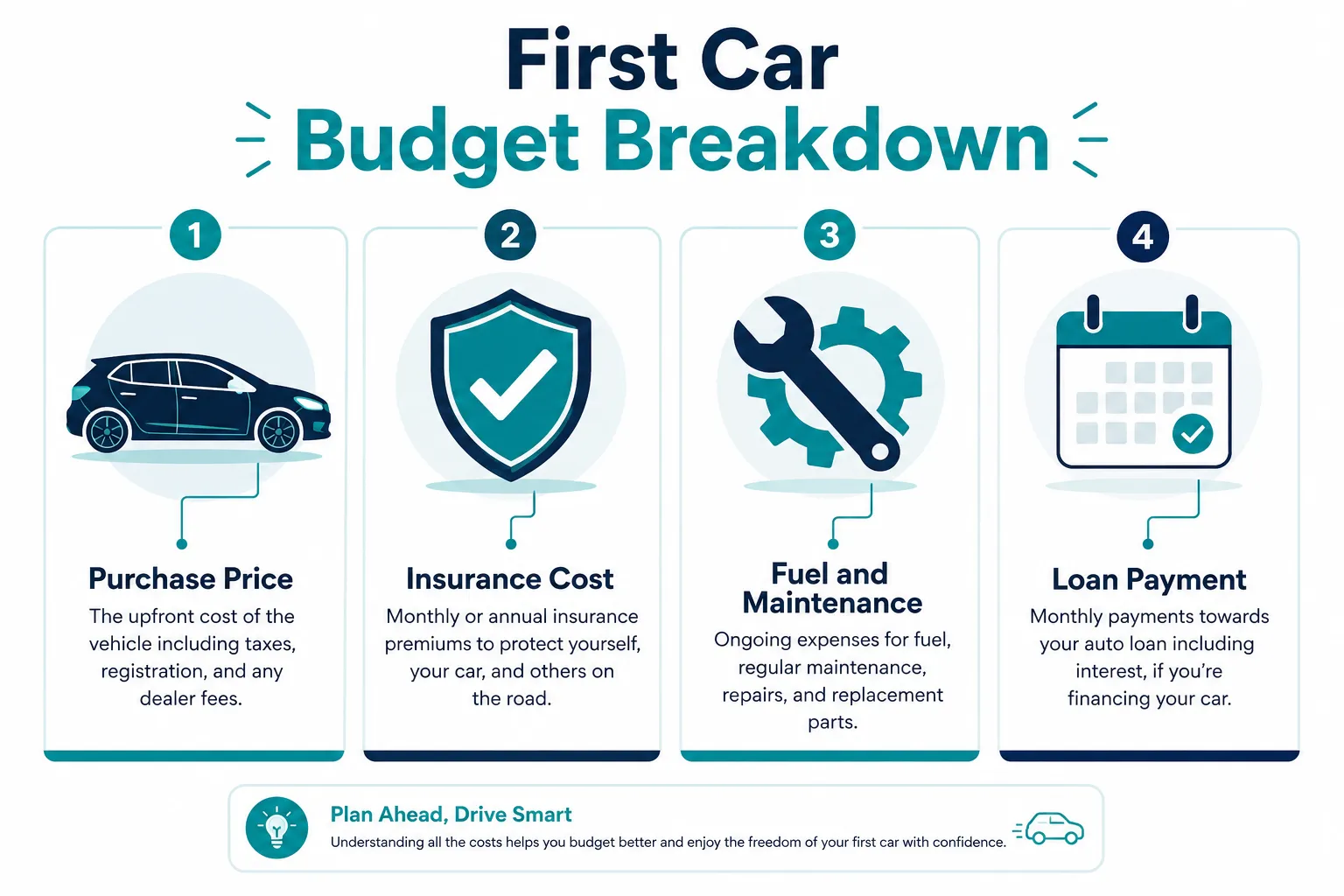
The sticker price is only part of the story. A first-time buyer should budget for:
- Loan payment: Depends on vehicle price, down payment, interest rate, and loan term
- Insurance: Often $150 to $300 per month or more for young and new drivers (see the insurance section below)
- Fuel: Varies by MPG and local gas prices
- Maintenance: Budget roughly $50 to $100 per month for routine upkeep
- Registration and taxes: One-time costs that vary by state
Common mistake: Many first-time buyers focus only on the monthly loan payment and forget that insurance can cost as much or more than the loan itself.
For more guidance on understanding vehicle valuations and pricing, the Blue Book Car Value Guide is a useful starting point when researching fair market prices.
Should You Buy New or Used for Your First Car?
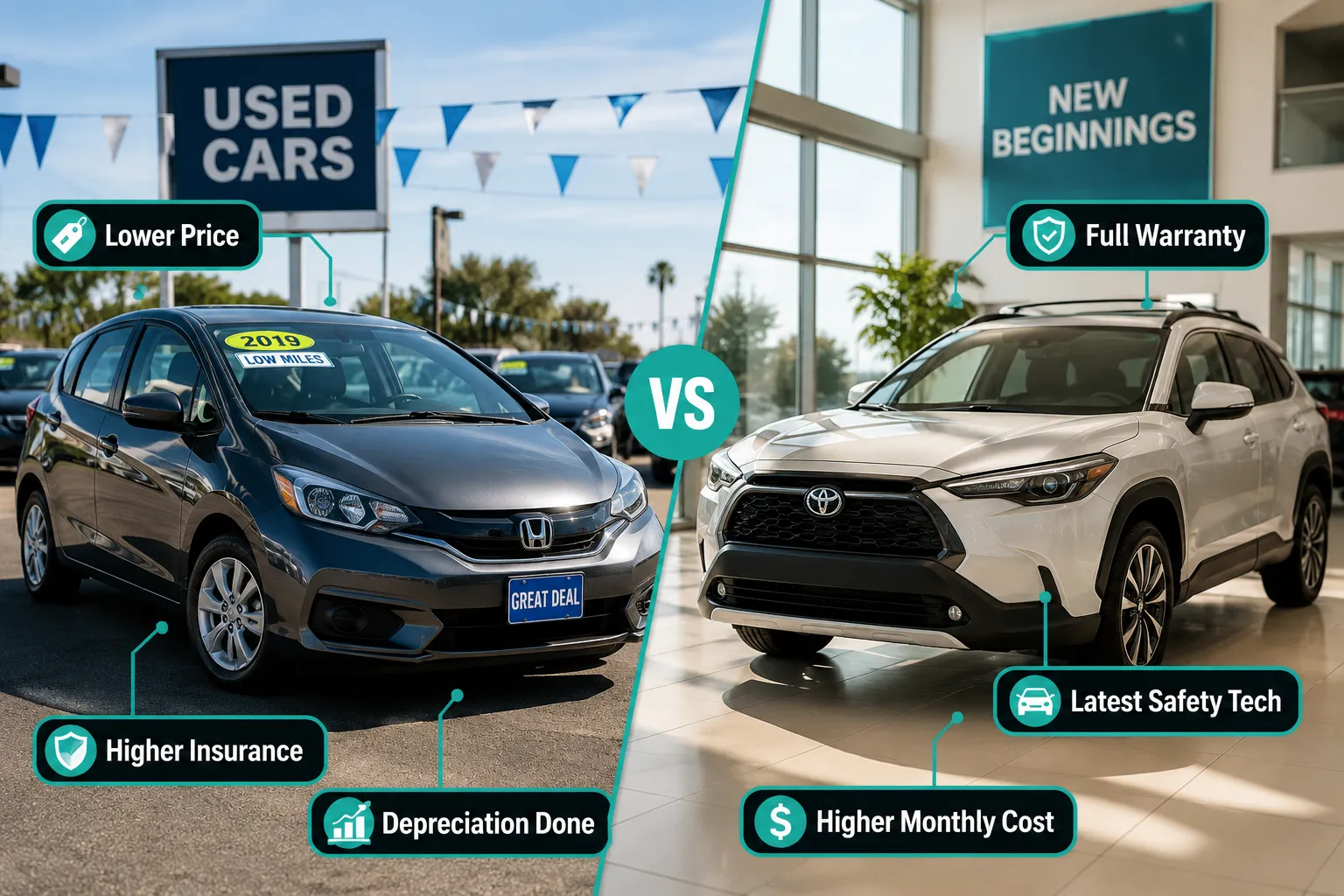
For most first-time buyers, a reliable used car is the smarter financial choice. New cars lose a significant portion of their value in the first few years, and the higher purchase price means larger loan payments and often higher insurance premiums. [10]
The Case for Buying Used
Expert commentary in 2026 strongly favors used cars over new ones for first-time buyers. Here is why:
- Lower purchase price: A three-to-five-year-old used car can cost 30 to 50 percent less than its new equivalent.
- Depreciation already absorbed: The steepest drop in value has already happened.
- Lower insurance costs: Older vehicles generally cost less to insure.
- Proven reliability record: A model that has been on the road for a few years has a known reliability history.
The sweet spot for a first car is typically a used vehicle that is three to seven years old, has under 80,000 miles, and comes from a brand with a strong reliability record. [4]
When Buying New Makes Sense
Buying new is not always wrong. It can make sense if:
- The buyer has a strong credit score and qualifies for a low-interest promotional rate (sometimes 0 to 2.9 percent APR from manufacturers)
- A certified pre-owned (CPO) deal is not available in the preferred model
- The buyer plans to keep the car for eight or more years, spreading the depreciation cost over a long ownership period
Decision rule: Buy used if budget is the primary concern. Buy new only if the financing terms are genuinely favorable and the car will be kept long-term.
What About Leasing?
Leasing is generally not recommended for a first car. Lease agreements come with mileage limits, wear-and-tear penalties, and no equity at the end of the term. New drivers who are still learning their habits and needs are better served by owning a vehicle outright or financing a purchase. [2]
Best First Cars for New Drivers in 2026
The best first cars for beginners combine strong safety ratings, proven reliability, manageable size, and affordable running costs. In 2026, the consensus among automotive experts points to compact sedans, small hatchbacks, and compact crossovers as the top choices. [1] [9]
Best Reliable First Cars Under $10,000
Finding a solid first car under $10,000 is still possible in 2026, but it requires patience and careful inspection. Look for:
- Toyota Corolla (2016 to 2019): One of the most reliable compact sedans ever built. Parts are cheap and mechanics know it well. [7]
- Honda Civic (2016 to 2019): Excellent fuel economy, strong safety record, and widely available. [3]
- Mazda3 (2017 to 2019): Slightly more refined driving experience, good reliability, and above-average safety scores.
- Hyundai Elantra (2017 to 2020): Good value, comfortable ride, and solid reliability for the price. [8]
- Toyota Yaris / Honda Fit (2015 to 2018): Smaller footprint, easier to park, and very fuel-efficient, great for city driving.
Important note: At this price point, every car needs a pre-purchase inspection from an independent mechanic. Do not skip this step.
Best First Cars in the $10,000 to $20,000 Range
With a slightly larger budget, the options improve significantly:
- Toyota Corolla (2020 to 2022): Adds Toyota Safety Sense as standard, automatic emergency braking, lane departure alert, and adaptive cruise control. [5]
- Honda Civic (2020 to 2022): Honda Sensing suite comes standard. Sporty, efficient, and very reliable.
- Mazda CX-30 (2020 to 2022): A small crossover with excellent safety ratings and a premium feel at a non-premium price. [9]
- Hyundai Tucson (2019 to 2021): More space than a sedan, good safety scores, and lower used prices than comparable Japanese models.
- Subaru Impreza (2018 to 2021): Standard all-wheel drive makes it a strong choice for buyers in snowy or wet climates.
Is a Sedan or SUV Better for a New Driver?
A compact sedan or small crossover is generally better for a new driver than a large SUV or truck. Here is why:
- Smaller dimensions make parking and maneuvering easier while skills are developing
- Lower center of gravity in sedans reduces rollover risk
- Better fuel economy in compact cars keeps running costs lower
- Easier to judge vehicle width and length in a smaller body
A small crossover like the Mazda CX-30 or Toyota Corolla Cross offers the best of both worlds: slightly higher seating position for visibility, manageable size, and good safety ratings. Large SUVs and pickup trucks are harder to park, cost more to insure, and use more fuel, none of which helps a new driver. [8]
What Features Do You Need in a First Car?
A first car should have a core set of safety and convenience features. In 2026, several technologies that were once optional are now standard on most new and recent used cars. [9]
Non-Negotiable Safety Features
- Automatic emergency braking (AEB): Applies brakes automatically if a collision is detected. This feature alone has been shown to reduce rear-end crashes significantly.
- Rearview camera: Required on all new U.S. cars since 2018. Essential for parking and reversing.
- Electronic stability control (ESC): Helps prevent skidding. Required on all new U.S. cars since 2012.
- Multiple airbags: Front, side, and curtain airbags provide full-body protection in a crash.
Strongly Recommended Features
- Lane-keeping assist or lane departure warning: Helps prevent drifting out of lane, especially on highways.
- Blind-spot monitoring: Alerts the driver to vehicles in hard-to-see zones beside the car.
- Adaptive cruise control: Maintains a safe following distance on highways, reducing fatigue.
- Apple CarPlay / Android Auto: Allows safe, hands-free phone use through the car’s screen.
Features to Skip for a First Car
Avoid paying extra for features that add cost without adding safety or reliability:
- Large panoramic sunroofs (expensive to repair if cracked)
- High-performance engine upgrades (higher insurance, more temptation to speed)
- Complex air suspension systems (costly to maintain)
- Premium audio packages (nice but not necessary)
What Insurance Costs Should You Expect for a First Car?
Insurance for new and young drivers is often the single biggest hidden cost of owning a first car. Rates vary widely by age, location, driving record, and vehicle type, but new drivers, especially those under 25, typically pay significantly more than experienced drivers. [4]
Typical Insurance Costs for First-Time Drivers
As a general estimate for 2026:
- Drivers under 20: Full-coverage insurance can run $200 to $400 per month or more, depending on location and vehicle.
- Drivers aged 20 to 25: Expect $150 to $300 per month for full coverage on a modest used car.
- Drivers over 25 buying their first car: Rates are lower, typically $100 to $200 per month for a comparable vehicle.
These are estimates. Actual rates depend on ZIP code, credit score (in most states), the specific car, and the coverage level chosen.
How to Lower Insurance Costs on a First Car
- Choose a modest, safe vehicle: Small sedans and compact crossovers cost less to insure than sports cars, large SUVs, or trucks.
- Take a defensive driving course: Many insurers offer discounts for completing an approved course.
- Stay on a parent’s policy if possible: Adding a young driver to an existing family policy is often cheaper than a standalone policy.
- Increase the deductible: A higher deductible lowers the monthly premium, but means more out-of-pocket cost after a claim.
- Compare multiple quotes: Rates vary significantly between insurers. Always get at least three quotes before choosing.
- Avoid comprehensive and collision on very cheap cars: If the car is worth less than $5,000, the cost of full coverage may exceed the car’s value.
Common mistake: Buying a sporty or high-performance car as a first vehicle dramatically increases insurance costs. A 2019 Honda Civic sedan costs far less to insure than a 2019 Civic Si or Type R.
How to Get Approved for a Car Loan as a First-Time Buyer
Getting approved for a car loan as a first-time buyer is possible even without a long credit history, but preparation matters. Auto-loan rates in 2026 make pre-approval and shorter loan terms critical for keeping total costs manageable. [2]
Steps to Secure a Car Loan
- Check your credit score first. Know where you stand before applying. A score above 670 typically qualifies for reasonable rates. Below 600, expect higher rates or the need for a co-signer.
- Save for a down payment. A down payment of 10 to 20 percent of the vehicle price reduces the loan amount, lowers monthly payments, and shows lenders the buyer is financially responsible.
- Get pre-approved before shopping. Apply at a bank, credit union, or online lender before visiting a dealership. Pre-approval gives a real budget and removes the dealer’s ability to control the financing conversation.
- Compare loan terms carefully. A 36 or 48-month loan costs more per month but far less in total interest than a 72 or 84-month loan. Avoid stretching a loan beyond 60 months on a used car.
- Consider a co-signer. A parent or trusted adult with good credit can help a first-time buyer qualify for a better rate.
What Lenders Look For
- Credit score and history
- Debt-to-income ratio (monthly debt payments vs. monthly income)
- Employment stability and income verification
- Down payment amount
- The age and mileage of the vehicle being financed (lenders are cautious about older, high-mileage cars)
Decision rule: If the only loan available carries an interest rate above 12 percent, it may be smarter to save for a few more months, improve the credit score, or buy a cheaper car outright with cash.
How to Inspect a Used First Car Before Buying
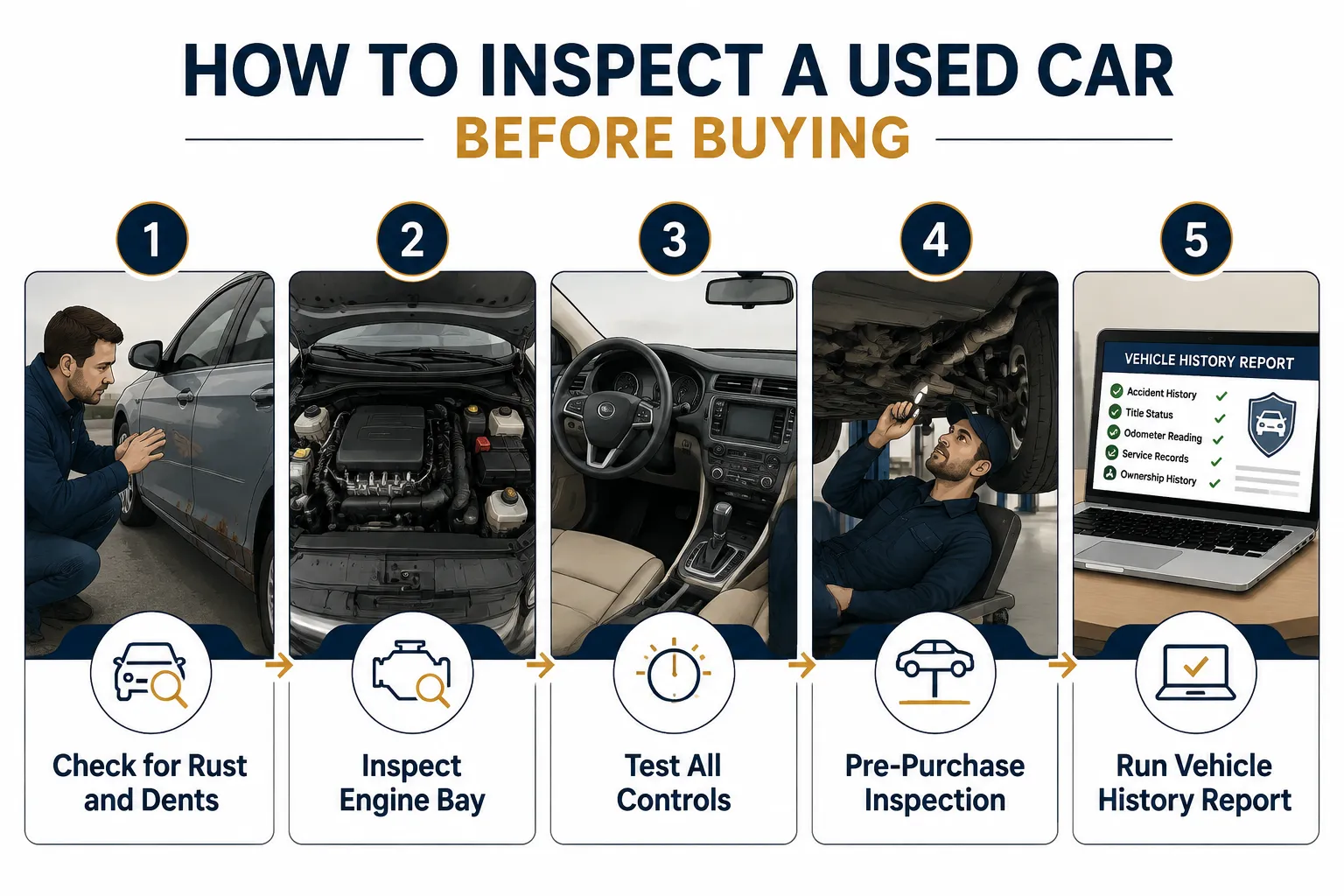
Every used car purchase should include a thorough inspection. Skipping this step is one of the most common and costly first car buying mistakes. [10]
Step-by-Step Used Car Inspection Checklist
Before the visit:
- Run a vehicle history report (Carfax or AutoCheck) using the VIN. Look for accident history, title issues, odometer rollbacks, and service records.
- Research the model’s known reliability issues and common problems.
At the car:
- Walk around the exterior. Look for rust, uneven panel gaps, mismatched paint, and signs of previous bodywork. These can indicate a repaired accident.
- Check all glass. Look for chips, cracks, or stress marks on the windshield and windows.
- Inspect the tires. Uneven wear patterns can signal alignment or suspension problems.
- Open the hood. Look for fluid leaks, corrosion, cracked hoses, and a dirty or low oil level. A milky or frothy appearance in the oil can indicate a serious engine problem.
- Check the interior. Test every switch, button, and screen. Look for water stains or mold, which can indicate flood damage.
- Test drive it. Drive at low speed and highway speed. Listen for unusual noises. Test the brakes, steering, and acceleration. Notice if the car pulls to one side.
After the test drive:
- Get an independent pre-purchase inspection (PPI). Pay a trusted mechanic $100 to $200 to put the car on a lift and inspect it thoroughly. This is the single most important step and can save thousands of dollars.
For buyers who are also researching larger vehicle purchases, the guide to buying a used commercial truck covers many of the same inspection principles in a different context.
How to Negotiate the Price on Your First Car
New drivers often feel intimidated at a dealership, but negotiation is a normal and expected part of the car-buying process. Preparation is the best tool. [10]
Research the Market Value First
Before negotiating, know what the car is actually worth. Use resources like Kelley Blue Book, Edmunds, and CarGurus to find the fair market value for the specific make, model, year, mileage, and condition. The Blue Book Car Value Guide explains how these valuations work in plain terms.
Negotiation Tips for First-Time Buyers
- Start below the asking price. A reasonable opening offer is 5 to 10 percent below the listed price on a used car.
- Negotiate the total price, not the monthly payment. Dealers can manipulate monthly payments by extending the loan term. Always anchor the conversation to the out-the-door price.
- Use competing offers. If another dealer or private seller has the same car for less, say so. Dealers respond to real competition.
- Be willing to walk away. This is the most powerful negotiating tool available. If the price does not reach a fair level, leaving is a legitimate option.
- Watch for add-ons. Dealers often add paint protection, fabric treatment, extended warranties, and other extras at the finance stage. Most of these are overpriced. Decline anything that was not part of the original agreed price.
Common mistake: Revealing a maximum monthly budget to a dealer before agreeing on a price. This shifts the conversation away from total cost and gives the dealer room to extend the loan term while appearing to meet the budget.
What Paperwork Do You Need to Buy a First Car?
Buying a car requires a specific set of documents. Having everything ready in advance speeds up the process and prevents last-minute delays. [2]
Documents Needed to Buy a Car
From the buyer:
- Government-issued photo ID (driver’s license or passport)
- Proof of insurance (required before driving the car off the lot)
- Proof of income (pay stubs or bank statements, especially for financing)
- Pre-approval letter from a lender (if financing through a bank or credit union)
- Down payment funds (cashier’s check, bank transfer, or cash)
From the seller (for a used car):
- Clean title in the seller’s name
- Vehicle history report
- Odometer disclosure statement
- Bill of sale
- Any remaining warranty documentation
After purchase:
- Title transfer (the buyer’s name goes on the title)
- Registration with the state DMV
- Proof of insurance filed with the state if required
Edge case: When buying from a private seller, the buyer is responsible for handling the title transfer and registration independently. Dealerships typically handle this as part of the sale process.
First Car Buying Mistakes to Avoid
First-time buyers make predictable mistakes. Knowing them in advance is the best way to avoid them. [2] [10]
Common First Car Buying Regrets
- Skipping the pre-purchase inspection: The most expensive mistake. A hidden mechanical problem can cost thousands of dollars after purchase.
- Buying based on looks alone: A car that looks good but has poor reliability, high insurance costs, or bad safety ratings is a poor choice for a first vehicle.
- Focusing only on monthly payments: A low monthly payment on a long loan term can mean paying far more in total interest.
- Underestimating insurance costs: Many buyers are shocked by their first insurance quote, especially if they chose a sporty or high-value vehicle.
- Not test driving the car: A car should feel right to drive. Comfort, visibility, and ease of use matter, especially for a new driver.
- Buying from a seller who refuses an inspection: Any seller who will not allow an independent mechanic to inspect the car is a red flag.
- Ignoring total cost of ownership: Purchase price is just the beginning. Fuel, insurance, maintenance, and repairs all add up.
- Rushing the process: Car buying takes time. Feeling pressured to decide on the spot is a manipulation tactic. A good deal will still be there after a night of reflection.
“The biggest regret most first-time buyers have is not the car they bought, it’s the process they skipped.” [10]
For buyers who have gone through similar research processes with other vehicles, the article on things RV owners wish they did before buying their RV covers a very similar set of pre-purchase regrets that apply across vehicle categories.
How to Handle the Finance and Paperwork Stage
The finance office at a dealership is where many buyers lose money they saved during negotiation. Understanding this stage protects the buyer’s budget. [2]
What to Expect in the Finance Office
After agreeing on a price, the buyer meets with a finance manager who handles the loan paperwork. This person may offer:
- Extended warranties: Sometimes useful, but often overpriced at dealerships. Research the cost independently before agreeing.
- GAP insurance: Covers the difference between the loan balance and the car’s value if it is totaled. This can be worth buying on a new car with a small down payment, but is often cheaper through a personal insurance provider.
- Credit life or disability insurance: Generally not worth the cost for most buyers.
- Paint and fabric protection: Almost always overpriced. Decline it.
Decision rule: Agree only to what was discussed and negotiated before entering the finance office. Any new product offered there should be researched independently before accepting.

First Car Buying Calculator
The interactive tool below helps estimate the total monthly cost of owning a first car, including loan payment, insurance, fuel, and maintenance.
First Car Monthly Cost Estimator
Loan Payment:
Insurance:
Fuel:
Maintenance (est.): $75/mo
Total Monthly Cost:
Estimates only. Actual costs vary by location, credit score, and vehicle.
Frequently Asked Questions About Buying a First Car
How much should I realistically spend on my first car? Most financial experts suggest keeping total monthly car costs (loan plus insurance plus fuel plus maintenance) at or below 15 to 20 percent of monthly take-home pay. For the vehicle purchase price alone, $8,000 to $16,000 is a realistic range for most first-time buyers in 2026.
Is it better to buy a first car with cash or finance it? Buying with cash avoids interest charges and monthly payment obligations. However, financing a modest amount at a reasonable rate while keeping cash reserves for emergencies is also a sound strategy. Avoid financing if the interest rate is above 10 to 12 percent.
What is the best age of used car to buy as a first vehicle? A used car that is three to seven years old typically offers the best balance of price, reliability, and available safety features. Avoid cars older than ten years unless they have a verified service history and pass a pre-purchase inspection.
Should a new driver get full coverage or liability-only insurance? If the car is financed, the lender will require full coverage. If the car is owned outright and worth less than $5,000, liability-only coverage may be more cost-effective. For any car worth more than $8,000, full coverage is generally recommended.
What credit score do I need to get a car loan as a first-time buyer? A credit score of 670 or above typically qualifies for reasonable auto-loan rates. Scores below 600 may still qualify but at higher rates. A co-signer with good credit can help secure better terms.
How long should a first car loan be? A 36 to 48-month loan is ideal. It keeps total interest paid low. Loans of 72 or 84 months reduce monthly payments but cost significantly more in total interest and often leave the buyer owing more than the car is worth (negative equity).
Is a Toyota Corolla or Honda Civic better as a first car? Both are excellent choices. The Toyota Corolla has a slight edge in long-term reliability data. The Honda Civic offers a slightly sportier driving feel and comparable safety scores. Either one is a strong first car choice. [7] [3]
What is a pre-purchase inspection and is it worth it? A pre-purchase inspection (PPI) is a paid examination of a used car by an independent mechanic. It typically costs $100 to $200 and can reveal hidden problems that would cost thousands to repair. It is always worth it for any used car purchase.
Can a first-time buyer get a car loan without a co-signer? Yes, but it depends on credit score and income. Buyers with limited credit history may face higher interest rates. A co-signer with good credit can improve the rate and increase the chances of approval.
What is GAP insurance and do I need it? GAP insurance covers the difference between what a car is worth and what is owed on the loan if the car is totaled. It is most useful when buying a new car with a small down payment. For used cars with a significant down payment, it is less necessary.
How do I know if a used car price is fair? Check the fair market value on Kelley Blue Book, Edmunds, and CarGurus for the specific year, make, model, mileage, and condition. If the asking price is more than 10 percent above the market average without a clear reason, negotiate or look elsewhere.
What should I do immediately after buying my first car? Get insurance in place before driving it home. Register the vehicle with the state DMV within the required timeframe. Schedule an oil change and basic service if the seller could not provide recent maintenance records.
Conclusion
Buying a first car in 2026 is a significant financial decision that deserves careful preparation. Car prices remain elevated, insurance costs for new drivers are high, and auto-loan rates reward buyers who come prepared with pre-approval and a realistic budget.
The path to a smart first car purchase comes down to a few clear actions:
- Set a real budget using the 15 to 20 percent of take-home pay guideline, accounting for insurance, fuel, and maintenance alongside the loan payment.
- Choose safety and reliability over style. A compact sedan or small crossover with strong crash-test ratings and modern safety features protects both the driver and the budget.
- Buy used, not new, unless financing terms are genuinely favorable. A three-to-seven-year-old Toyota Corolla, Honda Civic, or Mazda3 delivers excellent value.
- Get pre-approved for a loan before visiting any dealership. It creates negotiating power and prevents financing surprises.
- Inspect every used car thoroughly. Run a vehicle history report and pay for an independent pre-purchase inspection before signing anything.
- Negotiate the total price, not the monthly payment, and walk away from any deal that does not feel right.
The right first car is not the most exciting one on the lot. It is the one that is safe, reliable, affordable to run, and still on the road two or three years from now. Take the time to research, prepare, and inspect, and the first car purchase will be a foundation rather than a financial setback.
For buyers interested in understanding vehicle valuation tools more deeply, the Kelley Blue Book Motorcycle Value guide and the Kelley Blue Book ATV Guide both explain how Blue Book-style valuations work across different vehicle types, which can sharpen negotiation skills for any vehicle purchase.
References
[1] First Cars For New Drivers – https://www.autoexpress.co.uk/best/first-cars-for-new-drivers [2] First Time Car Buyer Guide 2026 – https://carmindapp.com/articles/guides/first-time-car-buyer-guide-2026 [3] N17012 – https://www.whatcar.com/best/first-cars-for-new-drivers/n17012 [4] Best First Car – https://www.insuredbetter.com/insurance-articles/wheels-wings-motors/best-first-car/ [5] First Cars – https://www.carwow.co.uk/first-cars [7] Best First Cars – https://www.cargurus.com/research/articles/best-first-cars [8] Best Cars Beginners – https://www.cargurus.com/research/articles/best-cars-beginners [9] Best First Cars Young Drivers 2026 – https://blog.aisinsurance.com/2026/01/27/best-first-cars-young-drivers-2026/ [10] Buying Your First Car – https://nextcarreview.com/buying-your-first-car/