
Last Updated on October 6, 2026
A single wrong bottle of oil can turn a smooth-shifting motorcycle into one that slips its clutch, overheats in traffic, or wears out its gearbox years ahead of schedule. That is not an exaggeration. Motorcycle engines, clutches, and transmissions often share one oil supply, which means the fluid poured into the crankcase has to do a job that car oil was never built for. Understanding what is the best oil for a motorcycle, including viscosity, JASO ratings, synthetic oil, and change intervals, is one of the most practical things a rider can learn, because the right choice protects thousands of dollars of machinery for the cost of a single tank of gas.
This guide answers the questions riders actually ask at the parts counter: which viscosity grade fits a given climate, what JASO MA2 really means, whether synthetic oil is worth the extra cost, how air-cooled engines change the math, and how long a bike can sit in storage before the oil itself becomes a problem.
Key Takeaways
- Most street motorcycles in 2026 run best on 10W-40 or 10W-30 synthetic or semi-synthetic oil, though air-cooled and high-mileage engines often need a thicker grade.
- JASO MA2 is the industry-recognized standard for wet-clutch motorcycles, while JASO MB is reserved for scooters and bikes without a wet clutch [3][6].
- API service ratings and JASO ratings work together; an oil needs both to be considered a true top-tier motorcycle oil [4][7].
- Full synthetic oil generally allows longer intervals and better high-temperature stability than mineral oil, but many manufacturers still spec shorter intervals for severe duty [4][7].
- Real-world change intervals run roughly 3,000 to 5,000 miles for mineral oil and 5,000 to 8,000 miles for full synthetic, depending on riding style and bike category [8][9].
Why Motorcycle Oil Is Not the Same as Car Oil
Car engines, transmissions, and clutches usually run on separate fluids. Most motorcycles do not offer that luxury. The engine, gearbox, and wet clutch frequently share a single sump, so the oil has to lubricate high-revving valve trains while also letting a clutch grip and release cleanly thousands of times per ride. This is the core reason the question of what is the best oil for a motorcycle cannot be answered with a generic automotive product, even if the viscosity number looks similar on the shelf.
Car oils often contain friction modifiers designed to reduce drag and improve fuel economy. Those same additives can make a wet clutch slip, causing a spongy feel at the lever and premature clutch wear [3]. That single difference is why the JASO certification system exists separately from the API ratings used for passenger cars, and why riders need to check the bottle for a motorcycle-specific label before topping off the crankcase.
What Is the Best Oil for a Motorcycle? Viscosity Grades Explained
Viscosity describes how thick an oil is at cold and hot temperatures, written as something like 10W-40. The number before the “W” shows how the oil flows when cold; the number after shows how it behaves once the engine is hot. Lower numbers mean thinner oil, which matters most at startup, while higher numbers mean the oil stays thicker and more protective once the engine reaches operating temperature.
The most common best-practice viscosity grades for street motorcycles in 2026 fall into a fairly narrow band:
| Viscosity Grade | Typical Use Case | Notes |
|---|---|---|
| 10W-30 | Liquid-cooled sport and commuter bikes | Common OEM fill, good cold-start flow |
| 10W-40 | General-purpose street and touring bikes | Most widely stocked grade worldwide |
| 15W-50 | Air-cooled and high-performance V-twins | Better film strength at high heat |
| 20W-50 | Older air-cooled engines, hot climates | Thicker protection, slower cold flow |
| 5W-30 or 0W-20 | Small-displacement and scooter engines | Common on 100cc to 150cc commuters |
Air-cooled engines run hotter and have less consistent oil-film control than liquid-cooled designs, so many manufacturers and independent mechanics lean toward 15W-50 or 20W-50 for these bikes, even in moderate climates. Small-displacement commuter bikes, including many 100cc models, often use thinner oils such as 10W-30 because their engines spin at lower loads and benefit from quicker lubrication at startup [2]. Riders in very cold regions should lean toward a lower first number, while riders in sustained heat or stop-and-go traffic benefit from a higher second number for better high-temperature film strength.
Always start with the viscosity printed in the owner’s manual. Climate and riding style can justify a slight shift up or down the chart, but going far outside the manufacturer’s range risks either poor cold flow or inadequate high-temperature protection.
JASO Ratings Explained: MA, MA2, and MB
JASO stands for the Japanese Automotive Standards Organization, and its motorcycle oil ratings are now treated as the global benchmark for wet-clutch compatibility. JASO MA2 remains the authoritative standard for modern wet-clutch motorcycles in 2026, representing the highest friction performance tier within the JASO system [1][6][10].
Here is how the three common ratings differ:
- JASO MA, An older, broader friction category for wet-clutch bikes. Still used, but largely superseded by the more specific MA1 and MA2 sub-ratings.
- JASO MA2, The highest friction-performance tier for wet-clutch motorcycles. Recommended for most modern sport bikes, naked bikes, and high-revving engines that need maximum clutch grip under load [3][6].
- JASO MB, Designed for scooters and bikes without a wet clutch, such as many automatic scooters and some dry-clutch machines. MB oils contain more friction modifiers, similar to car oil, which would cause clutch slip in a wet-clutch bike [3].
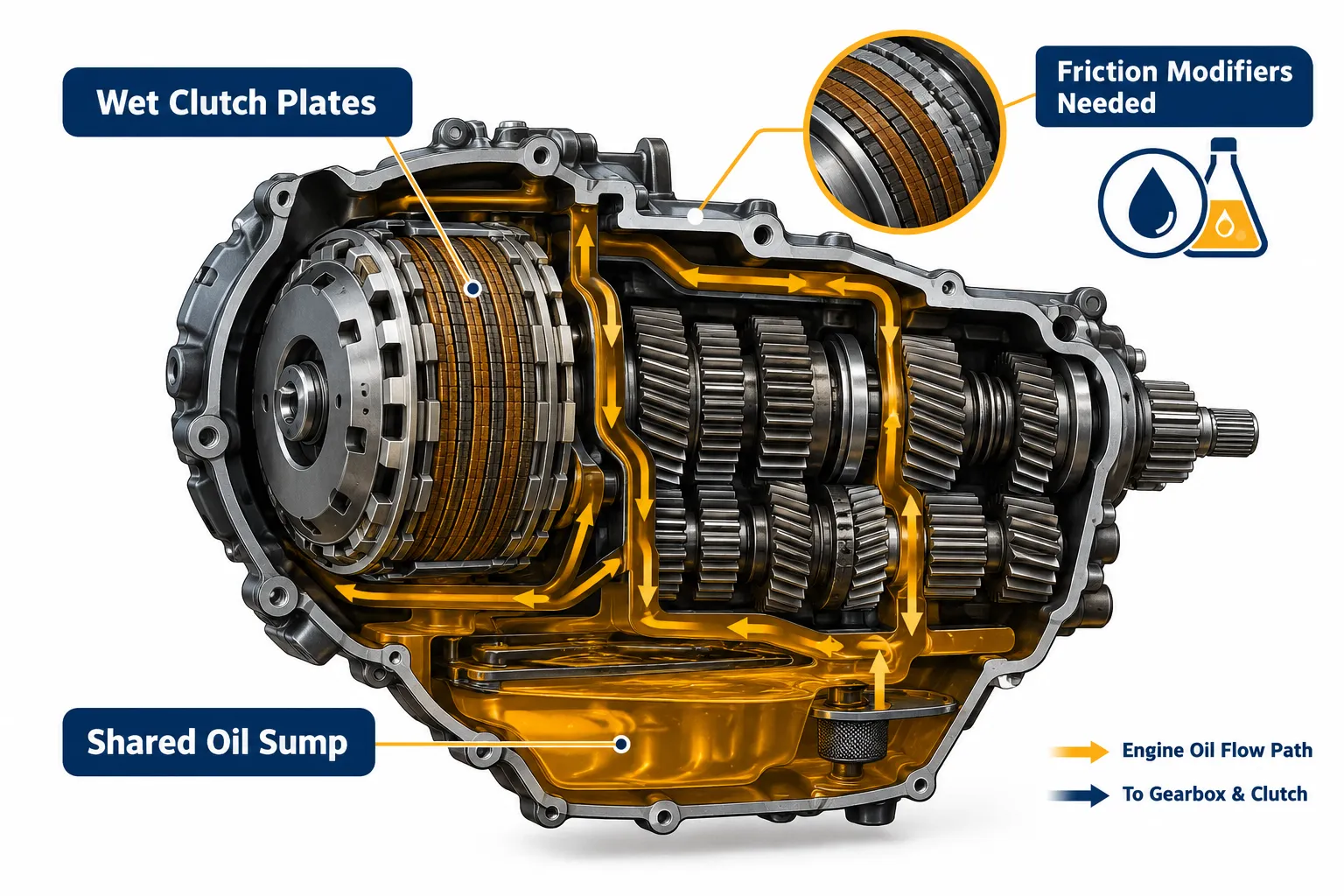
Choosing between MA, MA2, and MB is really a question of what kind of clutch and transmission the bike has. A 2026 consensus among mechanics and manufacturers is straightforward: if the bike has a wet clutch, which includes the overwhelming majority of standard, sport, and cruiser motorcycles, MA2 is the safer and more precise choice. If the bike is a scooter or uses a different clutch design entirely, MB-rated oil is correct, and using MA2 oil in that application would not cause harm but offers no benefit [3][10].
The official JASO approval lists, including documents that track engine and oil combinations tested against the standard, remain the most authoritative reference point for confirming whether a specific product meets MA2 requirements [1]. Riders who want certainty beyond the bottle’s marketing language can check these lists rather than relying on label claims alone.
API and JASO Together Define Top-Tier Motorcycle Oil
API, the American Petroleum Institute, rates oils for general engine protection, oxidation resistance, and additive performance. JASO ratings layer on top of that by specifically addressing wet-clutch friction behavior. In 2026, the consensus among lubricant engineers and major oil brands is that a genuinely top-tier motorcycle oil needs to satisfy both systems at once: an API service category appropriate for the engine’s design, combined with the correct JASO MA, MA2, or MB designation for the clutch type [4][7]. A bottle that only lists an API rating without a JASO stamp is a signal that it was formulated for cars, not motorcycles, and should generally be avoided in wet-clutch applications.
What Is the Best Oil for a Motorcycle? Synthetic vs Mineral vs Semi-Synthetic
Three base oil types dominate the motorcycle aisle: mineral, semi-synthetic, and full synthetic. Each has tradeoffs in cost, temperature stability, and interval length.
Mineral oil is refined crude oil with minimal processing. It is the least expensive option and works fine in older, low-revving engines or bikes that see light use. Its weakness is thermal stability. Mineral oil breaks down faster under high heat and high RPM, which shortens safe change intervals.
Semi-synthetic oil blends mineral base stocks with synthetic components. It splits the difference on price and performance, offering better heat resistance than pure mineral oil without the full cost of synthetic. Many commuter and mid-size bikes run well on semi-synthetic oil for years.
Full synthetic oil is engineered at the molecular level for consistent performance across a wide temperature range. It resists breakdown at high heat, flows better in cold starts, and generally holds its protective properties longer than mineral or semi-synthetic alternatives [4][7].
Current expert guidance in 2026 generally favors synthetic oil for sport bikes, high-revving engines, and bikes ridden hard or in extreme climates, while acknowledging that mineral oil remains an acceptable, budget-friendly choice for low-stress, low-mileage commuting on simpler engines [4][7]. Examples of current top-spec oils meeting modern standards typically carry both a JASO MA2 certification and a full synthetic base, positioning them as the default recommendation for most riders who want maximum protection and the longest safe interval between changes [7].
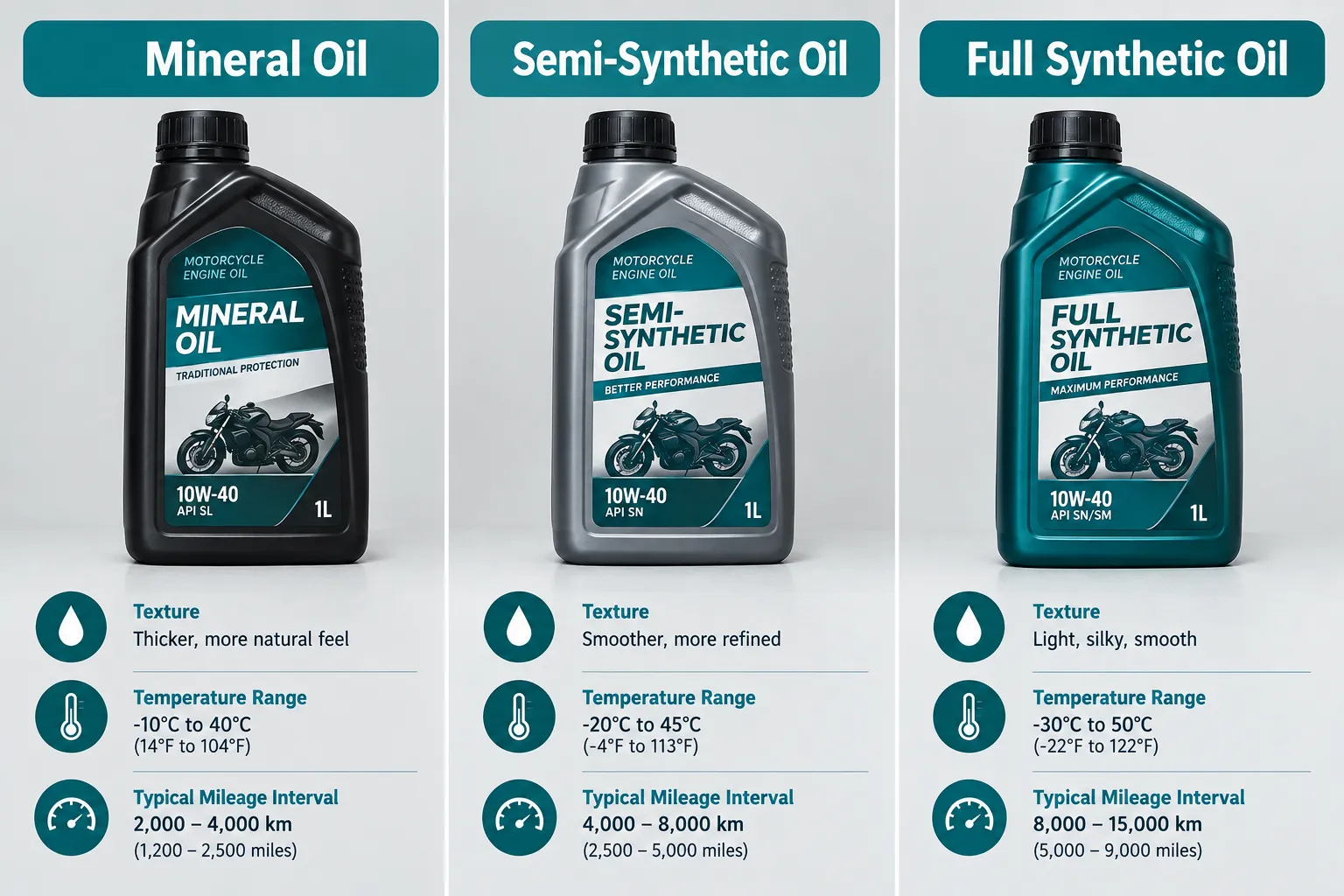
The practical tradeoff is cost versus interval length. Full synthetic oil costs more per bottle but often allows intervals nearly double that of mineral oil, which can close much of the price gap over a riding season.
Change Intervals: How Often Should You Change Motorcycle Oil
Oil change intervals depend on three things: the base oil type, the motorcycle category, and how the bike is actually ridden. Real-world data from 2026 service records suggests the following general ranges by oil type [8][9]:
| Oil Type | Typical Interval (Miles) | Typical Interval (Months) |
|---|---|---|
| Mineral | 3,000-4,000 | 3-4 |
| Semi-Synthetic | 4,000-6,000 | 4-6 |
| Full Synthetic | 5,000-8,000 | 6-12 |
Motorcycle category also shifts these numbers. Sport bikes and high-revving engines often call for shorter intervals because they spend more time at high RPM, which stresses oil faster even with synthetic formulations [5][9]. Touring and cruiser bikes with lower average RPM can sometimes stretch toward the longer end of the range. Off-road and adventure bikes that see dust, water crossings, and extreme heat cycles often need more frequent changes regardless of oil type, since contamination matters as much as thermal breakdown [9].
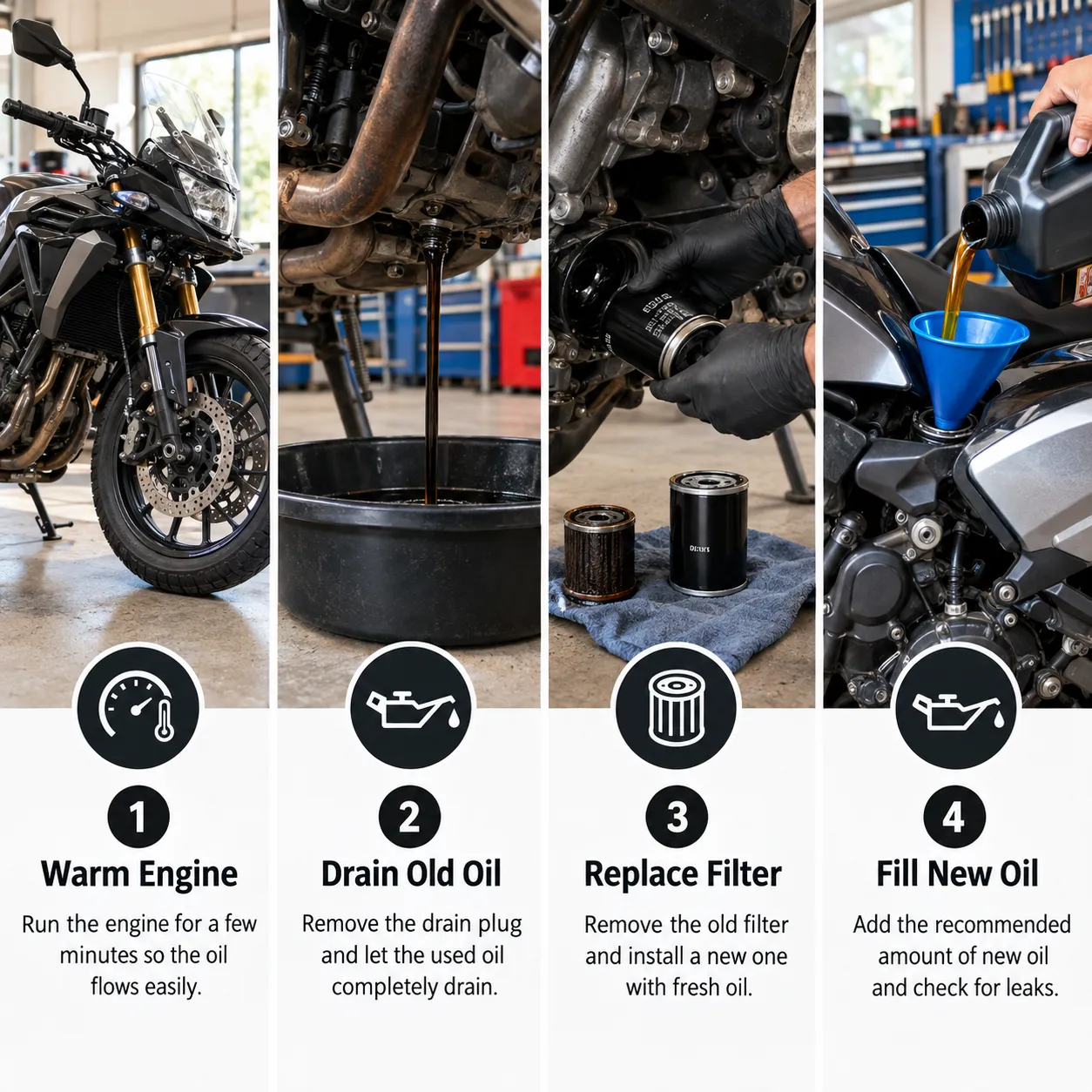
Brand-specific recommended intervals vary noticeably across manufacturers. Some sport bike makers specify intervals as short as 4,000 miles even with full synthetic oil, citing high-RPM operation, while some touring and cruiser brands extend to 8,000 miles or more under normal use [5]. The safest approach is always to default to the owner’s manual figure as the ceiling, then shorten that interval if the bike is ridden hard, used for towing, or exposed to dusty or wet conditions regularly.
Mileage is not the only trigger. A bike that sits unused for long stretches still needs attention, because oil picks up condensation and acids from combustion byproducts even when parked. Riders storing a motorcycle over winter should change the oil before storage, not after, so the engine is not sitting with contaminated oil coating internal components for months. For a full walkthrough of preparing a bike for cold-weather storage, see this guide to winterizing your motorcycle garage space.
Choosing Oil by Motorcycle Type: Air-Cooled, High-Mileage, and Storage Bikes
Different categories of motorcycles create different oil priorities, and this is where generic advice tends to fall short.
Air-cooled engines run hotter and have fewer ways to shed excess heat compared to liquid-cooled designs. These bikes benefit from thicker viscosity grades, such as 15W-50 or 20W-50, and many riders prefer full synthetic oil specifically for its superior high-temperature film strength. Classic cruisers and older standard bikes fall into this category most often.
High-mileage engines, generally those well past 40,000 or 50,000 miles, often develop slightly looser internal clearances from years of wear. A switch to a marginally thicker viscosity, or a high-mileage-formulated oil with added seal conditioners, can reduce minor leaks and restore some compression feel. This is similar to the logic used in high-mileage automotive oils, adapted for motorcycle-specific JASO requirements.
Small-displacement and scooter engines, including many commuter bikes under 150cc, typically call for thinner oils and, where the bike has no wet clutch, a JASO MB rating rather than MA2 [2][3]. These engines spin at different load profiles than larger sport or touring bikes, and using an oil built for a liter-class sport bike offers no real benefit here.
Stored or seasonal bikes need a pre-storage oil change, a full fuel system consideration, and ideally a short warm-up run before long-term parking to circulate fresh oil through every component. Riders setting up a dedicated space for bike storage and maintenance can find practical setup ideas in this guide to motorcycle garage organization.
Wet-clutch protection remains the thread that ties all of these categories together. Regardless of displacement, cooling method, or mileage, if the bike shares oil between the engine and a wet clutch, the JASO MA2 requirement takes priority over nearly every other consideration when selecting a bottle [3][6].
What Is the Best Oil for a Motorcycle? Practical Buying Checklist
Rather than memorizing every spec, riders can run through a short checklist at the parts counter or before ordering online:
- Check the owner’s manual viscosity grade first. This is the baseline; only deviate for documented climate or performance reasons.
- Confirm the clutch type. Wet clutch bikes need JASO MA or MA2. Bikes without a wet clutch, including most scooters, need JASO MB [3].
- Look for a dual API and JASO stamp on the bottle. This confirms the oil was formulated for motorcycles, not repackaged car oil [4][7].
- Match base oil type to riding style. Full synthetic for hard riding, high heat, or maximum interval length; mineral or semi-synthetic for light, low-stress commuting on a budget.
- Set the interval by the shorter of two numbers. Use whichever comes first between the manufacturer’s mileage figure and time-based figure, especially for bikes ridden infrequently.
- Change oil before storage, not just after. Fresh oil sitting in the engine during off-season storage protects internal components far better than old, acid-laden oil.
This checklist covers the practical core of what is the best oil for a motorcycle, viscosity, JASO ratings, synthetic oil, and change intervals for the overwhelming majority of street bikes on the road today. Riders researching a used bike’s maintenance history, including oil change records, can also cross-reference resale expectations using a motorcycle value lookup to see how consistent maintenance affects a bike’s worth over time.
Frequently Asked Questions
Does every motorcycle need JASO MA2 oil? No. Only wet-clutch motorcycles need MA or MA2. Scooters and bikes without a wet clutch should use JASO MB oil instead [3].
Is synthetic oil always better for a motorcycle? Synthetic oil offers better heat stability and generally longer intervals, but mineral oil remains acceptable for low-stress, low-mileage riding on simpler engines, particularly where cost is the main concern [4][7].
Can car oil be used in a motorcycle in an emergency? It is not recommended for wet-clutch bikes. Car oils often contain friction modifiers that can cause clutch slip, even for a single short ride [3].
How often should oil be changed on a bike that is rarely ridden? Time-based intervals matter as much as mileage for low-use bikes. Change the oil at least once a year, and always before long-term storage, regardless of how few miles were covered [8][9].
What viscosity is best for an air-cooled motorcycle in hot weather? Many air-cooled engines perform better on 15W-50 or 20W-50, which hold their protective film strength at sustained high temperatures better than thinner grades.
Conclusion
Picking the right bottle does not require a chemistry degree, but it does require checking three things every time: the viscosity grade matched to the climate and engine type, a JASO rating that matches the clutch design, and a base oil type that fits both the riding style and the budget. From there, the change interval should follow the manufacturer’s guidance first, adjusted down for hard riding, dusty conditions, or long periods of inactivity.
For most riders asking what is the best oil for a motorcycle, viscosity, JASO ratings, synthetic oil, and change intervals, the practical 2026 consensus points toward a full synthetic 10W-40 with a JASO MA2 certification for the majority of wet-clutch street bikes, with adjustments made for air-cooled engines, small-displacement commuters, and seasonal storage needs. Confirm the owner’s manual specification, check the bottle for both API and JASO markings, and set a realistic change schedule based on actual riding habits rather than guesswork. That single habit, repeated every few thousand miles, does more for engine longevity than almost any other maintenance task on the bike.
References
[1] 4t Ev List – https://www.jalos.or.jp/onfile/pdf/4T_EV_LIST.pdf [2] Best Engine Oil 100cc Bike – https://www.autodoc.co.uk/info/best-engine-oil-100cc-bike [3] Jaso Ma2 Vs Jaso Mb Which Engine Oil Powers Your Bs6 Bike Best In 2026 India – https://www.carbike360.com/articles/jaso-ma2-vs-jaso-mb-which-engine-oil-powers-your-bs6-bike-best-in-2026-india [4] Best Motorcycle Oil – https://itsbetterontheroad.com/posts/best-motorcycle-oil/ [5] Motorcycle Maintenance Checklist 2026 – https://motovault.app/blog/motorcycle-maintenance-checklist-2026 [6] Jaso Ma2 – https://ato24.de/en/motorbike-scooter-oil/motorbike-engine-oil/jaso-ma2.html [7] Best Motorcycle Oil – https://www.rokform.com/blogs/rokform-blog/best-motorcycle-oil [8] Motorcycle Engine Oil Change Intervals Kilometers – https://drivequip.com/motorcycle-engine-oil-change-intervals-kilometers/ [9] The Motorcycle Maintenance Schedule Every Rider Should Follow Quickref – https://www.carparts.com/blog/the-motorcycle-maintenance-schedule-every-rider-should-follow-quickref/ [10] Jaso Ma2 – https://www.auto-doc.ie/engine-oil/jaso-ma2