
Last Updated on November 16, 2026
Roughly 500,000 people now call an RV their permanent address, a number that has more than doubled since 2021. Another estimate puts full-time RV households closer to 1 million, with 54% of remote-work families running their jobs from the rig they live in. Those numbers prove one thing: there is no single “best” rig. The right answer to what is the best RV for full-time living? Class A vs Class C vs fifth wheel vs travel trailer depends on how much you drive, whether you tow, and how much space and storage your household actually needs[1][2].
This guide breaks down usable living space, driving difficulty, campground access, maintenance demands, fuel costs, towing requirements, and long-term livability for each RV class, so the decision fits your real life instead of a brochure.
Key Takeaways
- Fifth wheels generally win for couples and families planning long, stationary stays thanks to large tanks and residential layouts[1].
- Class A diesel motorhomes offer the most luxury and space but carry the highest price and maintenance burden[3][4].
- Class C motorhomes suit families who want to drive rather than tow, trading some storage for easier handling[1][4][5].
- Travel trailers are the most budget-friendly entry point but have thinner insulation and smaller tanks[1][5].
- Prioritize four-season insulation, large holding tanks, and dedicated workspace if you plan to live and work on the road full-time[1][6].
Comparing Usable Living Space and Daily Livability
Living space is the first thing full-timers notice once the honeymoon phase wears off. A rig that felt roomy on a weekend trip can feel cramped after six months of cooking, working, and storing gear in it.
Class A motorhomes, especially diesel pushers like the Thor Venetian F42, Tiffin, Newmar, and Entegra Coach, routinely exceed 35 to 40 feet with multiple slide-outs, separate climate zones, and washer/dryer prep built into the floorplan[3][4][7]. Fifth wheels come close on square footage without the driving cab eating into the layout. The Keystone Montana 3100RL, for example, runs about 35 feet 11 inches with 77 gallons of fresh water, 100 gallons gray, and 50 gallons black, tank capacity that matters enormously for extended stays off a sewer hookup[1].
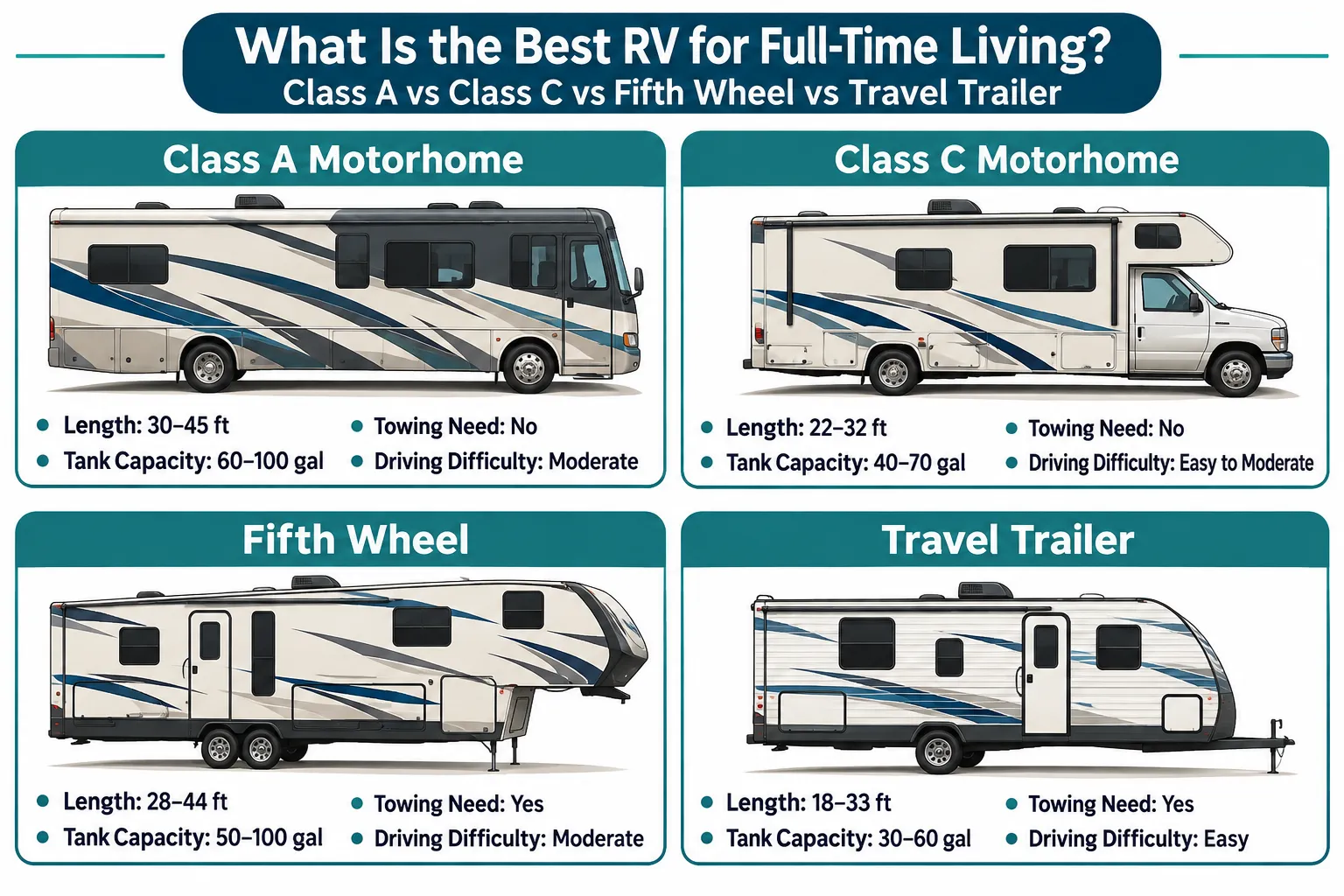
Class C rigs like the Winnebago Minnie Winnie 31K (about 32 feet 9 inches, GVWR 14,500 pounds, tanks around 44/30/20 gallons) sacrifice some basement storage and square footage in exchange for a drivable, family-friendly bunk layout[1][4][5]. Travel trailers such as the Forest River Wildwood or CrossRoads Zinger sleep anywhere from 4 to 10 people and offer residential-style kitchens, but generally have less storage and lighter insulation than a comparably sized fifth wheel[1][5]. If you’re weighing a smaller, more mobile setup against a true full-size towable, reviewing big RV lessons learned from full-time living can save months of trial and error.
Driving Difficulty, Towing Requirements, and Campground Access
This is where lifestyle preference really separates the four classes. Class A coaches drive like a bus, stable at highway speed but intimidating in tight parking lots, narrow mountain roads, or older campgrounds with low tree cover. Their length and turning radius also limit which campground sites and gas stations are realistic options.
Class C motorhomes split the difference. They are still drivable (no separate tow vehicle needed), but their shorter length and more car-like cab make parking and backing into sites noticeably easier for less experienced drivers[1][4][7]. This is a big reason experts recommend them for families who want to avoid towing altogether.
Fifth wheels and travel trailers require a capable tow vehicle and some backing-up skill, but they unhitch at the campsite, leaving a separate vehicle free for errands and sightseeing, a major quality-of-life advantage for full-timers who move only occasionally. Towing a fifth wheel demands a heavy-duty truck with proper hitch setup; getting that wrong is one of the most common mistakes new owners make, which is why reviewing a detailed RV travel day checklist and avoiding the common wrong way to RV travel pays off before your first long haul.
Campground access also varies by class. Smaller travel trailers and Class C rigs fit into more state park and older private campground sites. Large Class A diesel pushers and bigger fifth wheels often need pull-through sites or 50-amp, full-hookup resorts designed for bigger rigs, something to confirm before booking if you plan frequent moves.
Maintenance, Fuel Costs, and Long-Term Livability
Maintenance complexity scales directly with engine ownership. Class A and Class C motorhomes carry an engine, transmission, and chassis that need servicing like a commercial vehicle, on top of standard RV systems, generators, slide mechanisms, and plumbing[3][4]. Fifth wheels and travel trailers avoid engine maintenance entirely since they’re towed, which simplifies upkeep but shifts wear onto your truck.
Fuel costs follow the same pattern. Diesel Class A motorhomes and larger Class C rigs burn fuel constantly, even when just moving between sites, while a fifth wheel or travel trailer only adds fuel cost to the tow vehicle’s regular mileage, often a smaller bump if you’re already driving a capable truck daily.
For long-term livability, buyer guides updated through late 2026 consistently rate fifth wheels “Excellent” for full-time luxury living, with starting MSRPs around $85,000 for a Montana and $60,000 to $70,000 for well-equipped family fifth wheels. Travel trailers remain the budget-friendly path, often starting in the $32,000 to $35,000 range, but are better suited to moderate climates and park-based living rather than heavy boondocking[1][5]. Owners planning to upgrade a towable for true four-season use should look at proven fifth wheel upgrades that are genuine game changers.
Which Class Fits Which Full-Time Scenario
| Scenario | Best Fit | Why |
|---|---|---|
| Couple, mostly stationary | Fifth wheel | Largest tanks, residential layout[1] |
| Family wanting to drive, not tow | Class C | Easier handling, bunk space[1][4][5] |
| Luxury seekers, big budget | Class A diesel | Max space and amenities[3][4] |
| Tight budget, moderate climate | Travel trailer | Lower upfront cost[1][5] |
| Remote worker needing an office | Fifth wheel toy hauler | Garage doubles as workspace[1][8] |
What Build Features Actually Matter for Full-Timers
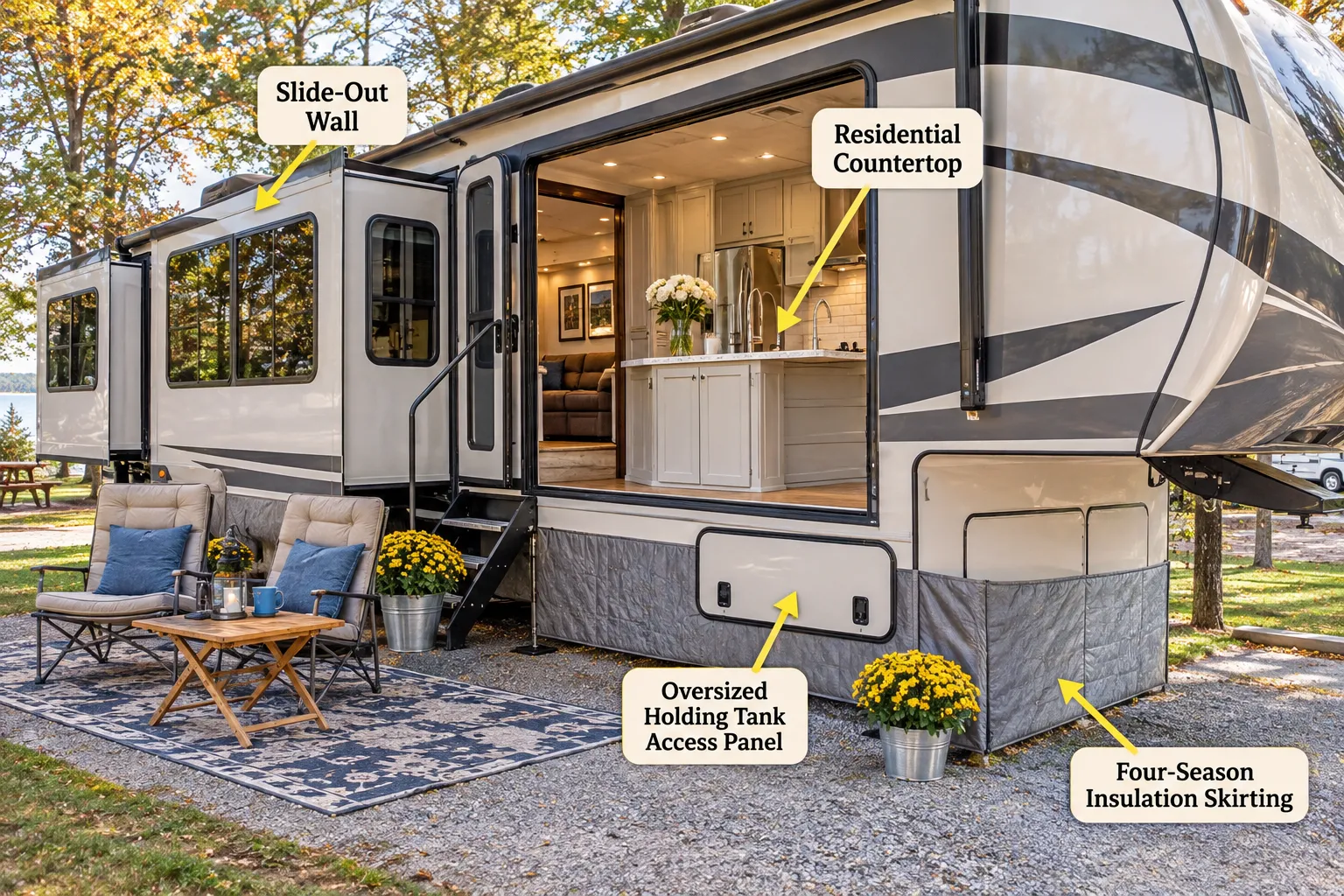
Regardless of class, the features that make or break full-time comfort are consistent: four-season insulation, dual-pane windows, strong heating and cooling, high cargo-carrying capacity, and oversized holding tanks for extended off-grid stretches[1][6]. Remote workers should prioritize dedicated office space, often a toy-hauler garage or spare room, along with a reliable residential or 12V fridge and washer/dryer prep[3][4].
“The best full-time rig isn’t the biggest one. It’s the one whose tanks, insulation, and layout match how you actually plan to live in it.”
Brand reputation matters more for full-timers than occasional campers, since you’ll be relying on factory support and parts availability for years. Newmar, Tiffin, Grand Design, Outdoors RV, Northwood, and Airstream consistently rank highest for full-time durability and service network strength[3]. Tiffin and Entegra Coach lead luxury Class A rankings, Winnebago and Forest River dominate Class C and B recommendations, and CrossRoads, Keystone, and Coachmen are frequently cited for family-friendly towables[3][4][5].
Rising housing costs are also reshaping demand. A late-2025 industry report noted more consumers researching RVs specifically as “an affordable place to live,” favoring units with greater storage and durable, long-stay construction[8]. The broader RV market is projected to hit $78.3 billion in 2026 and grow to $168.3 billion by 2033, confirming this isn’t a passing trend[9]. Expect to see more destination trailers and large toy-hauler fifth wheels with garage-office combos, like the Grand Design Momentum line, as manufacturers chase full-time buyers[1][5].
Conclusion
There’s no universal winner in the Class A vs Class C vs fifth wheel vs travel trailer debate, only the rig that matches your driving habits, budget, and daily routine. If you’re mostly parked and want residential comfort, a fifth wheel with four-season insulation and big tanks is the smartest long-term investment. If driving simplicity matters more than space, a Class C keeps things manageable. Deep pockets and a love of the open road point toward a Class A diesel pusher, while a travel trailer remains the most accessible entry point for new full-timers testing the lifestyle.
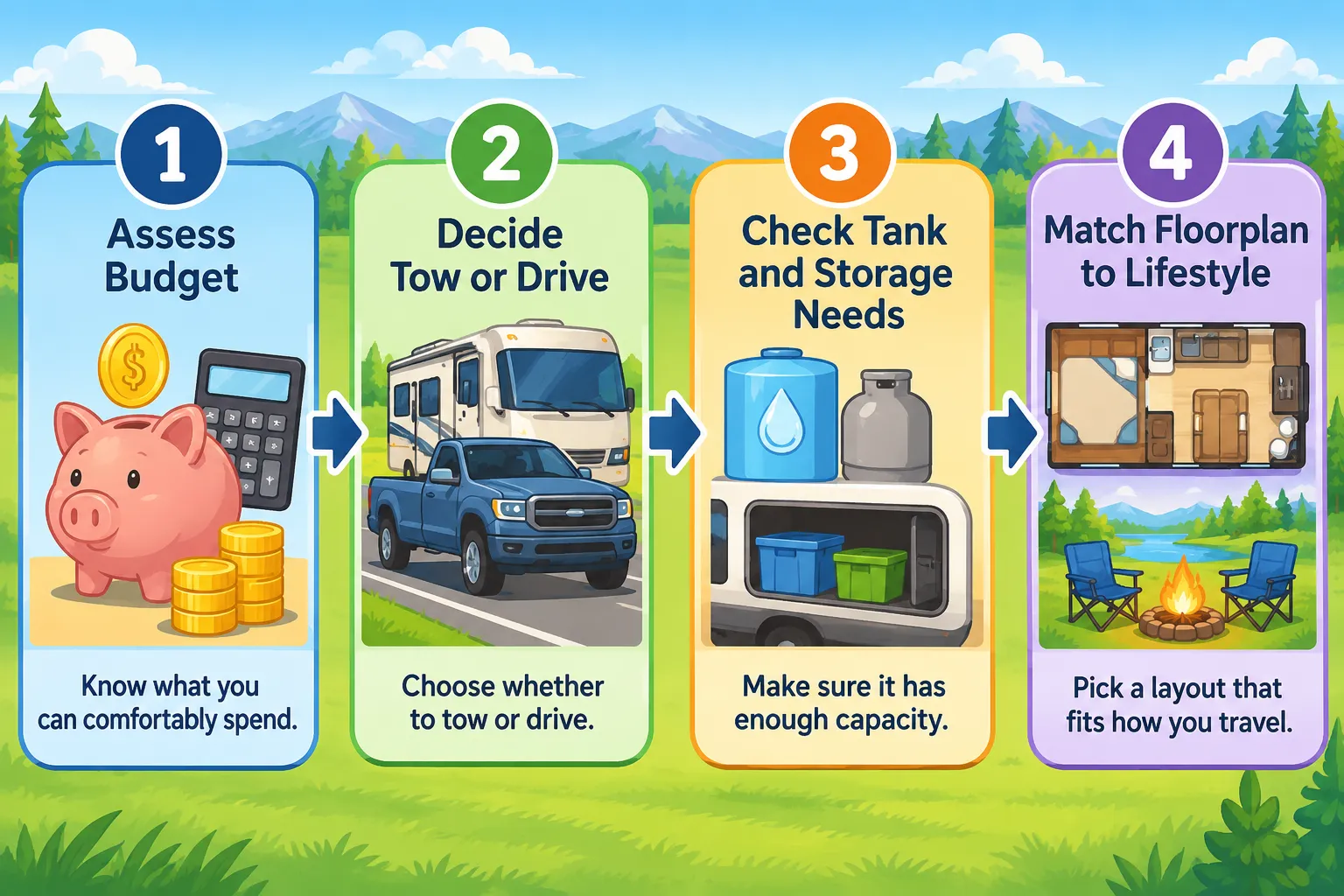
Before signing anything, walk through a model in person, check its tank sizes and insulation rating, and confirm your tow vehicle or driving comfort level matches the rig’s real-world demands. Start by comparing floorplans against your actual daily routine, kitchen use, workspace, and sleeping arrangements, rather than showroom appeal, and the right choice becomes obvious fast.
References
- Best Rv for Full Time Living. ecoflow.com.
- Best Rv for Full Time Living. campingworld.com.
- Best Rv Brands for Full Time Living Top Picks for Full Timers 258. popsells.com.
- Best Rvs. luxe.digital.
- Best Rv for Families. campingworld.com.
- Best Rv for Full Time Living. rvivy.com.
- Best Rv for Full Time Living. rvlife.com.
- Rv Market Sees New Growth as Consumers Seek an Affordable Place to Live. einpresswire.com.
- Recreational Vehicle Market. fairfieldmarketresearch.com.