
Last Updated on October 14, 2026
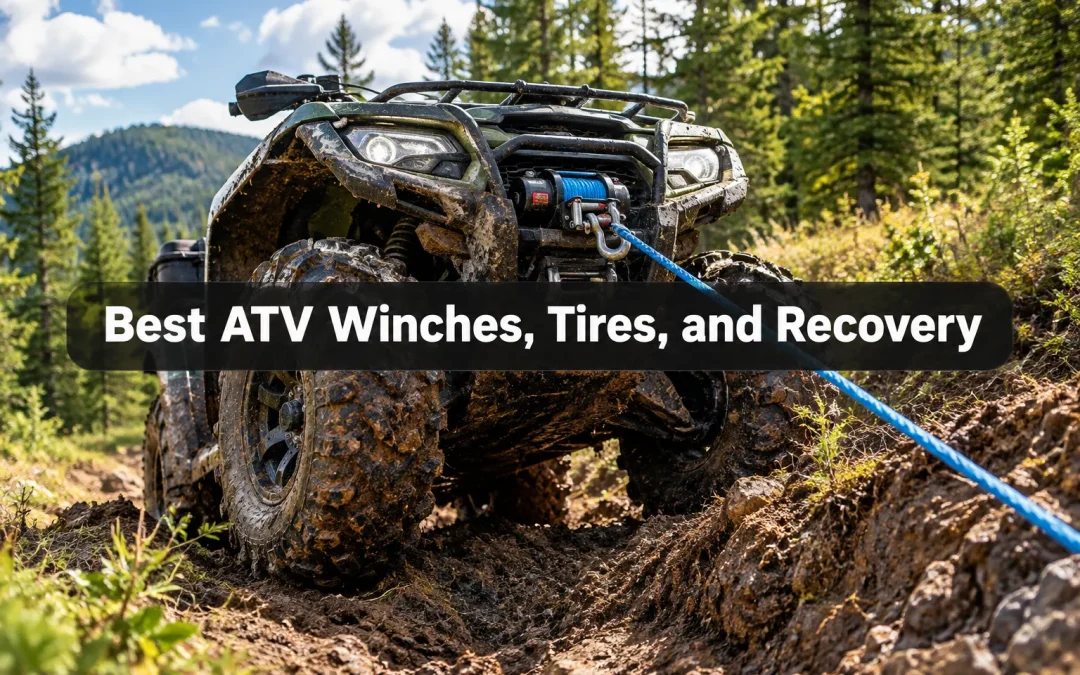
A stock ATV with factory tires and no winch will get stuck in the first serious mud hole it meets. That is not pessimism, it is physics. Factory machines are built for a broad range of light-duty riding, not for the specific punishment of deep mud, loose rock climbs, or hauling a loaded utility trailer across a wet pasture. Choosing the best ATV winches, tires, and recovery gear for mud, trails, and utility work means matching each component to your machine’s weight class and the terrain you actually ride, not just buying the biggest or cheapest option on the shelf.
This guide breaks down winch ratings, tire tread design, recovery point placement, tire pressure strategy, and the safety equipment that ties it all together, organized by use case so riders can skip straight to what applies to their rig.
Key Takeaways
- Most ATVs perform best with a 3000 to 3500 lb winch, while heavier UTVs and utility trailers call for 4500 to 5500 lb units for safe pulling margin.
- Synthetic rope and wireless remotes are now the baseline expectation on quality 2026 winches, improving safety and control in mud.
- Mud-specific tires like V-cut tread patterns self-clean better than traditional bogger tires, reducing the “smoothing over” effect that kills traction in deep slop.
- Recovery gear is a system, not a single product, fairlead, mounting plate, shackles, tree-saver straps, and gloves all matter as much as the winch itself.
- Lowering tire pressure and knowing your recovery points can prevent a stuck machine from becoming a damaged one.
Matching Winch Capacity to Your ATV and Use Case for Mud, Trails, and Utility Work
Winch shopping gets confusing fast because capacity numbers do not map directly to vehicle weight the way people assume. The standard rule of thumb among recovery gear manufacturers is to size a winch to at least 1.5 times the loaded weight of the vehicle, which accounts for friction, mud suction, and incline angle rather than just flat-ground towing.
For most recreational ATVs, that math lands squarely in the 3000 to 3500 lb range. Multiple 2026 comparison tests converge on this window as the sweet spot balancing pulling power, electrical draw on a stock ATV charging system, and overall cost [7]. Heavier UTVs, side-by-sides loaded with gear, or machines regularly used for utility work like log skidding and trailer recovery need to step up to 4500 to 5500 lb units to maintain that same safety margin [7].
Winch Capacity by Vehicle Type
| Vehicle or Use Case | Recommended Winch Capacity | Why |
|---|---|---|
| Light recreational ATV | 2500-3000 lb | Matches typical ATV curb weight with margin for mud suction |
| Trail-riding ATV, mixed terrain | 3000-3500 lb | Best balance of power, weight, and cost per most 2026 reviews |
| Heavier UTV / side-by-side | 4500 lb | Accounts for higher curb weight and passenger load |
| Utility work, trailers, steep technical terrain | 5000-5500 lb | Extra margin for rescue scenarios and loaded hauling [8] |
A retailer-level data point reinforces this pattern: a popular 3500-lb UTV and powersport winch from a major discount tool chain has racked up a 4.7-star average across more than 1,000 reviews, with the vast majority of buyers saying they would recommend it for quickly recovering UTVs and boats, and that same product guidance explicitly suggests 2,500 to 3,500 lb winches for standard ATV recovery tasks. That is a strong signal that the “bigger is always better” instinct can actually waste money and add unnecessary weight to a machine that will never need it.
Riders who are still deciding between a true ATV and a different class of off-road machine for utility duty might find it useful to first review the practical differences in the difference between 4×4 and 4×2 drivetrains before committing to a winch size, since drivetrain and curb weight both factor into the right capacity.
Best ATV Winches for Mud, Trails, and Utility Work in 2026
Once capacity is settled, the next decision is which specific winch delivers the best combination of reliability, waterproofing, and features for the price. Several models keep appearing at the top of independent 2026 testing across mud bogging, trail riding, and light utility scenarios.
WARN VRX 25 is the name reviewers reach for when long-term reliability matters more than anything else. It is repeatedly named Editor’s Choice in 2026 off-road recovery roundups for riders who treat their ATV like a work tool, plowing, hauling, and regular utility duty, rather than an occasional weekend toy. The appeal comes from all-weather sealing, backed customer support, and a reputation for simply not quitting in wet conditions [1][6].
SuperATV Black Ops winches, particularly the 3500 lb model, are the standout pick for riders whose primary battlefield is deep mud. The Black Ops line uses synthetic rope, strong waterproofing, and an integrated wireless control system, and several 2026 editors specifically call the Black Ops 3500 their top recommendation for anyone shopping for the best ATV winch this year, citing proven mud performance at a fair price point [1][2]. For UTV owners specifically, the larger Black Ops 4500 gets praised as one of the cleanest plug-and-play installs available, though that capacity sits above what most ATVs need.
OPENROAD 4500 shows up again and again as the “best value” winner. It pairs a 1.9 hp motor with synthetic rope, dual wireless remotes, and a dynamic brake, all while undercutting premium competitors by roughly $100 [1][2][3][4]. For budget-conscious riders who still want a near-ideal blend of power and features, this is consistently the editor’s choice for mixed mud, trail, and light utility use.
VIPER Midnight 4500 earns the title of top waterproof midrange winch. With IP68 sealing, a 1.8 hp motor, and about 100 feet of wireless remote range, it holds a 4.6-star average across roughly 390 customer reviews according to a September 2026 off-roading roundup, which positions it as a Best Overall pick for riders who regularly cross deep water or sloppy mud and still want USA-based support [3][4].
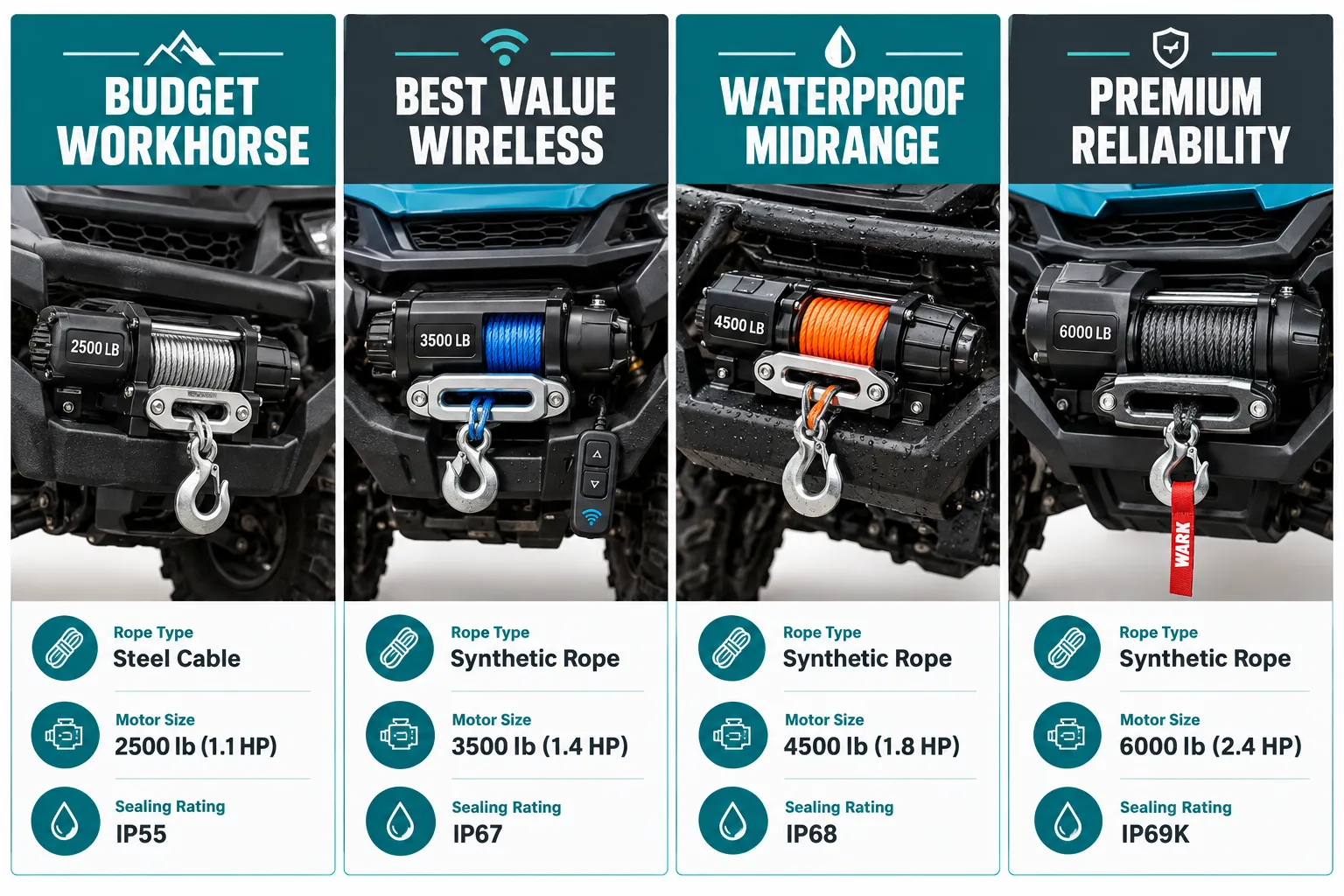
Champion 3000-lb ATV/UTV Winch Kit is the budget workhorse with the longest track record, dating back to 2013. At least one long-form 2026 test calls it the best ATV winch for off-roading this year based on durability under repeated use [3][5][9]. A dedicated mud-recovery review from October 2026 goes further, naming the Champion 3000-lb kit the best ATV winch for mud recovery specifically because its galvanized aircraft cable holds up over buried rocks and repeated muddy pulls better than many synthetic-rope competitors in that price tier [9].
Superwinch Terra 45 rounds out the premium durability category. Its sealed 1.6 hp motor, weather-sealed solenoid, bronze-bearing construction, and limited lifetime warranty make it a favorite among riders who view a winch as a decade-long investment rather than a seasonal accessory. One September 2026 recovery guide gives it the Editor’s Choice slot, while another calls it the safest long-term investment based on more than 1,880 verified reviews [7].
For heavier applications, riders should look at the Rough Country ProSeries 4500, ZESUPER IP67 units, or a tested STIMULATER 5500 lb winch, the highest capacity model in at least one September 2026 ATV/UTV comparison, positioned explicitly for heavy utility and rescue scenarios rather than casual recreational recovery [8].
Why Synthetic Rope and Wireless Control Matter
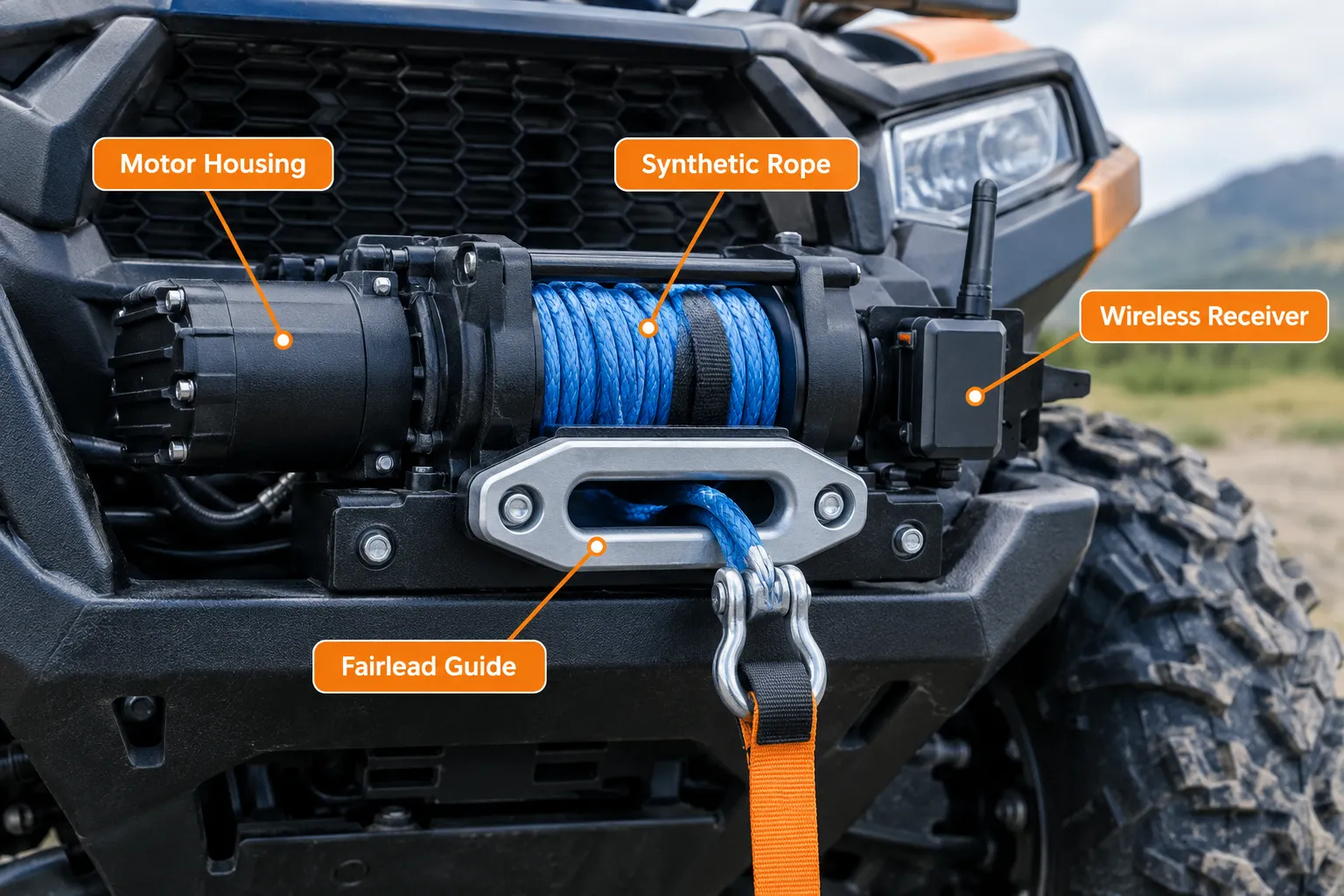
Steel cable used to be the default, but 2026 testing makes clear that synthetic rope and wireless remotes are now the expected baseline on any serious mud or trail winch. Synthetic rope weighs less, floats in standing water, and dramatically reduces the recoil danger if the line snaps under tension compared to steel cable [1][3][4][13 referenced generally]. Wireless remotes let the operator stand well clear of the line path during a pull, which matters most in mud where footing is unpredictable and a sudden slip could put someone directly in the rope’s recoil zone.
Riders comparing this gear against other off-road equipment upgrades may also want to check out general guidance on reliable off-road vehicles to understand how winch and recovery choices fit into a broader off-road reliability strategy.
Tires, Recovery Points, Air Pressure, and Safety Gear That Complete the Setup
A winch only pulls a machine out after it is already stuck. Tires, correct air pressure, and properly placed recovery points determine how often that winch actually gets used.
Tire Tread Patterns for Mud, Trail, and Utility Riding
“A tire that clogs with mud stops acting like a tire and starts acting like a smooth tube, all traction disappears the moment the tread fills in.”
That is the core problem factory mud machines are built to solve. Can-Am’s Outlander X MR 1000R, reviewed in detail in May 2025 and still relevant through the 2026 model year, ships with massive 30-inch ITP Cryptid tires using a V-cut tread pattern engineered to self-clean and dig through thick slop rather than packing solid [15, note: industry reporting]. The V-cut design throws mud outward as the tire rotates, which avoids the clogging and “smoothing over” problem seen in older bogger-style tread patterns. That self-cleaning action is now considered current best practice for deep-mud ATV tire design heading into the 2026 model year.
For riders who split time between mud, groomed trails, and utility hauling, a single aggressive mud tire is often the wrong call. Mud tires lose grip and wear unevenly on hard-packed trail or gravel, so a true mixed-use rig benefits from either a trail-biased all-terrain tire or a second tire set swapped seasonally.
Tire Pressure Strategy
Lowering tire pressure is one of the cheapest, most underused recovery tools available. A wider, softer contact patch floats better over soft ground and reduces the chance of digging straight down into a mud hole. General guidance for ATV mud and trail work:
- Hard-packed trail or gravel: manufacturer-recommended PSI, typically 4 to 7 PSI depending on tire size.
- Loose dirt or sand: reduce by roughly 1 to 2 PSI from baseline for a wider footprint.
- Deep mud or soft bog: reduce further, but stay above the point where the tire risks unseating from the bead, since a bead failure mid-mud turns a simple stuck situation into a flat-tire recovery.
Always re-check pressure before returning to higher-speed trail riding, since underinflated tires overheat and wear unevenly at speed.
Recovery Points and Rigging Gear
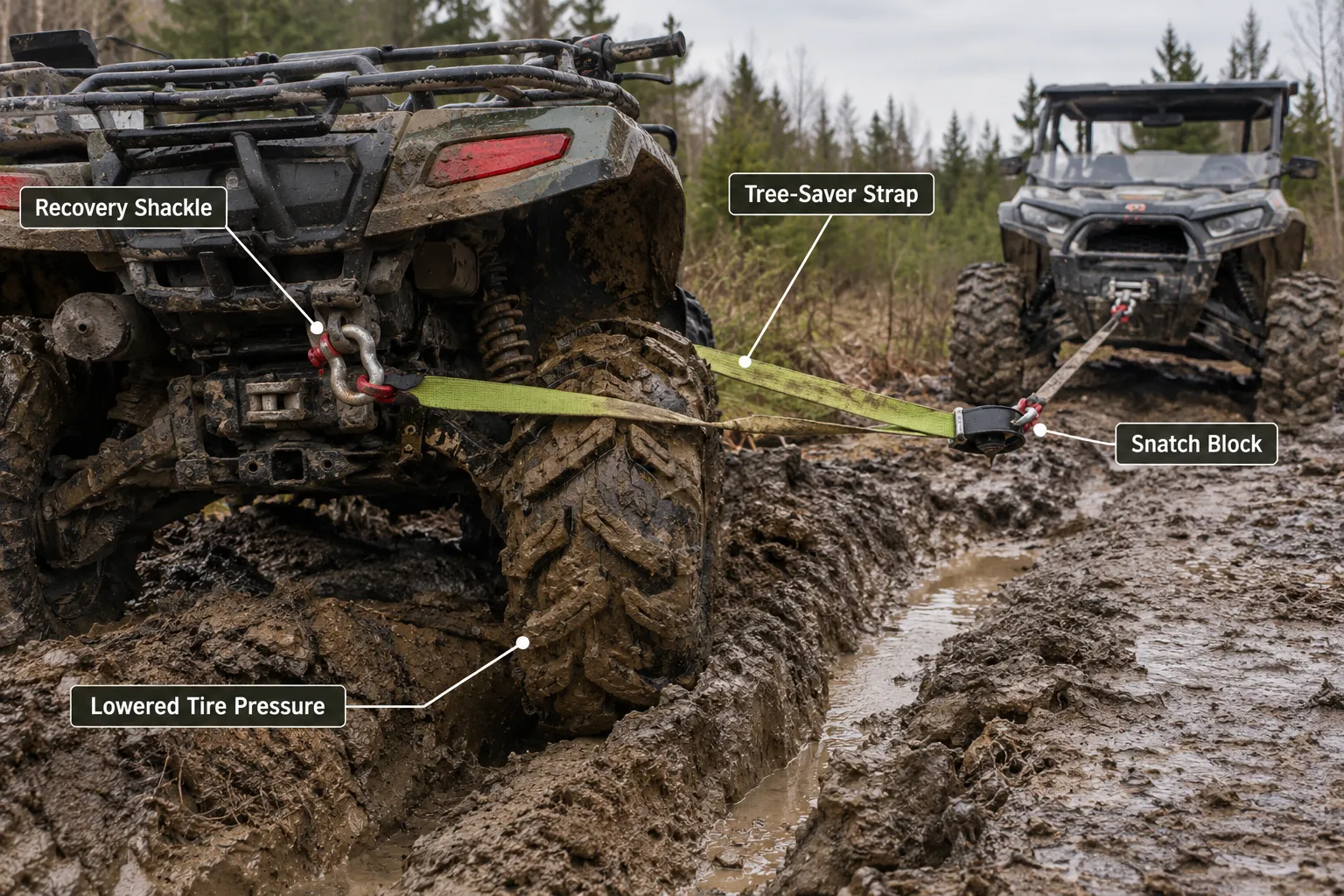
A winch is only as good as the point it is anchored to and the point it is pulling from. Off-road recovery guides in 2026 consistently stress that the winch is one part of a complete recovery system, not a standalone fix [6]. That system includes:
- Fairlead, guides the rope or cable straight onto the spool and prevents side-loading damage.
- Winch mounting plate, must match the ATV’s frame rating, not just bolt to plastic body panels.
- Snatch block, doubles pulling power and allows redirected pulling angles around obstacles.
- Tree-saver strap, protects the anchor tree’s bark and distributes load safely.
- Rated shackles, connect rope to strap or recovery point without introducing a weak link.
- Heavy gloves, protect hands from synthetic rope fray and steel cable burrs during handling.
These accessories receive less dedicated product testing than winches themselves in 2026 coverage, but their role in supporting safe recovery angles and controlled line loading is treated as essential, especially in mud where anchors and traction are already limited [6].
Before heading into technical terrain, riders should also build a basic preparedness habit around recovery scenarios, the same mindset covered in general guidance on preparing for shocking or unexpected incidents applies directly to planning for a stuck-machine emergency far from help.
Storing and Organizing Recovery Gear
Winches, straps, shackles, and spare tires take up real space, and gear that is buried under clutter does not get used correctly when a recovery situation turns stressful. Riders setting up a dedicated garage or shed space for ATV gear can borrow organization ideas from pet-friendly garage organization strategies or lighting upgrades from garage lighting transformation tips to keep recovery kits visible, labeled, and within arm’s reach before the next ride.
Seasonal storage also matters for riders who park machines over winter. The same principles used in seasonal motorcycle gear storage guidance apply well to ATV recovery straps and rope, which can degrade if left damp or exposed to UV light in an unheated shed.
Frequently Asked Questions
What size winch do I need for a standard ATV? Most recreational ATVs are well served by a 2500 to 3500 lb winch. This range covers typical curb weight with enough margin for mud suction and incline angles without overloading the ATV’s electrical system [7].
Is synthetic rope worth the extra cost over steel cable? Yes, for most mud and trail riders. Synthetic rope is lighter, floats in water, and significantly reduces recoil risk if the line fails under load, which is why nearly every top-rated 2026 winch now includes it standard [1][3][4].
Do I need a different tire for mud versus trail riding? In most cases, yes. V-cut and aggressive bogger-style tires dig through deep mud effectively but wear quickly and lose grip on hard-packed trail. Riders who split time between terrains often keep two tire sets.
How low should I drop tire pressure for mud recovery? There is no single universal number, since it depends on tire size and rim design, but the goal is a wider, softer contact patch without risking the bead unseating. Check manufacturer specs before making large pressure changes.
Can I use a UTV-rated winch on an ATV? Generally yes, as long as the mounting plate fits and the ATV’s electrical system can supply enough current, but it is usually unnecessary weight and cost. A 3000 to 3500 lb ATV-specific winch covers the vast majority of recreational and light utility needs.
Conclusion
Building out the best ATV winches, tires, and recovery gear for mud, trails, and utility work is not about chasing the single most powerful product on the market. It is about matching winch capacity to actual vehicle weight, choosing a tire tread designed for the terrain you ride most, and treating recovery gear as a connected system rather than a single purchase. A 3000 to 3500 lb winch like the Champion kit or OPENROAD 4500 covers most recreational riders, while heavier UTVs and utility trailers justify stepping up to 4500 to 5500 lb units like the Superwinch Terra 45 or STIMULATER 5500. Pair that winch with a self-cleaning mud tire pattern, correct tire pressure for the ground you are crossing, and a properly rigged recovery kit including shackles, straps, and a snatch block, and most stuck situations become a five-minute inconvenience instead of a call for outside help. Start by weighing your loaded machine, pick a winch capacity with real margin, and build the recovery kit around it before the next muddy trail finds you unprepared.
References
[1] Best Atv Winches – https://boundbyflame.com/best-atv-winches/ [2] Best Atv Winches – https://modelrec.com/best-atv-winches/ [3] Best Atv Winches – https://www.thirstybear.com/best-atv-winches/ [4] Best Atv Winches For Off Roading – https://www.oldsclub.org/best-atv-winches-for-off-roading/ [5] Best Atv Winches For Off Roading – https://marchforsciencesv.com/best-atv-winches-for-off-roading/ [6] Best Atv Winches For Off Road Recovery – https://www.haynet.net/best-atv-winches-for-off-road-recovery/ [7] Best Atv Winches – https://www.aquamarinepower.com/best-atv-winches/ [8] Best Atv And Utv Winches – https://www.propelrc.com/best-atv-and-utv-winches/ [9] Best Atv Winches For Mud Recovery – https://www.clevelandheart.com/best-atv-winches-for-mud-recovery/ [10] Best Atv Winches For Off Road – https://www.sarahleeandjohnny.com/best-atv-winches-for-off-road/