
Last Updated on October 18, 2026
Global electric vehicle sales just did something they had not done in six months: they shrank. In September 2026, worldwide EV deliveries slipped 2% year over year to 2.15 million units, even as year-to-date volume still sits 3% ahead of last year.[7][15] That single data point captures the whole story of the moment. EV demand shifts and regional polarization in the car market are no longer a forecast or a talking point among analysts, they are showing up on dealer lots, in factory production schedules, and in household driveways from Ohio to Oslo to Shanghai.
Buyers in Europe are snapping up EVs at record pace. Buyers in North America are walking past them toward hybrids. Buyers in China are still electrifying faster than anywhere else, but even there growth has cooled. This article breaks down what is actually happening, why it is happening, and what it means for anyone shopping for a new or used vehicle right now.
Key Takeaways
- US EV deliveries fell 36% in Q4 2025, 27% in Q1 2026, and 20.5% in Q2 2026 after the $7,500 federal tax credit for US-made EVs expired at the end of September 2025.[1][11]
- Hybrid sales in the US rose 18% from March to May 2026 compared with the same period a year earlier, while fully electric sales dropped 16% over the same window.[2]
- Global EV sales fell 2% year over year in September 2026, but Europe posted record highs while North America dropped 44% and China fell 18%, proving the market is polarizing by region rather than collapsing everywhere.[7][14][15]
- Hybrids now make up about 19% of total US retail vehicle sales, up from roughly 16% before a gasoline price spike tied to the Iran war pushed more buyers toward fuel-flexible options.[4][9][12]
- Automakers that bet early on hybrids, including Toyota and Hyundai, are capturing demand that EV-first companies like General Motors are now scrambling to catch up on.[4][5][10]
The Great Divide: EV Demand Shifts and Regional Polarization in the Car Market Explained
The phrase “global EV market” has started to lose meaning. What used to be a single growth story is now three separate stories running in opposite directions at the same time. Understanding EV demand shifts and regional polarization in the car market means looking at each region on its own terms instead of averaging them into one misleading global number.
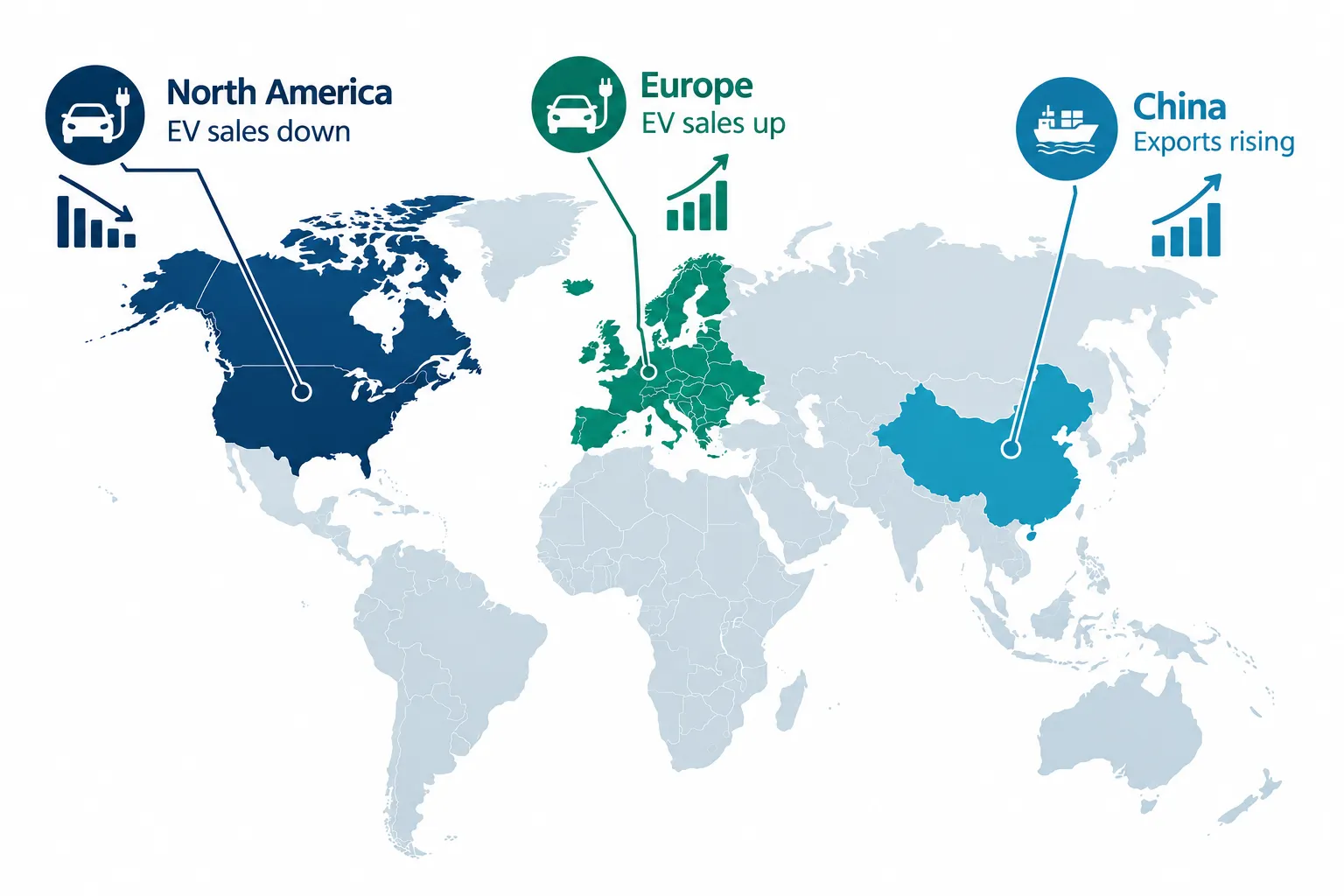
In the United States, the picture is one of retreat. Cox Automotive data cited by Business Insider shows EV deliveries falling 36% in the fourth quarter of 2025, 27% in the first quarter of 2026, and 20.5% in the second quarter of 2026.[1][11] That is three straight quarters of steep decline, not a one-time dip. The trigger is clear: the $7,500 federal tax credit for US-built EVs expired at the end of September 2025, and without that price cushion, many buyers simply walked away from electric showrooms.
Europe tells the opposite story. After a summer slowdown, European EV sales jumped 62% month over month heading into September 2026, pushing the region to record-high volumes.[7][14][15] Stricter emissions rules, denser charging networks in major cities, and continued purchase incentives in several countries have kept European demand climbing even as America’s cools.
China remains the largest EV market in the world by far, with 1.11 million units sold in September 2026 alone.[7][14][15] But even the world’s electrification leader is not immune to the slowdown. Sales there fell 18% year over year and are down 13% year to date, forcing Chinese automakers to lean harder on exports to keep factories running at capacity.[7][14][15]
Put side by side, the numbers make the polarization impossible to ignore.
| Region | September 2026 EV Sales Trend | Primary Driver |
|---|---|---|
| North America | Down 44% year over year | Expired $7,500 federal tax credit[1][11] |
| Europe | Record highs, up 62% month over month | Emissions rules, incentives, infrastructure[7][14][15] |
| China | 1.11 million units, down 18% year over year | Market saturation, price competition[7][14][15] |
This is not a global EV collapse. Year-to-date global volumes are still up 3% at 15.5 million units.[7][15] It is a redistribution of demand, with some regions pulling forward growth and others stalling out entirely.
Why US EV Sales Are Sliding While Hybrids Surge
America’s EV slowdown is not happening in isolation. It is happening alongside a hybrid boom that is reshaping what “buying electrified” means for millions of households. Between March and May 2026, US hybrid sales ran 18% higher than the same three months in 2025, while fully electric vehicle sales dropped 16% year over year in the same window.[2] That is a clean pivot, not a coincidence.
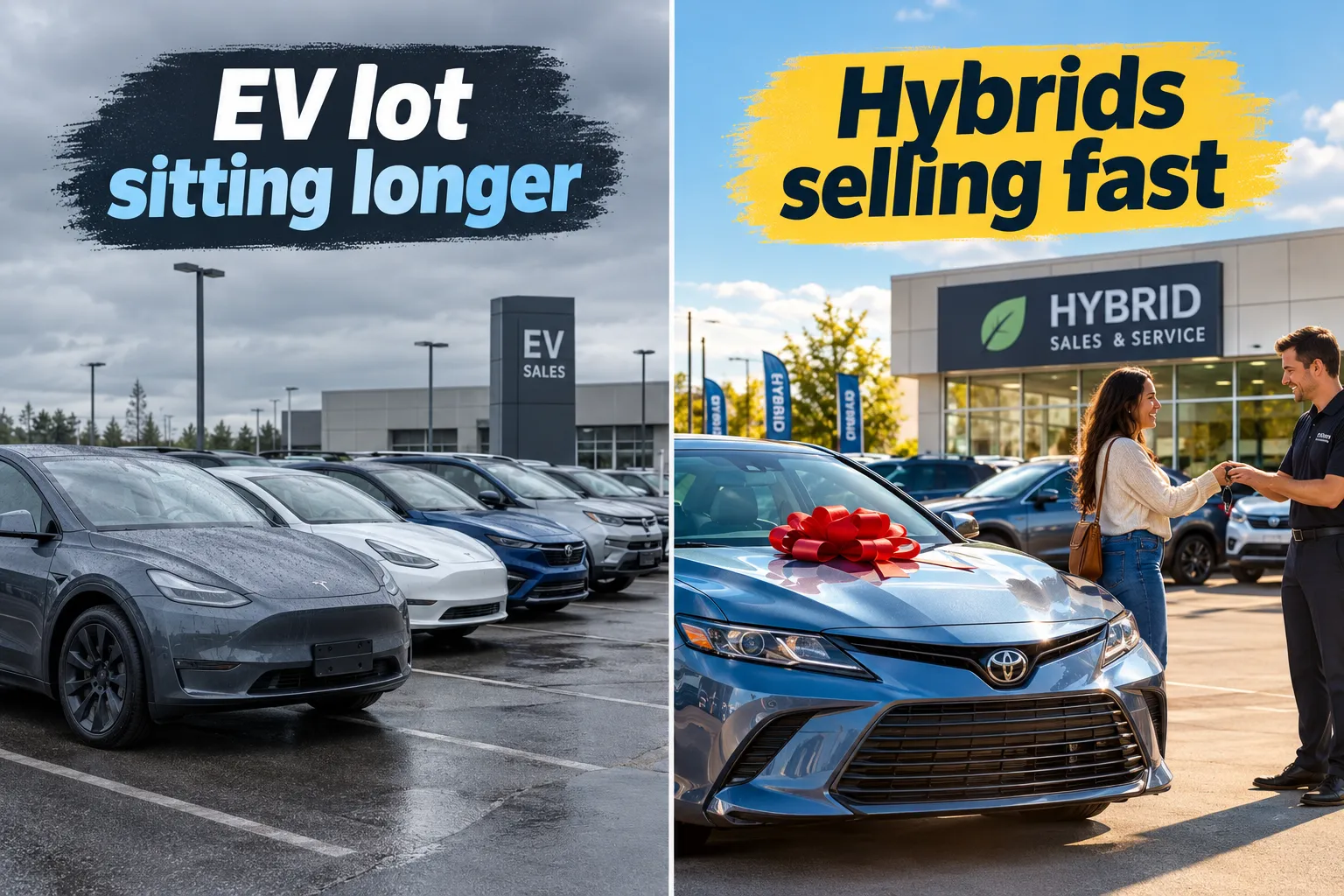
Argonne National Laboratory data reported in October 2026 reinforces the trend. Hybrid sales stayed above 216,000 units per month through the summer, while battery-electric vehicle sales actually slid from 101,000 units in May down to 86,000 by August.[2] Hybrids held steady while EVs lost ground month after month.
Hybrids now account for roughly 19% of total US retail vehicle sales as of August 2026, up from about 16% before a sharp gasoline price spike tied to the Iran war pushed prices roughly 40% higher.[4][9][12] When fuel costs jump that fast, buyers who are not ready to go fully electric often land on hybrids as the practical middle ground.
Demand for hybrids has actually outpaced the supply dealers can keep on their lots. Cars.com data shows shopper interest in hybrids running at roughly double their actual share of dealer inventory.[5][9] Days-on-lot for new hybrids fell to just 46 days in August, compared with 73 days for the average new vehicle.[5][9] Hyundai’s hybrid sales jumped 39% in September and 35% for the full third quarter, with hybrids making up 28% of the brand’s September volume.[5][9]
Why are buyers choosing hybrids over pure EVs right now? Analysts at the Los Angeles Times and USA Today point to three consistent reasons:[3][12][13]
- Lower upfront cost. Hybrids typically carry smaller price premiums than comparable EVs, especially now that the federal tax credit is gone.
- No range anxiety. A hybrid can be driven coast to coast without planning around charging stops.
- No dependence on public chargers. Charging infrastructure remains uneven across the country, while every gas station works for a hybrid.
The US Energy Information Administration adds a quieter but telling data point: light-duty EVs consumed nearly 14 billion kWh of electricity in the first half of 2026, just 8% more than the prior six months.[6] That modest growth rate, well below the pace seen in prior years, directly tracks the drop in new EV sales after incentives expired.[6] Fewer new EVs on the road means slower growth in electricity demand from them, a ripple effect that extends well beyond car dealerships.
Shoppers weighing a hybrid against a traditional gas vehicle should look closely at the trade-offs involved. A detailed breakdown of hybrid vs gas car ownership costs can help clarify whether the fuel savings justify the price difference in your specific situation.
Regional Polarization in the Car Market: How Automakers Are Responding
Automakers do not get to ignore regional demand swings, they have to build factories, order parts, and plan production years in advance. That makes the current EV demand shifts and regional polarization in the car market a genuine strategic headache for every major manufacturer.
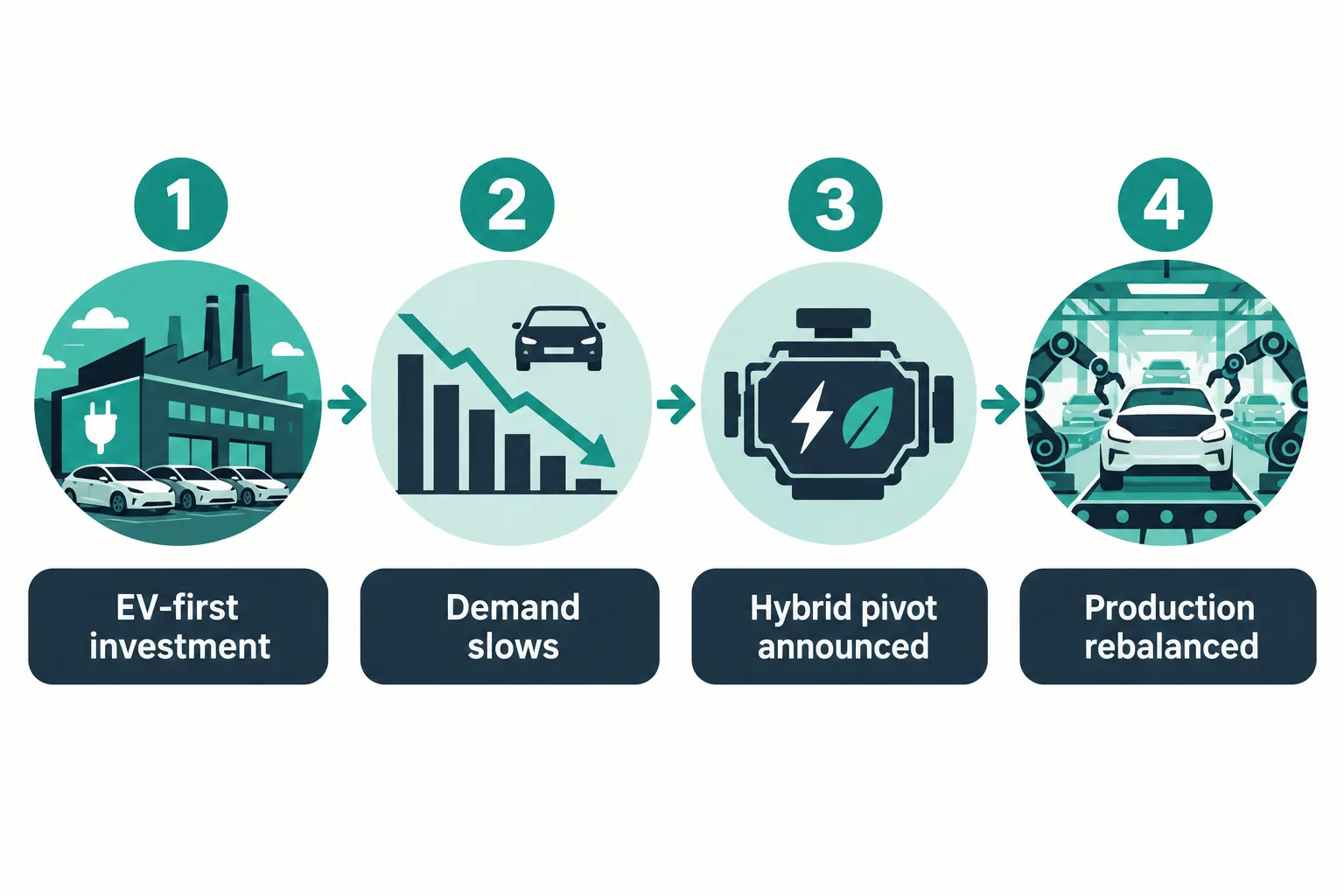
General Motors is the clearest example of a company caught flat-footed. GM bet heavily and early on an EV-first strategy, investing billions in battery plants and all-electric platforms. That bet looked smart when EV demand was climbing steadily. Now, with hybrids outselling EVs on a growth basis in the US, GM is publicly signaling a pivot toward hybrid models after effectively missing the current hybrid boom.[4][10][13]
Contrast that with Toyota and Hyundai. Both companies invested in hybrid technology years before it became fashionable again, and they are now capturing the lion’s share of spiking hybrid demand.[4][5][10][13] Hyundai’s 39% September jump in hybrid sales did not happen by accident, it happened because the vehicles were already designed, tooled, and sitting in the pipeline when demand surged.[5][9]
The broader sales outlook reflects this rebalancing. Industry analysts expect total US light vehicle sales to slip from about 16 million units in 2025 to roughly 15.7 million in 2026, even as hybrids gain share and EVs stagnate.[8][9][13] That combination tells a specific story: electrification in North America is advancing mostly through hybrids right now, not through fully electric vehicles.[8][9][13]
Chinese automakers are responding to their own slowdown differently. With domestic EV sales down 18% year over year and 13% year to date, manufacturers there are pushing harder into export markets to keep production volumes up.[7][14][15] That export push is partly why European EV sales have been able to climb so fast, Chinese brands are actively competing for European buyers who are already primed to go electric.
For buyers trying to make sense of which brands are adapting well, it helps to look at how established automakers are repositioning their lineups. Readers researching mainstream brands might find it useful to compare Volkswagen’s 2026 model lineup and pricing or check Mazda’s used car pricing and reliability ratings as examples of brands navigating the hybrid-versus-EV question with different strategies.
“Electrification is still happening, it’s just happening through hybrids instead of pure EVs in North America right now.” This framing, echoed across multiple industry analyses, captures the core shift buyers need to understand.[8][9][13]
What the EV and Hybrid Shift Means for Car Shoppers Right Now
If you are shopping for a new or used vehicle in 2026, these regional and powertrain shifts have direct, practical consequences. Here is what matters most for your buying decision.
For new vehicle shoppers:
- Hybrid inventory is tight. With days-on-lot for hybrids nearly 40% shorter than the average new vehicle, expect less negotiating room and fewer discounts on popular hybrid trims.[5][9]
- EV pricing may soften. With US EV demand down sharply for three consecutive quarters, some automakers and dealers are offering more aggressive incentives to move electric inventory, even without the federal credit.[1][11]
- Gasoline prices remain a wildcard. The roughly 40% spike tied to the Iran war already pushed hybrid demand higher once; another spike could tighten hybrid supply further.[4][9][12]
For used vehicle shoppers:
- Used EV values have been affected by the same demand slowdown hitting new EVs, which can mean better deals on the secondary market for buyers comfortable with electric ownership.
- Checking accurate valuation tools matters more than ever in a shifting market. Resources like Edmunds True Market Value, the Blue Book car value guide, and NADAguides vehicle pricing can help confirm whether an asking price reflects current demand realities rather than outdated assumptions.
- If you are specifically evaluating a used vehicle’s worth before negotiating, this guide on how to determine the value of your used car walks through the process step by step.
A quick decision framework:
| If you… | Consider… |
|---|---|
| Drive long distances regularly and lack home charging | A hybrid, given current supply constraints and no charging dependency[3][12] |
| Have reliable home or workplace charging access | An EV, potentially at a better price due to softening demand[1][11] |
| Live in a region with strong charging infrastructure (parts of Europe or California) | Either option remains viable; local incentives matter more[7][14] |
| Want to minimize fuel cost volatility | A hybrid or EV, both outperform pure gas vehicles when fuel prices spike[4][9] |
The underlying lesson is that there is no single “right” powertrain answer anymore. The right choice depends heavily on where you live, how you drive, and what infrastructure is actually available to you, which is exactly why regional polarization matters so much for individual buyers, not just automakers.
Conclusion
The data is consistent across every source: EV demand shifts and regional polarization in the car market are reshaping the auto industry in real time. The United States is pulling back from pure EVs and surging toward hybrids, driven by the loss of federal tax credits and a spike in gasoline prices.[1][2][4][12] Europe is doing the opposite, posting record EV sales as emissions rules and infrastructure investments pay off.[7][14][15] China remains the largest EV market on earth but is cooling at home while pushing harder into exports.[7][14][15]
None of this means electrification is stalling globally, year-to-date EV volumes are still up 3% worldwide.[7][15] It means the path to electrification now runs through different vehicles and different regions depending on where you are standing. For American buyers specifically, hybrids have become the practical bridge technology that EVs were supposed to be, at least for now.
Before your next vehicle purchase, take three concrete steps: check current regional demand data for the specific model you want, compare hybrid and EV total cost of ownership using tools like the hybrid vs gas car comparison, and verify pricing against trusted valuation guides before negotiating. The market is moving fast in different directions depending on where you shop, make sure your decision reflects where things actually stand today, not where they stood even a year ago.
References
[1] Evs Automakers Axed This Year 2026 3 – https://www.businessinsider.com/evs-automakers-axed-this-year-2026-3 [2] Americans Want Electric Cars They Just Cant Find Them 293901 – https://theconversation.com/americans-want-electric-cars-they-just-cant-find-them-293901 [3] Hybrid Cars Are Hot Again Globally – https://www.latimes.com/environment/story/2026-08-15/hybrid-cars-are-hot-again-globally [4] Gms Ev First Bet Leaves It Sidelines Us Hybrid Boom 2026 09 16 – https://www.reuters.com/business/autos-transportation/gms-ev-first-bet-leaves-it-sidelines-us-hybrid-boom-2026-09-16/ [5] Gas Price Effect Hybrid Demand Is Outstripping Supply Report 121335781 – https://finance.yahoo.com/markets/article/gas-price-effect–hybrid-demand-is-outstripping-supply-report-121335781.html [6] Us Ev Electricity Consumption Energy – https://energiesmedia.com/us-ev-electricity-consumption-energy/ [7] Global Ev Sales Fall 2 In September – https://www.atinitonews.com/2026/10/global-ev-sales-fall-2-in-september/ [8] North American Ev Demand Slows As Hybrids Gain Momentum And Automotive Oem Strategies Reset – https://www.fastmarkets.com/insights/north-american-ev-demand-slows-as-hybrids-gain-momentum-and-automotive-oem-strategies-reset/ [9] Car Buyers Have Chosen Hybrids Some Automakers Werent Ready – https://www.autoweek.com/news/a74103962/car-buyers-have-chosen-hybrids-some-automakers-werent-ready/ [10] Gm Says Hybrid Vehicles On The Way As Asian Carmakers Capture Spiking Demand – https://www.thedailyupside.com/industries/autos/gm-says-hybrid-vehicles-on-the-way-as-asian-carmakers-capture-spiking-demand/ [11] Evs Automakers Axed This Year 2026 3 – https://www.businessinsider.com/evs-automakers-axed-this-year-2026-3 [12] Hybrid Cars Are Hot Again Globally – https://www.latimes.com/environment/story/2026-08-15/hybrid-cars-are-hot-again-globally [13] Car Buyers Have Chosen Hybrids Some Automakers Werent Ready – https://www.autoweek.com/news/a74103962/car-buyers-have-chosen-hybrids-some-automakers-werent-ready/ [14] Global Ev Sales Fall 2 In September – https://www.atinitonews.com/2026/10/global-ev-sales-fall-2-in-september/ [15] Global Ev Sales Fall 2 In September – https://www.atinitonews.com/2026/10/global-ev-sales-fall-2-in-september/