Last Updated on November 5, 2026
A used Harley-Davidson that costs $9,000 to buy can easily cost another $20,000 to $35,000 to keep running over five years. That gap between sticker price and real ownership cost surprises a lot of first-time buyers who assume the hard part is finding the bike. In 2026, understanding how much does a used Harley-Davidson cost to own involves insurance, service, tires, storage, and common repairs matters just as much as the purchase price, because these recurring costs can rival or exceed what you paid for the motorcycle itself.
This guide breaks down real numbers by model family and age, separates one-time purchase costs from recurring expenses, and shows which maintenance tasks you can handle in your own garage versus which ones belong with a certified technician.
Key Takeaways
- Monthly ownership costs for a used Harley range from about $350 to $900+ depending on model, with Sportster S bikes at the low end and Road Glide touring models at the high end.
- A used Harley bought around $8,000 can realistically require $10,000 to $12,000 in total first-year costs once insurance, maintenance, tires, gear, and registration are added [1].
- Routine dealer service typically runs $300 to $1,000 per year, while a single tire replacement costs $150 to $500 [2].
- Insurance varies widely by model and coverage level, from around $44 to $208 per month for full coverage, with touring Harleys like the Road Glide often landing near the top [3].
- DIY maintenance like oil changes and air filters can cut costs significantly, but belt, transmission, and electrical work usually require a specialist.
Purchase Price vs. Recurring Costs: Why the Sticker Price Is Only the Start
New Harley pricing in 2026 starts around $9,999 for entry-level models and climbs past $50,000 for premium CVO trims, with popular models like the Sportster S, Street Glide, and Road Glide falling between roughly $15,999 and $51,999. Used models sell below these figures, but the ongoing costs of ownership track closely with the original model, since insurance, tires, and service pricing depend on the bike itself, not just its age.
This is the core mistake many buyers make: they budget for the purchase and forget the recurring side. A dealership pricing guide advises riders to set aside “several hundred to a few thousand dollars per year” for insurance, routine maintenance, and gear, and that advice applies just as strongly to a ten-year-old Softail as it does to a brand-new one.
If you’re cross-shopping against other brands before settling on a Harley, it’s worth reviewing how Harley-Davidson vs Honda Motorcycles in 2026 compare on pricing and long-term reliability, since that comparison highlights where Harleys tend to run higher on upkeep.
Monthly Ownership Budgets by Model Family
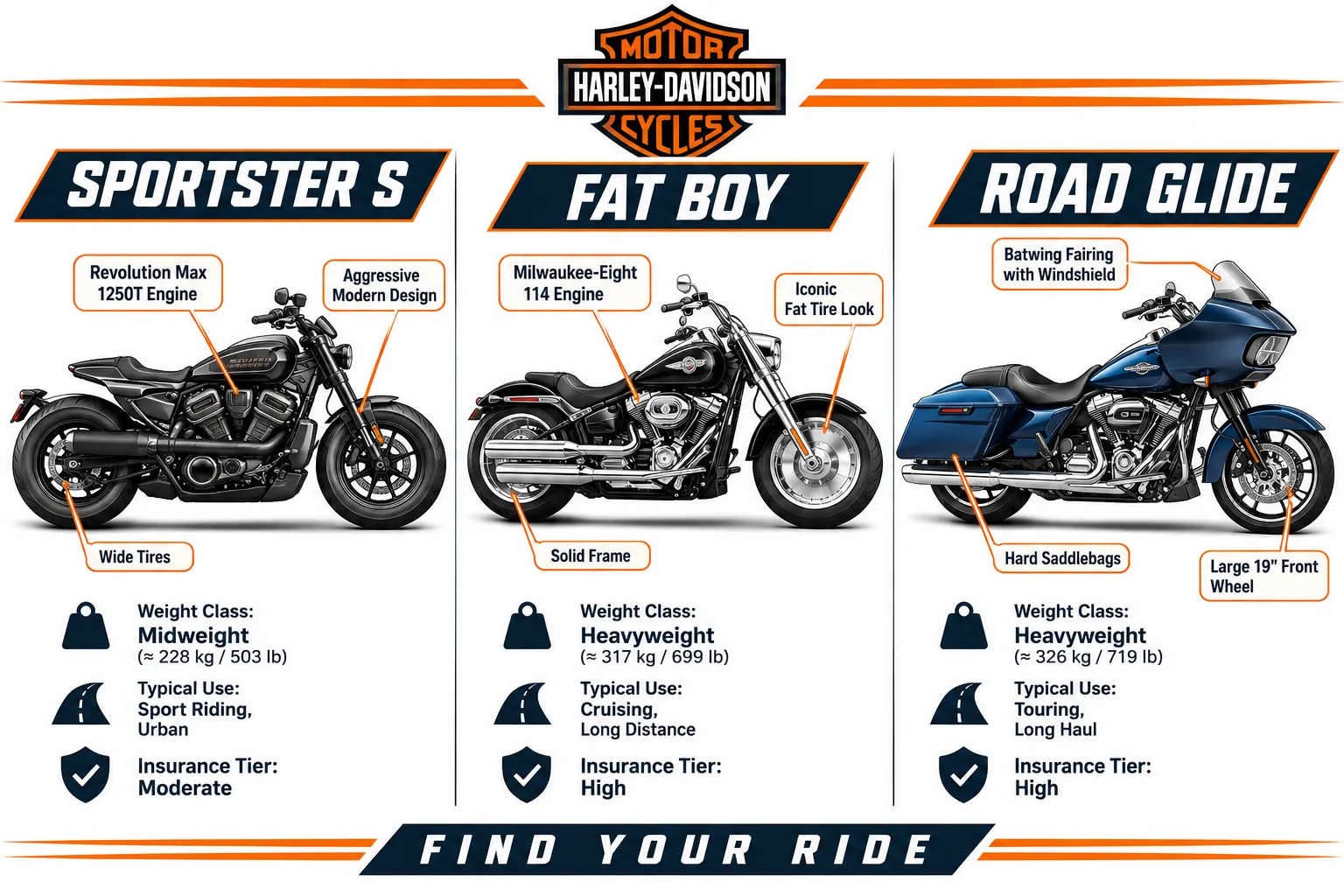
Answering how much does a used Harley-Davidson cost to own involves insurance, service, tires, storage, and common repairs requires looking at specific models rather than averages, because weight, engine size, and typical use change the math significantly.
Based on 2026 cost-of-ownership analysis, here’s how monthly totals (payment, insurance, fuel, maintenance, tires, and incidentals) typically break down:
| Model Family | Estimated Monthly Total | Why |
|---|---|---|
| Sportster S | $475,$675 | Lighter weight, smaller tires, lower insurance tier |
| Fat Boy | $600,$800 | Heavier cruiser, bigger tires, moderate insurance |
| Road Glide | $650,$900+ | Grand American Touring class, highest insurance and tire costs, long-distance riding wear |
The overall spread across most riders lands between roughly $350 and $900+ per month. Heavier touring bikes sit at the high end largely because of higher insurance premiums, larger and pricier tires, and the simple fact that touring riders log more highway miles, which accelerates wear on consumables.
A separate but complementary data point comes from a 2026 insurance-cost guide: for a used motorcycle purchased around $8,000, a realistic first year of ownership can reach $10,000 to $12,000 once insurance, maintenance, tires, gear, registration, and extras are factored in [1]. While that figure isn’t Harley-specific, it closely mirrors what many owners of mid-range used cruisers and touring Harleys actually experience in the current market [1].
Insurance Costs: The Biggest Variable in How Much Does a Used Harley-Davidson Cost to Own
Insurance is where cost estimates diverge the most, and it’s worth understanding why. Harley-Davidson’s own insurance arm reports a national average motorcycle insurance cost of about $721 per year, or roughly $60 per month [4]. Other Harley-branded pages quote a lower average of about $519 per year ($43 per month), and a broader 2024 overview cites a nationwide average closer to $396 per year ($33 per month) [5][6]. These numbers are cross-brand averages, and big-twin Harleys plus touring models tend to sit above the low end because of their higher value and typical usage patterns [3][5][7].
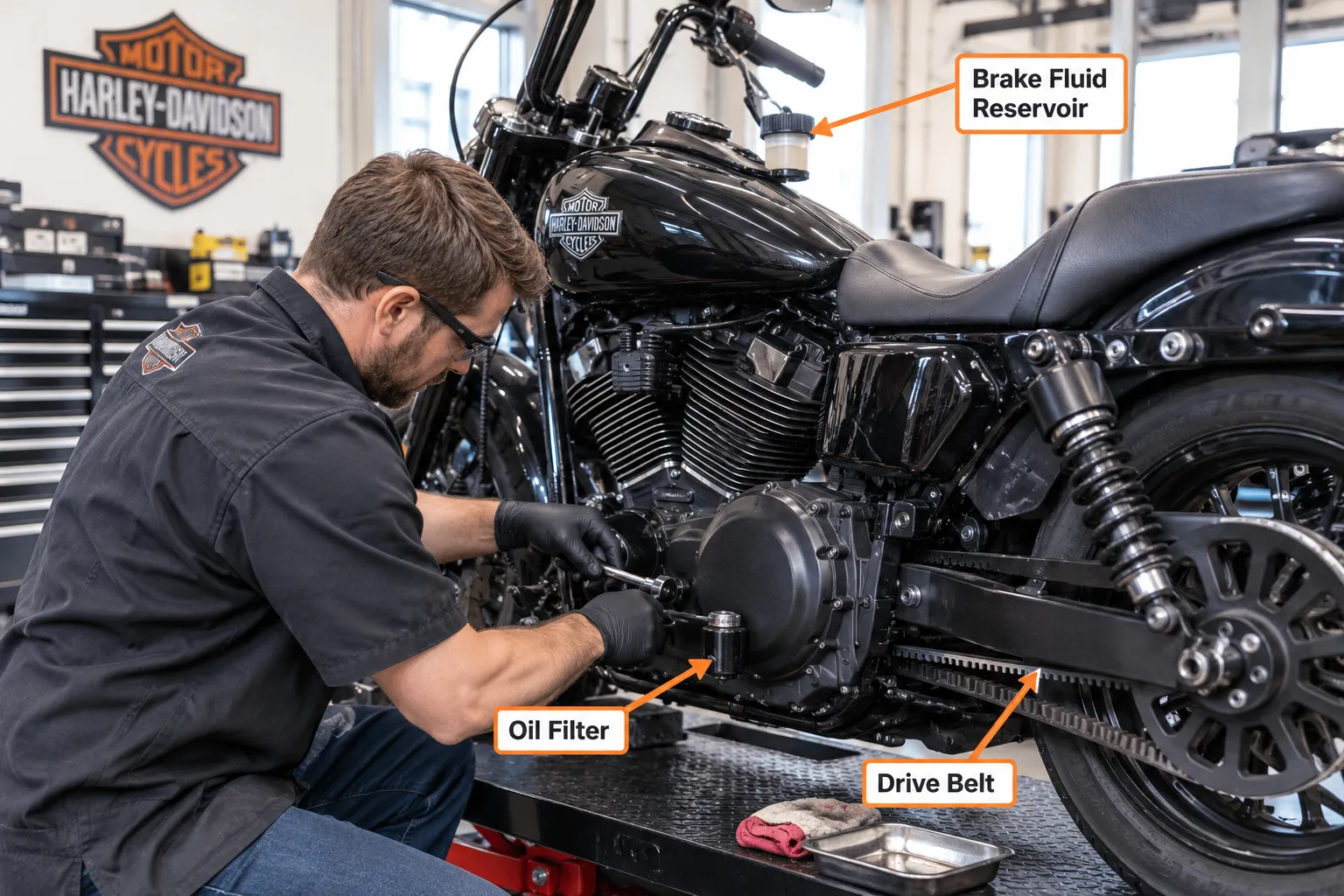
Independent 2026 data gets more specific. One customer-data analysis finds full-coverage motorcycle insurance generally runs $44 to $208 per month, with concrete examples of about $128 per month for a Harley-Davidson Street Glide and about $168 per month for a Harley-Davidson Road Glide [3]. A separate 2026 summary citing Insurify reports average premiums of about $68 per month for minimum coverage and $148 per month for full coverage across brands, which suggests a fully insured touring Harley will often land near or above that full-coverage average.
Several factors influence where your premium falls within these ranges:
- Deductible choice: Common deductibles cluster between $250 and $1,000, and lower deductibles raise your premium [8].
- Coverage for customizations: Accessory and custom-parts coverage adds cost but protects aftermarket investments [7].
- Discounts available: Home-owner status, claim-free history, completed rider safety courses, multi-bike policies, and Harley Owners Group (H.O.G.) membership can all lower your bill [5][9].
H.O.G. membership itself costs $59 per year and includes a 5% discount on Harley-Davidson Insurance policies, with a few state exclusions like California and Tennessee. Pairing that membership with a completed safety course is one of the most practical ways to trim insurance costs on a used Harley, especially for newer or higher-risk riders [9].
If you’re weighing a Harley purchase against a car-based vehicle and want a sense of how insurance and depreciation compare across categories, the Porsche and Mercedes-Benz used cars buying guide offers a useful parallel on how coverage choices shift total ownership cost.
Service and Maintenance: What Routine Upkeep Actually Costs
Harley-Davidson’s own service department guidance suggests most riders spend roughly $300 to $1,000 per year on routine service, including oil changes, scheduled mileage services, and inspections [2]. A full three-hole oil service at a dealer typically runs $150 to $300 [2].
Mileage-based service costs follow a fairly predictable pattern:
- 1,000-mile service: roughly $250,$400
- 2,500/7,500-mile check-ups: roughly $125,$175
- 5,000-mile service: roughly $330,$410
- 10,000-mile comprehensive service: roughly $315,$400 [2]
Over a five-year span, a typical cruiser or touring Harley owner spends about $2,000 to $5,000 on maintenance, according to a detailed five-year ownership breakdown. That figure includes engine oil and filter changes, primary and transmission fluid service, air filter replacement, brake fluid changes, drive-belt inspections, and occasional battery replacement [2]. A combined service visit covering several of these tasks is commonly described as costing “several hundred dollars” per visit [2].
DIY-Friendly vs. Specialist-Required Maintenance
Separating what you can do yourself from what needs a trained technician is one of the clearest ways to control costs on a used Harley.
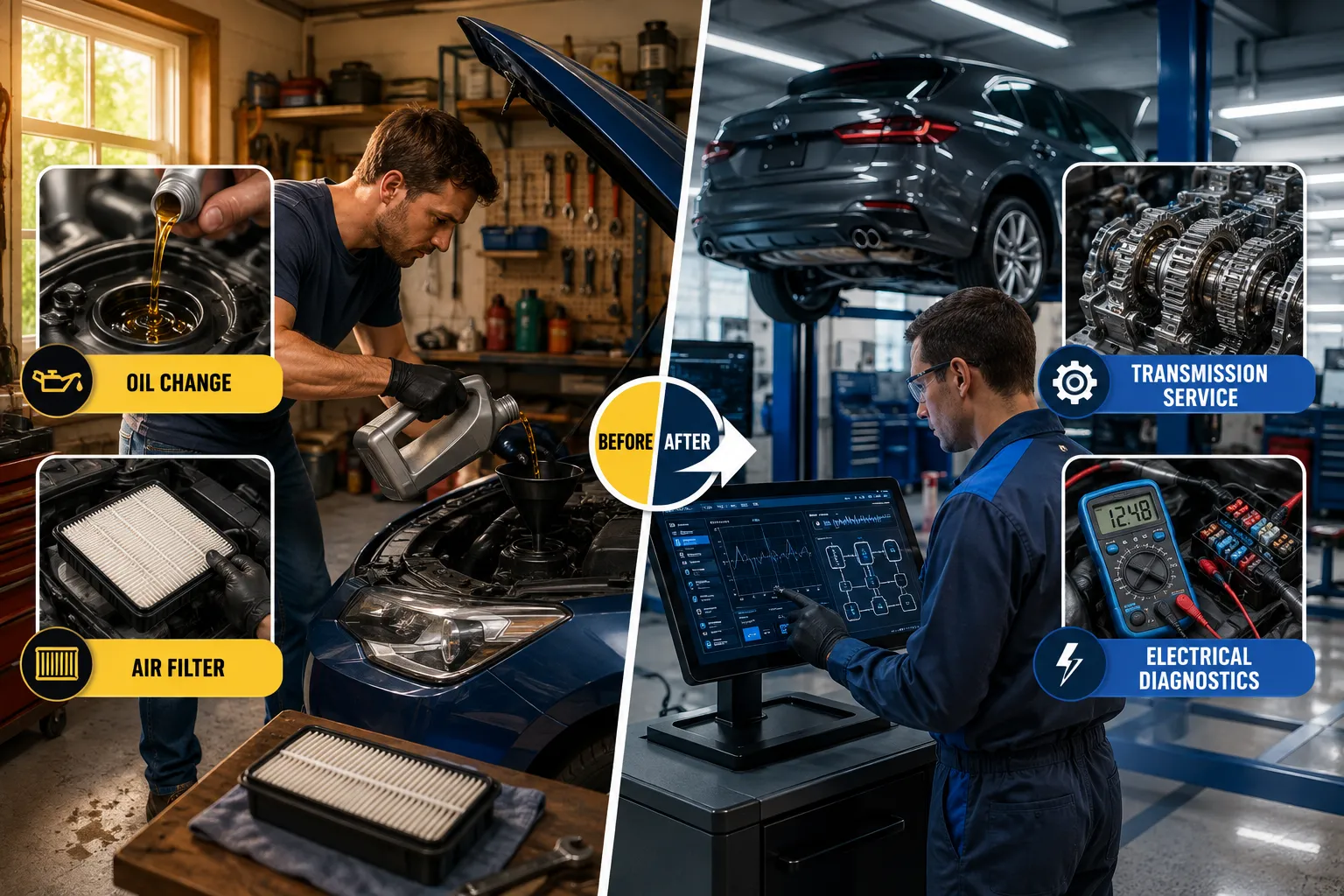
Tasks most owners can handle at home:
- Engine oil and filter changes
- Air filter replacement
- Battery checks and terminal cleaning
- Brake fluid top-offs and visual pad inspection
- Tire pressure monitoring and visual tread checks
Tasks that typically require a dealer or specialist:
- Primary and transmission fluid service (requires specific tools and torque specs)
- Drive-belt replacement and tension adjustment
- Transmission or clutch diagnostics
- Electrical system troubleshooting (charging system, ECU faults)
- Any work affecting warranty coverage on a certified pre-owned bike
If you’re deciding whether to buy from a dealer versus a private seller, the reliability data in Most Reliable Used Cars to Buy in 2026 illustrates how documented service history influences long-term reliability across vehicle categories, a principle that applies directly to used motorcycles too.
Tires: A Predictable but Significant Expense
Tires are one of the most forecastable costs in Harley ownership, and also one of the most underestimated by new buyers. A single Harley tire generally costs $150 to $500 depending on size and brand, and riders are advised to plan on a new set roughly every 10,000 to 20,000 miles [2].
A broader five-year ownership analysis estimates a full set of quality replacement tires runs $400 to $800 before installation, with typical owners spending $1,000 to $3,000 on tires over five years [2]. Heavier cruisers and touring bikes tend to sit at the higher end of this range because their larger tires cost more and wear faster under sustained highway speeds.
Budgeting for tires in advance rather than treating them as a surprise expense is one of the simplest ways to avoid a budget shock on a used Harley, especially if you’re buying a bike that’s already logged several thousand miles since its last tire change.
Storage Costs: The Missing Piece in Most Ownership Estimates
Unlike insurance, service, and tires, storage costs don’t have a clean nationwide figure. Several recent Harley and motorcycle ownership analyses explicitly break out insurance, maintenance, tires, fuel, depreciation, and accessories, but none provide a robust national statistic for storage, because it varies so widely by region and setup.
Riders generally fall into three storage categories:
- Home garage space: Free if you already have it, but requires climate consideration in humid or freezing regions.
- Commercial vehicle storage: Monthly fees vary by region and facility type, often ranging from modest to several hundred dollars depending on climate control and security.
- Shared or seasonal facilities: Common for riders who store bikes during winter months in colder states.
Because of this variability, authoritative 2025-2026 cost-of-ownership estimates recommend adding local storage or parking charges on top of the documented budgets for insurance, service, and tires rather than relying on a single universal number [1]. If you’re building a winter storage plan, the strategies in Winterizing Boat Storage Ideas That Work translate surprisingly well to motorcycle storage, particularly around moisture control and battery maintenance during off-season months.
Common Repairs and How to Budget for Them
Beyond routine service, used Harleys eventually need repairs tied to age and mileage rather than a fixed schedule. The most common repair categories include:
- Drive belt replacement: Typically needed between 20,000 and 40,000 miles depending on riding style.
- Battery replacement: Common every 3 to 5 years, more frequent in extreme climates.
- Charging system repairs: Stators and voltage regulators can fail on higher-mileage bikes.
- Fork seals and suspension work: More common on bikes with 30,000+ miles.
- Clutch and primary chain wear: Shows up gradually and is best caught during routine inspections.
Following manufacturer-recommended service intervals consistently is the best defense against expensive surprise repairs, since many of these issues are caught early during routine maintenance visits [2].
Putting It All Together: A Five-Year Cost Snapshot
A detailed five-year cost-of-ownership breakdown for a typical Harley cruiser or touring model estimates:
- Insurance: $3,000,$8,000
- Maintenance: $2,000,$5,000
- Tires: $1,000,$3,000
Adding these together with the purchase price, total five-year running costs (excluding financing and custom work) often fall between $20,000 and $35,000 [2]. That’s a critical number for anyone comparing a used Harley against other recreational vehicle purchases. If you’re weighing a motorcycle against a boat or other recreational vehicle, the cost structures in How Much Does a Pontoon Boat Cost show a similar pattern where ongoing costs eventually outpace the initial purchase price.
Before finalizing a purchase, it’s also worth comparing how different platforms present used-vehicle listings and pricing transparency. The breakdown in CarMax vs CarGurus vs AutoTrader covers negotiation and pricing strategies that apply broadly to used vehicle shopping, including motorcycles sold through dealer networks.
Conclusion
The real answer to how much does a used Harley-Davidson cost to own involves insurance, service, tires, storage, and common repairs isn’t a single number, it’s a budget built from several moving parts that shift depending on which model you choose and how you ride it. A Sportster S owner riding casually might land near $475 a month, while a Road Glide rider putting on highway miles could see $900 or more.
Before buying, get an actual insurance quote for the specific model and your rider profile, not just a general average. Ask the seller for maintenance records to see whether belt, tire, and fluid services have been kept current. Budget tires and storage separately from your monthly payment calculation, since both tend to get overlooked until they show up as a surprise expense. And decide early which maintenance tasks you’re comfortable doing yourself, since DIY oil changes and filter swaps can meaningfully offset the recurring costs that come with Harley ownership.
References
- Motorcycle Insurance Cost Guide 2026. riders-share.com.
- How Much Does Harley Davidson Service Cost. shorelinehd.com.
- Full Coverage. jerry.ai.
- Touring Bikes. insurance.harley-davidson.com.
- Motorcycle Insurance Faqs. harley-davidson.com.
- How Much Is Motorcycle Insurance. insurance.harley-davidson.com.
- Motorcycle Insurance for All Types of Bikes. insurance.harley-davidson.com.
- Choosing Right Insurance Deductible. insurance.harley-davidson.com.
- Best Motorcycle Insurance. businessinsider.com.