Last Updated on September 11, 2026
A $50,000 boat will quietly cost its owner about $17,750 this year in upkeep alone [2]. That is not a typo, and it is not a worst-case scenario. It is the realistic middle ground for a “typical” recreational boat owner in 2026. Most first-time buyers focus on the sticker price at the dealership. Few plan for the second price tag that shows up every single year after that: fuel, storage, insurance, and the maintenance bills that never really stop.
This boat maintenance guide is built for people who are new to boat ownership or thinking about buying their first boat. It breaks down real costs, real maintenance schedules, and real mistakes to avoid, using current market data instead of guesswork. By the end, a beginner should be able to build an honest budget and a maintenance calendar that actually protects their investment.
Key Takeaways
- Budget 10-20% of your boat’s purchase price every year for total running costs, including insurance, storage, fuel, and repairs [2][6].
- Entry-level boats often cost $3,000,$6,000 a year to own, while larger boats can push past $40,000 annually [2][4].
- Insurance typically runs 1.5-3% of hull value per year for a standard recreational boat [2][6].
- New boat retail unit sales slipped about 8.8% in 2025, yet overall marine spending stayed strong at roughly $54 billion [5][10].
- Routine servicing, bottom paint, and seasonal prep are the three cost drivers that matter most for beginners [6][7].
What a Boat Really Costs: Building Your Boat Maintenance Guide Budget
Most new boat owners make the same mistake. They save up for the purchase price and stop there. Then the first winter storage bill arrives, and the shock sets in.
Here is the simple rule that industry cost calculators use again and again: plan to spend 10% to 20% of your boat’s value every single year on ownership costs [2][6]. A $20,000 boat might cost $2,000 to $4,000 a year to run. A $100,000 boat could easily cost $10,000 to $20,000 a year. This range covers insurance, dockage or storage, fuel, routine maintenance, and small repairs. It does not always cover big one-time repairs like a new engine.
For a mid-range boat valued around $50,000, real-world data points to an average annual cost near $17,750, which lands right in that 10-20% band [2]. That number includes the boring stuff nobody budgets for: dock fees, winterizing, cleaning supplies, and the little repairs that pop up every season.
Cost ranges vary a lot by boat size and how the boat is used:
| Boat Category | Typical Purchase Price | Estimated Annual Cost |
|---|---|---|
| Small entry-level boat | Under $15,000 | $3,000,$6,000 [2][4] |
| Mid-range recreational boat | $30,000,$60,000 | $6,000,$18,000 [2][6] |
| Larger cruiser or sailboat | $75,000+ | $15,000,$40,000+ [2][4] |
This same 10-20% pattern shows up outside the United States too. Boaters in the UK and across the EU report very similar running-cost ratios once moorage fees, VAT-related maintenance costs, and insurance are added together [2]. The specific dollar or pound amounts shift, but the percentage-of-value rule holds up remarkably well across markets.
Anyone still comparing boat sizes and layouts before buying should also look at how hull type changes long-term costs. A pontoon compared to a deck boat will have very different maintenance needs, and understanding what a pontoon boat actually costs before signing anything is one of the smartest moves a beginner can make.
Core Recurring Costs Every Beginner Boat Maintenance Guide Must Cover
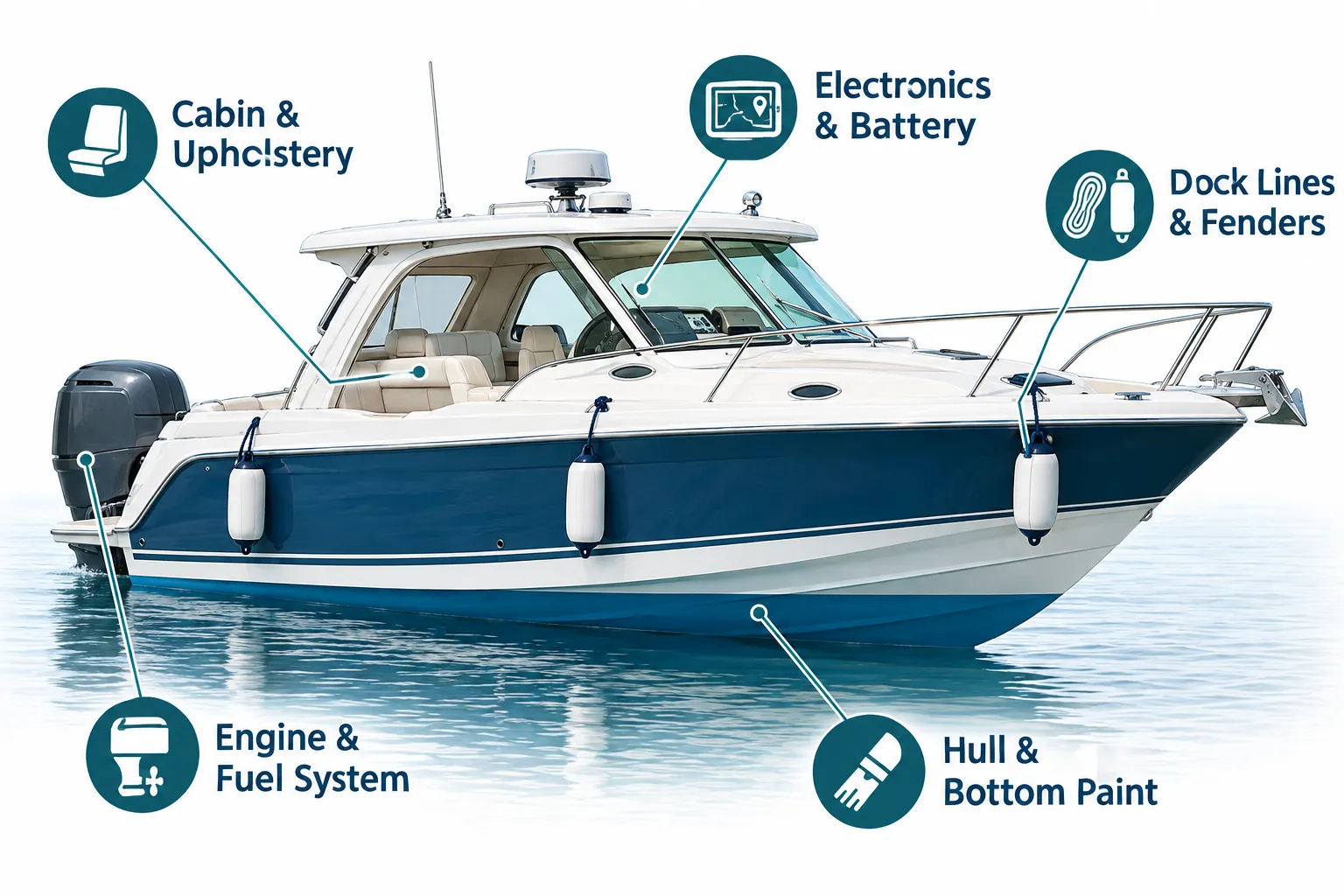
A solid boat maintenance guide needs to name every recurring cost category, not just the fun ones. Beginners tend to remember fuel and forget insurance. They remember insurance and forget the cost of a fall haul-out. Here is the full list, organized the way experienced owners actually budget.
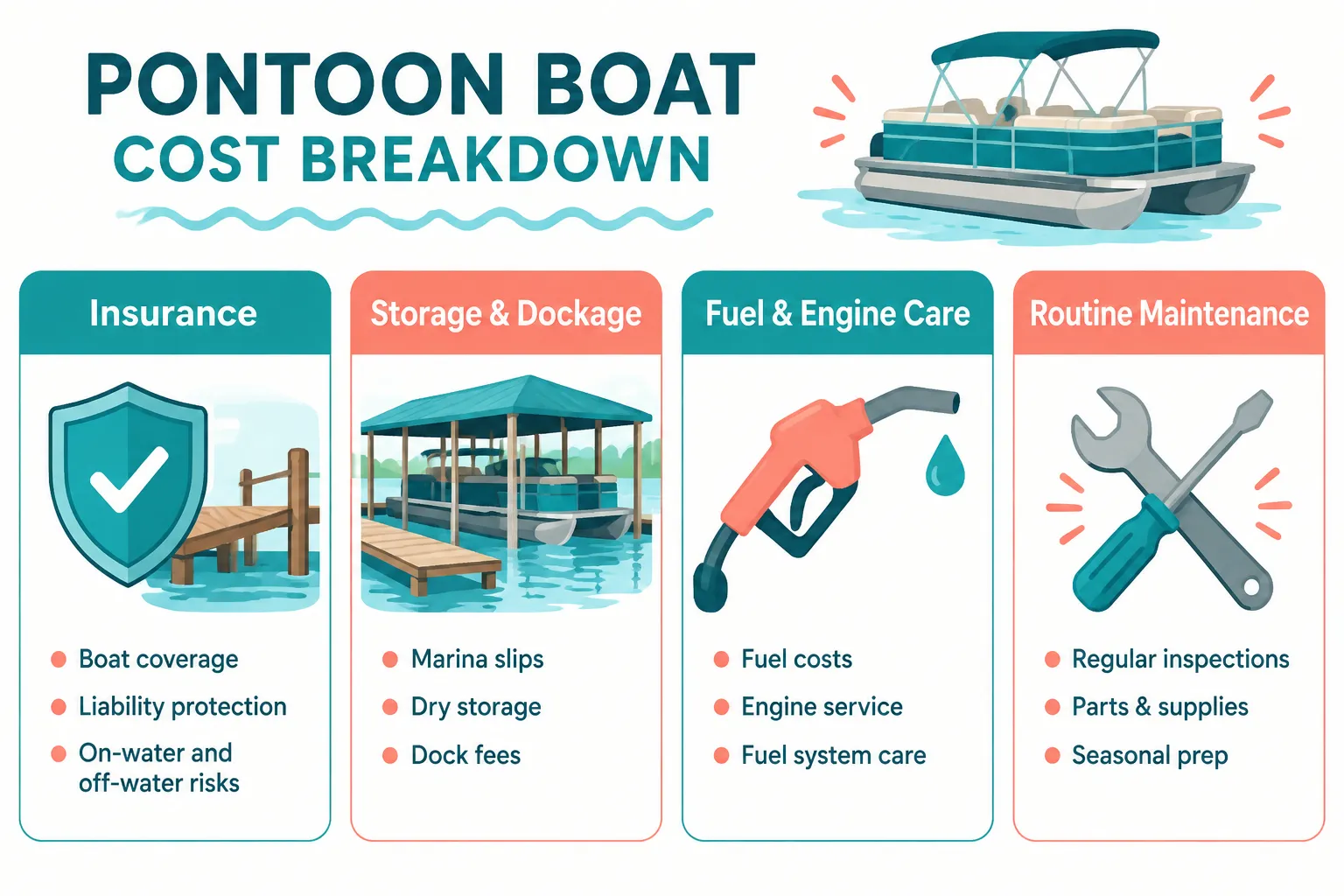
Insurance Recreational boat insurance typically costs 1.5% to 3% of the boat’s hull value per year [2][6]. That means a $40,000 boat might cost $600 to $1,200 a year to insure, depending on the boat’s age, location, and how it is used. Liability coverage, storm damage, and towing assistance are usually the biggest factors that move this number up or down.
Storage and Dockage Where a boat lives when it is not on the water often becomes the single biggest line item. Marina slips, dry storage, and trailer storage all carry very different price points. Coastal marinas in high-demand areas charge significantly more than inland lake storage.
Fuel Fuel costs scale with engine size, hull design, and how often the boat runs. A weekend pontoon boater burns far less than someone running offshore twice a week in a center console.
Routine Maintenance This includes oil changes, filter swaps, spark plugs, impeller checks, and general engine servicing. It is the category most beginners underestimate, and it is also the category that prevents the most expensive failures.
Bottom Paint and Hull Care Bottom paint protects the hull from marine growth and drag. It needs reapplication every one to two years for boats kept in the water year-round, and it is one of the biggest predictable maintenance costs [6][7].
Winterizing and Seasonal Prep Cold-climate owners face an annual winterizing bill that covers draining systems, adding fuel stabilizer, and often shrink-wrapping the boat. Anyone new to this process should walk through a proven step-by-step winterizing guide before the first freeze hits, and revisit de-winterizing tips when spring rolls around.
Loan Payments (If Financed) Not every owner pays cash. Financed boats add a monthly loan payment on top of every other cost listed here, which is why lenders and cost calculators recommend running the full 10-20% math before signing a purchase agreement [2].
Pull quote:
“A boat is not one bill. It is six or seven smaller bills that show up all year long.”
Sample Cost Breakdown: A Mid-Range Pontoon Boat Maintenance Guide Case Study
Numbers feel abstract until they are attached to a real example. So here is a realistic annual cost breakdown for a mid-range recreational pontoon boat purchased around $40,000, based on typical 2026 ownership patterns [2][6][7].
Insurance: At 1.5-3% of hull value, this pontoon owner should expect roughly $600 to $1,200 annually [2][6].
Storage/Dockage: Seasonal marina storage or a covered dry rack typically represents one of the largest single costs for pontoon owners, often rivaling or exceeding the insurance bill.
Fuel: Pontoon boats are generally fuel-efficient compared to deep-V hulls, but regular weekend use across a season still adds up steadily.
Routine Maintenance: Oil changes, filter changes, and engine tune-ups fall here, along with occasional upholstery cleaning and small hardware fixes.
Winterizing and Spring Prep: Two seasonal service visits a year, one to winterize and one to de-winterize, are standard for owners in states with cold winters.
Bottom Paint or Pontoon Cleaning: Aluminum pontoons don’t need traditional bottom paint, but they do need regular cleaning to prevent algae and scum lines, plus periodic inspection of the pontoon tubes themselves.
Add these categories together and the total consistently lands inside that same 10-20% rule discussed earlier [2][6]. For this $40,000 pontoon, that places realistic annual costs somewhere between roughly $4,000 and $8,000, depending on region, usage, and how much maintenance the owner handles personally versus paying a marina to do.
Sailboat owners face a slightly different mix. Moorage fees tend to run higher because sailboats often require deeper, more sheltered slips. Rigging inspections, sail repairs, and standing rigging replacement (needed roughly every 10 years) add categories that powerboat owners simply don’t have. Insurance for sailboats often sits at a similar 1.5-3% of value, but total annual costs can trend toward the higher end of the 10-20% range because of these extra maintenance categories [2][4].
Before buying, it helps to work through a practical pre-purchase checklist that covers inspection points most beginners never think to check.
Beginner Boat Maintenance Guide Priorities: What to Service and When
New owners often ask the same question: what actually needs attention first? A good boat maintenance guide should answer this in plain terms, ranked by how much damage neglect can cause.
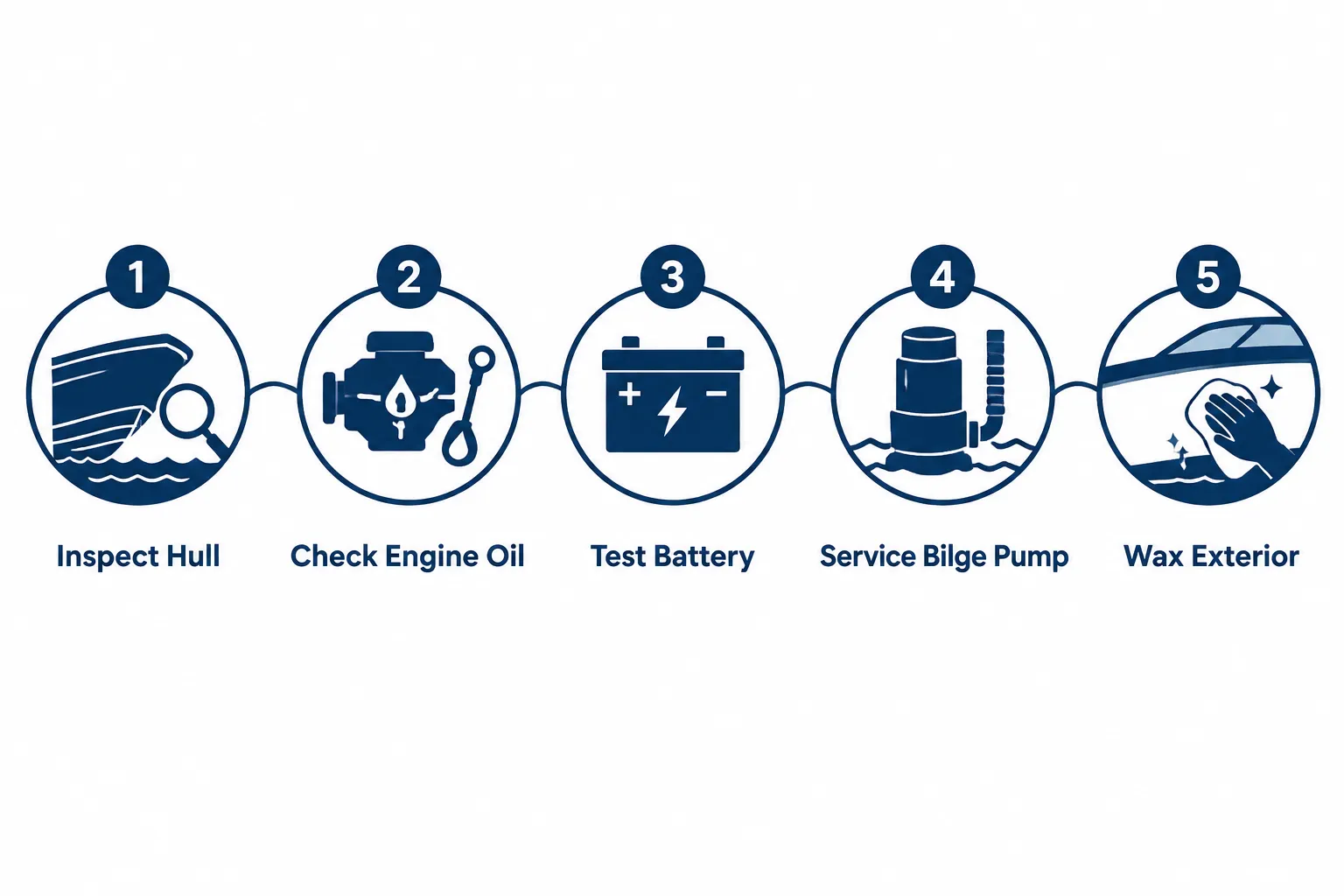
1. Engine Oil and Filters Skipping oil changes is the fastest way to destroy an engine. Follow the manufacturer’s hour-based schedule, not just a calendar date, since usage varies wildly between owners.
2. Battery Health A dead battery on the water is more than annoying, it can be dangerous. Check terminals for corrosion, test voltage monthly during the season, and always fully charge before storage.
3. Bilge Pump Function This small pump keeps a boat from filling with water. Test it every time before heading out. It is one of the cheapest parts on the boat and one of the most important.
4. Hull and Bottom Condition Inspect for blisters, cracks, or heavy growth. Bottom paint should be reapplied on the schedule recommended for the local water (fresh vs. salt water changes this timeline significantly) [6][7].
5. Fuel System Checks Old fuel, water contamination, and clogged filters cause more breakdowns than almost anything else. Fuel additives and fresh fuel at the start of each season prevent most of these issues.
6. Electrical and Electronics Corrosion is the enemy of every wire connection on a boat. A yearly inspection of wiring, especially near the transom and battery box, catches problems before they become expensive.
A simple maintenance rhythm works well for most beginners:
- Weekly (in season): Visual check of bilge, battery, and fuel level.
- Monthly (in season): Oil level check, belt inspection, hardware tightness.
- Seasonal (spring/fall): Full service, winterizing or de-winterizing, hull inspection.
- Annual: Insurance review, bottom paint evaluation, professional engine service.
Owners running smaller boats should also review small boat essentials to make sure basic safety and maintenance gear is always on board, not just at the dock.
Seasonal Maintenance and Winterizing Basics
Seasonal transitions cause more preventable damage than almost any other single factor in boat ownership. Water left in an engine block over a freezing winter can crack the block entirely, turning a $200 winterizing job into a multi-thousand-dollar repair.
Fall Winterizing Checklist
- Drain and flush the engine cooling system.
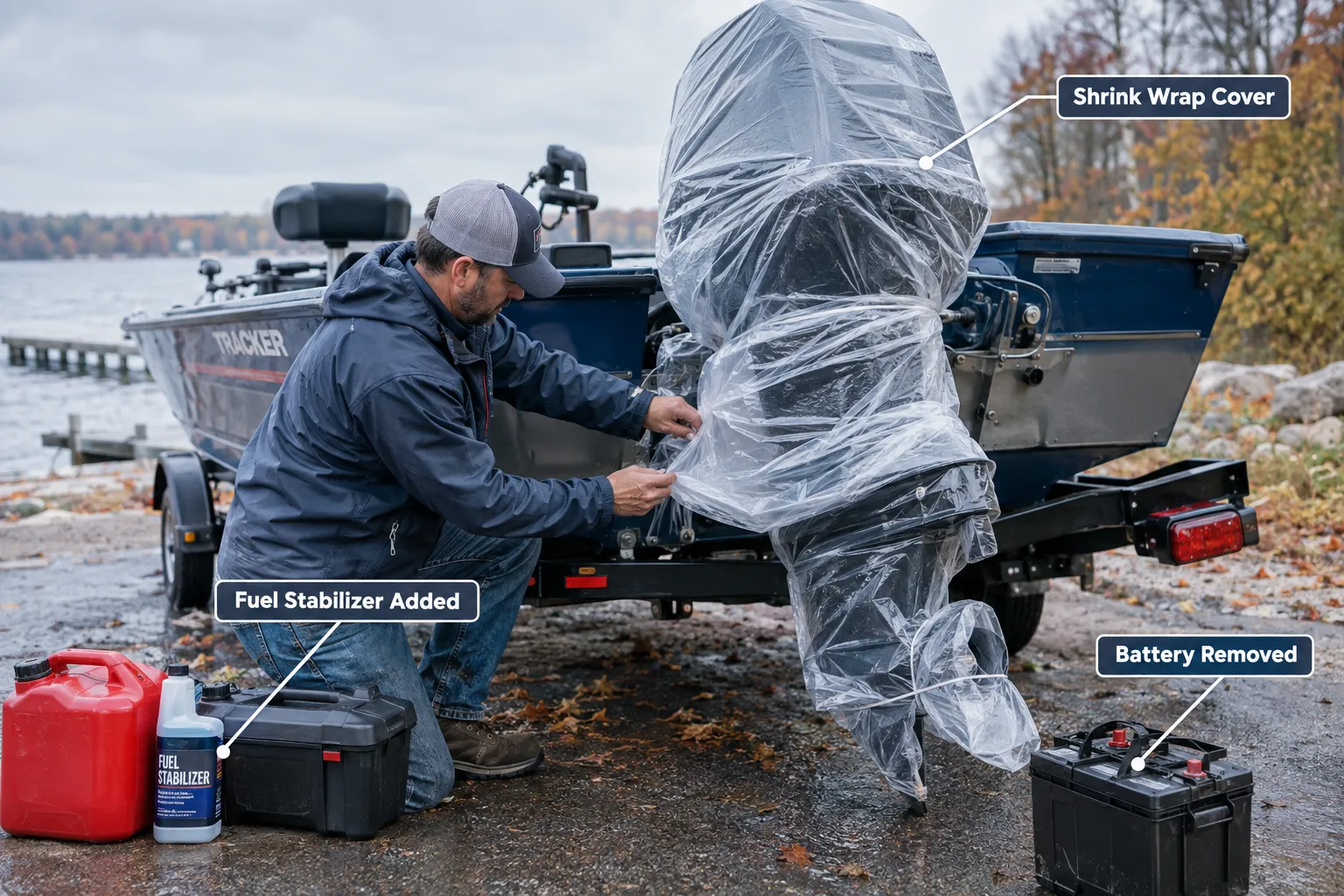
- Add fuel stabilizer to a full tank to prevent condensation and gum buildup.
- Change the engine oil before storage, since old oil holds contaminants that damage internals over months of sitting.
- Remove and store the battery somewhere temperature-stable.
- Fog the engine cylinders if recommended by the manufacturer.
- Cover or shrink-wrap the boat to block moisture and pests.
A full walkthrough of this process is covered in the complete winterizing guide for boats, which breaks each step into a beginner-friendly order.
Spring De-Winterizing Checklist
- Remove covers and inspect for winter damage or pest activity.
- Reinstall and fully charge the battery.
- Check all fluids and top off as needed.
- Inspect belts, hoses, and clamps for cracking after months of cold storage.
- Run the engine at the dock before the first real outing to catch any issues early.
Detailed guidance on reversing winter storage properly is available in this boat de-winterizing tips guide.
Owners in warmer climates who never truly winterize still benefit from a seasonal “off-season checkup” during the slowest boating months. Marine growth, UV damage to upholstery, and slow leaks don’t take a break just because the water never freezes.
Insurance, Market Trends, and What to Expect Going Forward
Insurance deserves its own conversation because it is one of the few costs that beginners can meaningfully control through smart decisions.
Recreational boat insurance generally costs 1.5% to 3% of the hull’s value annually [2][6]. Factors that push this number higher include:
- Older boats with less documented maintenance history
- High-horsepower engines
- Coastal or hurricane-prone storage locations
- Limited boating experience on the owner’s record
Factors that can lower the rate include completing a boating safety course, bundling with an existing home or auto policy, and choosing storage on a trailer or in dry dock rather than leaving the boat in the water year-round.
Market Conditions Worth Knowing
The broader boating market shifted in 2025. New boat retail unit sales softened by about 8.8% compared to the prior year [5]. That sounds like bad news for the industry, but total recreational marine spending still reached an estimated $54 billion [10]. In other words, fewer new boats were sold, but the money being spent on boating overall, including maintenance, upgrades, and used boats, stayed remarkably strong.
For a beginner, this trend has a practical takeaway: the used boat market has stayed active and well-supplied, and maintenance-related spending (parts, service, storage) is not slowing down. That means budgeting for upkeep matters just as much, if not more, than chasing a deal on the purchase price itself.
Forward-Looking Expectations (Labeled as Predictions)
Industry data releases through early and mid-2026 point toward continued strength in the maintenance and service side of boating, even if new boat sales stay soft [3][5][10]. Beginners entering the market now should expect:
- Continued emphasis on used boat sales as buyers look for value.
- Steady or slightly rising service costs, tracking general inflation in parts and skilled labor.
- Growing interest in connected boat technology for maintenance alerts and safety monitoring, which is worth exploring through resources like this overview of connected boat technology.
These are reasonable projections based on current data trends, not guarantees, but they help frame realistic expectations for anyone budgeting multiple years ahead.
Common Beginner Mistakes (and How to Avoid Them)
Even careful buyers make predictable errors during their first year or two of ownership. Naming them clearly is the fastest way to avoid repeating them.
Mistake 1: Budgeting Only for the Purchase Price The purchase price is the smallest number in the total ownership equation over five or ten years. The 10-20% annual rule should be calculated before signing any purchase agreement, not after [2][6].
Mistake 2: Skipping the Sea Trial or Inspection A pre-purchase inspection catches hull damage, engine problems, and electrical issues that are invisible to an untrained eye. This step alone can prevent thousands of dollars in surprise repairs.
Mistake 3: Underestimating Storage Costs Many first-time buyers assume they’ll just keep the boat “somewhere cheap.” Marina waitlists and seasonal storage rates can change that plan fast, and dockage often becomes one of the largest annual costs.
Mistake 4: Ignoring Small Maintenance Until It’s Big Maintenance A small fuel leak, a slightly loose belt, or a corroded terminal rarely stays small. Left alone, these turn into engine failures or electrical fires. Regular, low-cost checks prevent expensive, high-stress repairs.
Mistake 5: Forgetting Safety Compliance Beginners sometimes treat safety gear and boating laws as optional extras. They are not. A full review of current boating safety, laws, and compliance requirements should happen before the first trip out, not after a close call.
Mistake 6: Not Planning for the Off-Season Whether that means true winterizing or an off-season inspection in warmer climates, skipping this step is one of the most expensive mistakes a new owner can make.
Pull quote:
“The boats that last decades aren’t lucky. Their owners just never skipped the boring maintenance.”
Frequently Asked Questions
How much should a beginner budget per year for boat ownership? Plan for 10% to 20% of the boat’s purchase price annually. A $30,000 boat should have roughly $3,000 to $6,000 set aside every year for insurance, storage, fuel, and maintenance [2][6].
Is boat insurance required? Requirements vary by location and lender. Financed boats almost always require insurance. Even where it’s optional, insurance costing 1.5-3% of hull value is a small price compared to storm, collision, or liability risk [2][6].
How often does bottom paint need to be redone? Most boats kept in the water need new bottom paint every one to two years, depending on water type and local marine growth conditions [6][7].
What is the biggest hidden cost new owners forget? Storage and dockage. Many first-time buyers underestimate how much marina slips or covered storage actually cost in their area until they start calling around.
Does a smaller boat always cost less to maintain? Generally yes, but not always proportionally. A small boat with an old, poorly maintained engine can cost more in repairs than a slightly larger, well-maintained boat.
Conclusion
A boat maintenance guide is only useful if it turns into action. The math in this guide is simple on purpose: plan for 10% to 20% of the purchase price every year, know the six or seven recurring cost categories cold, and treat seasonal maintenance as non-negotiable rather than optional.
Next steps for anyone starting this journey:
- Calculate a realistic annual budget using the 10-20% rule before making an offer on any boat.
- Build a maintenance calendar covering weekly, monthly, and seasonal tasks.
- Get a proper pre-purchase inspection, no matter how good the boat looks in photos.
- Review local insurance quotes early, since rates vary widely by region and boat type.
- Bookmark a winterizing checklist before the first cold season arrives.
Boat ownership rewards owners who plan ahead and punishes the ones who don’t. With the numbers and checklists in this guide, a beginner has everything needed to start on the right foot and keep their boat running well for years to come.
References
[1] Boat Ownership Cost Calculator – https://statecalc.com/boat/boat-ownership-cost-calculator/
[2] The True Cost Of Boat Ownership A 2026 Guide – https://www.morningstarmarinas.com/blog/the-true-cost-of-boat-ownership-a-2026-guide/
[3] nmma – https://www.nmma.org/statistics/article/25544
[4] Boat Ownership Cost – https://globalyachtguide.com/costs/boat-ownership-cost/
[5] nmma – https://www.nmma.org/press/article/25432
[6] Boat Ownership Costs Breakdown What To Budget In 2026 – https://yachtingexperts.com/boat-ownership-costs-breakdown-what-to-budget-in-2026/
[7] Boat Ownership Cost By The Numbers – https://sortedgear.com/boat-ownership-cost-by-the-numbers/
[8] How Much Does A Boat Cost – https://freefixo.com/tools/how-much-does-a-boat-cost/
[9] Boat Ownership Cost – https://boats-for-sale.com/boat-ownership-cost/
[10] Recreational Marine Spending Hit 54 Billion In 2025 – https://boatingindustry.com/news/2026/07/08/recreational-marine-spending-hit-54-billion-in-2025/