
Last Updated on August 26, 2026
Fewer than 30% of private car sellers ever check more than one pricing source before listing their vehicle, a gap that routinely costs them hundreds, sometimes thousands, of dollars. Whether buying, selling, trading in, or insuring a vehicle, using the right car valuation tool is one of the most consequential financial decisions a vehicle owner makes. This guide explains how these tools work, which ones lead the market in 2026, and exactly how to use them to your advantage.
Key Takeaways
- A car valuation tool uses market data, vehicle history, and condition inputs to estimate a vehicle’s current worth.
- Leading tools include Kelley Blue Book, Edmunds TMV, CarGurus, Consumer Reports, and CARFAX, each with distinct strengths.
- No single tool is universally “best”; combining two or three sources produces the most accurate estimate.
- AI-driven and VIN-specific tools are rapidly improving accuracy, especially for condition-based and regional pricing.
- Understanding the difference between trade-in value, private-party value, and dealer retail price is essential before any transaction.
What Is a Car Valuation Tool and How Does It Work
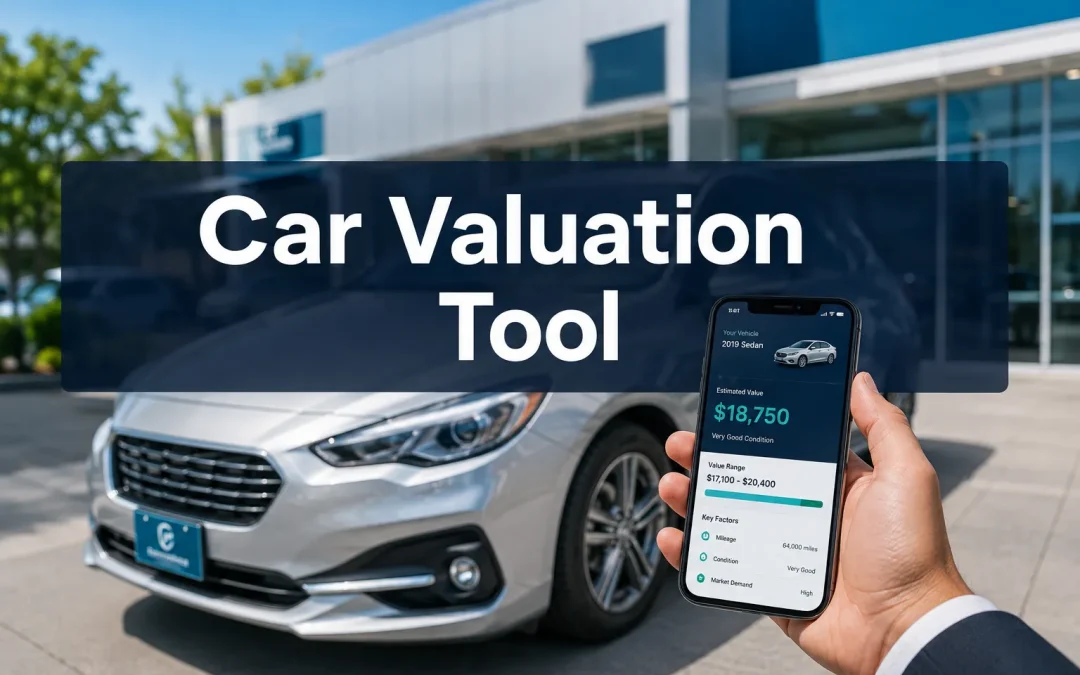
A car valuation tool is a digital platform, web-based, app-based, or API-integrated, that calculates a vehicle’s current market value based on a combination of inputs. Those inputs typically include the vehicle’s make, model, year, trim level, mileage, condition, zip code, and optional vehicle history data.
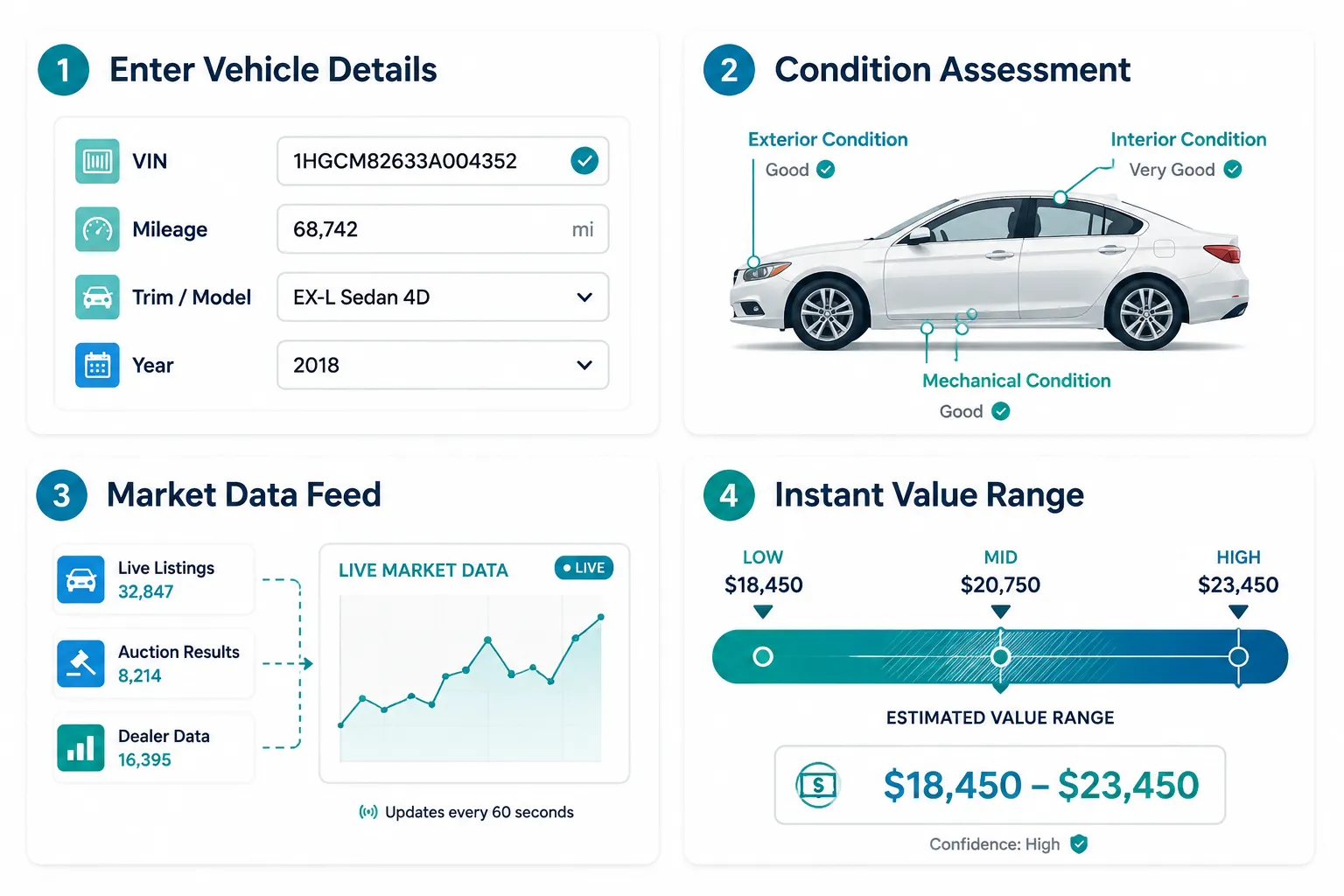
The underlying engine pulls from several data streams simultaneously. Most major tools aggregate active listings from dealer inventories, recent private-party sales, and auction results. The more listings a platform can analyze, the more precise its output. CarGurus, for example, leverages more than 4 million active listings to generate real-time pricing [5]. Edmunds’ True Market Value (TMV) methodology cross-references actual transaction prices, not just asking prices, to reflect what buyers genuinely pay at the dealership [4].
Three value types appear in almost every tool:
| Value Type | What It Means | Best Used For |
|---|---|---|
| Trade-In Value | What a dealer will pay you | Selling to a dealer or dealership trade |
| Private Party Value | Expected price in a peer-to-peer sale | Listing on Craigslist, Facebook Marketplace |
| Dealer Retail Value | What a dealer charges a buyer | Benchmarking a purchase price |
| Certified Pre-Owned Value | Premium for CPO-certified vehicles | Evaluating CPO deals |
Understanding which figure applies to your situation is critical. A trade-in value is almost always lower than a private-party value because the dealer needs room for reconditioning and profit margin. Confusing the two is one of the most common negotiation mistakes sellers make.
Condition grading is another major variable. Most tools use a four- or five-tier scale: Excellent, Very Good, Good, Fair, and Poor. Moving a vehicle from “Good” to “Very Good” can shift the estimate by several hundred dollars, so honest self-assessment matters. Tools like CARFAX add a VIN-specific layer by incorporating accident history, title status, and service records directly into the valuation [8], which removes much of the guesswork around condition.
For a broader look at how value and worth interact conceptually, the article on value vs. worth provides useful context that applies directly to vehicle pricing decisions.
The Leading Car Valuation Tools in 2026
The market for vehicle pricing platforms has grown considerably, and the tools available today vary widely in methodology, data freshness, and intended audience. Knowing which tool to reach for, and why, separates informed buyers and sellers from those who leave money on the table.
Kelley Blue Book (KBB)
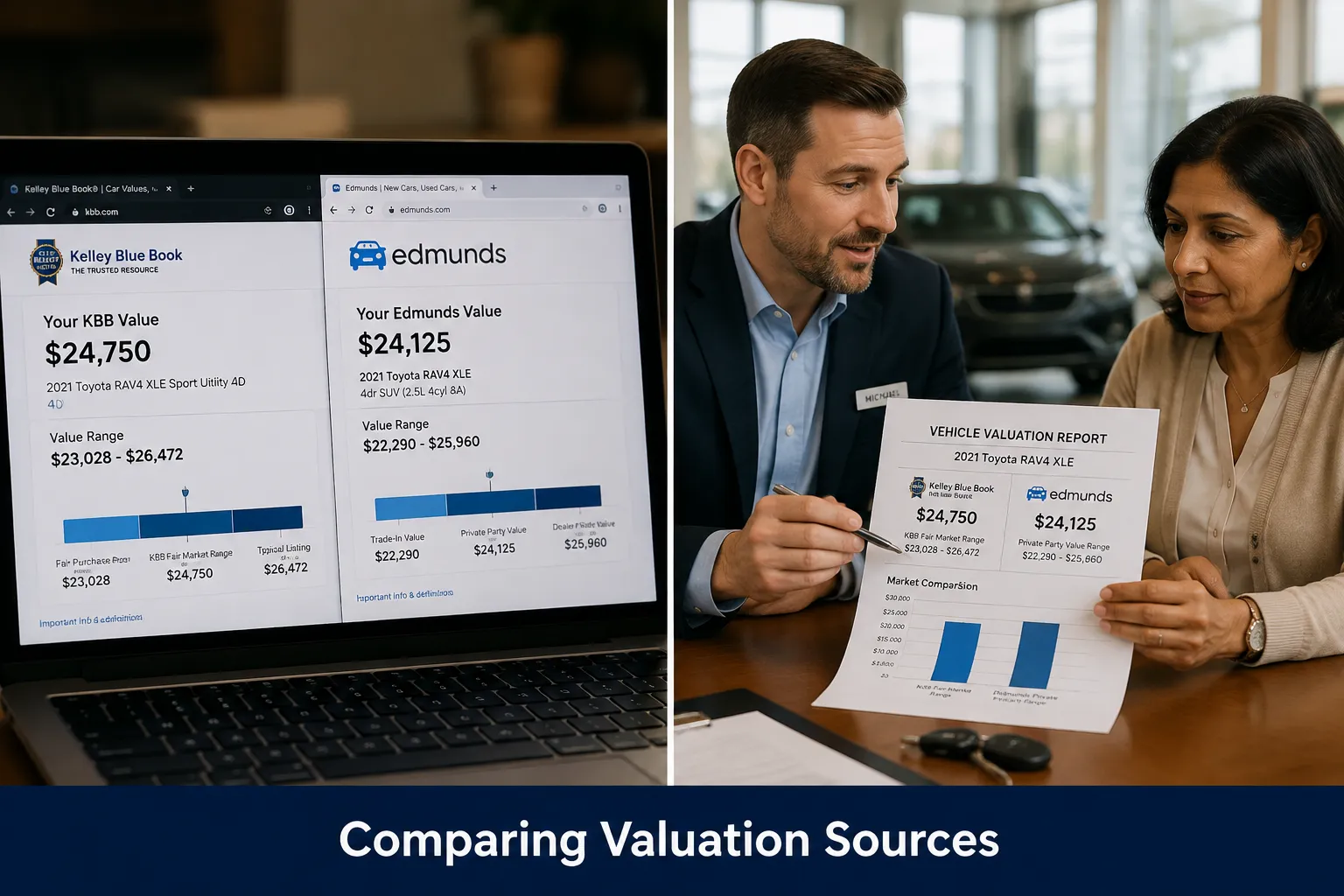
Kelley Blue Book remains the most recognized consumer-facing car valuation tool in the United States [2]. Its brand carries significant weight at dealerships, which means that quoting a KBB figure in a negotiation carries practical leverage. KBB updates its pricing weekly using live transaction data, dealer listings, and auction results. It covers trade-in ranges, private-party values, and suggested retail prices, and its Instant Cash Offer feature connects sellers directly with local dealers.
Strengths: Brand recognition, weekly updates, broad vehicle coverage, Instant Cash Offer integration. Limitations: Valuations can skew slightly higher than actual transaction prices in some markets.
Edmunds True Market Value (TMV)
Edmunds’ TMV is widely regarded by automotive journalists and analysts as one of the most transaction-accurate tools available [1][4]. Rather than relying solely on listing prices, TMV is built on actual sales data, which means it reflects what people truly pay, not just what dealers ask. Edmunds also offers an appraisal tool that factors in your specific vehicle’s condition and local market demand.
Strengths: Transaction-based accuracy, appraisal tool, strong editorial reputation. Limitations: Interface is slightly less intuitive than KBB for first-time users.
CarGurus
CarGurus approaches valuation from a marketplace perspective. Its engine analyzes more than 4 million live listings and assigns each a “deal rating”, ranging from Overpriced to Great Deal, based on how a listed price compares to similar vehicles in the same region [5]. This makes CarGurus especially powerful for buyers evaluating specific listings rather than seeking a general estimate.
Strengths: Real-time listing data, deal rating system, strong regional accuracy. Limitations: Less useful for trade-in scenarios; primarily a buyer’s tool.
Consumer Reports Car Value Estimator
Consumer Reports offers a subscription-backed Car Value Estimator that draws on current market data without the commercial incentives that can influence dealer-affiliated platforms [3]. Because Consumer Reports accepts no advertising from automakers or dealers, its valuations are considered neutral. The tool is most useful for buyers who already subscribe to the service.
Strengths: Unbiased, no dealer advertising influence, integrates with Consumer Reports’ reliability data. Limitations: Requires a paid subscription; less real-time than CarGurus or KBB.
CARFAX Vehicle Value
CARFAX adds a dimension that other tools lack: VIN-specific history integration [8]. A vehicle with a clean CARFAX report commands a higher value than an identical vehicle with a reported accident, and CARFAX’s valuation tool bakes that directly into its estimate. This makes it particularly valuable for used vehicle transactions where history is unknown.
Strengths: VIN-specific, accident and title history integration, trusted by dealers. Limitations: Primarily a supplementary tool; best used alongside KBB or Edmunds.
Emerging AI-Driven Tools
The valuation landscape is shifting rapidly. Platforms like Specd.ai are targeting dealership-grade accuracy using real-time market feeds and machine learning models [10]. AI photo-analysis is also being integrated into condition assessment, users upload images of their vehicle, and the algorithm estimates condition grade based on visible wear, dents, and paint quality. This removes subjectivity from the condition input, which has historically been the weakest link in self-reported valuations.
LLM-integrated services are also emerging, with some valuation APIs now plugging directly into AI assistants. In the UK and Ireland, regional live-data tools are gaining traction, and TheCarExpert’s 2026 guide explicitly recommends combining multiple tools rather than relying on any single platform [9].
The concept of value vs. price is worth understanding here, a tool gives you a price estimate, but the true value of a vehicle depends on factors no algorithm fully captures, including emotional attachment, urgency to sell, and local demand.
How to Use a Car Valuation Tool Effectively
Getting an accurate estimate requires more than typing in a make and model. The following steps maximize the reliability of any car valuation tool output.
Step 1: Gather your vehicle details first. Have the VIN, current odometer reading, trim level, and a list of optional features ready before opening any tool. Trim level alone can shift a valuation by $1,500 or more on mid-range vehicles.
Step 2: Be honest about condition. Most sellers overestimate their vehicle’s condition. Use the tool’s condition descriptions carefully. “Very Good” typically means no mechanical issues, minimal cosmetic wear, and a clean interior, not just “it runs fine.”
Step 3: Use your actual zip code. Vehicle values vary significantly by region. A pickup truck commands a premium in rural Texas compared to urban California. Always enter the zip code where the vehicle will be sold, not where it was purchased.
Step 4: Run at least two tools. Cross-reference KBB with Edmunds, or CarGurus with CARFAX, to establish a realistic range. If the outputs diverge by more than 10%, investigate why, it often points to a regional data gap or a condition mismatch.
Step 5: Check the date of the estimate. Market conditions shift. Fuel price spikes affect the value of large SUVs and trucks within weeks. Always use the most current estimate available, and re-run the tool if more than two weeks have passed since your last check.
Step 6: Factor in vehicle history. If your vehicle has a clean title and no accident history, note that explicitly in tools that allow it. Run a CARFAX report to confirm what data is on record, buyers will pull one anyway.
“The single biggest mistake sellers make is using one tool, in the wrong condition tier, without checking regional demand. That combination can undervalue a vehicle by 15% or more.”, composite insight from 2026 meta-analyses of top valuation platforms [6][9]
For owners of specialty vehicles, the same principles apply but the tools differ. Motorcycle owners, for example, should consult a dedicated resource like the Kelley Blue Book Motorcycle Value guide rather than applying car-specific tools to two-wheeled vehicles. Similarly, RV and motorhome owners have distinct valuation needs, the NADA ATV Guide covers off-road and recreational vehicle pricing in a format parallel to what KBB provides for cars.
Factors That Affect Car Valuation Tool Accuracy
No tool is perfectly accurate, and understanding the sources of variance helps users interpret outputs intelligently.
Mileage and Age
These are the two most consistent value drivers. The average depreciation curve for a new vehicle sees it lose roughly 20% of its value in the first year and up to 50% within five years, though this varies significantly by brand, model, and market conditions. Tools handle this well because the data is objective.
Supply and Demand Shifts
The used car market experienced extreme volatility between 2021 and 2023 due to new vehicle inventory shortages. In 2026, the market has stabilized in most segments, but electric vehicles, hybrids, and certain truck segments still show elevated demand that can make valuations lag behind real-time market conditions. CarGurus’ live-listing approach handles this better than tools that update weekly or monthly [5].
Regional Market Conditions
A convertible in Minnesota has different seasonal demand than the same car in Florida. Tools that allow zip-code input handle this, but the quality of regional data varies. Edmunds and KBB have deep US data; for UK and European markets, region-specific tools tend to outperform US-centric platforms [9].
Vehicle History and Title Status
A salvage title can reduce a vehicle’s value by 20-40% compared to a clean-title equivalent. Most general valuation tools do not automatically account for this unless a VIN is entered and history data is integrated. This is where CARFAX’s approach adds measurable accuracy [8].
Modifications and Aftermarket Parts
Most standard tools do not add value for aftermarket modifications. A custom exhaust, lift kit, or upgraded audio system rarely increases the estimated value in a car valuation tool, even though some buyers will pay a premium for them. Conversely, non-factory modifications can sometimes reduce value in the eyes of conservative buyers. Owners of classic or heavily modified vehicles should supplement tool estimates with specialist appraisals.
Classic car enthusiasts face a unique challenge here. Standard valuation tools are poorly suited to pre-1980 vehicles. The ongoing effort to preserve automotive heritage, as covered in the article on classic car enthusiasts rallying behind Leno’s Law, underscores the cultural and financial complexity of valuing vehicles that sit outside mainstream market data.
Car Valuation Tools for Specific Transaction Types
Different transactions call for different tool strategies.
Selling to a Private Buyer
Use KBB’s private-party value as your anchor, then cross-reference with CarGurus to see what comparable vehicles are listed for in your zip code [2][5]. Price slightly above your floor to allow negotiation room. A clean CARFAX report attached to your listing adds credibility and can justify a higher asking price [8].
Trading In at a Dealership
Run KBB’s trade-in tool and Edmunds’ appraisal tool before walking into any dealership [1][2]. Dealers will make an offer based on their own internal systems, knowing your range prevents you from accepting a lowball figure. Edmunds’ appraisal tool is particularly useful here because it generates a specific offer from local dealers, giving you a real-world data point rather than a range.
Buying a Used Vehicle
CarGurus’ deal-rating system is the most actionable tool for buyers evaluating specific listings [5]. It tells you immediately whether a listed price is above or below market for that vehicle in that region. Combine this with a CARFAX report on any vehicle you are seriously considering [8].
Insurance Appraisal
Insurers use their own internal valuation systems, but knowing your vehicle’s current market value from KBB or Edmunds gives you a defensible position if you need to dispute an insurance settlement. Consumer Reports’ neutral estimator can serve as a third-party reference in such disputes [3].
Financing and Refinancing
Lenders use loan-to-value (LTV) ratios, and the value side of that equation often comes from NADA or KBB. Understanding your vehicle’s current value helps you assess whether refinancing makes financial sense and whether you are at risk of being underwater on your loan.
Interactive Car Value Estimator
Car Value Quick Estimator
Estimated Trade-In:
Estimated Private Party:
Estimated Dealer Retail:
Illustrative estimate only. Use KBB, Edmunds, or CarGurus for precise figures.
Common Mistakes to Avoid When Using a Car Valuation Tool
Even experienced vehicle owners make errors that skew their results. The following pitfalls are the most frequently observed.
Relying on a single source. No single tool has perfect data for every vehicle in every region. Cross-referencing two sources is a minimum best practice [6][9].
Using national averages in a regional market. A car valued at $18,000 nationally might fetch $21,000 in a market with low inventory of that model. Always localize your search.
Ignoring the condition tiers. Selecting "Excellent" when the vehicle has a dent and worn upholstery inflates the estimate and sets unrealistic expectations. Buyers will negotiate down regardless.
Failing to update the estimate. Market conditions change. An estimate from three months ago may be materially different from today's figure, especially in volatile segments like EVs or full-size trucks.
Not accounting for vehicle history. A tool that does not incorporate VIN-specific data will overvalue a vehicle with a hidden accident history. Always verify with CARFAX before buying [8].
Applying car tools to non-car vehicles. Motorcycles, RVs, ATVs, and boats have dedicated valuation resources. Using a car-specific tool for a motorcycle produces unreliable results. The Kelley Blue Book Motorcycle Value guide is the correct resource for two-wheeled vehicles, just as the NADA ATV Guide applies to off-road vehicles.
Conclusion
A car valuation tool is not a luxury, it is a baseline requirement for any informed vehicle transaction in 2026. The difference between a well-researched valuation and a guessed figure can easily exceed $2,000 on a typical used vehicle purchase or sale.
Actionable next steps:
- Before any transaction, run your vehicle through at least two tools, KBB and Edmunds for US vehicles, or a regional tool for UK and European markets.
- Pull a CARFAX report on any used vehicle you are seriously considering buying or selling, to ensure the valuation reflects actual history.
- Localize every estimate to your zip code and select the condition tier honestly.
- For specialty vehicles, motorcycles, ATVs, RVs, classic cars, use the dedicated valuation resources designed for those categories.
- Re-run your estimate if more than two weeks pass between your initial check and the transaction date.
- Consider emerging AI-driven tools like Specd.ai for dealership-grade precision, especially on higher-value transactions.
The most accurate valuation is always a range, not a single number. Use that range strategically, as a floor when selling, as a ceiling when buying, and as a benchmark when negotiating.
References
[1] Appraisal - https://www.edmunds.com/appraisal/ [2] Car Values - https://www.kbb.com/car-values/ [3] Car Value Estimator - https://www.consumerreports.org/cars/car-value-estimator/ [4] edmunds - https://www.edmunds.com/tmv.html [5] Car Valuation - https://www.cargurus.com/research/car-valuation [6] Car Value Sites - https://vincario.com/blog/car-value-sites/ [8] Value - https://www.carfax.com/value/ [9] The Best Sites To Value Your Car - https://www.thecarexpert.co.uk/the-best-sites-to-value-your-car/ [10] Specd - https://theresanaiforthat.com/ai/specd/