

Last Updated on August 26, 2026
Last updated: August 26, 2026
Quick Answer
Buying and selling cars successfully in 2026 comes down to three things: knowing the market value of the vehicle, having the right documents in order, and understanding the legal steps required in your state. Whether you are a private individual or building a business around buying and selling cars, the process follows a clear path from research and inspection to price negotiation and title transfer. Used car prices are largely stable in mid-2026, which means both buyers and sellers need to be strategic rather than reactive.
Key Takeaways
- Used car prices stabilized in 2026 after years of volatility, creating a market where research and timing matter more than ever [4]
- The most important documents for any car transaction are the vehicle title, bill of sale, and odometer disclosure statement
- Private sales typically yield more money for sellers than dealer trade-ins, but they require more time and legal knowledge
- A pre-purchase inspection from an independent mechanic is one of the best investments a buyer can make before any used car purchase
- High interest rates in 2026 make the total cost of financing a car more important than the sticker price alone [10]
- Certified pre-owned (CPO) vehicles offer more protection than standard used cars but cost more upfront
- The best time to buy a car is typically late fall or year-end; the best time to sell is spring and early summer
- Anyone selling more than a few cars per year may need a dealer’s license depending on their state’s rules
- Knowing your state’s specific title transfer and disclosure laws protects both buyers and sellers from legal liability
- For used car values, tools like the Blue Book Car Value Guide and 7 Steps to NADA Guides Used Car Values are essential starting points
What Is the Current State of the Buy and Selling Cars Market in 2026?
The used car market in 2026 is stable but selective. Prices are no longer spiking the way they did in 2021 and 2022, but they have not dropped dramatically either. Buyers and sellers both have room to negotiate, but only if they understand which vehicle segments are moving and which are sitting.
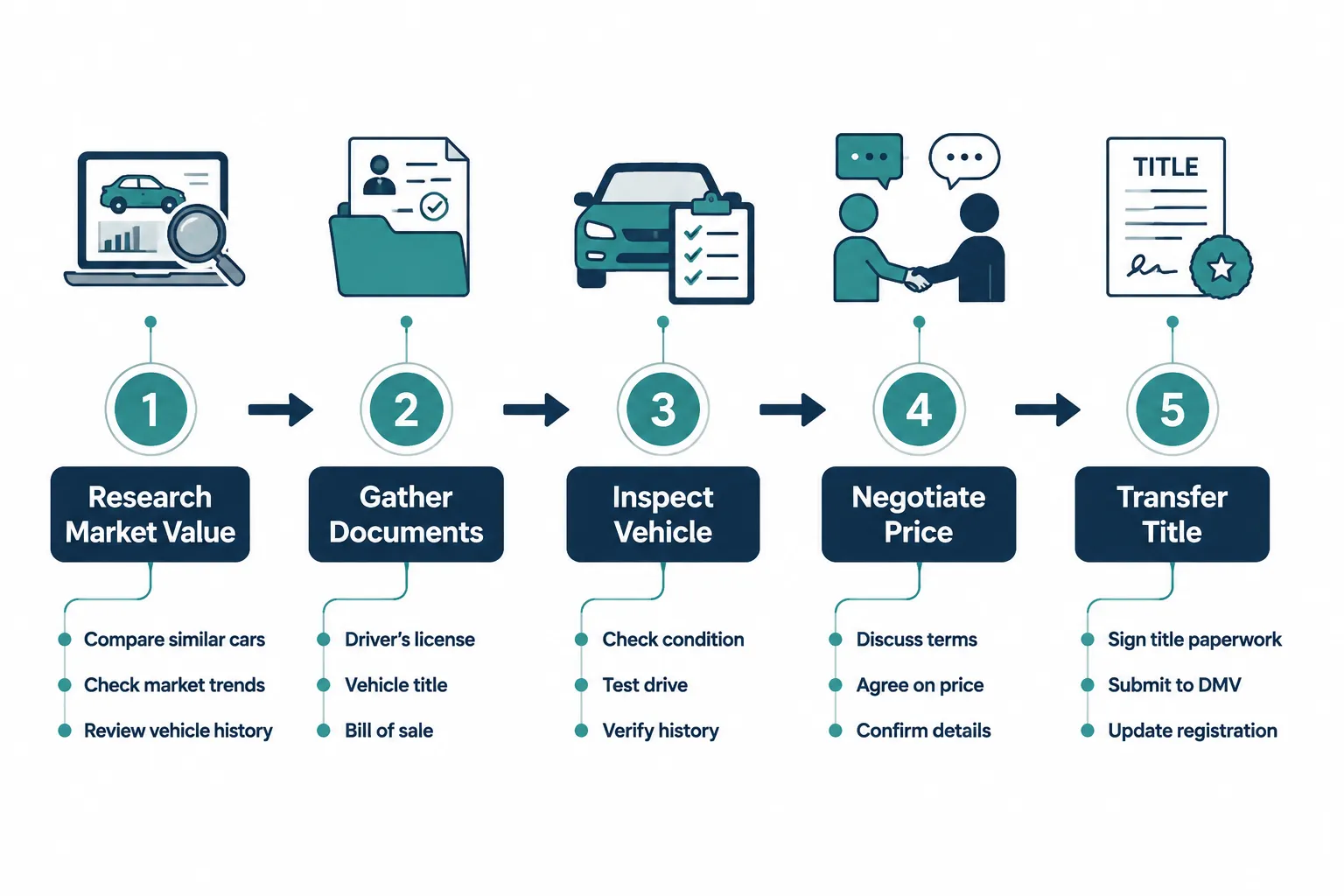
According to Edmunds’ Q1 2026 report, used car inventory is growing slightly, but overall sales volumes are expected to dip modestly compared to 2025 [3]. Black Book data from mid-2026 shows that values are holding steady across most segments, with electric vehicles and compact cars behaving differently than trucks and SUVs [4].
Key market facts for 2026:
- Used car prices are high by historical standards but no longer rising sharply [6]
- Inventory is slowly increasing as more off-lease vehicles return to market [5]
- High interest rates continue to push up the total monthly cost of financing [10]
- EVs are seeing softer resale values compared to gas-powered vehicles in many segments [4]
- The seller still holds a slight edge in most used car transactions, but smart buyers can find good deals [2]
What this means for buyers: Focus on total cost of ownership, not just the sticker price. With financing rates elevated, a lower-priced car with a smaller loan often saves more money over time than a newer model with a bigger payment.
What this means for sellers: Timing and presentation matter. A well-maintained, clean vehicle with full service records will sell faster and closer to asking price than one that looks neglected, even in a stable market.
“The used vehicle market in 2026 rewards preparation. Buyers who research before they shop and sellers who prepare before they list consistently get better outcomes than those who wing it.”
What Documents Do You Need When Buying and Selling Cars Legally?
Every car sale, whether private or through a dealer, requires a specific set of documents to be legal and binding. Missing even one of these can delay registration, create title problems, or expose either party to fraud liability.
Required documents for most states:
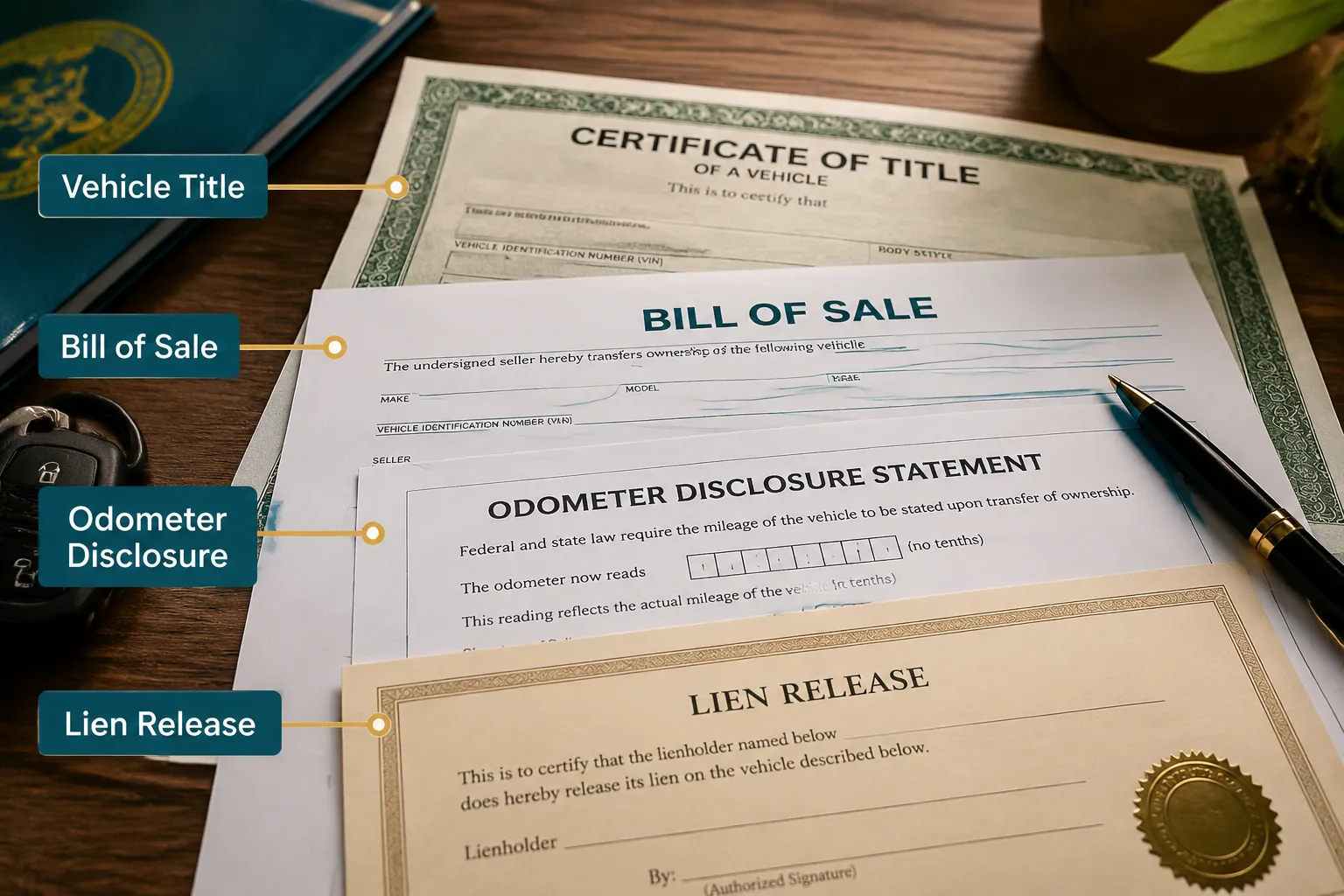
| Document | Who Prepares It | Why It Matters |
|---|---|---|
| Vehicle Title (Certificate of Title) | Seller signs over to buyer | Proves legal ownership |
| Bill of Sale | Both parties sign | Records the transaction details |
| Odometer Disclosure Statement | Seller completes | Required by federal law for vehicles under 10 years old |
| Lien Release Letter | Lender provides | Required if the seller had a car loan |
| As-Is Disclosure (private sales) | Seller provides | Protects seller from post-sale claims |
| Emissions/Safety Inspection Certificate | Varies by state | Required in many states before registration |
Additional documents that may be needed:
- A valid government-issued photo ID from both buyer and seller
- Power of attorney if someone is signing on behalf of the owner
- Dealer paperwork and warranty documents if buying from a licensed dealer
- Financing agreement if the buyer is taking out a loan
Common mistake: Many private sellers forget to get a lien release before the sale. If the car still has an outstanding loan, the lender holds the title. The seller must pay off the loan and obtain the lien release before legally transferring ownership to the buyer.
For anyone buying a used commercial vehicle, the document requirements can be even more involved. The guide to buying a used commercial truck covers the additional steps specific to commercial vehicle transactions.
How Do You Know If a Used Car Is Worth the Price?
A used car is worth its asking price when the price aligns with its condition, mileage, history, and current market comparables. The best way to verify this is to check multiple valuation sources and compare them to similar vehicles listed for sale in your area.
Step-by-step valuation process:
- Look up the vehicle on multiple valuation tools. Use NADA Guides, Kelley Blue Book, and Edmunds. Each uses slightly different data, so checking all three gives a realistic range. The Blue Book Car Value Guide is a good starting point for understanding how these tools work.
- Search current listings. Look at what similar vehicles (same year, make, model, trim, mileage, and condition) are actually selling for in your local market right now.
- Factor in condition honestly. Valuation tools use condition ratings (excellent, good, fair, poor). Most used cars fall into “good” or “fair,” not “excellent.”
- Check the vehicle history report. A CARFAX or AutoCheck report reveals accidents, title issues, number of previous owners, and service records. A clean history supports a higher price; a salvage or rebuilt title drops the value significantly.
- Account for current market trends. In mid-2026, EVs are seeing softer resale values in many segments, while trucks and well-maintained SUVs hold value better [4].
Choose this approach if: The car is more than two or three years old, has over 30,000 miles, or was previously owned by more than one person.
Red flags that suggest the price is too high:
- Asking price is above the highest valuation tool estimate with no justification
- Seller refuses to share service records or a vehicle history report
- The car has been listed for more than 60 days with no price reduction
Should You Trade In Your Car or Sell It Privately?
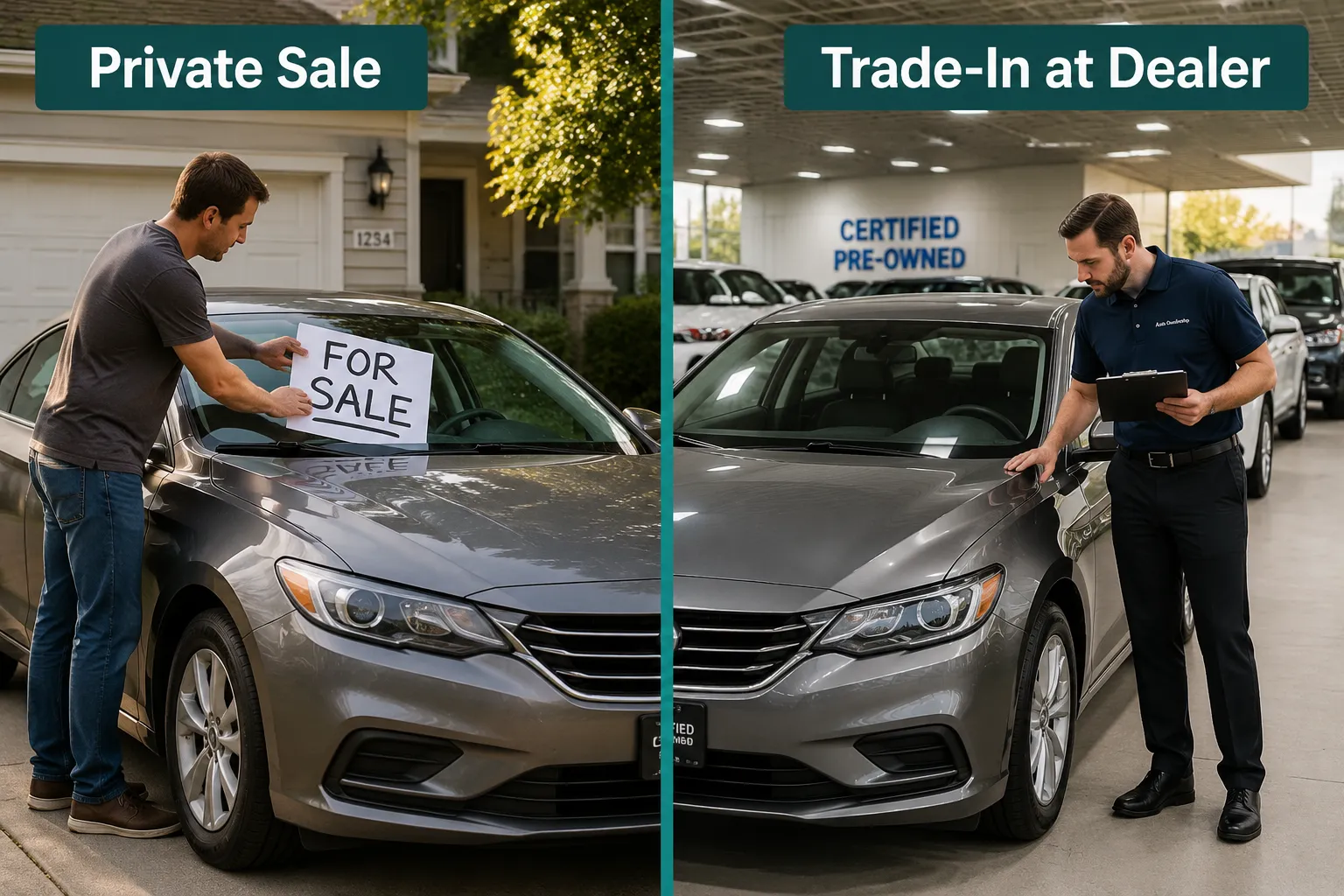
Selling a car privately almost always results in more money than a dealer trade-in, but it takes more time and effort. A trade-in is faster and simpler, but dealers typically offer less than private market value because they need to resell the car at a profit.
Trade-in vs. private sale comparison:
- Trade-in pros: Fast, convenient, no need to handle paperwork or meet strangers, can offset the purchase price of a new car
- Trade-in cons: You will almost always receive less money, sometimes significantly less
- Private sale pros: Higher sale price, direct negotiation, you control the timeline
- Private sale cons: Takes longer, requires you to handle all legal paperwork, involves meeting potential buyers, and carries more risk if you are not careful
When a trade-in makes sense:
- You need to sell quickly
- The car has high mileage or needs repairs that would be hard to disclose in a private sale
- The tax savings from trading in (in states that tax only the difference between trade-in and new car price) offset the lower offer
When a private sale makes sense:
- The car is in good condition and priced in a popular segment
- You have time to list, show, and negotiate
- You want to maximize the return on your vehicle
According to Kelley Blue Book data, the gap between trade-in value and private party value can range from a few hundred dollars to several thousand depending on the vehicle [2]. Always get at least two or three trade-in offers before accepting one.
What Are the Legal Requirements for Buying and Selling Cars Privately?
Private car sales are legal in every U.S. state, but each state has specific rules about disclosures, title transfers, and the number of cars you can sell per year before needing a dealer’s license. Failing to follow these rules can result in fines, voided sales, or even criminal charges.
Core legal requirements for private sales:
- Title transfer: The seller must sign the back of the title over to the buyer. In most states, this must happen at the time of sale. Some states require a notary.
- Odometer disclosure: Federal law (the Truth in Mileage Act) requires sellers to disclose the actual mileage on vehicles under 10 years old. This is done on the title itself or on a separate form.
- As-is disclosure: Private sellers are generally not required to provide warranties, but many states require a written “as-is” disclosure so the buyer cannot later claim they were misled.
- Sales tax: In most states, the buyer pays sales tax when registering the vehicle. The bill of sale showing the purchase price is required for this.
- Dealer license thresholds: Most states allow private individuals to sell between 3 and 5 cars per year without a dealer’s license. Selling more than that threshold typically requires a license. This varies by state, so check your state’s DMV website for the exact number.
Edge case: If you sell a car and the buyer does not immediately register it, you could still be held liable for parking tickets or accidents. Always notify your state’s DMV of the sale as soon as it is complete, and keep a copy of the bill of sale as proof.
How to Make a Profit Buying and Selling Used Cars
Making a consistent profit buying and selling used cars requires buying below market value, controlling costs, and selling at or above market price. The margin in this business comes from knowledge, not luck.
The basic profit formula:
Purchase price + Repair/prep costs + Fees = Total cost Selling price – Total cost = Gross profit
Strategies that work:
- Buy in the right segments. In 2026, well-maintained compact cars and popular SUVs tend to move faster and hold value better than sedans or EVs with uncertain resale trajectories [4].
- Source vehicles below market. Estate sales, auctions, private sellers who need to sell quickly, and fleet disposals often offer vehicles below retail value.
- Keep repair costs low. Cosmetic fixes (detailing, minor dents, new floor mats) often return more per dollar spent than mechanical repairs.
- Price competitively. List at or just below comparable vehicles in your market. Overpricing leads to longer hold times, which eats into profit.
- Know your costs. Factor in storage, insurance, advertising, and any fees into every deal before you buy.
How to start with no experience:
- Start small. Buy and sell one car at a time until you understand the process.
- Learn to read vehicle history reports and spot red flags.
- Build relationships with a trusted mechanic who can give you honest repair estimates before you buy.
- Use valuation tools consistently to avoid overpaying. The 7 Steps to NADA Guides Used Car Values guide walks through how to use these tools accurately.
- Keep detailed records of every transaction for tax purposes.
Common mistake: New buyers underestimate the cost of holding a vehicle. Every week a car sits unsold costs money in insurance, storage, and opportunity cost. Buying right matters more than selling high.
What Is the Best Time of Year to Buy or Sell a Car?
The best time to buy a car is late fall (October through December), when dealerships are clearing inventory to meet year-end targets and demand from private buyers slows down. The best time to sell is spring (March through May), when tax refunds boost buyer purchasing power and demand peaks.
Seasonal patterns:
- Spring (March-May): Highest buyer demand, best time to sell. Tax refunds drive purchases. Prices tend to be higher.
- Summer (June-August): Demand stays solid, especially for trucks and SUVs. Convertibles and sports cars peak in summer.
- Fall (September-November): Demand begins to cool. Buyers gain more leverage. Good time to buy.
- Winter (December-February): Lowest demand overall. Best discounts available. Harder to sell privately but good for buyers.
Segment-specific timing:
- Four-wheel-drive trucks and SUVs sell well in late fall before winter weather arrives
- Convertibles and sports cars are easier to sell in spring and summer
- Electric vehicles follow general market trends but can be affected by federal tax credit changes, so timing around policy changes matters [9]
Practical tip for sellers: If you need to sell in winter, price slightly below comparable listings to compensate for lower demand. A car priced right will still sell in any season.
How to Negotiate the Best Price When Buying a Car
The best negotiators walk into a car purchase with three things: a clear maximum budget, competing offers from other sellers, and patience. Dealers and private sellers both respond to buyers who are prepared and willing to walk away.
Negotiation steps that work:
- Research the market first. Know the fair market value range before you start talking price. Use NADA, KBB, and Edmunds.
- Get competing offers. If you are buying from a dealer, mention that you are also looking at similar vehicles elsewhere. This is leverage.
- Start below your target price. Open with an offer 5-10% below what you are willing to pay. This gives you room to move without exceeding your budget.
- Focus on total price, not monthly payment. Dealers can make a bad deal look affordable by stretching the loan term. Always negotiate the out-the-door price first.
- Use condition issues as leverage. If the inspection reveals problems, use the estimated repair cost to justify a lower offer.
- Be willing to walk away. This is the single most powerful negotiating tool available to any buyer.
For private sellers: Negotiation is often simpler but more personal. Be respectful, make a reasonable offer with a clear explanation (market comps, condition issues), and avoid lowball offers that insult the seller.
High interest rate environment note (2026): With financing costs elevated, negotiating a lower purchase price saves more money than negotiating a slightly better interest rate. A $1,000 reduction in price saves money immediately; a small rate reduction saves money slowly over the loan term [10].
Do You Need a Pre-Purchase Inspection Before Buying Used?
Yes. A pre-purchase inspection (PPI) from an independent mechanic is one of the most valuable steps any used car buyer can take. It typically costs between $100 and $200 and can reveal problems that would cost thousands to fix after purchase.
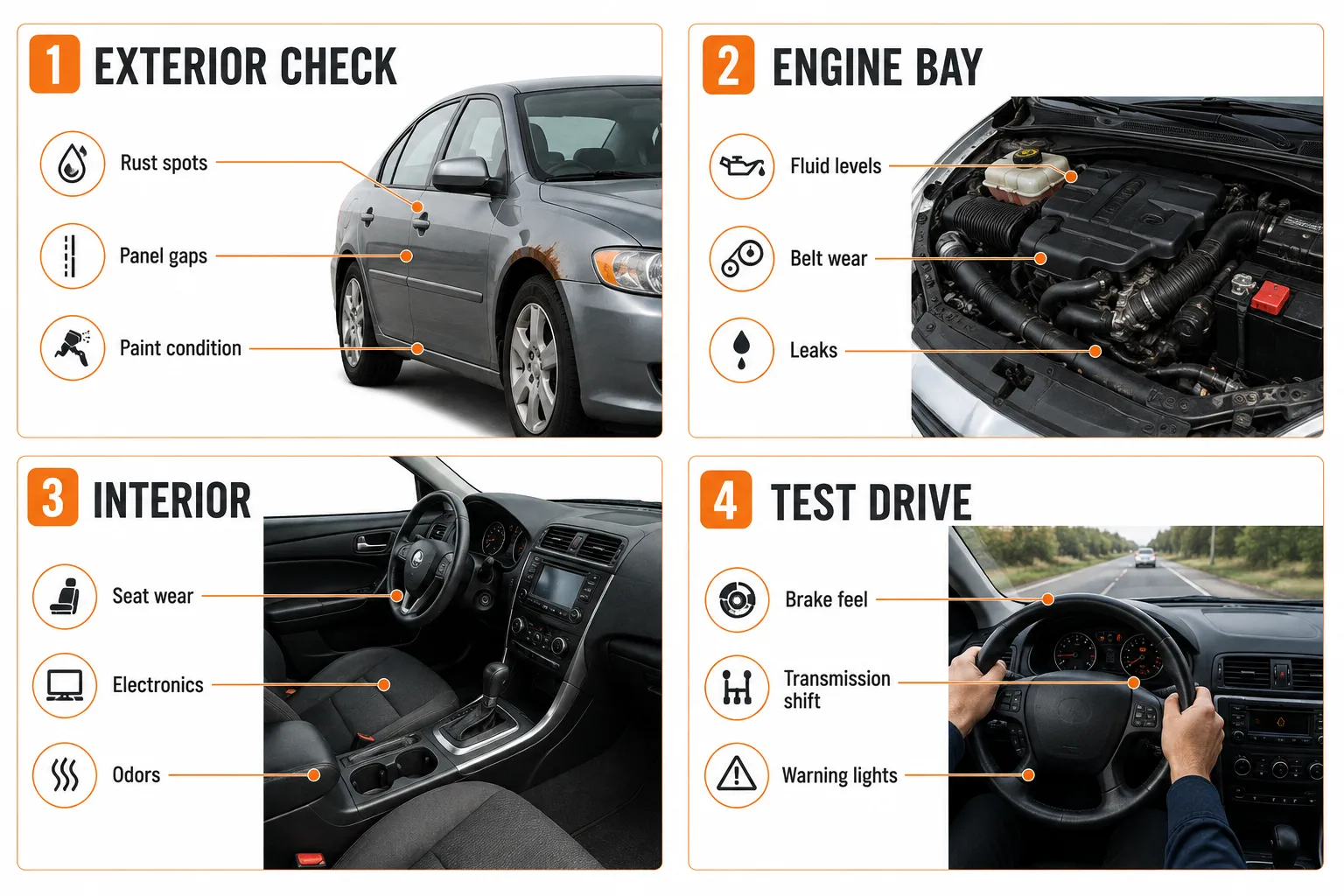
What a good PPI covers:
- Engine and transmission condition
- Brake wear and suspension components
- Signs of previous accident damage or poor repairs
- Fluid levels and condition
- Tire wear patterns (which can reveal alignment or suspension problems)
- Electrical systems and warning lights
- Frame or structural damage
What to check before the test drive:
- Review the vehicle history report for accidents, title issues, and service gaps
- Check that the VIN on the dashboard, door jamb, and title all match
- Look for signs of rust, especially under the car and in the wheel wells
- Check for uneven panel gaps, which can indicate accident repairs
- Look at the tires for uneven wear
What to check during the test drive:
- Brakes should feel firm and not pull to one side
- Transmission should shift smoothly without hesitation or clunking
- No warning lights should appear on the dashboard
- The car should drive straight without pulling
- Listen for unusual noises over bumps, during acceleration, and at highway speed
Edge case: Even certified pre-owned vehicles can benefit from an independent inspection. CPO programs vary widely in what they cover, and an independent mechanic has no financial interest in the sale.
What Is the Difference Between Certified Pre-Owned and Used?
A certified pre-owned (CPO) vehicle is a used car that has passed a manufacturer-specific inspection process and comes with an extended warranty. A standard used car has no such certification and is typically sold as-is.
CPO vs. standard used car:
- CPO vehicles are typically newer (often under 6 years old and under 80,000 miles), have passed a multi-point inspection, and come with a manufacturer-backed warranty. They cost more than comparable non-certified used cars.
- Standard used cars can be any age and condition. They are priced lower but carry more risk unless independently inspected.
Choose CPO if:
- You want warranty coverage and peace of mind
- You are buying a higher-mileage luxury vehicle where repairs are expensive
- You cannot afford a full independent inspection or are buying remotely
Choose standard used if:
- You have a trusted mechanic who can inspect the car
- You are comfortable with some risk in exchange for a lower price
- The vehicle is older and would not qualify for CPO anyway
Important caveat: CPO programs are run by manufacturers, not independent bodies. The quality and coverage of CPO programs varies significantly between brands. Always read the specific CPO warranty terms before paying a premium for certification.
How Much Should You Spend on a Car Based on Your Income?
A widely used rule of thumb is to keep total vehicle costs (loan payment, insurance, fuel, and maintenance) at or below 15-20% of your monthly take-home pay. In 2026, with elevated used car prices and high interest rates, this benchmark is harder to hit than it was five years ago [10].
Simple affordability framework:
- Monthly take-home pay x 15% = maximum total monthly vehicle cost
- Subtract estimated insurance, fuel, and maintenance costs
- The remainder is your maximum monthly loan payment
- Work backward from that payment to find your maximum purchase price based on current interest rates
Example (estimate only, based on general assumptions):
- Monthly take-home: $4,000
- 15% of take-home: $600 maximum total vehicle cost
- Estimated insurance + fuel + maintenance: $350/month
- Maximum loan payment: $250/month
- At current rates (estimated 7-9% for used car loans in 2026), a $250/month payment over 48 months supports a loan of roughly $10,000-$11,000
Common mistake: Many buyers focus only on the monthly payment and ignore total cost. A longer loan term lowers the monthly payment but increases total interest paid significantly.
Practical advice: If the car you want does not fit within your affordability range at current interest rates, consider a less expensive vehicle rather than stretching the loan term. The used market in 2026 has enough inventory that stepping down one trim level or model year often saves thousands [3].
How Do You Transfer a Title and Register a Car After Buying It?
Title transfer and registration must be completed after every car purchase to legally establish ownership. The process varies by state but follows a consistent general pattern.
General title transfer steps:
- Seller signs the back of the title. The seller signs their name exactly as it appears on the front of the title, fills in the odometer reading, and writes the sale price.
- Buyer completes their section. The buyer fills in their name, address, and the date of purchase on the title.
- Both parties sign the bill of sale. Keep copies.
- Buyer takes the signed title to the DMV. Bring the signed title, bill of sale, proof of insurance, valid ID, and payment for taxes and registration fees.
- DMV issues a new title and registration. The new title will be mailed to the buyer (or to the lender if there is a loan).
Timeline: Most states require the buyer to register the vehicle within 10-30 days of purchase. Driving an unregistered vehicle can result in fines.
If the title is lost: The seller must apply for a duplicate title before the sale can proceed. This takes time, so factor it in before agreeing to a purchase timeline.
Lien situations: If the seller still has a loan on the car, the lender holds the title. The seller must pay off the loan, obtain the lien release, and then transfer the clean title to the buyer. Some transactions handle this through an escrow arrangement where the buyer’s payment goes directly to pay off the loan.
What Are Common Mistakes People Make When Selling Their Car?
The most common and costly mistakes in private car sales come down to poor pricing, incomplete paperwork, and skipping the legal steps that protect the seller after the sale.
Top seller mistakes:
- Overpricing based on emotional attachment. The market does not care what you paid for the car or what it means to you. Price based on current comps.
- Not getting a lien release before listing. If you still owe money on the car, you cannot legally transfer a clean title until the loan is paid off.
- Skipping the as-is disclosure. Without a signed disclosure, a buyer could potentially claim you misrepresented the vehicle’s condition.
- Accepting a personal check. Personal checks can bounce. Accept cash, a cashier’s check, or a verified bank transfer for private sales.
- Not notifying the DMV after the sale. If the buyer does not register the car promptly, you could receive tickets or be linked to accidents involving the vehicle.
- Poor presentation. A dirty, undetailed car will sell for less and take longer to sell. A basic detail and clean photos can add hundreds of dollars to the perceived value.
How to prepare your car for sale:
- Get a thorough interior and exterior detail
- Fix obvious cosmetic issues (replace burned-out bulbs, clean up minor scratches if cost-effective)
- Gather all service records and present them to buyers
- Take high-quality photos in good light from multiple angles
- Price based on current market data, not what you paid or what you hope to get
- Write an honest, detailed listing that covers mileage, condition, and any known issues
What Financing Options Are Available When Buying a Car?
Buyers in 2026 have several financing options, but elevated interest rates mean the choice of lender and loan term has a bigger impact on total cost than in previous years [10].
Main financing options:
- Dealer financing: Convenient and sometimes offers manufacturer incentives (primarily on new cars). Dealers can also mark up the interest rate above what the lender charges, so always compare.
- Bank or credit union loan: Often offers better rates than dealer financing, especially for buyers with good credit. Get pre-approved before shopping so you know your budget and have leverage.
- Online lenders: Companies like LightStream, Capital One Auto Finance, and others offer competitive rates and fast pre-approval. Useful for comparison shopping.
- Personal loan: Generally carries higher rates than auto loans and should only be used if the vehicle does not qualify for traditional auto financing (very old, high mileage, or salvage title).
Key financing tips for 2026:
- Get pre-approved before you start shopping. Pre-approval locks in a rate and tells you exactly what you can afford.
- Compare the APR (annual percentage rate), not just the monthly payment.
- Shorter loan terms (36-48 months) cost less in total interest than longer terms (60-72 months), even though the monthly payment is higher.
- A down payment of 10-20% reduces the loan amount and lowers total interest paid.
With used car affordability under pressure from high rates, the Electric Cars Cheaper Than ICE Within Five Years study offers useful context on how total cost of ownership comparisons between vehicle types are shifting, which can inform financing decisions.
How to Start a Car Buying and Selling Business
Starting a car buying and selling business follows the same basic principles as any retail business: buy low, add value, sell at a profit, and stay legal. The difference is that cars come with specific legal requirements that vary by state.
Step-by-step process for starting out:
- Check your state’s dealer license requirements. Most states require a dealer’s license if you sell more than 3-5 cars per year. Requirements typically include a physical business location, a surety bond, a background check, and completion of a dealer training course.
- Choose a business structure. An LLC protects your personal assets from business liability. Consult a business attorney or accountant before starting.
- Open a separate business bank account. Keep business and personal finances completely separate from day one.
- Source vehicles strategically. Start with segments you know well. Compact cars and popular SUVs are easier to sell quickly than niche vehicles.
- Build a reliable inspection process. Partner with a trusted mechanic who can evaluate every car before you buy it.
- Price to sell, not to maximize. Turning inventory quickly is more profitable than holding out for top dollar on every car.
- Keep meticulous records. Every purchase, every repair cost, every sale. This is essential for taxes and for tracking which types of vehicles are most profitable.
Legal considerations for a car business:
- Dealer licenses require renewal and continuing education in most states
- You must collect and remit sales tax on vehicle sales
- Advertising rules apply: you cannot misrepresent a vehicle’s condition or history
- Warranty laws vary: some states require dealers to offer implied warranties even on used vehicles
FAQ: Buying and Selling Cars
Q: How many cars can I sell per year without a dealer’s license? Most states allow private individuals to sell between 3 and 5 cars per year without a dealer’s license. The exact number varies by state. Check your state’s DMV website for the current threshold.
Q: Can I sell a car if I still owe money on it? Yes, but you must pay off the loan before or at the time of sale to transfer a clean title. Many transactions handle this by having the buyer’s payment go directly to the lender to pay off the balance, with any remaining equity going to the seller.
Q: What is the safest way to accept payment in a private car sale? Cash, a cashier’s check from a known bank (verify it in person at the bank before signing over the title), or a verified bank wire transfer are the safest options. Personal checks and payment apps carry fraud risk for large transactions.
Q: Do I need to disclose accidents when selling a car privately? In most states, private sellers are required to disclose known material defects, which can include accident history. Failing to disclose known issues can expose you to fraud claims. When in doubt, disclose.
Q: How long does a title transfer take? Most states process title transfers within 2-6 weeks after the buyer submits paperwork to the DMV. The buyer receives a temporary registration immediately and the permanent title by mail.
Q: Is it worth buying a car at auction? Auctions can offer below-market prices, but most auction vehicles cannot be test-driven or inspected thoroughly before purchase. This risk is higher for beginners. Experienced buyers who know how to spot problems quickly can find good deals.
Q: What is a salvage title and should I avoid it? A salvage title means the vehicle was declared a total loss by an insurance company due to damage. Rebuilt salvage titles mean the car was repaired and passed a state inspection. Both carry lower resale values and can be harder to insure. Avoid salvage titles unless you are an experienced buyer who can assess the repair quality.
Q: How do I know if a car has been in a flood? Check the vehicle history report for flood damage notation. Also look for water stains under the seats, musty odors, rust on metal components inside the car, and mud or debris in unusual places like under the dashboard.
Q: Should I buy an extended warranty on a used car? Extended warranties (also called vehicle service contracts) can provide peace of mind on older, higher-mileage vehicles, but they vary widely in coverage and cost. Read the contract carefully, understand what is excluded, and compare the cost to the likely repair expenses for that specific vehicle.
Q: What is the fastest way to sell a used car? Price it at or slightly below comparable listings in your area, take high-quality photos, write an honest detailed description, and list it on multiple platforms (Facebook Marketplace, Craigslist, AutoTrader, Cars.com). Responding quickly to inquiries also speeds up the sale significantly.
Q: How do I check if a car has any outstanding recalls? Enter the VIN at the National Highway Traffic Safety Administration (NHTSA) website at nhtsa.gov. Recall checks are free and take less than a minute.
Q: What happens if I buy a car and the title is not in the seller’s name? This is a red flag. A title not in the seller’s name (called a “jumped title” or “title jumping”) can create legal complications and may indicate the car was not properly purchased by the person selling it. Avoid these transactions unless you fully understand the legal process for clearing the title in your state.
Conclusion
Buying and selling cars in 2026 is a process that rewards preparation. The market is stable but not forgiving of mistakes. Prices are high by historical standards, interest rates make financing more expensive than it was a few years ago, and the legal requirements for transferring ownership are non-negotiable.
Actionable next steps:
- If you are buying: Get pre-approved for financing before you shop, use NADA and KBB to establish a fair price range, always get a pre-purchase inspection, and never skip the title check.
- If you are selling: Price based on current market data, gather all your documents before listing, detail the car thoroughly, and notify your DMV as soon as the sale is complete.
- If you want to build a business: Start with one car at a time, check your state’s dealer license requirements early, keep detailed records from day one, and focus on segments with consistent demand.
The difference between a good deal and a bad one in this market almost always comes down to how much research was done before the transaction, not during it. Use the tools available, follow the legal steps, and treat every transaction as a business decision, whether you are buying one car for personal use or building a business around the process.
References
[1] Is Buying Used Actually Worth It Anymore 2026 – https://www.reddit.com/r/whatcarshouldIbuy/comments/1qldbge/is_buying_used_actually_worth_it_anymore_2026/
[2] Is Now The Time To Buy Sell Or Trade In A Used Car – https://www.kbb.com/car-advice/is-now-the-time-to-buy-sell-or-trade-in-a-used-car/
[3] Q1 2026 Edmunds Insights Used Car Report – https://www.edmunds.com/car-news/q1-2026-edmunds-insights-used-car-report.html
[4] Used Car Market 2026 Where Values Stand At The Halfway Point – https://www.blackbook.com/used-car-market-2026-where-values-stand-at-the-halfway-point/
[5] Used Car Index – https://www.carfax.com/used-car-index
[6] Used Car Prices 2026 – https://curbsold.com/blog/used-car-prices-2026
[7] Used Vehicle Sales Expected To Dip In 2026 – https://niada.com/dashboard/used-vehicle-sales-expected-to-dip-in-2026/
[8] Used Car Market – https://www.mordorintelligence.com/industry-reports/used-car-market
[9] Used Vehicle Prices 2026 Cox Forecast – https://www.cnbc.com/2026/01/08/used-vehicle-prices-2026-cox-forecast.html
[10] Used Car Affordability – https://www.cnbc.com/2026/02/17/used-car-affordability.html