
Last Updated on September 15, 2026
A boat fire can turn a quiet afternoon on the water into a five-minute race for survival. There is no fire truck waiting around the bend, no garden hose, and often no land in sight. That is why boat fire safety is not just another item on a checklist. It is one of the most important skills any boat owner can learn, and in 2026, the rules around it are changing faster than at any point in the last decade.
New international shipping rules took effect on January 1, 2026, tightening fire detection, alarm systems, and firefighting foam standards across commercial and recreational vessels alike[1][9]. At the same time, everyday boat owners are getting clearer, simpler guidance on extinguisher requirements, electrical checks, and what to do in the first sixty seconds of a fire[3][5][8]. This guide brings all of that together in plain language, so you know exactly what boat fire safety looks like this year, before you start the engine, and if the worst ever happens.
Key Takeaways
- New SOLAS fire safety amendments effective January 1, 2026, require better smoke detection, alarm coverage, and PFOS-free firefighting foam on many vessels[1][4][9].
- Most boat fires start with electrical faults or fuel problems, and both are highly preventable with routine checks[3][5].
- U.S. Coast Guard rules set clear extinguisher requirements by boat length, ranging from one 5-B unit on small boats to two 5-B or one 20-B unit on larger vessels[8].
- If a fire breaks out, never walk into smoke. Get life jackets on, move away from the fire, and call for help on VHF channel 16 before trying to fight anything beyond a small, contained flame[2][7].
- Lithium-ion batteries on tenders and small electric craft are a growing fire risk, and new UK guidance is pushing for dedicated, ventilated storage spaces[6].
Why Boat Fire Safety Rules Are Changing in 2026
Something big happened at the start of this year that most casual boaters never heard about. On January 1, 2026, a wave of updates to the International Convention for the Safety of Life at Sea, known as SOLAS, officially entered into force. Resolution MSC.555(108) and a set of related code changes now require stronger fire detection, wider alarm coverage, and better suppression systems on a huge range of vessels[1][9]. Classification societies like Lloyd’s Register have spent the year updating design rules, survey checklists, and operational procedures to match[1].
Why should a weekend boater care about rules written for cargo ships and ferries? Because these changes signal where all marine fire safety is heading, and many of the same underlying risks apply to smaller boats too. Three trends stand out.
Firefighting Foam Is Getting a Major Overhaul
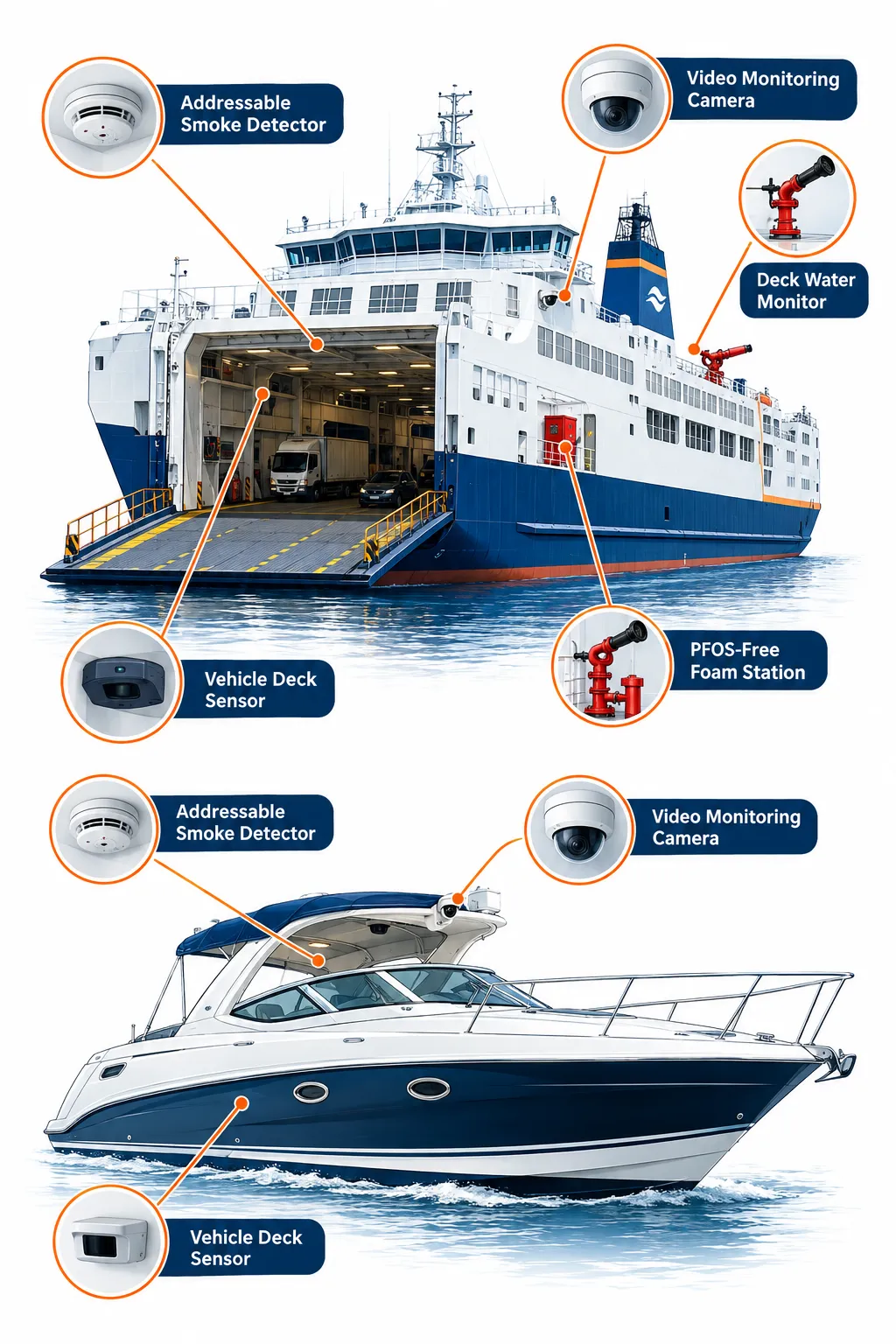
For decades, many boats and ships used PFOS-containing firefighting foam because it worked well on fuel fires. That foam is now being phased out under SOLAS Chapter II-2. Every ship must remove or replace PFOS-containing foam by its first survey after January 1, 2026[4]. Owners are shifting to marine-approved alternative foams and reviewing their fixed foam systems on decks and in machinery spaces[4]. If you own a boat with an older fixed foam suppression system, this is worth checking with your marine surveyor, since older stock may no longer meet current standards.
Vehicle and Ro-Ro Decks Are Under the Spotlight
Roll-on/roll-off ferries and vehicle carriers are facing some of the strictest new requirements, largely because of concerns about electric vehicle battery fires[6][10]. New vessels with vehicle decks must now install individually addressable smoke and heat detectors, permanent video monitoring, and better protection around openings so fire cannot easily spread toward crew and passenger areas[4][6][10]. For new Ro-Ro passenger ships built from January 1, 2026 onward, fixed water-based monitors on open decks must cover the entire vehicle parking area and meet minimum flow rates, with extra nozzles added anywhere a monitor cannot reach[10]. This is a direct response to a real and growing hazard: electric vehicles and battery-powered equipment can ignite in ways that are harder to detect and harder to put out than a traditional fuel fire.
Detection Gaps Are Being Closed
Earlier SOLAS cycles left some gaps in fire alarm coverage. The 2026 amendments specifically extend fire detection and alarm requirements to cargo ship control stations, navigation bridges, and fire control stations[6][9]. That might sound purely technical, but the goal is simple: give the people in charge of a vessel earlier warning, so they can make faster, better decisions during a developing fire[6][9]. This same principle, early warning saves lives, applies just as much to a 24-foot bowrider as it does to a 900-foot container ship.
If you want a broader view of how these kinds of regulations fit into everyday boating, the complete 2026 guide to boating safety, laws, and compliance is a useful next stop.
“Early detection is the single biggest factor in whether a small onboard fire stays small.” This idea sits at the heart of nearly every 2026 fire safety update, from massive Ro-Ro ferries down to family runabouts.
Boat Fire Prevention: Stopping Fires Before They Start
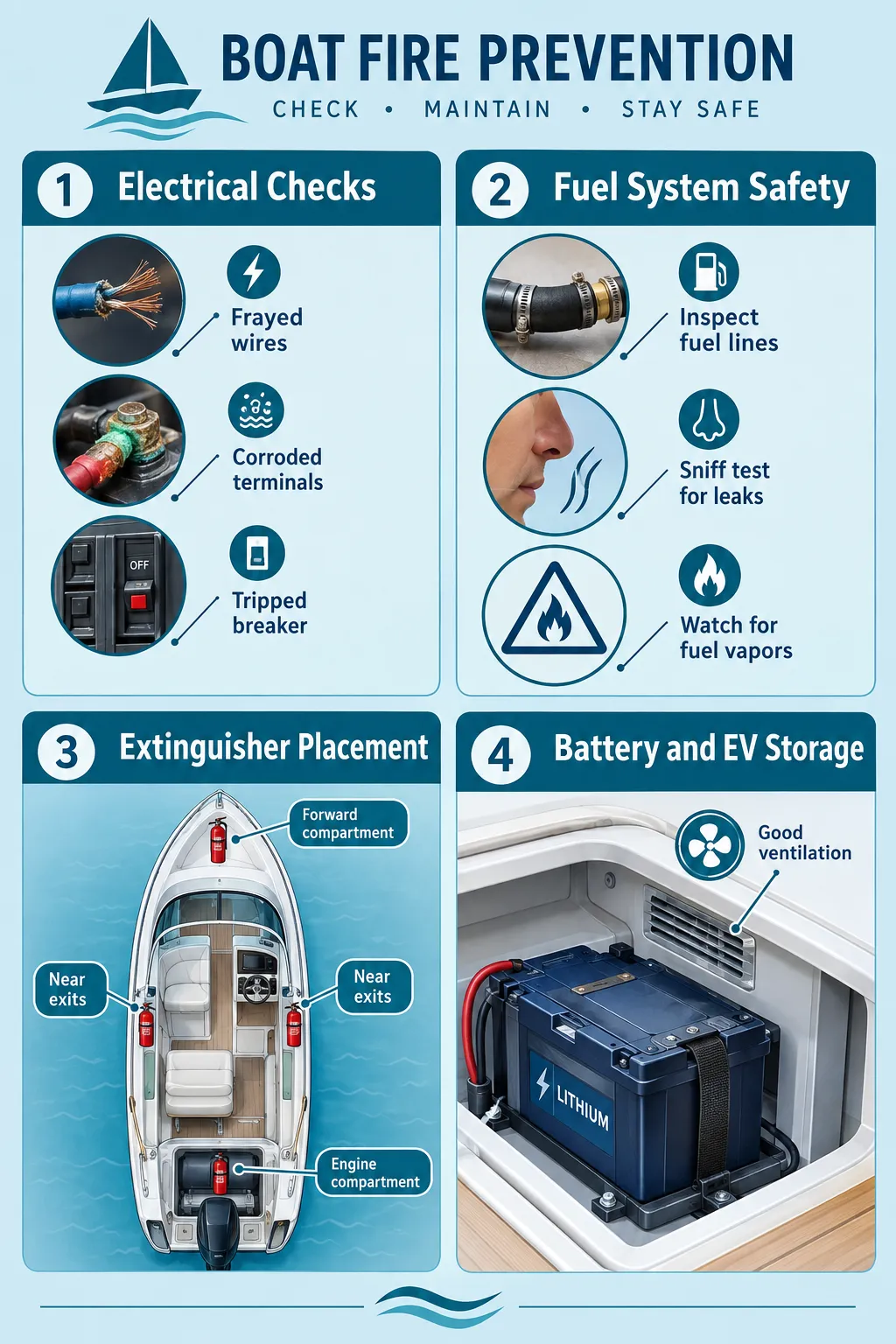
Prevention is the least exciting part of boat fire safety, and also the most effective. Most boat fires do not start with dramatic explosions. They start quietly, with a frayed wire, a leaking fuel line, or a battery left charging in a poorly ventilated space. National awareness campaigns like Boat Fire Safety Week 2026 exist specifically because these small, boring problems cause the vast majority of real fires[3]. Updated guidance from the U.S. Fire Administration similarly points to electrical systems and fuel handling as the two biggest everyday risks on recreational boats[5].
Electrical System Checks
Boats live in a harsh environment. Salt air, constant vibration, and moisture work together to break down wiring insulation and corrode connections faster than almost anything on land. A basic electrical check should happen at least once a season, and ideally before every long trip.
Look for these warning signs:
- Discolored or melted insulation on any wire, especially near the engine or battery.
- Corroded battery terminals with a white or green crust.
- Loose connections that feel warm to the touch after running.
- Overloaded outlets at shore power connections, a problem specifically flagged in updated marina fire safety guidance[5].
- Breakers that trip repeatedly, which almost always means something is wrong further down the circuit, not the breaker itself.
If your boat has any aftermarket electronics installed, such as entertainment systems or connected boat technology for monitoring the vessel remotely, make sure those installations were wired properly and are not drawing more current than the circuit was designed for.
Fuel System Safety
Fuel fires are especially dangerous on boats because gasoline vapors are heavier than air and can pool in a closed bilge, waiting for a single spark. A few habits go a long way:
- Run the bilge blower for at least four minutes before starting a gasoline engine.
- Sniff the engine compartment before every start, since a nose can often catch a fuel leak before any sensor does.
- Check fuel lines and connections for cracking, softness, or weeping fuel at the start of every season.
- Never fuel up with the engine running, and always shut off anything that could spark.
- Confirm fuel flashpoint information on delivery paperwork if you take on bulk fuel, since marine rules now specify a minimum flashpoint of 60°C for safety[4][6].
Fire Extinguisher Requirements by Boat Length
One of the clearest updates for everyday boat owners in 2026 is a simplified breakdown of U.S. Coast Guard fire extinguisher rules by vessel length[8]. This table gives a general overview, though owners should always confirm current requirements for their specific boat class and fixed suppression setup.
| Boat Length | Minimum Without Fixed System | Minimum With Certified Fixed System |
|---|---|---|
| Under 26 feet | One USCG-approved 5-B extinguisher | Reduced or no portable unit required |
| 26 to 40 feet | Two 5-B units, or one 20-B unit | One 5-B unit typically sufficient |
| Over 40 feet | Three 5-B units, or a mix reaching equivalent rating | Two 5-B units typically sufficient |
Extinguishers must be marine-type, mounted where they are easy to reach, and kept in serviceable condition with a current inspection tag[8]. National boating organizations also stress where extinguishers sit matters almost as much as how many you carry. Positioning units near cabin exits and the companionway lets a boater make a quick attempt at a small fire while still keeping an open path to escape[7].
For smaller vessels without much dedicated storage, review what belongs on board with this list of small boat essentials, which covers safety gear beyond just fire extinguishers.
Battery and Lithium-Ion Storage
Electric tenders, e-bikes stored on deck, and battery-powered accessories are becoming common, and they bring a new kind of fire risk: thermal runaway. Unlike a fuel fire, a lithium-ion battery fire can reignite even after it appears to be out, and it can be very difficult to smother.
Guidance for pleasure yachts under 24 meters already calls for strategic distribution of extinguishers and appropriate layout choices for smaller craft[13]. Newer UK guidance goes further, recommending dedicated, ventilated spaces for storing, charging, and handling small electric-powered craft to reduce the chance of a battery fire spreading[14]. Practical takeaways for any boat owner with battery-powered gear on board:
- Charge batteries in a ventilated space, never in a sealed locker.
- Never leave batteries charging unattended overnight while docked.
- Inspect battery casings for swelling, cracks, or heat damage before every trip.
- Keep battery-powered gear away from fuel storage areas.
Emergency Response: What To Do When a Fire Breaks Out on a Boat
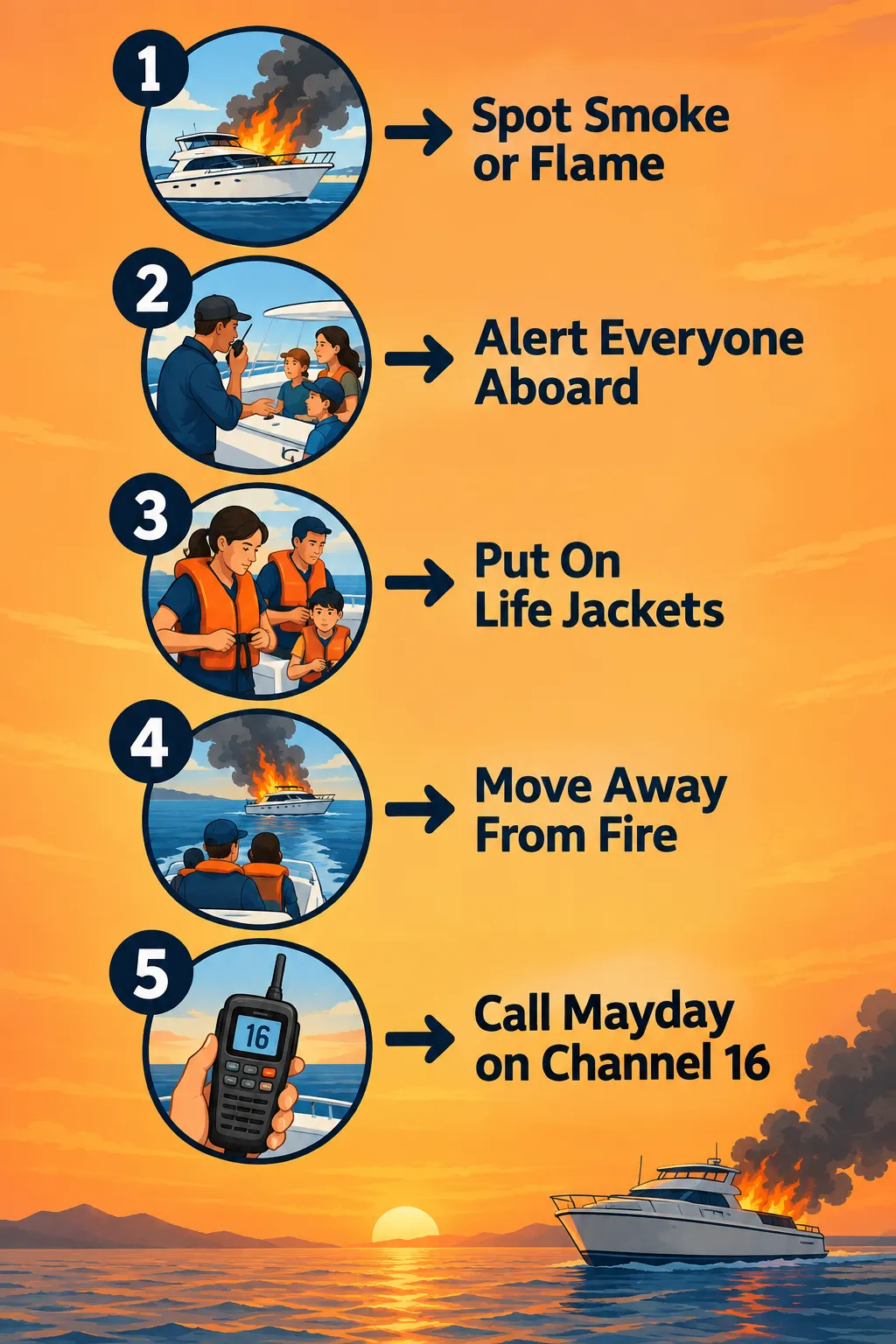
Prevention fails sometimes, no matter how careful anyone is. When it does, the first sixty seconds decide almost everything. National guidance on fire safety on boats is remarkably consistent on this point: do not be a hero, be fast and calm[2][7].
Step 1: Spot It Early and Alert Everyone
The moment anyone smells smoke, sees flame, or notices an unusual electrical smell, say it out loud immediately. Do not wait to confirm it is serious. Every second matters, and other people on board need time to react too.
Step 2: Never Walk Into Smoke
This is one of the most important boat fire safety rules there is, and it goes against instinct for many people. Smoke inhalation, not flame, injures and kills far more boaters in fires than burns do. If a space is already filled with smoke, stay out of it[2]. If smoke fills a space someone is already inside, that person should get low, since smoke rises and clearer air sits near the floor[2].
Step 3: Get Life Jackets On
Before anything else, everyone aboard should put on a life jacket. This sounds simple, but in the panic of a fire, it is often forgotten. A fire may force people into the water quickly, either on purpose or by accident, and there will be no time to search for gear once flames spread[2].
Step 4: Move Away From the Fire, Not Toward It
If the boat has open deck space, move everyone away from the fire and toward the opposite end of the vessel[2]. This keeps people clear of smoke, heat, and the risk of an explosion if the fire reaches a fuel tank. It also keeps the escape route toward the water open in case abandoning the boat becomes necessary.
Step 5: Fight Small Fires Only, and Only With an Escape Route Open
A contained, small fire, a pan fire in a galley, or a small electrical fire that has not spread, may be manageable with a portable extinguisher. But this should only be attempted if:
- The fire is small and has not spread beyond its starting point.
- There is a clear escape route behind the person fighting the fire.
- Everyone else is already moving to safety or already in life jackets.
If the fire is large, spreading, or blocking the exit, the guidance is unanimous: stop trying to fight it and focus entirely on getting everyone off the boat safely[2][7].
Step 6: Call for Help the Right Way
Once everyone is safe or safely moving toward safety, call for help using VHF channel 16, the international hailing and distress channel. A proper Mayday call includes the boat’s name, position, number of people aboard, and the nature of the emergency[2]. If a handheld VHF or flares are available, use them. Do not rely solely on a cell phone, since coverage on the water is unreliable and rescue services monitor marine channels specifically for this reason.
This same structured approach carries over into other emergencies on the water. For a related situation, see how boaters should respond to a man overboard emergency, since both scenarios rely on the same core principles: stay calm, act fast, and communicate clearly.
Marina Fires and Docked Boats
Fires do not only happen underway. A large share of boat fires start while a vessel is docked, often connected to shore power. Updated U.S. guidance on boats and marinas highlights several dock-specific steps[5]:
- Install smoke and carbon monoxide alarms belowdecks, since fumes can build up unnoticed while docked.
- Inspect wiring and shore power connections regularly, since these are exposed to weather and constant plugging and unplugging.
- Avoid overloaded outlets and power strips on the dock or aboard the boat.
- Know the marina’s escape routes and emergency contact numbers before an emergency happens, not during one.
Larger marine incidents also increasingly follow formal incident command structures, where the first official on scene takes charge as Incident Commander and coordinates communication and resources until additional help arrives[12]. While that level of structure is built for larger response teams, the underlying lesson applies to any boater: know who is in charge, know the plan, and communicate clearly the moment something goes wrong.
Boat Fire Safety Equipment Checklist by Boat Size
Different boats need different levels of fire safety equipment. A small fishing boat does not need the same setup as a 40-foot cruiser with a galley and sleeping cabins. Use this checklist as a starting point, then confirm exact requirements for the specific vessel class.
| Equipment | Small Boats (Under 26 ft) | Mid-Size Boats (26-40 ft) | Larger Boats (Over 40 ft) |
|---|---|---|---|
| Portable fire extinguishers | 1 unit, 5-B rated | 2 units, 5-B, or 1 unit, 20-B | 3 units, 5-B, or equivalent combination |
| Smoke/CO alarms | Recommended in enclosed spaces | Required in cabins and sleeping areas | Required in all enclosed and sleeping areas |
| Fixed suppression system | Not typical | Recommended in engine compartment | Often required in machinery spaces |
| Life jackets accessible | One per person, stored openly | One per person plus throwable device | One per person plus throwable device |
| VHF radio | Handheld recommended | Fixed-mount recommended | Fixed-mount required for offshore use |
This kind of checklist works well alongside a broader review of onboard safety gear. Boaters upgrading an older vessel or buying a new one may also want to compare available features across different types of powerboats before deciding what extra fire protection makes sense for their specific hull and layout.
Marina and Storage Fire Safety Tips
A boat sitting still is not a boat that is automatically safe. Storage periods, particularly winter layup, create their own fire risks, often tied to batteries left connected, fuel left stagnant in tanks, or electrical systems left unchecked for months at a time.
Before storing a boat for any extended period:
- Disconnect batteries unless using a smart charger designed for long-term storage.
- Check fuel stabilizer needs so tanks are not left with fuel that degrades and becomes more volatile.
- Inspect all wiring one final time before the boat sits unused.
- Store the boat in a well-ventilated space, away from other flammable materials.
For boaters preparing a vessel for the off-season, a full walkthrough is available in this guide to winterizing a boat in five steps, which covers fuel, battery, and system checks in more depth. General on-water precautions are also worth revisiting seasonally through this collection of boating safety tips to follow.
Marina layout matters too. Boats packed tightly together at a dock mean a fire on one vessel can spread quickly to neighboring boats. Whenever possible, know two ways off the dock, not just one, and keep an eye on neighboring boats’ shore power setups, since a fire does not respect property lines.
Frequently Asked Questions About Boat Fire Safety
What causes most boat fires? Most boat fires trace back to electrical faults, fuel leaks, or improperly stored batteries. Wiring damaged by salt air and vibration is one of the most common root causes[3][5].
How many fire extinguishers does my boat need? It depends on length. Boats under 26 feet without a fixed suppression system typically need at least one 5-B rated extinguisher. Boats between 26 and 40 feet generally need two 5-B units or one 20-B unit, with reduced requirements if a certified fixed system is installed[8].
Should I ever fight a boat fire myself? Only if the fire is small, contained, and there is a clear path to escape behind you. Never attempt to fight a fire that is spreading or blocking an exit. Focus on getting everyone into life jackets and away from the fire instead[2][7].
What is the correct way to call for help during a boat fire? Use VHF channel 16 to send a Mayday call with your boat’s name, location, number of people aboard, and the nature of the emergency. Do not rely only on a cell phone, since marine channels are specifically monitored for distress calls[2].
Are lithium-ion batteries a real fire risk on boats? Yes. Battery fires can reignite even after appearing extinguished, and newer guidance recommends storing and charging electric tenders and small electric craft in dedicated, ventilated spaces rather than sealed lockers[14].
Do the new 2026 SOLAS rules apply to my personal boat? The 2026 SOLAS amendments primarily apply to larger commercial and passenger vessels[1][9]. However, they reflect a broader shift toward better detection and safer firefighting materials that is also shaping updated U.S. Coast Guard guidance for recreational boats[8].
Conclusion
Boat fire safety comes down to two simple habits: preventing problems before they start, and knowing exactly what to do in the first minute if prevention fails anyway. The rules guiding both sides of that equation are getting sharper in 2026, from international shipping standards on foam and detection systems down to clear, length-based extinguisher rules for personal boats[1][8][9].
None of this requires expensive upgrades to get started. Check the wiring. Sniff the bilge before starting the engine. Mount extinguishers near the exits, not buried in a locker. Talk through the escape plan with everyone on board before leaving the dock, not after smoke fills the cabin. These small habits, repeated every season, are what actually keep boaters safe.
Before the next trip, walk through the boat with fresh eyes. Check every extinguisher tag, test every alarm, and make sure everyone aboard knows the plan if something goes wrong. That five-minute walkthrough is the simplest, cheapest form of boat fire safety available, and it is the one most likely to matter the day it counts.
References
[1] 07 26 – https://www.lr.org/en/knowledge/class-news/07-26/ [2] Fire Safety On Boats Accessible Version – https://www.gov.uk/government/publications/fire-safety-on-boats/fire-safety-on-boats-accessible-version [3] Boat Fire Safety Week 2026 Stay Safe On The Water – https://www.fireandsafetyteam.co.uk/boat-fire-safety-week-2026-stay-safe-on-the-water/ [4] Shipboard Fire Fighting Equipment Procedures Solas Requirements 2026 – https://marineinspection.app/blog/shipboard-fire-fighting-equipment-procedures-solas-requirements-2026 [5] Boats And Marinas – https://www.usfa.fema.gov/prevention/vehicle-fires/boats-and-marinas/ [6] Solas Convention 2026 Complete Guide All Chapters Explained – https://marineinspection.app/blog/solas-convention-2026-complete-guide-all-chapters-explained [7] Fire Safety On Boats – https://www.rya.org.uk/water-safety/boat-safety-and-maintenance/fire-safety-on-boats/ [8] Fire Extinguisher Requirements For Boats 2026 Guide – https://safeboatingamerica.com/blog/fire-extinguisher-requirements-for-boats-2026-guide [9] 4 Year Cycle Amendments To Solas And Related Codes Effective On 1 January 2026 – https://www.krs.co.kr/TECHNICAL_FILE/4-year%20cycle%20amendments%20to%20SOLAS%20and%20related%20Codes%20effective%20on%201%20January%202026%20(E).pdf [10] Bulletin Imo Nr 15 2025 Imo Requirements 2026 Eng – https://prs.pl/wp-content/uploads/Bulletin_IMO_nr_15_2025_IMO-Requirements-2026_ENG.pdf