
Last Updated on November 2, 2026
A boat sinks a trailer more often from math errors than from rust. Owners eyeball hull length, pick a trailer that “looks about right,” and then discover at the ramp that the axle is groaning under a load it was never built to carry. This Boat Trailer Buying Guide: How to Match Capacity, Axles, Brakes, Tires, and Hitch to Your Boat exists because trailer failures are almost always predictable, calculable, and avoidable before you ever sign a receipt.
Buying the right trailer is not about brand loyalty or finding the cheapest frame on the lot. It is a weight problem first, a mechanical-compatibility problem second, and a corrosion-environment problem third. Get those three right, and everything else, bunks, winches, fenders, is just detail work.
Key Takeaways
- Trailer capacity must be sized to your boat’s fully loaded weight (hull, motor, fuel, gear, water in the bilge), not just hull length.
- Tongue weight should land near 10% of gross trailer weight (GTW); too little causes sway, too much overloads the tow vehicle’s hitch rating.
- Brakes are required by most states and strongly advised by regulators once combined trailer and boat weight hits roughly 3,000 pounds [1].
- Tires need a load rating that exceeds your per-axle share of the loaded weight, with pressure set to the trailer tire’s max sidewall rating, not the vehicle tire chart.
- Frame material and axle choice should reflect your towing environment, saltwater demands galvanized or aluminum construction, and axle sourcing is shifting toward marine-grade, domestically engineered components in 2026 [2].
Capacity: Start With Loaded Weight, Not Hull Length
Trailer capacity is the foundation of this entire Boat Trailer Buying Guide: How to Match Capacity, Axles, Brakes, Tires, and Hitch to Your Boat, and it is the step most buyers get wrong. A 20-foot center console sounds simple to size, but the dry hull weight listed in brochures ignores the outboard motor, full fuel tank, battery bank, anchor and chain, cooler, fishing gear, and the water that always seems to pool in the bilge after a wet morning.
Calculate it this way:
- Start with dry hull weight from the manufacturer.
- Add motor weight (outboards range from roughly 300 to 600+ pounds depending on horsepower).
- Add full fuel weight (gasoline weighs about 6.3 pounds per gallon).
- Add gear, batteries, and anchor tackle, a conservative estimate is 150 to 400 pounds for most recreational rigs.
- Add a 10-15% safety buffer for water intrusion and future gear accumulation.
The trailer’s GVWR (Gross Vehicle Weight Rating), the stamped maximum for trailer plus cargo, must exceed this total with margin, not match it exactly. A trailer running at 95% of its rating on day one has no room for a bigger motor repower or added fuel capacity later. If you are still shopping for the boat itself, review a complete buyer’s guide to shopping for a boat before locking in trailer specs, since motor and fuel choices change the math significantly.
Tongue Weight: The Number Everyone Skips
Tongue weight, the downward force the trailer coupler exerts on the hitch ball, should sit near 10% of GTW. Too little tongue weight (under 5%) causes dangerous trailer sway at highway speed. Too much (over 15%) can overload the tow vehicle’s rear axle and hitch receiver rating. Tongue weight is adjusted by sliding the boat forward or backward on the bunks, so this is a fit-and-test step, not a one-time spec you check once.
Axles, Brakes, and Tires: The Load-Bearing Trio
Once capacity is settled, axles, brakes, and tires have to work together as a matched system, not three separate purchases.
Axle Ratings and the 2026 Supply Shift
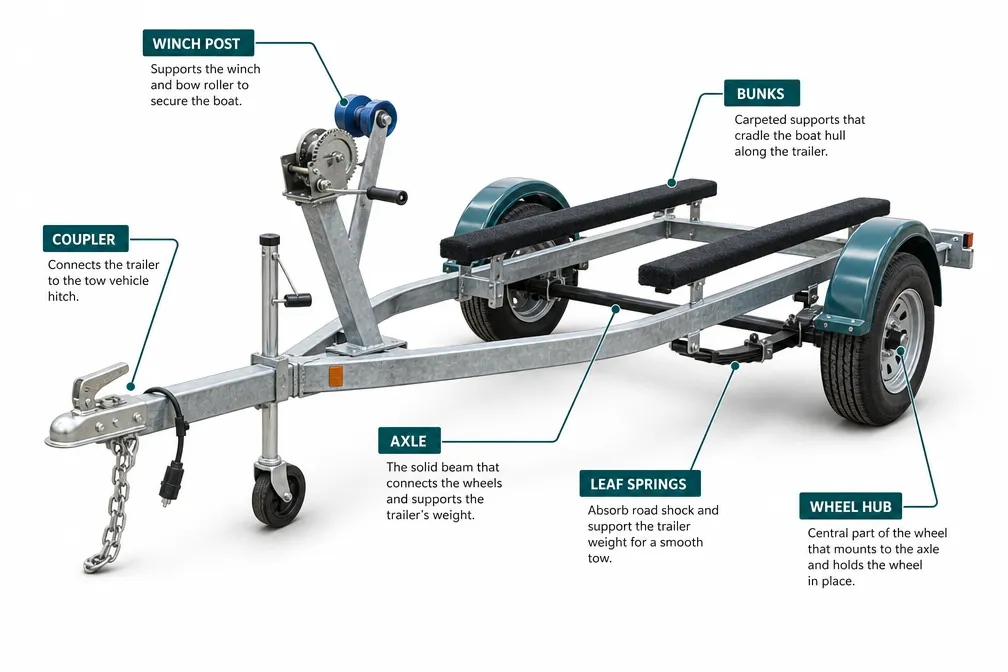
Axles carry the entire loaded weight, and undersizing here is the single most common cause of trailer failure on long hauls. Single-axle trailers typically top out in the 3,500-pound range; anything heavier calls for tandem or triple axles to spread the load and add redundancy if one tire fails mid-trip.
In 2026, the marine trailer industry has leaned harder into marine-grade, domestically engineered axle production, responding to past supply disruptions and growing demand for corrosion-resistant components built specifically for saltwater exposure rather than repurposed utility-trailer parts [2]. This shift matters for buyers: axles designed for marine service typically use sealed bearings and coated spindles that resist the pitting ordinary steel axles suffer near salt water.
Quick rule of thumb:Add the weight capacity of both axles together, then subtract at least 15% as a safety margin before comparing it to your fully loaded boat weight.
Brakes: When They Stop Being Optional
Most states require brakes on at least one axle once combined trailer and boat weight crosses roughly 3,000 pounds, and regulatory guidance continues to reinforce this threshold as a baseline safety standard rather than a suggestion [1]. Three brake types dominate the market:
| Brake Type | Best For | Maintenance Note |
|---|---|---|
| Surge (hydraulic) | Most recreational trailers | Fluid flush needed, especially after saltwater dunks |
| Electric over hydraulic | Larger tandem-axle rigs, frequent long hauls | Requires brake controller in tow vehicle |
| None | Small trailers under local weight threshold | Check state law before skipping |
Industry innovation around boat loading and ramp safety continues to accelerate, including recent patent-pending safety assistance concepts aimed at reducing loading accidents at the ramp [3]. That trend reflects a broader industry push: brakes and loading aids are increasingly treated as core safety equipment, not optional upgrades.
Tires: Load Rating Beats Everything Else
Trailer tires are not car tires. They are built with stiffer sidewalls to resist sway rather than absorb bumps, and they fail differently, usually through sudden blowouts rather than slow tread wear. Two numbers matter above all else:
- Load rating, printed on the sidewall, must exceed your per-tire share of loaded weight with margin.
- Max sidewall pressure, trailer tires should be inflated to the maximum cold pressure listed on the sidewall, unlike passenger tires that follow a vehicle-specific chart.
Underinflated trailer tires overheat on the highway and are a leading cause of roadside blowouts. If you tow a travel trailer or RV alongside your boat trailer, the warning signs are similar across both, worth comparing against warning signs your RV tires are bad for a broader failure checklist.
Hitch, Hull Fit, and the Full Boat Trailer Buying Guide Checklist
The last piece of this Boat Trailer Buying Guide: How to Match Capacity, Axles, Brakes, Tires, and Hitch to Your Boat is making sure the trailer actually connects to your vehicle and actually cradles your hull correctly.
Hitch and Coupler Compatibility
Match the hitch class to GTW, not the other way around. A Class III hitch rated for 5,000 pounds should never carry a 6,000-pound loaded trailer, even briefly. Check:
- Hitch class rating versus GTW
- Ball size matching coupler size (1-7/8″, 2″, or 2-5/16″)
- Wiring harness compatibility (4-pin, 5-pin, or 7-pin trailer connector)
- Safety chain rating and crossing pattern
Bunks, Rollers, and Structural Hull Support
A trailer that is rated correctly but shaped wrong will still damage the hull. Bunk trailers use padded wooden or composite boards running the length of the keel and chines; roller trailers use rollers for easier launching on shallow ramps. V-hull boats generally need adjustable bunks matched to deadrise angle, while pontoons require multi-pontoon-specific cradles. If you are shopping pontoon-specific trailers, pair this research with a look at how much a pontoon boat costs since pontoon trailer pricing tracks closely with boat value.
Corrosion: Saltwater vs. Freshwater Frames
Frame material is a budget decision disguised as a durability decision. Galvanized steel resists rust reasonably well and costs less upfront; aluminum resists saltwater corrosion far better but costs more. Saltwater boaters should treat aluminum or well-galvanized frames as a near-requirement, while freshwater-only owners can often get by with standard galvanized steel at a lower price point.
The Full Matching Checklist
Before you buy, confirm:- GVWR exceeds fully loaded boat weight by at least 15-20%
- Tongue weight lands near 10% of GTW once boat is positioned
- Axle rating (combined, minus safety margin) covers loaded weight
- Brakes installed if combined weight approaches or exceeds 3,000 lbs
- Tire load rating exceeds per-tire share of weight, inflated to max sidewall pressure
- Hitch class and coupler size match tow vehicle and trailer exactly
- Frame material suited to saltwater or freshwater use
- Bunks or rollers matched to hull shape and deadrise
Industry Context: Where the Trailer Market Is Headed
The trailer segment is not standing still. Specialized transport and launching solutions are expanding, with manufacturers like Vanclaes showcasing complete boat transport and launching systems at major industry events such as METSTRADE 2026 [2]. Broader marine retail consolidation, including recent dealership acquisitions [4][5], signals a maturing market where buyers increasingly expect integrated trailer-and-boat packages rather than aftermarket guesswork. Analysts tracking the marine sector also note steady structural growth in trailerable boat ownership continuing through the back half of the decade [6], meaning trailer compatibility will only become a bigger purchasing consideration, not a smaller one.
Before finalizing any trailer purchase, it’s also worth reviewing your broader boat ownership and maintenance responsibilities, since trailer upkeep is really an extension of overall boat care. Towing laws and insurance requirements also intersect with trailer specs, so cross-check your plans against boating safety, laws, and compliance guidance for your state.
Conclusion
Matching a trailer to a boat is arithmetic wrapped in mechanics. Start with the fully loaded weight of the boat, hull, motor, fuel, gear, and a safety buffer, then size the axle, brake, tire, and hitch system to exceed that number with margin at every step. Skipping the math is how owners end up with sagging axles, cooked tires, or a sheared hitch ball on the interstate.
Before buying, run the full checklist above against the specific trailer listing, confirm the GVWR tag on the trailer frame itself (not just the sales brochure), and have a dealer verify tongue weight once the boat sits on the bunks. A trailer bought this way will outlast two or three boats, not the other way around.
Meta Title and Description
Tags
boat trailer buying guide, trailer capacity, axle ratings, trailer brakes, trailer tires, hitch compatibility, tongue weight, GVWR, boat towing, marine trailers, corrosion resistance, trailer maintenance
References
- Trailering Safety. portal.ct.gov.
- Vanclaes Brings Complete Boat Transport and Launching Solutions to Metstrade 2026. metstrade.com.
- An Inventhelp 123invent Client Develops Safety Assistance Idea For Boat Loading Ksg 320 302923724. prnewswire.com.
- Seattle Boat Company Acquires Bayside Marine in Everett. boatingindustry.com.
- Seattle Boat Co Acquires Dealership. tradeonlytoday.com.
- Page. marineindustrynews.co.uk.