
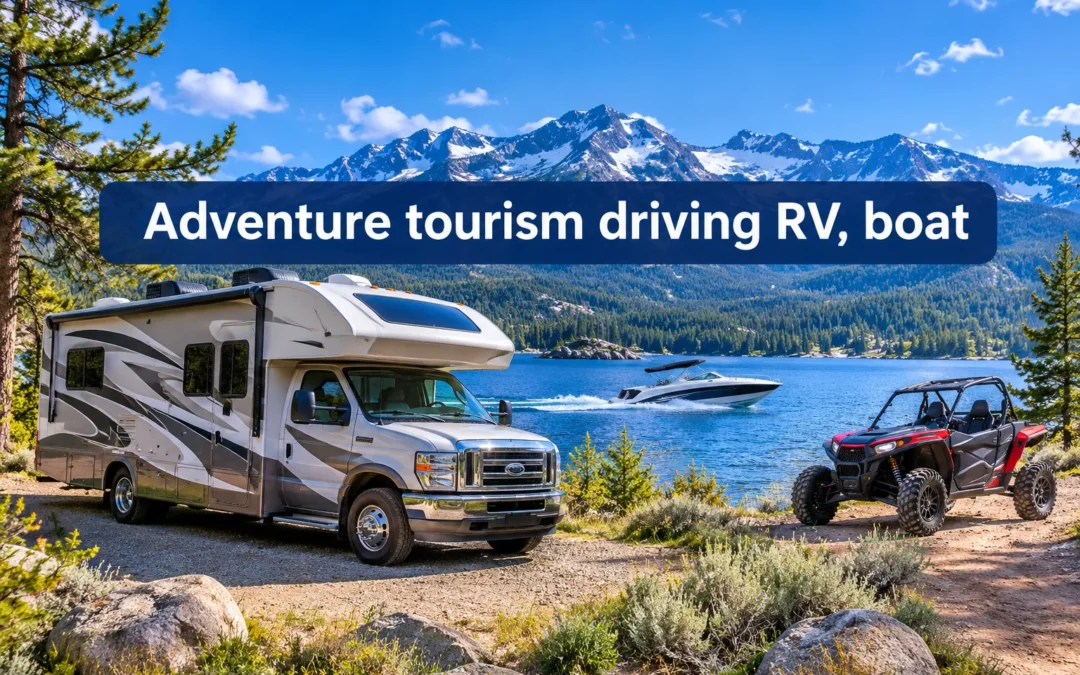
Last Updated on November 22, 2026
Boating and fishing alone generated roughly $39.1 billion in value added to the U.S. economy in 2025, making water recreation the single largest “conventional” outdoor activity tracked by federal economists.[1][2] That number is not a fluke. It is part of a much bigger story: adventure tourism driving RV, boat and powersports demand across nearly every corner of the recreation economy. From desert side-by-side tours to lakeside RV rentals, travelers are trading hotel bookings for self-directed, nature-based trips, and manufacturers, dealers, and rental fleets are scrambling to keep up.
This shift is not seasonal noise. It is a structural change in how people define a vacation. Understanding why adventure tourism is driving RV, boat and powersports demand helps explain pricing trends, inventory shortages, and where smart buyers and investors should be looking next.
Key Takeaways
- Boating and fishing generated about $39.1 billion in value added in 2025, confirming water recreation as a top economic driver.[1][2]
- Off-road recreation accounted for 48.39% of global powersports revenue in 2025, with adventure-tourism marketing cited as a direct cause.[3]
- The global powersports market, valued near $41-42 billion in 2025, is projected to reach $66.8-$72.1 billion within the next decade.[4][5][6]
- North America’s RV market is forecast to jump from $27.24 billion in 2024 to $59.3 billion by 2033, a 9.03% CAGR tied to adventure travel trends.[7]
- 92% of RVers plan to travel the same amount or more in 2025, and 60% of U.S. travelers plan an RV-based road trip, showing demand is durable, not just cost-driven.[8][9]
Why Adventure Tourism Is Driving RV, Boat and Powersports Demand
The logic is straightforward. Adventure tourism rewards flexibility, and flexibility is exactly what RVs, boats, and powersports vehicles sell. A traveler chasing a remote trailhead, a secluded cove, or a backcountry route does not want to be tied to a fixed itinerary or a rental car agency’s paved-road limits. They want a vehicle that doubles as transportation, lodging, and the activity itself.
Grand View Research points directly to this dynamic, noting that the “rising popularity of adventure tourism among younger demographics” is pushing more people into off-road activities and fueling demand for versatile side-by-side (SxS) units that can carry multiple passengers comfortably.[4] The same report argues that adventure tourism and extreme sports are “fostering a culture of outdoor recreation” that keeps powersports relevant well beyond a single buying cycle.[4]
Mordor Intelligence’s 2026 powersports analysis backs this up with hard numbers: off-road recreation generated 48.39% of global powersports revenue in 2025, and the firm explicitly credits “adventure-tourism marketing” as a contributing factor.[3] Tourism-led adventure sports are treated as their own growth lever in that analysis, adding roughly 0.7 percentage points to the forecast compound annual growth rate, a meaningful bump concentrated heavily in Asia-Pacific markets.[3]
The Numbers Behind the Trend
| Segment | 2025 Market Size | Projected Size | Timeframe | Key Driver Cited |
|---|---|---|---|---|
| Boating & Fishing | $39.1B value added | , | 2025 | Largest conventional outdoor activity[1][2] |
| Global Powersports | $41-42B | $66.8B-$72.1B | By 2033-2034 | Off-road adventure tourism[4][5][6] |
| North America RV Market | $27.24B (2024) | $59.3B | By 2033 | Adventure travel trends[7] |
| U.S. Off-Road Vehicles | $11.82B | $17.72B | By 2034 | Tourism infrastructure, regulation |
These figures tell a consistent story: whether the product is a pontoon boat, a travel trailer, or a four-wheeler, the growth engine is the same. People want flexible, experience-based ways to get into nature, and manufacturers are designing accordingly.
How RV Demand Reflects the Adventure Travel Shift
RVs have become the clearest symbol of this shift. The latest North America Recreational Vehicle Market report projects growth from $27.24 billion in 2024 to an estimated $59.3 billion by 2033, a 9.03% compound annual growth rate.[7] The report ties this surge directly to “increasing demand for outdoor travel” and “adventure travel trends,” plus a growing preference for flexible, experience-based mobility that blends ownership and rental options.[7]
Survey data backs the forecast. The 2025 RV Travel Trends Report from Harvest Hosts and Progressive Insurance found that 92% of surveyed RVers plan to travel the same amount or more in 2025, even amid economic uncertainty.[8] Two-thirds of respondents, 65%, expressed interest in agritourism experiences like vineyard and orchard stops, signaling that RV trips are increasingly built around curated, nature-adjacent experiences rather than simple point-A-to-point-B travel.[8]
RVshare’s 2025 traveler survey adds another layer: 60% of respondents plan RV trips in 2025, and 47% say they prefer RVs as their actual lodging, not just transportation.[9] Gen X travelers showed a 12-percentage-point year-over-year jump in planned RV travel, suggesting the adventure-RV crossover is spreading well beyond younger demographics.[9] A separate travel-trends brief echoes this, finding that 60% of people planning 2025 travel intend to take a road trip or RV vacation, with strong interest in “regional getaways” and programs that blend outdoor wellness with adventure.
“RV demand is being sustained by homegrown adventures, regional exploration, and experience-focused travel rather than purely cost-driven decisions.”
For dealers browsing accessories and setup needs, even practical gear like a double reach RV power cord reflects how campground infrastructure is adapting to longer, more flexible RV stays.
Boat and Powersports Trends Tied to Outdoor Recreation Growth
Boating remains the anchor of the water-based side of this trend. With boating and fishing contributing about $39.1 billion in value added in 2025, the category continues to outperform most other “conventional” outdoor recreation segments tracked by the U.S. Outdoor Recreation Satellite Account.[1][2] That scale matters because it signals sustained consumer willingness to invest in watercraft, from entry-level fishing boats to premium cruisers.
On the powersports side, the growth story is more global and more tourism-specific. Multiple 2026 forecasts converge on a global powersports market worth roughly $41-42 billion in 2025, with projections ranging from $66.8 billion by 2034 to $72.1 billion by 2033, implying annual growth rates between 5.4% and 7.4%.[4][5][6] A separate 2026-2035 outlook pegs the market slightly lower, at $29 billion in 2025 rising to $44.5 billion by 2035, but reaches the same conclusion: growth is “supported by rising participation in outdoor recreation, adventure tourism, leisure mobility, off-road exploration, and water-based activities worldwide.”[6]
Market Research Future’s 2026 report breaks out a specific demand channel worth watching closely: tourism and rental fleets. In 2025, “Tourism & Rental” accounted for 12% of total powersports demand, driven by what the report calls the “guided experience economy.”[10] Guided off-road tourism is expanding rapidly in destinations like Iceland, Dubai, Baja California, and the American Southwest.[10] Because fleet operators typically replace vehicles every 18-24 months, this segment creates a steady, recurring stream of new-unit and certified-pre-owned turnover, a detail dealers and resellers should factor into inventory planning.[10]
The off-road vehicle (ORV) category shows similar regional specificity. Global Market Insights forecasts the U.S. ORV market growing from $11.82 billion in 2025 to $17.72 billion by 2034, a 4.6% CAGR, with the strongest opportunities concentrated in states like Texas, Alaska, and Wyoming, where tourism infrastructure and favorable regulation support off-road adventure. Industry analysts have even flagged U.S. off-road vehicles as an “emerging market” given surging demand for specialized hunting vehicles and recreational off-road equipment.
Powersports trend research also highlights youth demand as a major factor, alongside rising disposable income and active promotion of off-road activities by clubs and state organizations, particularly across North America and Europe, where recreational use is expected to remain the largest market segment going forward.[5]
For readers drawn to the water side of this trend, browsing types of powerboats is a good starting point for understanding which hull designs suit different adventure styles, from calm lake cruising to open-water exploration.
What This Means for Buyers, Dealers, and Rental Operators
Adventure tourism driving RV, boat and powersports demand is not just a headline trend, it changes practical decisions for anyone buying, selling, or renting these vehicles.
For individual buyers:
- Expect continued price pressure on versatile, multi-passenger models like side-by-sides, since demand is outpacing some supply chains.[4]
- Consider rental or fractional ownership models, especially for boats, given how RV and boat usage patterns increasingly favor flexible access over full ownership.[7]
- Factor resale value into timing. Fleet operators replacing units every 18-24 months create a reliable certified-pre-owned pipeline worth watching.[10]
For dealers and manufacturers:
- Regional tourism infrastructure matters. States and regions investing in off-road trail systems, marinas, and campground access, like Texas, Alaska, and Wyoming for ORVs, are seeing disproportionate demand growth.
- Agritourism and experience-based add-ons are increasingly relevant to RV buyers, with 65% of surveyed RVers expressing interest in vineyard and orchard stops.[8]
- Younger buyers are a growing share of the powersports market, and marketing that emphasizes guided adventure experiences resonates strongly with this group.[4][5]
For rental and tour operators:
- The “guided experience economy” is a distinct and fast-growing revenue channel, representing 12% of powersports demand in 2025.[10]
- International hotspots like Iceland, Dubai, and Baja California show that adventure-tourism demand is global, not confined to North America.[10]
Enthusiasts researching lifestyle upgrades might also enjoy browsing cobalt boats for premium watercraft options, or exploring innovative boat kitchen designs for small spaces if liveaboard-style travel is part of the long-term plan. Those weighing extended water-based trips may also want to review houseboat interior ideas for modern living on water before committing to a purchase.
Regional and Demographic Patterns Worth Watching
Not every region is benefiting equally from adventure tourism driving RV, boat and powersports demand. Asia-Pacific is singled out in powersports research as a region where tourism-led adventure sports are adding measurable growth on top of baseline demand.[3] Meanwhile, North America and Europe remain the largest markets for recreational powersports use overall, supported by club culture and state-level promotion of off-road activities.[5]
Within the U.S., certain states are emerging as adventure-tourism hubs specifically because their regulatory and infrastructure environment favors off-road and water-based recreation. Texas, Alaska, and Wyoming stand out in ORV forecasting as places where tourism infrastructure aligns well with off-road vehicle growth.
Demographically, the RV market’s growth is broader than many assume. While younger travelers are driving powersports growth, Gen X is showing a notable 12-percentage-point year-over-year increase in planned RV travel, proof that the adventure-RV crossover spans generations, not just one age bracket.[9]
Those planning their next trip for inspiration can also browse visual collections like 14 boat pics that fuel wanderlust or 17 fishing boat ideas for organized weekend trips for practical trip-planning ideas rooted in the same adventure-travel trend.
Conclusion
The data is consistent across every major source: adventure tourism driving RV, boat and powersports demand is a durable economic force, not a temporary spike. Boating and fishing remain the largest conventional outdoor recreation category at roughly $39.1 billion in value added.[1][2] Powersports markets are set to grow by tens of billions of dollars over the next decade, with off-road adventure tourism repeatedly cited as a core driver.[3][4][5][6] RV demand is climbing even faster on a percentage basis, fueled by travelers who want flexible, experience-rich trips rather than fixed hotel stays.[7]
For buyers, the actionable takeaway is simple: research regional infrastructure, compare rental versus ownership models, and pay attention to how tourism-driven fleet turnover affects used-vehicle pricing. For dealers and operators, the opportunity lies in building offerings around guided experiences, agritourism add-ons, and multi-passenger versatility, the exact features adventure travelers are already paying for. Whoever adapts fastest to this experience-first mindset will capture the largest share of a market that shows no sign of slowing down.
References
- Outdoor Recreation Economic Statistics US and States 2025. bea.gov.
- Bea Newsrelease 20261118. fraser.stlouisfed.org.
- Powersports Market. mordorintelligence.com.
- Power Sports Market Report. grandviewresearch.com.
- Powersports Market 105156. fortunebusinessinsights.com.
- Power Sports Market Outlook 2026 2035 Featuring Profiles of Leading Companies Polaris Brp and Yamaha Motor. globenewswire.com.
- North America Recreational Vehicle Market Report. marketresearchfuture.com.
- Harvest Hosts Progressive Give Rv Travel Trends Report. woodallscm.com.
- Rvshares 2025 Report Highlights Shift to Quality Travel and Rv Adventures. moderncampground.com.
- Powersports Market 877. marketresearchfuture.com.