
Last Updated on August 27, 2026
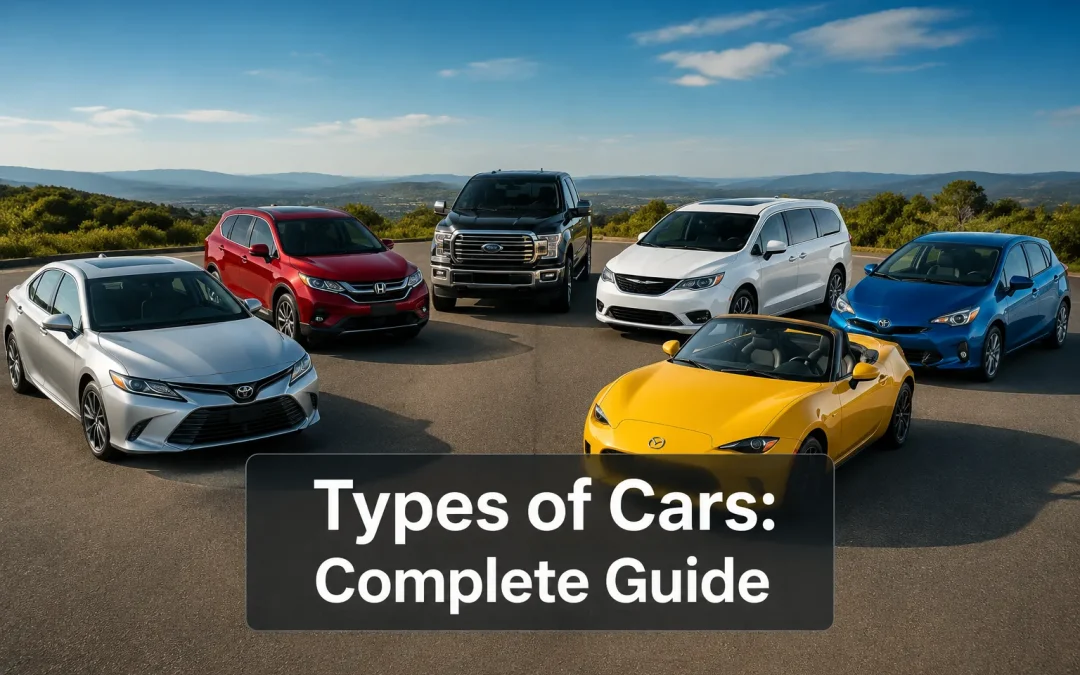
There are roughly 10 core types of cars available to buyers today, ranging from sedans and hatchbacks to SUVs, pickup trucks, minivans, and convertibles. Each body style is built for a different purpose, whether that is daily commuting, hauling cargo, carrying a large family, or weekend fun. Knowing the differences helps you pick the right vehicle for your life and budget.
Key Takeaways
- The main types of cars include sedans, coupes, hatchbacks, SUVs, crossovers, pickup trucks, minivans, station wagons, and convertibles.
- SUVs and pickup trucks dominate U.S. auto sales, but sedans remain popular and widely available.
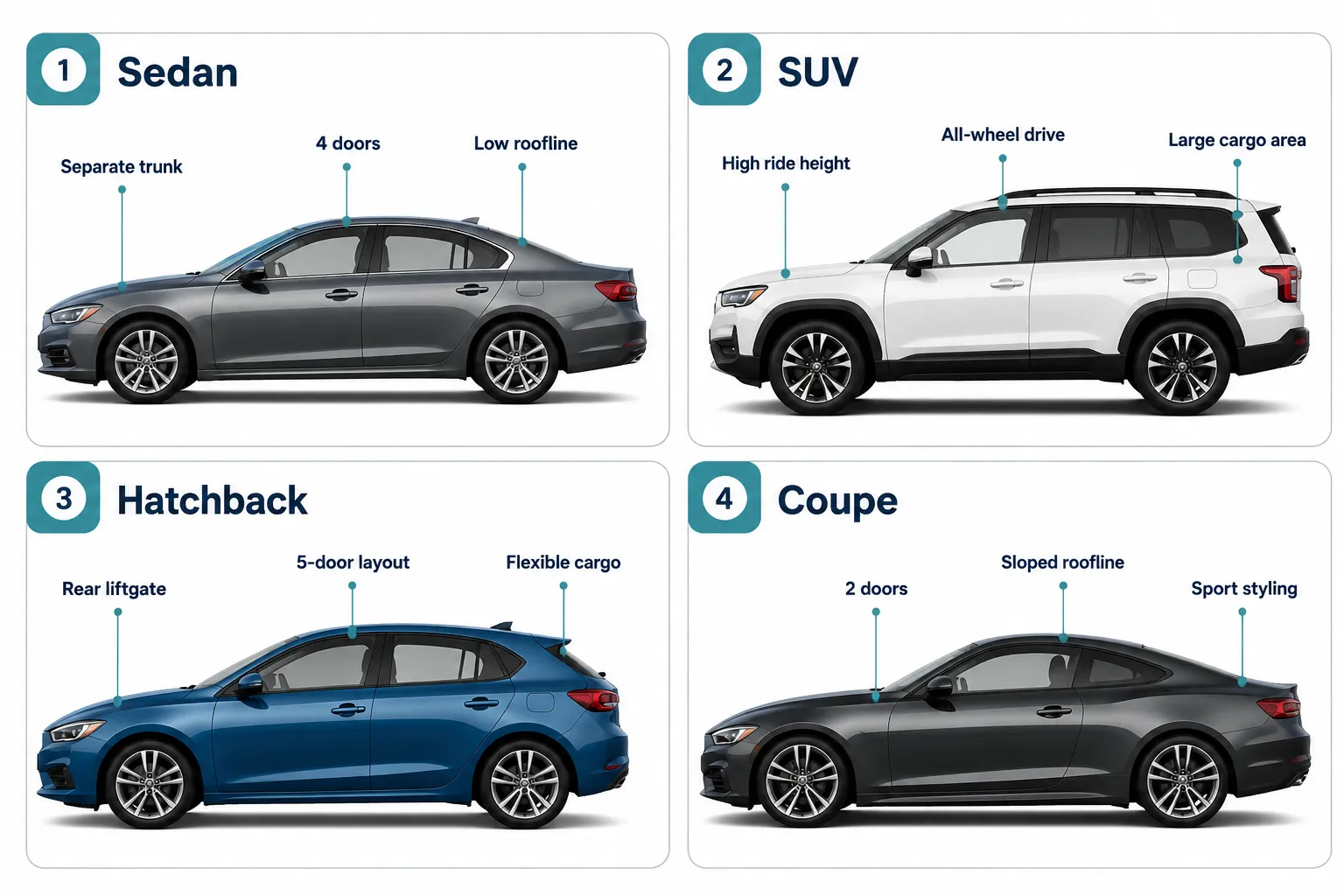
- Sedans have a separate trunk and four doors; coupes have two doors and a sloped roofline; hatchbacks have a rear liftgate for flexible cargo space.
- SUVs and crossovers look similar but differ in their underlying platform and off-road capability.
- Minivans offer the most passenger space per dollar, making them a strong choice for large families.
- Electric vehicles (EVs) are now available in nearly every body style, from compact hatchbacks to full-size pickup trucks.
- Choosing the right car type depends on your passenger count, cargo needs, budget, and typical driving conditions.
- First-time buyers should compare total cost of ownership, not just the sticker price.
What Are the Main Types of Cars and How Are They Different
There are approximately 10 widely recognized types of cars in the modern light-vehicle market [1][7]. Each type is defined by its body shape, door count, roofline, and intended use. Understanding these differences is the first step toward making a smart purchase.
Here is a quick overview of each major type:
| Car Type | Doors | Key Feature | Best For |
|---|---|---|---|
| Sedan | 4 | Separate trunk | Daily commuting |
| Coupe | 2 | Sloped roofline | Sport driving |
| Hatchback | 4-5 | Rear liftgate | City driving + cargo |
| SUV | 4-5 | High ride height | Versatility, families |
| Crossover (CUV) | 4-5 | Car-based platform | Fuel efficiency + space |
| Pickup Truck | 2-4 | Open cargo bed | Hauling, towing |
| Minivan | 4-5 | Sliding rear doors | Large families |
| Station Wagon | 4-5 | Extended roofline | Cargo + comfort |
| Convertible | 2-4 | Retractable roof | Weekend/sport driving |
| Van/Cargo Van | 2-4 | Large enclosed cargo | Commercial use |
The light-vehicle universe has expanded well beyond traditional “cars.” Today, SUVs and trucks are the dominant sellers, but sedans, hatchbacks, and wagons remain important options for buyers who want lower prices and better fuel economy [3][6].
What Is the Difference Between a Sedan and a Coupe
A sedan has four doors and a separate, enclosed trunk compartment. A coupe has two doors and a sloped rear roofline that blends into the trunk area. That is the core difference. [3][7]
Sedan key facts:
- Four full-size doors for easy entry and exit
- Separate trunk (called a “three-box” design because the engine, cabin, and trunk are three distinct sections)
- Generally more practical for passengers and everyday use
- Examples: Toyota Camry, Honda Accord, Hyundai Sonata
Coupe key facts:
- Two doors, often with longer door panels to allow rear-seat access
- Sloped or fastback roofline for a sportier look
- Rear seat is smaller and harder to access
- Examples: Ford Mustang, Chevrolet Camaro, BMW 4 Series
For a deeper comparison, see our dedicated article on coupe vs sedan vs hatchback differences.
Choose a sedan if you regularly carry adult passengers or need easy rear-seat access. Choose a coupe if styling and sport driving matter more than rear-seat practicality.
Common mistake: Many buyers assume a coupe is always a sports car. Some coupes, like the Honda Civic Coupe, are economy cars with a sporty shape but modest performance.
What Is the Difference Between a Sedan, Hatchback, and SUV
These three are among the most searched types of cars, and they are often confused. The short answer: sedans have a separate trunk, hatchbacks have a rear liftgate that opens into the passenger cabin, and SUVs sit higher off the ground with much more cargo and passenger space [2][8].
Hatchback details:
- The rear window and cargo area are one continuous space
- The liftgate opens upward, giving access to a flexible cargo floor
- Rear seats often fold flat, creating a large, flat load area
- More cargo flexibility than a sedan of the same size
- Examples: Honda Civic Hatchback, Volkswagen Golf, Toyota Corolla Hatchback
Are hatchbacks good for long road trips?
Yes, hatchbacks are well-suited for road trips. The folding rear seats create a large, flat cargo area for luggage and gear. The lower ride height also means better fuel economy on highways compared to SUVs. The main trade-off is that hatchbacks offer less total cargo volume than a mid-size SUV, and rear passengers may have slightly less headroom in some models.
SUV details:
- Taller body with higher ground clearance
- More total interior volume than most sedans or hatchbacks
- Available in compact, mid-size, and full-size versions
- Examples: Ford Explorer, Toyota RAV4, Honda CR-V
SUV vs Crossover: Which Is Better
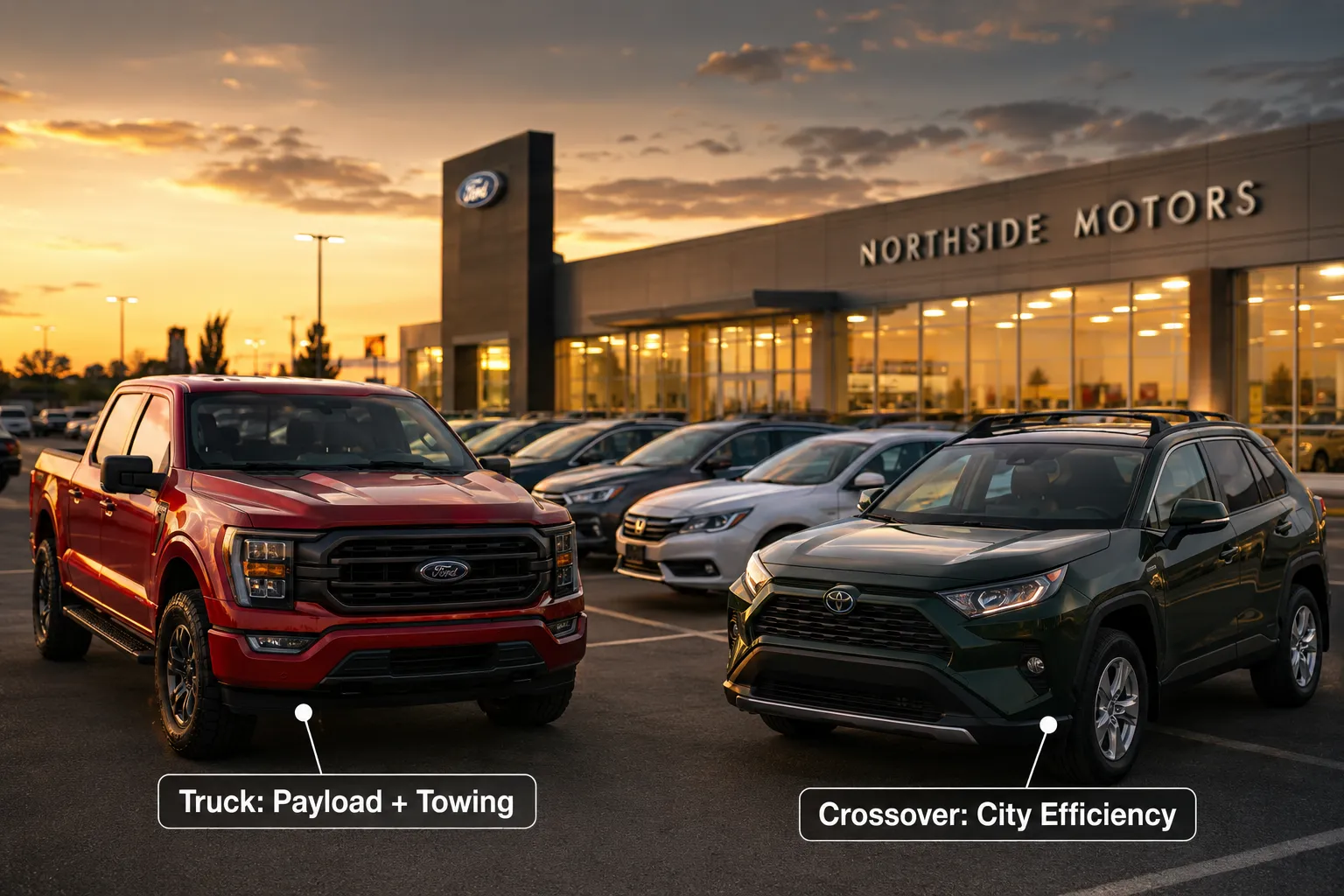
An SUV and a crossover look nearly identical from the outside, but they are built differently underneath. A traditional SUV is built on a truck-like body-on-frame platform, which gives it stronger towing and off-road capability. A crossover (also called a CUV) is built on a car-like unibody platform, which makes it lighter, more fuel-efficient, and more comfortable on paved roads [1][4].
Key differences:
- Platform: SUV = body-on-frame (truck-based); Crossover = unibody (car-based)
- Ride quality: Crossovers ride more smoothly on pavement
- Off-road ability: Traditional SUVs handle rough terrain better
- Fuel economy: Crossovers typically get better gas mileage
- Towing capacity: Full-size SUVs tow more than most crossovers
Which is better? For most buyers, a crossover is the better everyday choice. It offers SUV-like space and visibility with better fuel economy and a more comfortable ride. A traditional body-on-frame SUV makes more sense if you regularly tow a trailer or drive on unpaved roads.
In practice, most vehicles marketed as “SUVs” today are actually crossovers built on car platforms [3][8].
What Type of Car Is Best for Families with Kids
For most families, the best car types are mid-size SUVs, three-row SUVs, and minivans. The right choice depends on how many children you have, how much gear you carry, and your budget. [7][9]
Minivan vs SUV for families:
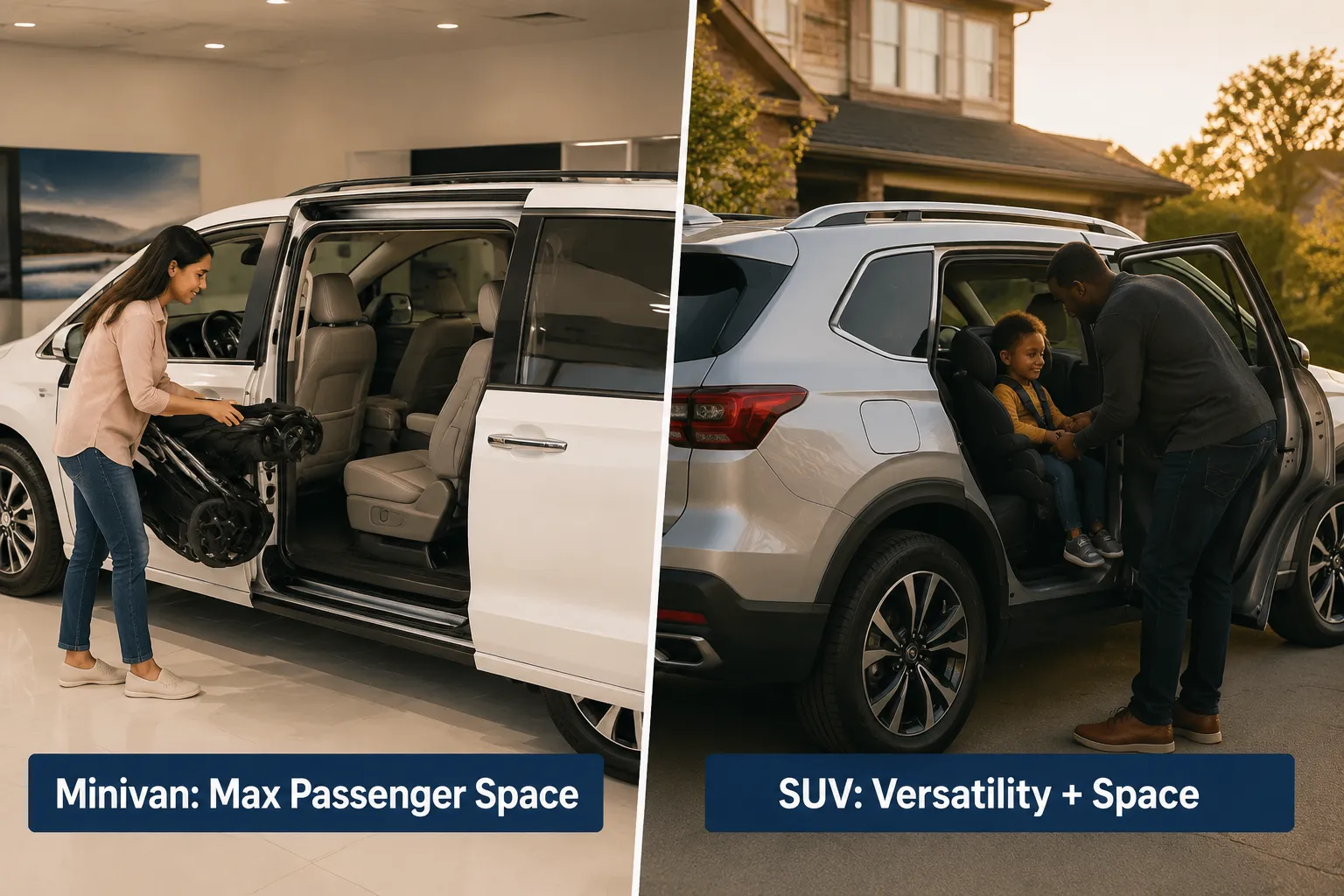
Minivans are purpose-built for families. They offer more usable interior space, easier entry and exit for children (thanks to sliding doors), and better cargo capacity than most SUVs at the same price point. The Honda Odyssey and Chrysler Pacifica are common examples.
Mid-size and three-row SUVs offer similar passenger capacity but with a higher ride height, available all-wheel drive, and a more versatile look that works for both family hauling and weekend adventures.
| Feature | Minivan | 3-Row SUV |
|---|---|---|
| Sliding rear doors | Yes | No |
| Third-row access | Easy | Moderate |
| Cargo behind 3rd row | More | Less |
| All-wheel drive option | Rare | Common |
| Towing capacity | Low-moderate | Moderate-high |
| Fuel economy | Better | Lower |
| Average cost | Lower | Higher |
Minivan pros:
- Lowest cost per seat among large family vehicles
- Sliding doors are safer in tight parking lots
- Flat floor makes it easier for kids to move between rows
- Strong fuel economy for their size
Minivan cons:
- Less desirable styling to many buyers
- Limited all-wheel drive availability
- Lower towing capacity than a comparable SUV
- Resale value can be lower than SUVs
Best for families with 3+ children: Minivan or three-row SUV. Best for families with 1-2 children: Compact or mid-size SUV, or a large sedan.
What Car Type Gets the Best Gas Mileage
Small hatchbacks, compact sedans, and hybrid versions of any body style get the best fuel economy. Among non-hybrid vehicles, compact hatchbacks and sedans consistently lead in miles per gallon (MPG). [6][8]
General fuel economy by car type (estimates based on typical EPA ratings):
- Compact hatchback or sedan: 30-40 MPG combined
- Mid-size sedan: 28-35 MPG combined
- Compact crossover/SUV: 25-32 MPG combined
- Mid-size SUV: 20-28 MPG combined
- Full-size SUV: 16-22 MPG combined
- Pickup truck (half-ton): 16-24 MPG combined
- Minivan: 22-28 MPG combined
- Convertible: varies widely by engine
Hybrid versions of sedans, crossovers, and SUVs can push fuel economy 30-50% higher than their non-hybrid counterparts. The Toyota Camry Hybrid, for example, is rated at approximately 51 MPG combined (EPA estimate).
Electric vehicles (EVs) in every car type:
EVs are now available across nearly all body styles, from compact hatchbacks like the Chevrolet Equinox EV to full-size pickup trucks like the Ford F-150 Lightning. EVs have no MPG in the traditional sense, but their equivalent (MPGe) ratings are often well above 100 MPGe. For more on the cost comparison between EVs and traditional vehicles, see our article on electric cars becoming cheaper than ICE vehicles.
How Much Does Each Type of Car Cost
Car prices vary widely within each type, but body style does influence the typical price range. Pickup trucks and full-size SUVs tend to cost the most, while compact sedans and hatchbacks are the most affordable. [7][8]
Typical new-car price ranges by type (2026 estimates, U.S. market):
- Compact sedan: $20,000 – $30,000
- Mid-size sedan: $26,000 – $42,000
- Compact hatchback: $19,000 – $29,000
- Compact crossover/SUV: $26,000 – $40,000
- Mid-size SUV: $35,000 – $55,000
- Full-size SUV: $50,000 – $80,000+
- Pickup truck (half-ton): $35,000 – $70,000+
- Minivan: $35,000 – $50,000
- Convertible: $30,000 – $80,000+
- Station wagon: $35,000 – $55,000
Used-car prices are significantly lower. For help estimating what a used vehicle is worth, the Blue Book Car Value Guide is a reliable starting point. You can also use the 7 steps to NADA Guides used car values to get a more precise estimate before you buy or sell.
Cost tip: The sticker price is only part of the picture. Insurance, fuel, maintenance, and depreciation all vary by car type. Full-size trucks and SUVs cost more to insure and fuel than compact sedans or hatchbacks.
Pickup Truck vs Cargo Van for Small Business
For small business owners, the choice between a pickup truck and a cargo van depends on what you are hauling and where you are going. Pickup trucks offer an open bed and strong towing capacity. Cargo vans offer a large, secure, weather-protected enclosed space. [5][7]
Pickup truck advantages for business:
- Higher towing capacity (up to 13,000+ lbs for heavy-duty models)
- Can tow trailers, boats, or equipment
- Open bed works well for landscaping, construction materials, or large items
- Easier to park in many locations
- Dual-use as a personal vehicle
Cargo van advantages for business:
- Enclosed cargo area protects tools and products from weather and theft
- More total cargo volume than a pickup bed
- Easier to organize with shelving systems
- Better for deliveries, plumbing, electrical, and HVAC work
- Some models offer taller walk-in heights
Choose a pickup truck if your work involves towing, hauling bulk materials, or working on job sites with rough terrain. Choose a cargo van if your work involves delivering goods, carrying tools and equipment that need to stay dry and secure, or making multiple stops in urban areas.
For more detail on commercial truck options, see our guide to buying a used commercial truck. If you need to understand how much weight a truck can legally carry, our article on truck load capacity in tons covers the key numbers.
Convertible vs Coupe: What Is the Difference
A coupe has a fixed, permanent roof. A convertible has a roof that folds down or retracts, either manually or automatically. Both typically have two doors and a sport-oriented design, but the convertible adds open-air driving at the cost of structural rigidity, trunk space, and sometimes rear-seat room. [3][6]
Convertible key points:
- Soft-top or hard-top retractable roof
- More wind and road noise than a coupe
- Slightly less trunk space due to roof storage
- Higher price than the equivalent coupe model
- Not ideal in cold or wet climates as a daily driver
Coupe key points:
- Fixed roof adds structural stiffness, which can improve handling
- Quieter cabin than a convertible
- More practical in all weather conditions
- Generally less expensive than the convertible version of the same model
Choose a convertible if you live in a warm, dry climate and want the open-air experience. Choose a coupe if you want sport styling with better all-weather practicality and a lower price.
What Is the Best Car Type for Bad Weather and Snow
All-wheel drive (AWD) or four-wheel drive (4WD) SUVs and crossovers are the best car types for bad weather and snow. The combination of high ground clearance, AWD traction, and a taller seating position makes them the most capable vehicles in winter conditions. [4][9]
Best car types for snow and ice:
- All-wheel drive crossover or SUV – Best balance of winter capability, fuel economy, and everyday usability. Examples: Subaru Outback, Toyota RAV4 AWD, Honda CR-V AWD.
- 4WD pickup truck or full-size SUV – Best for deep snow or off-road winter conditions. Higher ground clearance and stronger 4WD systems.
- All-wheel drive sedan – A good option if you prefer a lower vehicle. The Subaru Legacy and Audi A4 both offer standard AWD.
- Front-wheel drive hatchback with winter tires – A budget-friendly option. Good winter tires on a FWD hatchback outperform all-season tires on an AWD vehicle.
Common mistake: Many buyers assume AWD means they can drive fast in snow. AWD helps with acceleration and stability, but it does not shorten stopping distances. Winter tires make a bigger difference in braking than AWD alone.
Is a Station Wagon Still Worth Buying in 2026
Station wagons are a small but dedicated segment in 2026. They offer sedan-like driving dynamics with significantly more cargo space, thanks to an extended roofline and rear liftgate. For buyers who want cargo utility without the height of an SUV, a wagon is still a smart choice. [6][9]
Station wagon pros:
- More cargo space than a sedan
- Lower center of gravity than an SUV for better handling
- Often available with AWD
- More fuel-efficient than a comparable SUV
- Understated, practical styling
Station wagon cons:
- Very limited model selection in the U.S. market
- Smaller market means fewer used options
- Some buyers find the styling less appealing than an SUV
- Resale value can be inconsistent
Available station wagons in 2026 (examples): Subaru Outback (which blurs the line between wagon and crossover), Volvo V60/V90, Audi A4 Allroad. The selection is much broader in European markets.
Worth buying if: You want maximum cargo in a low, car-like package and do not need the height of an SUV. Not worth it if: You need a wide selection of models or strong resale value.
Car Types Explained for First-Time Buyers
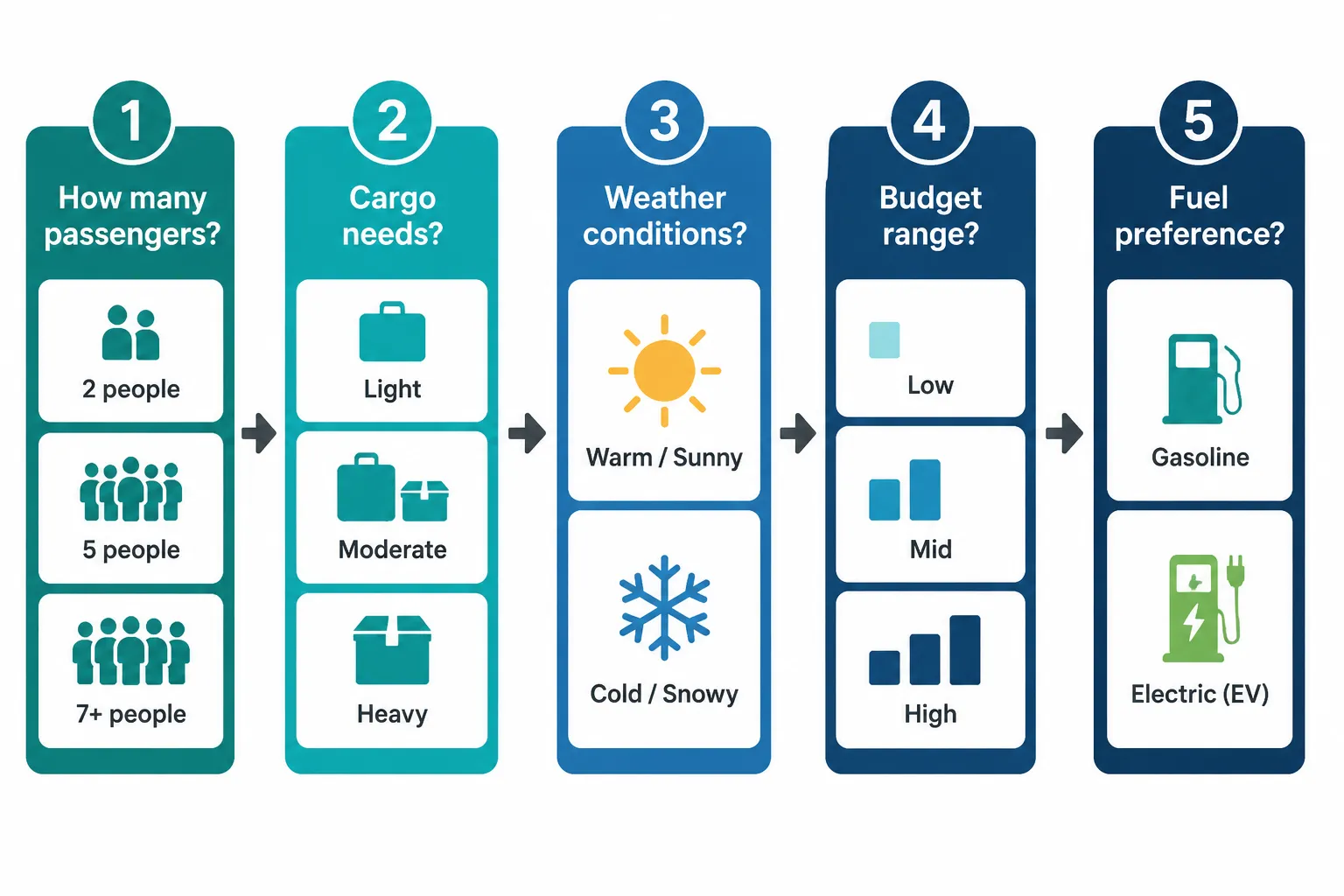
First-time buyers should focus on three things: how many people and how much cargo the car needs to carry, what kind of driving they will do most, and what total monthly cost they can afford. The types of cars that work best for new buyers are usually compact sedans, compact crossovers, and compact hatchbacks. [7][8]
Step-by-step guide for first-time buyers:
- Count your passengers. If you regularly carry more than four adults, look at three-row SUVs or minivans. For one to four people, a sedan, hatchback, or compact crossover works well.
- Think about cargo. Do you move furniture, haul sports equipment, or carry a stroller regularly? If yes, a hatchback, crossover, or SUV gives you more flexibility than a sedan.
- Consider your commute. City driving favors smaller, more fuel-efficient cars. Highway and rural driving opens up larger options.
- Set a total budget. Include insurance, fuel, and maintenance, not just the monthly payment.
- Decide on new vs. used. Used vehicles cost less upfront and depreciate more slowly. A certified pre-owned (CPO) vehicle from a dealer offers some warranty protection.
- Test drive at least three body styles. Sitting in a sedan, a crossover, and a hatchback will quickly show you which feels right.
Common mistakes first-time buyers make:
- Buying more car than they need because SUVs “seem safer”
- Ignoring fuel costs on large trucks or SUVs
- Skipping the test drive
- Not checking insurance costs before buying a sporty coupe or convertible
Electric Vehicles Available in Each Car Type
EVs are no longer limited to one or two body styles. In 2026, buyers can find electric versions of nearly every major car type, from compact hatchbacks to full-size pickup trucks. [2][8]
EV options by car type:
- Compact hatchback/sedan: Chevrolet Bolt EV, Nissan Leaf, Tesla Model 3
- Mid-size sedan: Tesla Model 3 Long Range, BMW i4, Hyundai Ioniq 6
- Compact crossover/SUV: Tesla Model Y, Ford Mustang Mach-E, Chevrolet Equinox EV, Hyundai Ioniq 5
- Mid-size SUV: Kia EV9, Rivian R1S, BMW iX
- Pickup truck: Ford F-150 Lightning, Rivian R1T, Chevrolet Silverado EV, GMC Sierra EV
- Luxury/sport: Porsche Taycan, Audi e-tron GT, Tesla Model S
Hybrids are also available across most body types and offer a middle ground between traditional gas engines and full EVs. Plug-in hybrids (PHEVs) add a larger battery that can be charged externally, allowing short all-electric trips with a gas engine for longer range.
Key consideration for EV buyers: Charging infrastructure matters as much as range. If you have home charging, an EV works well for daily driving. If you rely on public charging, check the availability of fast chargers along your regular routes before committing.
Common Mistakes When Choosing a Car Type
Choosing the wrong car type is one of the most expensive mistakes a buyer can make. These are the most common errors and how to avoid them. [7][9]
Mistake 1: Buying based on looks alone. A coupe looks great but is impractical if you regularly carry rear passengers. A pickup truck looks capable but costs significantly more to fuel and insure than a crossover.
Mistake 2: Ignoring total cost of ownership. Large SUVs and trucks have higher insurance premiums, fuel costs, and sometimes higher maintenance costs. A compact sedan or hatchback often costs thousands less per year to operate.
Mistake 3: Overbuying for occasional needs. Buying a full-size truck because you move furniture twice a year is not cost-effective. Renting a truck or using a delivery service for occasional large loads is almost always cheaper.
Mistake 4: Not testing the right body style. Many buyers test drive only one type. Testing a sedan, a crossover, and a hatchback side by side often reveals a clear preference.
Mistake 5: Assuming AWD means all-weather safety. AWD improves traction during acceleration but does not improve braking. Winter tires on a two-wheel drive vehicle often outperform all-season tires on an AWD vehicle in snow.
Mistake 6: Forgetting about resale value. Some car types hold their value better than others. Pickup trucks and popular SUVs tend to depreciate more slowly than sedans and minivans in the U.S. market.
Frequently Asked Questions About Types of Cars
How many types of cars are there? Most automotive guides recognize between 7 and 10 core car body types: sedan, coupe, hatchback, SUV, crossover, pickup truck, minivan, station wagon, convertible, and cargo van. Some guides add sub-types like sports cars, muscle cars, and roadsters, bringing the total higher [1][3].
What is the most popular type of car in the U.S.? SUVs and pickup trucks are the top-selling vehicle types in the U.S. The Ford F-Series pickup has been the best-selling vehicle in America for decades. Among passenger cars, the Toyota Camry and Toyota Corolla consistently rank at the top [10].
What is the difference between an SUV and a crossover? An SUV is traditionally built on a truck-based body-on-frame platform. A crossover is built on a car-based unibody platform. Most vehicles sold as SUVs today are technically crossovers. Crossovers ride more smoothly and get better fuel economy; traditional SUVs tow more and handle rougher terrain [1][4].
What type of car is best for a new driver? Compact sedans and compact hatchbacks are generally recommended for new drivers. They are easier to park, less expensive to insure, and more fuel-efficient than larger vehicles. Good examples include the Honda Civic, Toyota Corolla, and Mazda3.
Are sedans going away? Sedans have declined in market share as SUVs have grown, but they are not disappearing. The Toyota Camry and Honda Accord remain strong sellers, and sedans continue to offer better fuel economy, lower prices, and easier parking than most SUVs [10].
What is the cheapest type of car to own? Compact sedans and compact hatchbacks are typically the cheapest to buy, insure, fuel, and maintain. They have lower sticker prices, better fuel economy, and lower insurance premiums than trucks or large SUVs.
What car type is best for towing? Full-size pickup trucks and body-on-frame SUVs have the highest towing capacities. Half-ton trucks like the Ford F-150 can tow up to approximately 13,000 lbs depending on configuration. Heavy-duty trucks (F-250, Ram 2500) can tow even more.
What is a crossover SUV? A crossover SUV (CUV) is a vehicle that looks like a small or mid-size SUV but is built on a car-like unibody platform instead of a truck frame. Most compact and mid-size SUVs sold today, including the Toyota RAV4 and Honda CR-V, are crossovers [1][3].
What is the best car type for city driving? Compact hatchbacks and compact sedans are best for city driving. They are easier to park, more fuel-efficient in stop-and-go traffic, and less expensive to own than larger vehicles. Electric compact cars are an especially good fit for city use.
What is a muscle car? A muscle car is a high-performance American coupe or sedan with a large, powerful engine. Classic examples include the Ford Mustang, Chevrolet Camaro, and Dodge Challenger. For more on this category, see our article on muscle cars.
Can I find an electric pickup truck? Yes. Electric pickup trucks are available in 2026, including the Ford F-150 Lightning, Rivian R1T, Chevrolet Silverado EV, and GMC Sierra EV. They offer similar or greater towing and payload capability compared to gas-powered half-ton trucks in many configurations.
What is the difference between a van and a minivan? A minivan is designed primarily for passenger use, with multiple rows of seats, sliding rear doors, and family-friendly features. A cargo van is designed for commercial use, with a large enclosed cargo area and minimal rear seating. Minivans are smaller and more car-like than full-size cargo vans.
Conclusion
The world of types of cars is broader than most buyers realize. From compact hatchbacks and practical sedans to rugged pickup trucks, spacious minivans, and fully electric crossovers, each body style exists because a real group of buyers has a specific need it fills well.
The best car type is not the most popular one or the most expensive one. It is the one that fits your actual daily life, your passenger count, your cargo needs, your budget, and your driving conditions.
Actionable next steps:
- Write down your top three daily driving needs before visiting a dealership.
- Test drive at least two different body styles, not just the one you think you want.
- Use a trusted valuation tool to check fair market prices before you negotiate. Our Blue Book Car Value Guide and NADA Guides used car values are good places to start.
- Calculate total monthly cost, including insurance, fuel, and estimated maintenance, before signing anything.
- If you are considering a truck for business use, read our guide to buying a used commercial truck before you commit.
The right vehicle is out there. Knowing the differences between body styles puts you in a much stronger position to find it.
References
[1] Defining Vehicle Types – https://www.edmunds.com/car-buying/defining-vehicle-types.html [2] Understanding Car Types Hatchback Coupe Sedan Suv Evs Hybrids – https://kogta.in/blog/understanding-car-types-hatchback-coupe-sedan-suv-evs-hybrids/ [3] Vehicle Car Truck Suv Body Types Explained – https://www.caranddriver.com/shopping-advice/a64655267/vehicle-car-truck-suv-body-types-explained/ [4] Guide To Vehicle Classification – https://xnmotors.com/en/knowledge/guide-to-vehicle-classification [5] Car Body Types – https://www.upmove.com.au/post/car-body-types [6] Car Types Models Body Styles – https://www.motortrend.com/features/car-types-models-body-styles [7] Types Of Cars A Complete Guide – https://www.carfax.com/buying/types-of-cars-a-complete-guide [8] Types Of Vehicles Explained – https://www.kbb.com/car-advice/types-of-vehicles-explained/ [9] Vehicle Types Explained 89853 – https://www.carsguide.com.au/car-advice/vehicle-types-explained-89853 [10] Toyota Corolla Camry Sales Usa 2025 – https://www.motor1.com/news/783510/toyota-corolla-camry-sales-usa-2025/