Last Updated on September 27, 2026
A 750cc Honda now shifts gears without a clutch lever. That single engineering shift says more about where the motorcycle industry is headed in 2026 than any horsepower figure ever could. While Harley-Davidson continues to lean on the tactile, mechanical feel of a traditional manual gearbox, Honda has spent 2026 rolling semi-automatic technology across nearly every price point in its lineup, from commuter scooters to its flagship touring machine.
This article breaks down Honda Motorcycles in 2026: Model Lineup, Pricing, and Reliability Compared to Harley-Davidson so riders shopping for a new bike this year can see exactly where the two brands overlap, where they diverge, and which one actually makes more sense for their riding style and budget.
Key Takeaways
- Honda’s 2026 lineup spans entry-level 125cc bikes to the flagship Gold Wing, with new E-Clutch technology now available on the CB750 Hornet, XL750 Transalp, and the 500cc A2-license range.[1][3][7]
- U.S. pricing for 2026 Honda motorcycles ranges from roughly the mid-$4,000s for small-displacement models up to the mid-$30,000s for a fully loaded Gold Wing Tour Airbag DCT.[5]
- Harley-Davidson generally competes at a higher average price point while sticking to traditional manual transmissions across most of its range.
- Honda’s historical reliability advantage, combined with lower running costs and semi-automatic technology, gives it an edge for commuting, touring, and mixed-use riders.
- Harley-Davidson still wins on brand heritage, exhaust sound, and cruiser-culture customization for riders who prioritize character over convenience.
The Honda Motorcycles in 2026 Model Lineup Explained
Honda’s approach to its 2026 model year is less about a single headline bike and more about breadth. According to a detailed European market breakdown, the current range covers naked, trail and adventure, sport, sport-touring, touring and GT, custom, and scooter segments all at once.[9] That is a wider spread of categories than almost any other manufacturer offers, including Harley-Davidson, which remains concentrated in cruiser, touring, and a handful of adventure-styled models.
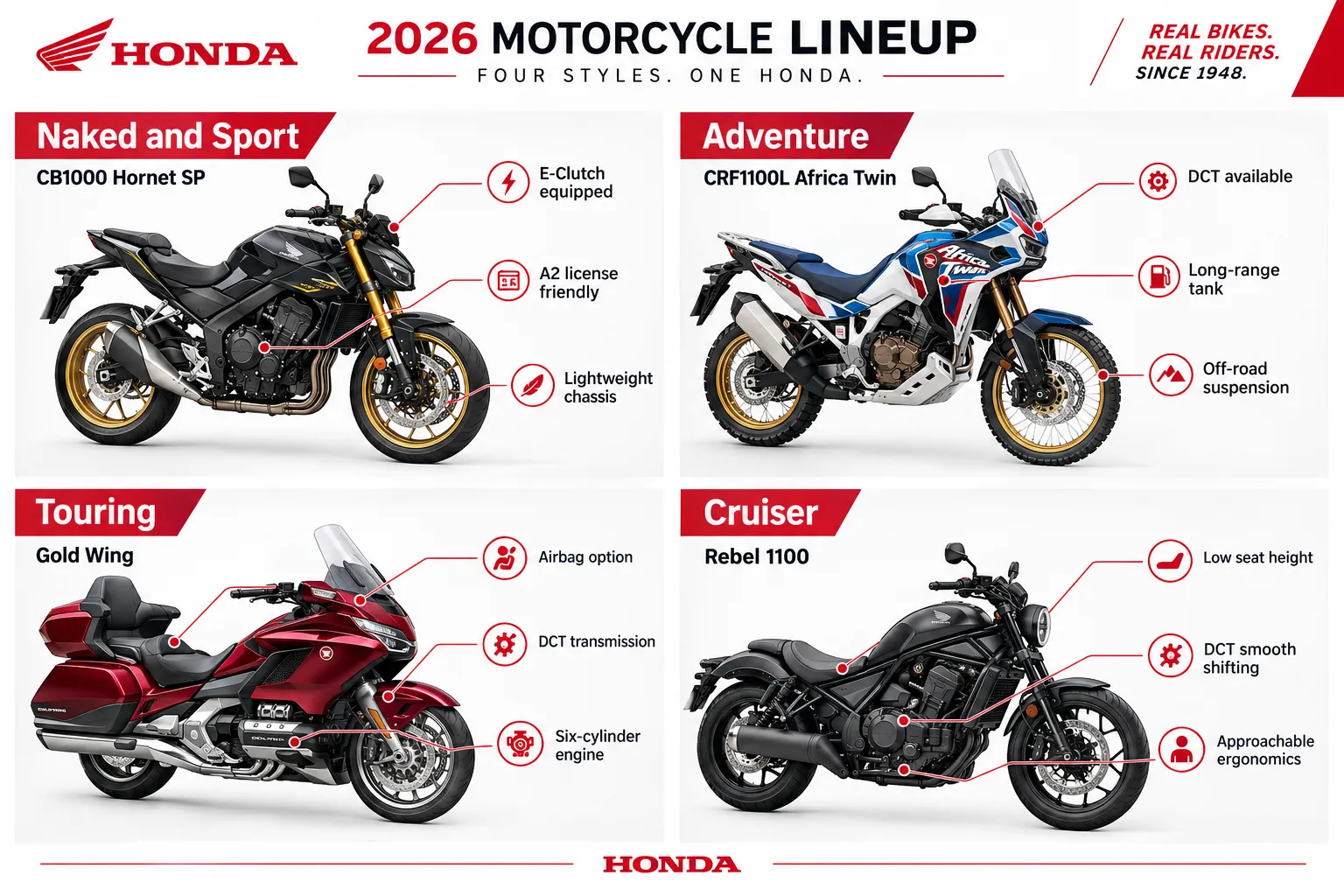
At the entry level, Honda introduced the new CB125F for European riders, giving new license holders a low-displacement option that still carries modern styling and fuel injection.[6][9] Moving up, the CB500 Hornet, CBR500R, and NX500 form Honda’s A2-license mid-range trio, and all three now offer E-Clutch as an option, effectively removing the clutch lever from the riding experience while keeping full manual control of gear selection.[3][15]
The naked and performance side of the lineup gets a notable refresh too. The CB1000 Hornet SP and CB1000F (new for 2026) sit alongside the CB650R, which now comes with E-Clutch as well.[1][6][9] For riders chasing outright performance, the CBR1000RR-R Fireblade SP returns with a special Dean Harrison Replica edition, a nod to Honda’s road-racing pedigree.[6]
Adventure riders have two clear paths: the XL750 Transalp, now offered in a standard version and an SP trim with E-Clutch tuned through throttle-by-wire for smoother shifts, and the larger CRF1100L Africa Twin along with the Africa Twin Adventure Sports.[1][7][8][14][15] Gear Patrol’s mid-September 2026 roundup specifically praised the Africa Twin for blending modern electronics with approachable, real-world performance, calling out its value against European adventure-bike rivals.[2]
Touring riders get the NT1100 and the range-topping GL1800 Gold Wing, offered in Tour, DCT, and Airbag configurations.[9][12] Cruiser buyers can choose from the CMX1100 Rebel family, while scooter and crossover riders have the Forza 750 and X-ADV 750.[9] Honda even listed a V3R 900 E-Compressor prototype as part of its 2026 range, a signal that forced-induction and hybrid-adjacent technology could be coming to future motorcycles.[9]
In the United States, American Honda’s February 2026 announcement confirmed the return of eight motorcycles for the 2026-2027 model years, spanning adventure, mini-moto, scooter, and trials categories, including the PCX and ADV160 scooters and models built on the competition-proven Montesa Cota trials platform.[4][10][11][13] That confirms Honda’s U.S. strategy is not just about big-displacement flagship bikes; small-displacement and specialty models remain a core part of the lineup. For anyone weighing a first motorcycle purchase, this breadth matters, and it’s worth reviewing general guidance on things to consider before buying a motorcycle before narrowing down a specific Honda or Harley model.
Honda Motorcycles in 2026 Pricing Compared to Harley-Davidson
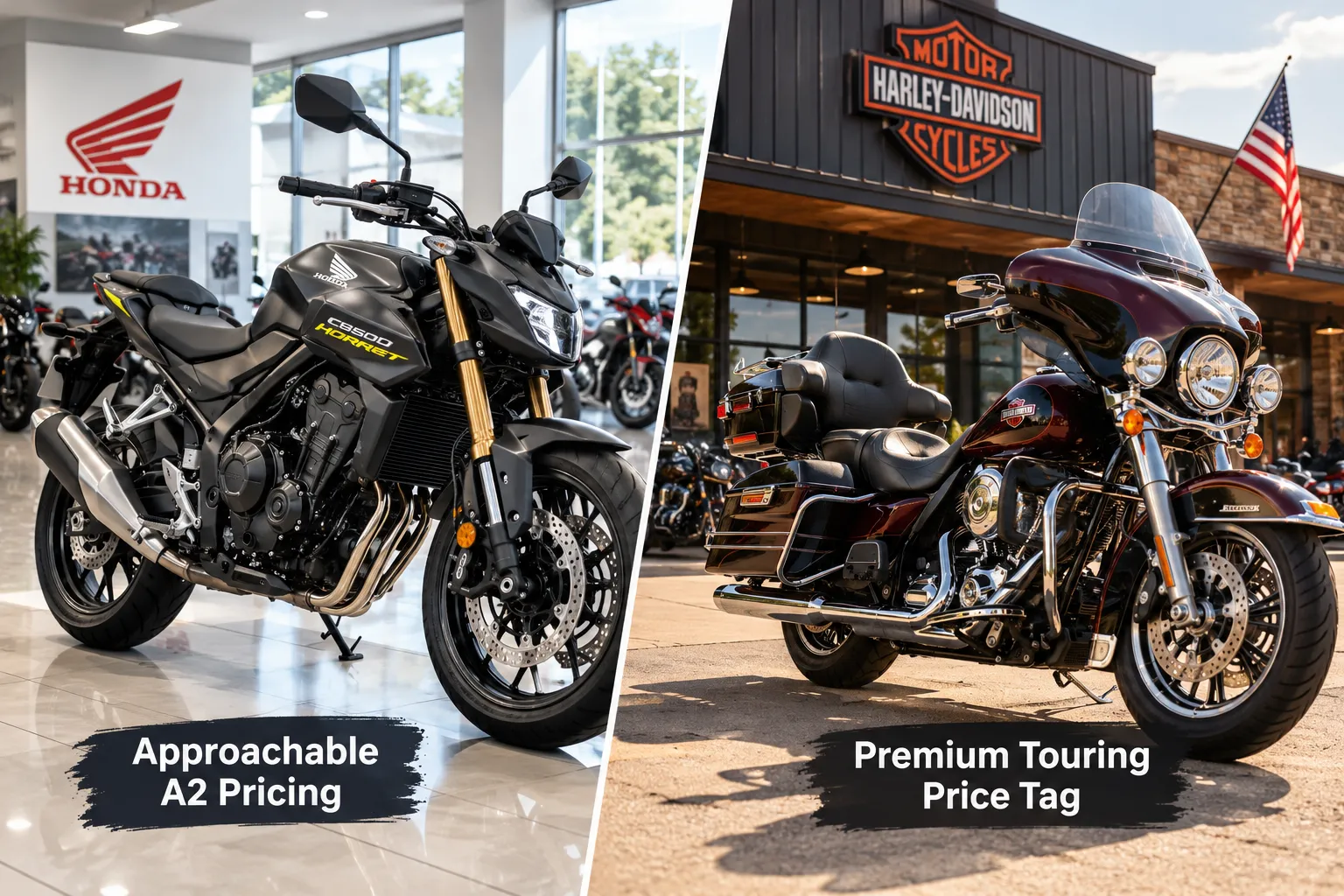
Price is often the deciding factor between these two brands, and the gap is more nuanced than most riders expect. A U.S. dealer showroom listing updated in late September 2026 shows Honda’s current retail pricing spanning a wide range.[5] Here is how some key 2026 Honda models stack up:
| Model | Category | Approximate U.S. MSRP |
|---|---|---|
| NC750X DCT | Sport-Touring | $9,499 |
| CB1000 Hornet SP | Naked/Performance | $10,999 |
| Rebel 1100T DCT | Cruiser | $11,599 |
| Gold Wing | Touring | $25,500 |
| Gold Wing Tour DCT | Touring | $30,500 |
| Gold Wing Tour Airbag DCT | Touring (flagship) | $33,800 |
Data compiled from official 2026 dealer showroom listings.[5]
That range, from roughly $4,399 for the smallest entry-level machines up into the mid-$30,000s for a fully equipped Gold Wing, shows Honda covering nearly every price bracket a rider could want.[5] Harley-Davidson, by contrast, tends to concentrate its lineup in the $9,000 to $30,000-plus range, with fewer sub-$5,000 entry points. That means a new rider on a tight budget almost always finds more options on the Honda side of the showroom.
At the top end, the comparison gets more interesting. Honda’s Gold Wing Tour Airbag DCT at $33,800 competes directly with Harley’s premium touring cruisers, but it brings a dual-clutch automatic transmission and an integrated airbag system as standard technology on that trim.[5][12] Harley’s comparable touring flagships focus more on styling, sound, and heritage than on matching that level of rider-assist technology. For shoppers who also track resale value across vehicle categories, it’s worth cross-referencing insights from what cars actually hold their value and go up, since similar depreciation patterns often apply to motorcycles with strong brand loyalty like Harley-Davidson.
Reliability and Ownership: Honda vs Harley-Davidson in 2026
Reliability is where the Honda-versus-Harley conversation gets the most personal, because it directly affects how much time and money an owner spends at the dealership instead of on the road.
Honda and other Japanese manufacturers have a long-standing reputation for scoring above average in mechanical reliability surveys, while Harley-Davidson has historically rated closer to average, particularly on older air-cooled platforms. There is no widely cited new independent reliability study specifically covering 2025 or 2026 model years, but the absence of reported systemic issues on Honda’s major 2026 platforms, paired with the brand’s decades-long track record, suggests Honda remains the lower-risk choice for buyers who want minimal unscheduled maintenance.
Pull quote: “Honda’s low-maintenance reputation isn’t a marketing claim, it’s a decades-long pattern that 2026’s new models have done nothing to break.”
A few practical factors support this pattern for 2026 specifically:
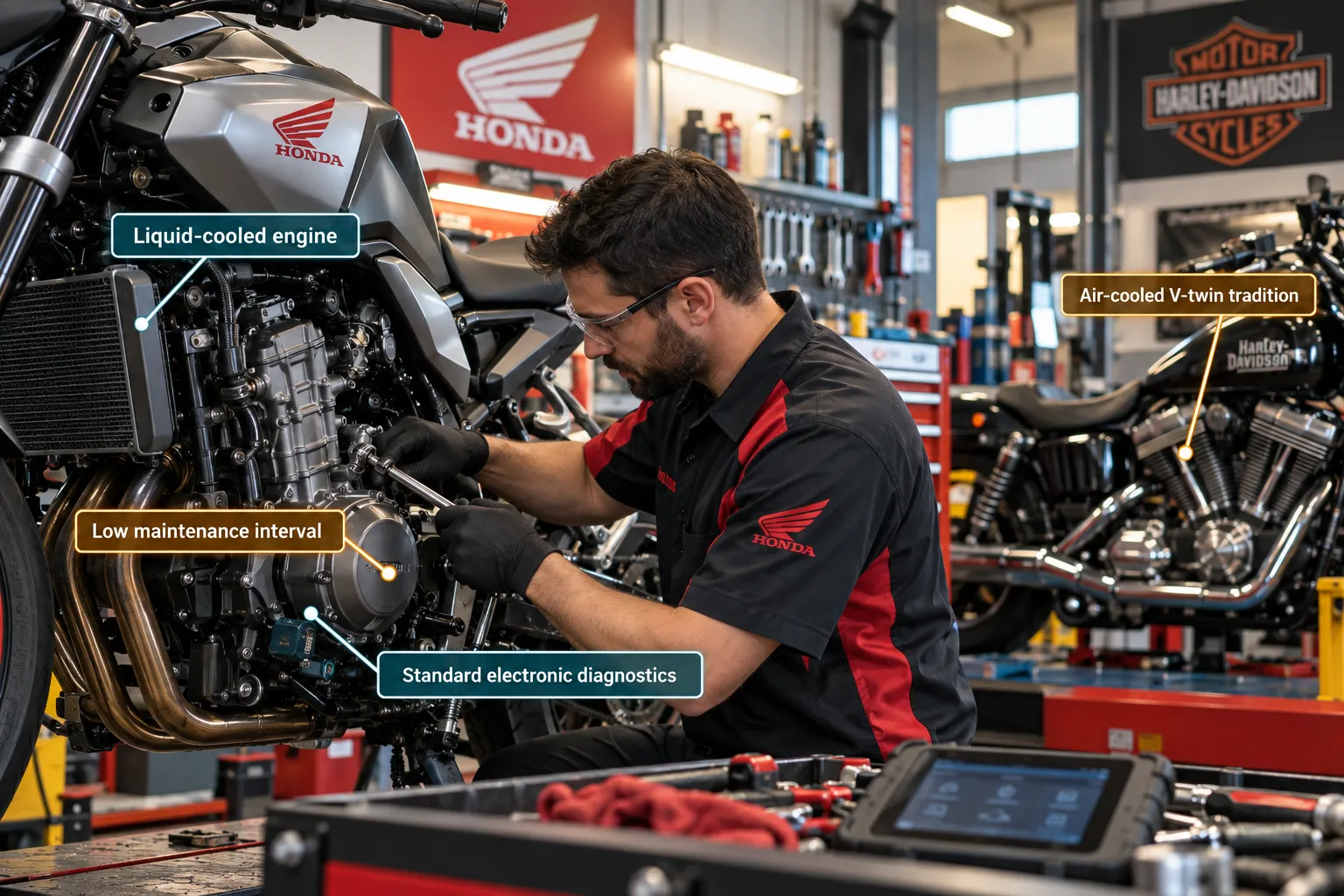
- Liquid-cooled engines across most Honda models reduce heat-related wear compared to Harley’s air-cooled and air/oil-cooled V-twins in several of its lineup.
- E-Clutch and DCT reduce clutch wear caused by inconsistent manual engagement, particularly helpful for city riders who shift constantly in traffic.
- Wider dealer network parts availability for Honda, since the brand sells far higher volumes globally, generally means faster, cheaper repairs.
- Simpler electronics architecture on most Honda models compared to Harley’s touring electronics suite, which can mean fewer software-related service visits.
That said, Harley-Davidson has narrowed the gap on refinement in recent years, and its dealer network in the U.S. remains extremely strong for warranty work. The bigger differentiator is really about maintenance philosophy: Harley owners often expect and even enjoy a certain amount of hands-on wrenching as part of the ownership culture, while Honda owners typically prioritize low-touch reliability. Riders weighing this trade-off against a first purchase should also read up on general motorcycle buying considerations before committing to either camp.
E-Clutch and DCT: The Technology Gap Between Honda and Harley
If there is one theme that defines Honda Motorcycles in 2026: Model Lineup, Pricing, and Reliability Compared to Harley-Davidson, it is the aggressive rollout of semi-automatic technology. Official Honda country sites updated in late September 2026 confirm E-Clutch has expanded beyond its original launch models to the CB750 Hornet and XL750 Transalp, with throttle-by-wire tuning designed to smooth out gear changes.[1][7][8][14][15]
Just as significant, E-Clutch has now reached Honda’s 500cc A2-license range: the CB500 Hornet, CBR500R, and NX500.[3][15] That decision positions these mid-range bikes as genuinely easier to ride in stop-and-go traffic than most manual-only motorcycles, Harley-Davidson’s lineup included. A rider can keep full manual control over which gear they’re in without ever touching a clutch lever, which lowers the skill barrier for new riders and reduces fatigue for experienced ones during long commutes.
Honda’s Dual Clutch Transmission, offered on models ranging from the NC750X to the Africa Twin and Gold Wing, takes this even further by fully automating both clutch and gear selection while still allowing manual paddle-shift override.[5][9][12] Harley-Davidson’s 2026 communication, by contrast, still centers heavily on traditional manual gearboxes and the classic V-twin riding character that its core customer base specifically wants. That’s not a flaw for Harley riders who value the mechanical connection to the bike, but it is a real usability gap for anyone cross-shopping based on convenience.
Analysts following Honda’s roadmap also point to the V3R 900 E-Compressor prototype listed in the 2026 lineup as evidence the brand plans to keep pushing semi-automatic transmissions and forced-induction or hybrid-adjacent technology into future models.[6][9][12] Harley’s evolution, meanwhile, appears more incremental, focused on refinement, styling, and limited electrification through select models rather than a wholesale technology shift.
Which Should You Buy: Honda or Harley-Davidson in 2026
There is no universal right answer here, but the decision usually comes down to what kind of rider you are.
Choose Honda if you want:
- A lower entry price point, especially for a first motorcycle
- Semi-automatic shifting through E-Clutch or DCT
- A wider range of displacement and body-style options, from 125cc commuters to full touring rigs
- A stronger historical reliability track record with lower long-term maintenance costs
Choose Harley-Davidson if you want:
- The traditional V-twin sound and feel that defines American cruiser culture
- A strong resale and customization ecosystem built around decades of brand loyalty
- A more hands-on, mechanically engaged riding and ownership experience
- A dealer and rider community built specifically around cruiser and touring lifestyle
Riders still deciding between new and used options, or comparing motorcycle ownership costs against other vehicle purchases, may also find it useful to review guidance on checking a vehicle’s market value before buying and the seven steps to understanding NADA-style used values, since similar valuation logic applies when shopping used Hondas or Harleys. For a broader perspective on brand identity and custom motorcycle culture, the Keanu Reeves Arch Motorcycle origin story offers an interesting look at how far the “heritage versus engineering” debate extends beyond just Honda and Harley.
Frequently Asked Questions
Is Honda cheaper than Harley-Davidson in 2026? Generally yes, especially at the entry level. Honda’s 2026 lineup starts in the low $4,000s for small-displacement models, while Harley-Davidson rarely offers anything below roughly $9,000.[5]
What is Honda’s E-Clutch technology? E-Clutch is Honda’s semi-automatic clutch system that lets riders shift gears manually without ever pulling a clutch lever. It’s now available on the CB750 Hornet, XL750 Transalp, CB650R, and the 500cc A2 range.[1][3][7][15]
Does Harley-Davidson offer anything like DCT? Harley-Davidson’s mainstream 2026 lineup remains centered on traditional manual transmissions, without a direct equivalent to Honda’s Dual Clutch Transmission across most models.
Which brand has better long-term reliability? Honda has historically scored above average in mechanical reliability, while Harley-Davidson tends to rate closer to average, particularly on older air-cooled platforms. No major new independent study covers 2025-2026 specifically, but no systemic issues have been reported on Honda’s current lineup.
Are there new entry-level Honda models for 2026? Yes. The CB125F is new for Europe, and the CB125F and CB125R remain part of Honda’s entry-level category alongside off-road options like the CRF450RL.[6]
Conclusion
Honda Motorcycles in 2026: Model Lineup, Pricing, and Reliability Compared to Harley-Davidson comes down to a simple trade-off: Honda offers broader model choice, lower entry pricing, cutting-edge semi-automatic technology, and a stronger historical reliability record, while Harley-Davidson still delivers unmatched heritage, sound, and cruiser culture for riders who value character over convenience.
If ease of ownership, lower maintenance costs, and modern rider-assist technology top your priority list, Honda’s 2026 lineup, from the CB125F to the Gold Wing Tour Airbag DCT, is difficult to beat on value. If you’re buying into a lifestyle and community as much as a machine, Harley-Davidson still holds a unique place in the market. Either way, test ride both before signing anything, compare total ownership costs over at least three years, and check current dealer inventory since 2026 pricing and availability continue to shift throughout the model year.
References
[1] Coming Soon – https://www.honda.pl/motorcycles/range/coming-soon.html [2] Best New Honda Motorcycles Of 2026 So Far – https://www.gearpatrol.com/motorcycles/best-new-honda-motorcycles-of-2026-so-far/ [3] Coming Soon – https://www.honda.de/motorcycles/range/coming-soon.html [4] Honda Returns A Diverse 2 Wheel Linuep For New Model Years – https://powersportsbusiness.com/top-stories/2026/02/17/honda-returns-a-diverse-2-wheel-linuep-for-new-model-years/ [5] hbhonda – https://www.hbhonda.com/Showroom/New-Honda-Models/Model-List/Honda/Motorcycles/2026 [6] Honda Models – https://www.totalmotorcycle.com/motorcycles/2026/honda-models [7] Coming Soon – https://www.honda.es/motorcycles/range/coming-soon.html [8] Coming Soon – https://moto.honda.fr/motorcycles/range/coming-soon.html [9] Honda – https://www.motoplanete.com/constructeurs/constructeur/2/2026/honda.php [10] New 2026 Honda Icons Return More Tariffs Usmca Dead – https://www.totalmotorcycle.com/new-2026-honda-icons-return-more-tariffs-usmca-dead/