
Last Updated on August 26, 2026
Last updated: August 26, 2026
Quick Answer
Buying a used car in 2026 means getting far more vehicle for your money than buying new, but it requires careful research, a thorough inspection, and a solid understanding of market prices. The safest approach is to check the vehicle’s history report, inspect it in person (ideally with a mechanic), verify the title is clean, and compare the asking price against a reliable valuation guide before signing anything. Most reliable used cars fall in the $8,000 to $25,000 range depending on age, mileage, and model.
Key Takeaways
- Used car prices in 2026 remain elevated compared to pre-2020 levels, but the market is stabilizing, giving buyers more room to negotiate than in 2022 or 2023.
- Always run a vehicle history report (Carfax or AutoCheck) before visiting a seller. It reveals accidents, title issues, odometer rollbacks, and past owners.
- The FTC Used Car Rule requires dealers to display a Buyers Guide on every used vehicle, disclosing warranty terms and known defects. [2]
- Certified pre-owned (CPO) vehicles cost more than regular used cars but come with manufacturer-backed warranties and multi-point inspections.
- A pre-purchase inspection by an independent mechanic costs roughly $100 to $150 and can save thousands in surprise repairs.
- Reliable models with strong resale value include the Toyota Camry, Honda Civic, Toyota RAV4, Honda CR-V, and Subaru Outback.
- Good mileage for a used car is generally under 12,000 miles per year of age. A 5-year-old car with 60,000 miles or fewer is considered low mileage.
- The best time to buy is at the end of the month, end of a quarter, or in January and February when dealer incentives are highest.
- For accurate used car pricing, use NADA Guides, Kelley Blue Book, or Edmunds before negotiating. See the Blue Book Car Value Guide and the 7 Steps to NADA Guides Used Car Values for step-by-step help.
- Private sellers typically offer lower prices, but dealers provide legal protections and financing options.
Used Car vs. New Car: Which Is Better for Most Buyers?
For most buyers, a used car delivers significantly better value than a new one. New vehicles lose roughly 15 to 25 percent of their value in the first year alone, according to industry estimates. Buying a car that is two to three years old means someone else absorbed that depreciation hit.
Here is a simple comparison:
| Factor | New Car | Used Car |
|---|---|---|
| Purchase price | Higher | Lower |
| Depreciation (year 1) | 15-25% loss | Already absorbed |
| Insurance cost | Higher | Lower |
| Warranty | Full factory warranty | Varies (CPO has warranty) |
| Repair risk | Low | Moderate (depends on age) |
| Registration fees | Higher | Lower |
Choose a new car if: you want the latest safety technology, a full factory warranty, and plan to keep the vehicle for 10 or more years.
Choose a used car if: you want to minimize monthly payments, avoid steep depreciation, or need reliable transportation on a tighter budget.
One important note: electric vehicles (EVs) are a special case. Battery technology changes quickly, and older EVs may have reduced range. If you are considering a used EV, check battery health reports carefully. For context on where EV pricing is heading, see this overview of electric cars becoming cheaper than ICE vehicles.
How Much Should You Spend on a Used Car?
The right budget depends on your income, existing debt, and how much you need the vehicle. A widely used rule of thumb is to keep total vehicle costs (payment, insurance, fuel, and maintenance) under 15 to 20 percent of your monthly take-home pay.
General price ranges by reliability tier in 2026:
- Under $8,000: Older models (2012-2016), higher mileage (100,000+ miles). Higher repair risk. Best for buyers who can do basic maintenance themselves.
- $8,000 to $15,000: Sweet spot for budget buyers. Models from 2016-2020 with moderate mileage (60,000-100,000 miles). Many reliable options available.
- $15,000 to $25,000: Newer used cars (2020-2023), lower mileage, often CPO eligible. Lower repair risk, closer to new-car quality.
- Above $25,000: Near-new used vehicles (2022-2025), often with remaining factory warranty. Prices are still elevated in this range due to tight new-car inventory.
Common mistake: Stretching the budget to the maximum and leaving nothing for insurance, registration, and the first round of maintenance. Budget at least $500 to $1,000 for immediate upkeep after purchase.
For help calculating what a specific vehicle is actually worth before you negotiate, the guide to determining used car value walks through the process clearly.
What Should You Check When Buying a Used Car?
Before handing over any money, every used car purchase requires three layers of checking: the vehicle’s history, its physical condition, and its paperwork. Skipping any one of these layers is where buyers get burned.
Layer 1: Vehicle History
- Run a Carfax or AutoCheck report using the Vehicle Identification Number (VIN).
- Look for: accident history, number of previous owners, title status (clean vs. salvage vs. rebuilt), odometer readings at each service visit, and whether it was ever a rental or fleet vehicle.
- A clean history report does not guarantee a perfect car, but a bad report is a clear reason to walk away.
Layer 2: Physical Inspection
- Inspect the exterior in daylight. Look for mismatched paint, uneven panel gaps, or ripples in the body panels (signs of prior accident repair).
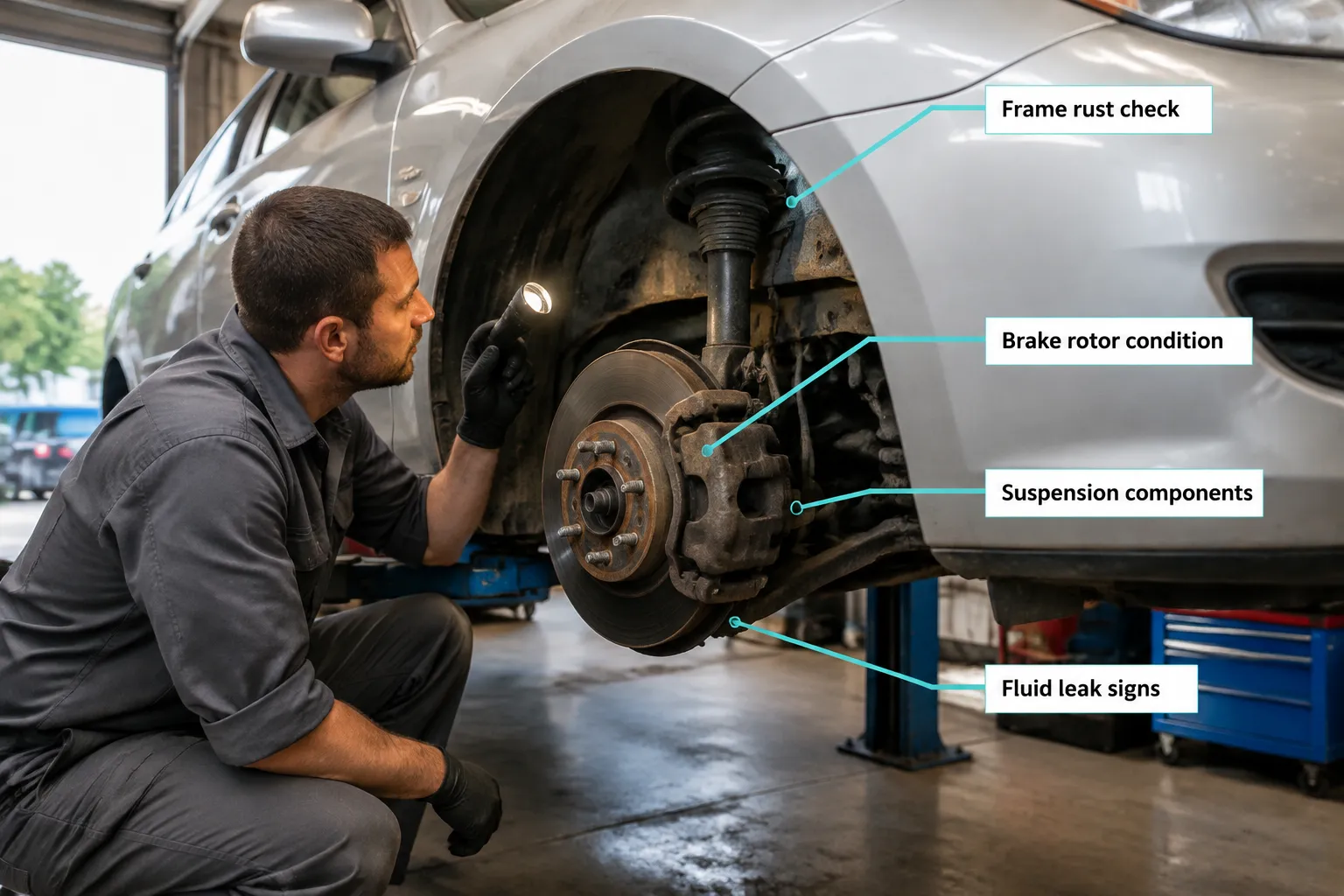
- Check all four tires for uneven wear, which can signal alignment or suspension problems.
- Open the hood. Look for corrosion, cracked hoses, low fluid levels, or signs of leaks.
- Check under the car for rust, especially on the frame and exhaust system.
- Inspect the interior for water stains, mold smell, or sand in unusual places (signs of flood damage).
- Test every electrical feature: windows, locks, air conditioning, radio, backup camera.
Layer 3: Paperwork Check
- Confirm the VIN on the dashboard matches the VIN on the title.
- Verify the seller’s name matches the name on the title.
- Check for any liens on the vehicle through your state’s DMV.
Decision rule: If a seller refuses to let you take the car to an independent mechanic for a pre-purchase inspection, treat that as a serious red flag and walk away.
How to Inspect a Used Car Before Buying
A proper used car inspection takes about 30 to 60 minutes and should always include a test drive. Here is a step-by-step checklist.
Exterior inspection:
- Walk around the car in full daylight. Crouch down and look along the body panels from the front and rear.
- Check that all door gaps are even. Uneven gaps suggest the car was in a collision.
- Look for overspray on rubber trim, windows, or plastic parts, which indicates a repaint.
- Check all lights: headlights, taillights, brake lights, turn signals.
Under the hood:
- Check the engine oil on the dipstick. Dark, gritty oil means it has not been changed regularly. Milky oil can mean a head gasket leak.
- Check the coolant reservoir. It should be at the correct level and be a clear green, orange, or pink color, not brown.
- Look for any cracks in belts or hoses.
- Check the battery terminals for heavy corrosion.
Interior:
- Sit in every seat. Check that seatbelts latch and retract properly.
- Test the air conditioning and heat.
- Check that the odometer reading matches the wear on the pedals, steering wheel, and seats.
- Smell the interior carefully for mold, mildew, or a strong air freshener masking something.
Test drive (minimum 15 minutes):
- Drive at both low and highway speeds.
- Brake firmly in a safe area. The car should stop straight without pulling.
- Listen for clunks, rattles, or grinding sounds over bumps.
- Test the steering for vibration or pulling to one side.
- Check that the transmission shifts smoothly (both automatic and manual).
Pro tip: Book a pre-purchase inspection with an independent mechanic for $100 to $150. This is the single most valuable step a used car buyer can take. [3]
How to Check Used Car History and Accident Reports
The best way to check a used car’s history is to run a paid vehicle history report using the car’s 17-digit VIN number. Carfax and AutoCheck are the two most widely used services. The National Motor Vehicle Title Information System (NMVTIS) also provides title and odometer data.
What a history report shows:
- Accident and damage records reported to insurance companies
- Title brands (salvage, flood, lemon law buyback, rebuilt)
- Number of previous owners
- Odometer readings over time
- Service and maintenance records (if reported)
- Recall information
What a history report does NOT show:
- Accidents that were never reported to insurance
- Cash repairs done without any documentation
- Mechanical problems that were never diagnosed
Important: The FTC warns that online used car listings can be fraudulent. Always verify the VIN matches the physical vehicle and never wire money or pay before seeing the car in person. [8]
For dealers, the FTC Used Car Rule requires that a Buyers Guide be displayed on every used vehicle offered for sale. This guide must disclose whether the car is sold “as is” or with a warranty, and what systems are covered. [9] Always read the Buyers Guide before signing anything. [2]
Are Certified Pre-Owned Cars Worth the Extra Cost?
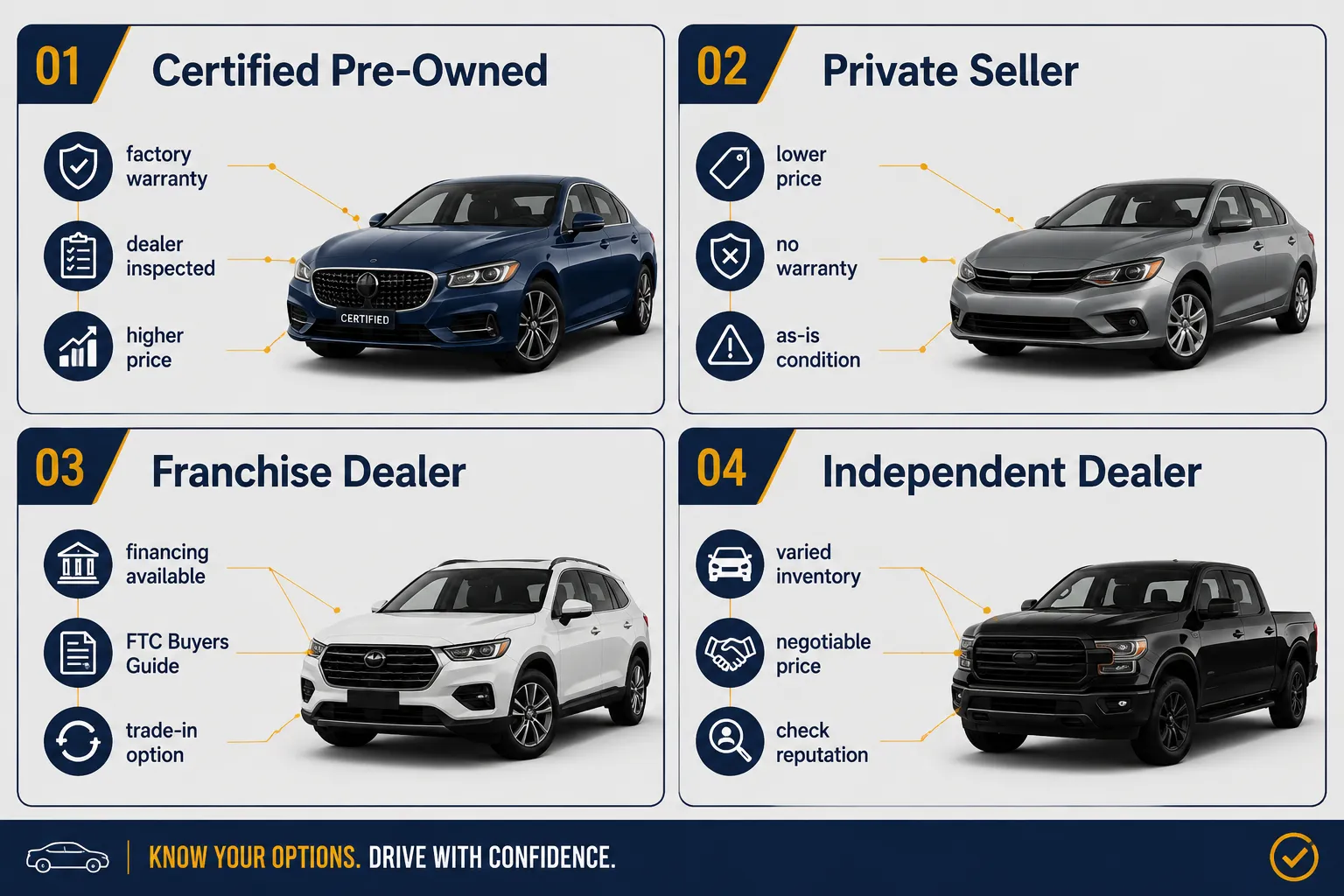
Certified pre-owned (CPO) vehicles are worth the extra cost for buyers who want near-new reliability without a new-car price. CPO programs require the vehicle to pass a manufacturer-defined multi-point inspection, be under a certain age and mileage limit, and come with an extended warranty backed by the manufacturer.
CPO advantages:
- Manufacturer-backed warranty (typically 1 to 7 years depending on brand)
- Multi-point inspection completed by a factory-trained technician
- Often includes roadside assistance and loaner car benefits
- Access to manufacturer financing rates
CPO disadvantages:
- Costs $1,000 to $3,000 more than a comparable non-CPO vehicle on average
- Only available at franchise dealerships, not private sellers
- Age and mileage limits mean fewer options for older or higher-mileage vehicles
Choose CPO if: you want peace of mind, plan to keep the car several years, and the price difference fits your budget.
Skip CPO if: you are buying a well-documented, low-mileage car from a private seller and are willing to pay for your own pre-purchase inspection and any needed repairs.
Common mistake: Assuming all CPO programs are equal. Toyota’s CPO program, for example, offers a 7-year/100,000-mile powertrain warranty, while some other brands offer only 1 year. Always read the specific CPO terms before paying the premium. [3]
What Is a Good Mileage for a Used Car?
A good mileage benchmark for a used car is roughly 12,000 miles per year of age. So a 4-year-old car with 48,000 miles or fewer is considered low mileage, while the same car with 80,000 miles is above average.
Mileage guide by vehicle age:
| Vehicle Age | Low Mileage | Average Mileage | High Mileage |
|---|---|---|---|
| 3 years old | Under 36,000 | 36,000-45,000 | Over 45,000 |
| 5 years old | Under 60,000 | 60,000-75,000 | Over 75,000 |
| 8 years old | Under 96,000 | 96,000-120,000 | Over 120,000 |
| 10 years old | Under 120,000 | 120,000-150,000 | Over 150,000 |
Mileage matters less than maintenance history. A well-maintained Honda Civic with 130,000 miles can be more reliable than a neglected Toyota Corolla with 60,000 miles. Always ask for service records.
High-mileage vehicles to consider: Trucks and SUVs with diesel engines (like the Toyota Land Cruiser or older Ford F-250 diesel) are often engineered to run 200,000 to 300,000 miles with proper care.
Edge case: City-driven cars with low mileage can actually have more wear on brakes, clutches, and suspension than highway-driven cars with higher mileage, because stop-and-go driving is harder on components.
Best Used Cars to Buy in 2026 That Hold Their Value
The best used cars to buy are models with a long track record of reliability, widely available parts, and low ownership costs. These vehicles also tend to hold their value better, which matters if you plan to sell or trade in later.
Best used cars under $15,000:
- Toyota Corolla (2017-2020): Extremely reliable, low maintenance costs, excellent fuel economy.
- Honda Civic (2016-2020): Sporty, fuel-efficient, strong reliability record.
- Mazda3 (2017-2021): Premium feel at a budget price, excellent driving dynamics.
- Toyota Camry (2016-2019): Spacious, comfortable, one of the most dependable sedans ever made.
- Honda Fit (2015-2020): Small but surprisingly practical, very low running costs.
Best used SUVs and crossovers:
- Toyota RAV4 (2018-2022): Consistently one of the top-selling and most reliable crossovers.
- Honda CR-V (2017-2022): Spacious interior, strong resale value, reliable hybrid option available.
- Subaru Outback (2018-2022): Standard all-wheel drive, great for families and outdoor use.
- Mazda CX-5 (2017-2022): Upscale interior, strong reliability, fun to drive.
Best used trucks:
- Toyota Tacoma (any year): Legendary reliability, holds value better than almost any other truck.
- Honda Ridgeline (2017-2022): Car-based comfort with truck utility, very low repair costs.
Best used cars under $10,000:
- Toyota Corolla (2014-2017), Honda Civic (2013-2016), Mazda3 (2014-2017), Hyundai Elantra (2016-2019)
Models to approach with caution: Vehicles with known expensive issues, such as certain Volkswagen diesel models (emissions recall history), some Chrysler/Dodge products with transmission problems, and any luxury brand outside of CPO coverage (repair costs can be very high).
For those interested in classic or collectible vehicles, the muscle cars guide covers a different side of the used car market.
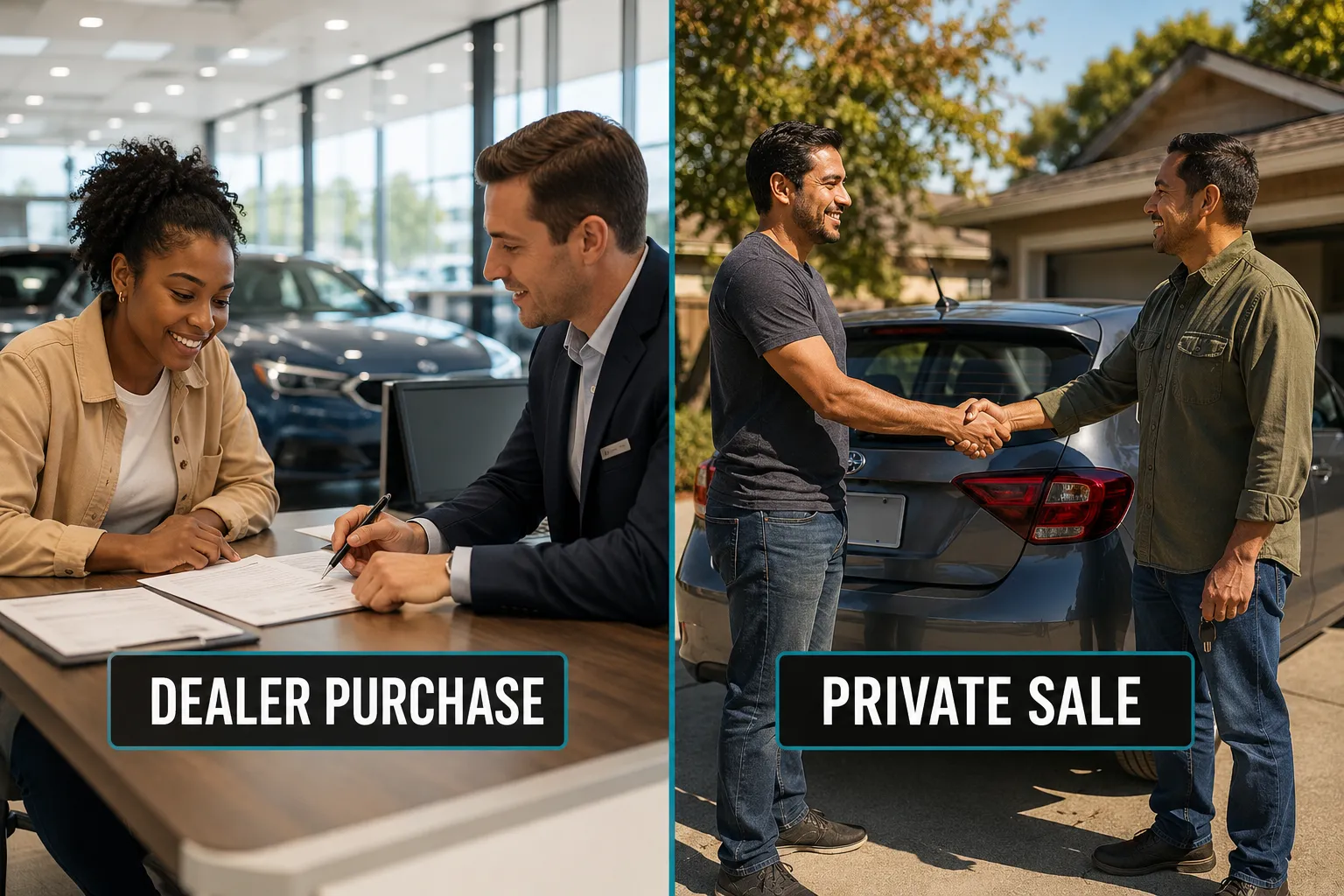
Should You Buy a Used Car from a Dealer or Private Seller?
Dealers and private sellers each have real advantages. The right choice depends on your budget, risk tolerance, and how much time you want to spend on the process.
Buying from a dealer:
- Required to display an FTC Buyers Guide disclosing warranty status [2]
- Can offer financing on-site
- May offer CPO vehicles with manufacturer warranty
- Prices are typically higher than private sales
- More legal recourse if something goes wrong
Buying from a private seller:
- Usually 10 to 20 percent cheaper than dealer prices
- No sales pressure, more flexible negotiation
- No warranty (sold as-is in most cases)
- Seller may have more detailed maintenance history
- More risk if the seller is not honest about the car’s condition
Common mistake: Trusting a private seller’s verbal claims about the car’s condition. Always verify with a history report and an independent inspection regardless of how trustworthy the seller seems.
Decision rule: If you are a first-time buyer or not mechanically inclined, start with a dealer or CPO vehicle. If you are comfortable with cars and want the best price, a well-documented private sale can be a great deal.
How to Spot a Flood-Damaged or Salvage Title Car
Flood-damaged and salvage title vehicles are among the riskiest used cars to buy. They can look perfectly normal on the outside while hiding serious electrical, mechanical, and structural damage.
Signs of flood damage:
- Musty or moldy smell inside the cabin, even with windows open
- Sand, mud, or grit in unusual places: under seats, in door hinges, in the spare tire well
- Rust on metal parts that should not rust quickly, like seat rail bolts or interior screws
- Water stains on the headliner (ceiling fabric) or carpet
- Fog or moisture inside headlight or taillight housings
- Electrical gremlins: windows that work intermittently, warning lights that come on randomly
How to check for a salvage title:
- Run a vehicle history report. Flood damage and salvage titles are typically reported. [4]
- Check the title document itself. A salvage or rebuilt title will be clearly marked.
- Search the VIN in the National Motor Vehicle Title Information System (NMVTIS).
What a salvage title means: The vehicle was declared a total loss by an insurance company. It can be repaired and re-titled as “rebuilt” or “reconstructed,” but it will always carry that history, which affects insurance rates, resale value, and safety.
Hard rule: Unless you are an experienced mechanic buying a salvage vehicle specifically to restore it, avoid salvage title cars entirely. The savings rarely justify the risk.
How to Negotiate Used Car Prices
Negotiating a used car price is straightforward when you come prepared with data. The goal is to know the car’s fair market value before you sit down, so you are negotiating from facts, not feelings.
Before you negotiate:
- Look up the car’s value on NADA Guides, Kelley Blue Book, and Edmunds. Note the private party value and the dealer retail value. The 7 Steps to NADA Guides Used Car Values is a useful starting point.
- Check similar listings in your area on CarGurus, AutoTrader, and Facebook Marketplace to see what comparable cars are actually selling for.
- Get the vehicle history report before negotiating. Any issues you find are leverage.
- Know your walk-away number before you walk in.
During negotiation:
- Start below your target price, not at it.
- Point to specific issues: worn tires, a minor dent, higher mileage than average, or anything the history report flagged.
- Negotiate the out-the-door price (total cost including fees and taxes), not just the sticker price.
- Do not reveal your maximum budget to the dealer.
- Be willing to walk away. In 2026, inventory is more available than in 2022, so you have options.
At a dealer:
- Watch for add-on fees: documentation fees, dealer prep fees, and “market adjustment” markups. These are negotiable.
- If financing through the dealer, negotiate the car price first, then discuss financing separately.
Common mistake: Focusing only on the monthly payment instead of the total price. A dealer can make a high-priced car seem affordable by stretching the loan to 72 or 84 months, which costs far more in total interest. For more on how used car loans work, see how a used car loan works.
What Documents Do You Need When Buying a Used Car?
Buying a used car requires specific documents to transfer ownership legally. Missing any of these can delay registration or create legal problems.
Documents the seller must provide:
- Clean title: Signed over to you by the seller. The name on the title must match the seller’s ID.
- Bill of sale: A written record of the transaction including price, date, VIN, and both parties’ names and signatures.
- Odometer disclosure statement: Required by federal law for most vehicles under 10 years old. [9]
- Release of lien (if applicable): If the car had a loan, the lender must have released the lien before the title can transfer.
Documents you will need:
- Valid government-issued photo ID
- Proof of insurance (most states require this before you can drive the car off the lot)
- Payment method (cashier’s check, wire transfer, or financing approval letter)
After purchase:
- Register the vehicle at your state’s DMV within the required timeframe (usually 10 to 30 days depending on state)
- Pay any applicable sales tax and title transfer fees
- Keep a copy of the bill of sale and title transfer for your records
Common mistake: Accepting a title that is not in the seller’s name (a “jumped” or “open” title). This is illegal in most states and can make it impossible to register the vehicle. [4]
What Is the Best Time of Year to Buy a Used Car?
The best time to buy a used car is at the end of the month, at the end of a quarter (March, June, September, December), or during the slower winter months of January and February.
Why timing matters:
- Dealers and salespeople often have monthly and quarterly sales quotas. Near the end of a period, they are more motivated to close deals.
- January and February see lower buyer traffic, which gives you more negotiating power.
- New model year releases (typically late summer and fall) push dealers to clear out older inventory, which can mean better deals on one-year-old used vehicles.
Best months for used car deals:
- January and February: Post-holiday slowdown, low foot traffic
- End of any month: Quota pressure on salespeople
- October and November: Dealers clearing inventory before new model years arrive
Worst times to buy:
- Tax refund season (March and April): More buyers in the market, less negotiation room
- Summer: High demand for trucks and SUVs, prices tend to be higher
Market context for 2026: Used car prices are stabilizing after the sharp increases of 2021-2023. Inventory is recovering, and buyers have more leverage than they did two years ago. This makes 2026 a reasonable time to buy, especially if you are patient and willing to shop around.
Common Problems to Avoid When Buying Used Cars
Most used car buying mistakes fall into a small number of categories. Knowing them in advance saves time, money, and frustration.
1. Skipping the vehicle history report A $40 history report can reveal a salvage title, flood damage, or odometer fraud that would cost thousands to deal with later. Never skip this step.
2. Not getting a pre-purchase inspection A mechanic can find problems that are invisible to the untrained eye. Worn timing chains, leaking head gaskets, and failing transmissions do not always show symptoms during a short test drive.
3. Buying based on appearance alone A freshly detailed car with new floor mats can hide serious mechanical problems. Focus on the mechanical condition and history, not how clean it looks.
4. Ignoring the title status Salvage, rebuilt, flood, and lemon law buyback titles all carry significant risks and reduce resale value. Always confirm the title is clean before proceeding.
5. Falling for online scams The FTC warns that online used car listings are a common source of fraud. Be very cautious of deals that seem too good to be true, sellers who want payment before you see the car, or listings that ask for wire transfers or gift cards. [8]
6. Financing through the dealer without shopping rates first Dealer financing can be convenient, but it is not always the best rate. Check with your bank or credit union first so you know what rate you qualify for.
7. Ignoring recall history Check the NHTSA website for any open recalls on the vehicle’s VIN. Some recalls are safety-critical and must be addressed. Open recalls are typically fixed for free at a dealership.
FAQ: Buying Used Cars
Q: How do I find a reliable used car on a tight budget? Focus on high-volume, well-documented models from Toyota, Honda, and Mazda in the $8,000 to $12,000 range. Avoid luxury brands and vehicles with known expensive repairs. Always get a pre-purchase inspection before buying.
Q: Is it safe to buy a used car online without seeing it in person? It carries more risk. The FTC advises buyers to be cautious of online listings, never pay before seeing the car, and always verify the VIN and title in person before transferring money. [8]
Q: What is a reasonable dealer documentation fee? Documentation fees vary by state. In many states, they range from $100 to $500. Some states cap them by law. Always ask what fees are included in the out-the-door price before agreeing to anything.
Q: Can I return a used car after buying it? In most cases, no. Used cars are typically sold as-is unless the dealer offers a specific return policy. The FTC does not require dealers to offer a cooling-off period for car purchases. [2]
Q: How do I know if a used car has been in a flood? Check the vehicle history report for a flood title brand, inspect the interior for musty smells and water stains, look for rust on interior screws and seat rails, and check for moisture inside the headlights. A mechanic can also check for corrosion in the electrical system.
Q: What is the difference between a salvage title and a rebuilt title? A salvage title means the car was declared a total loss by an insurance company and has not been repaired. A rebuilt title means it was repaired and passed a state inspection, but it still carries the history of being totaled. Both reduce resale value and can make insurance harder to get.
Q: Should I buy an extended warranty on a used car? Third-party extended warranties vary widely in quality and coverage. If you are buying a CPO vehicle, the manufacturer warranty is usually more reliable. For non-CPO purchases, read any extended warranty contract carefully, check what is excluded, and research the warranty company’s reputation before paying.
Q: How many miles is too many for a used car? There is no hard cutoff. A well-maintained Toyota or Honda at 150,000 miles can be a better buy than a neglected vehicle at 60,000 miles. Focus on maintenance history, not just the number on the odometer.
Q: What is the FTC Buyers Guide and why does it matter? The FTC Buyers Guide is a form that dealers are required by federal law to display on every used vehicle for sale. It tells you whether the car is sold “as is” or with a warranty, and what the warranty covers. Always read it before buying from a dealer. [9]
Q: How long does it take to buy a used car from a dealer? The process typically takes 2 to 4 hours from test drive to signing paperwork, assuming financing is pre-arranged. If you are applying for financing at the dealership, allow more time.
Q: Is a private seller sale legally binding? Yes. A signed bill of sale is a legally binding contract. Make sure the bill of sale includes the VIN, sale price, date, and both parties’ signatures.
Q: What should I do immediately after buying a used car? Get insurance before driving it home. Then schedule an oil change, check the tire pressure, verify all fluid levels, and have a mechanic do a general inspection if you did not do a pre-purchase inspection. Check for any open recalls on the NHTSA website.
Conclusion
Buying a used car in 2026 is one of the smartest financial moves most people can make, but only when done carefully. The market is more buyer-friendly than it was two years ago, prices are stabilizing, and there is a wide selection of reliable models available at every budget level.
Actionable next steps:
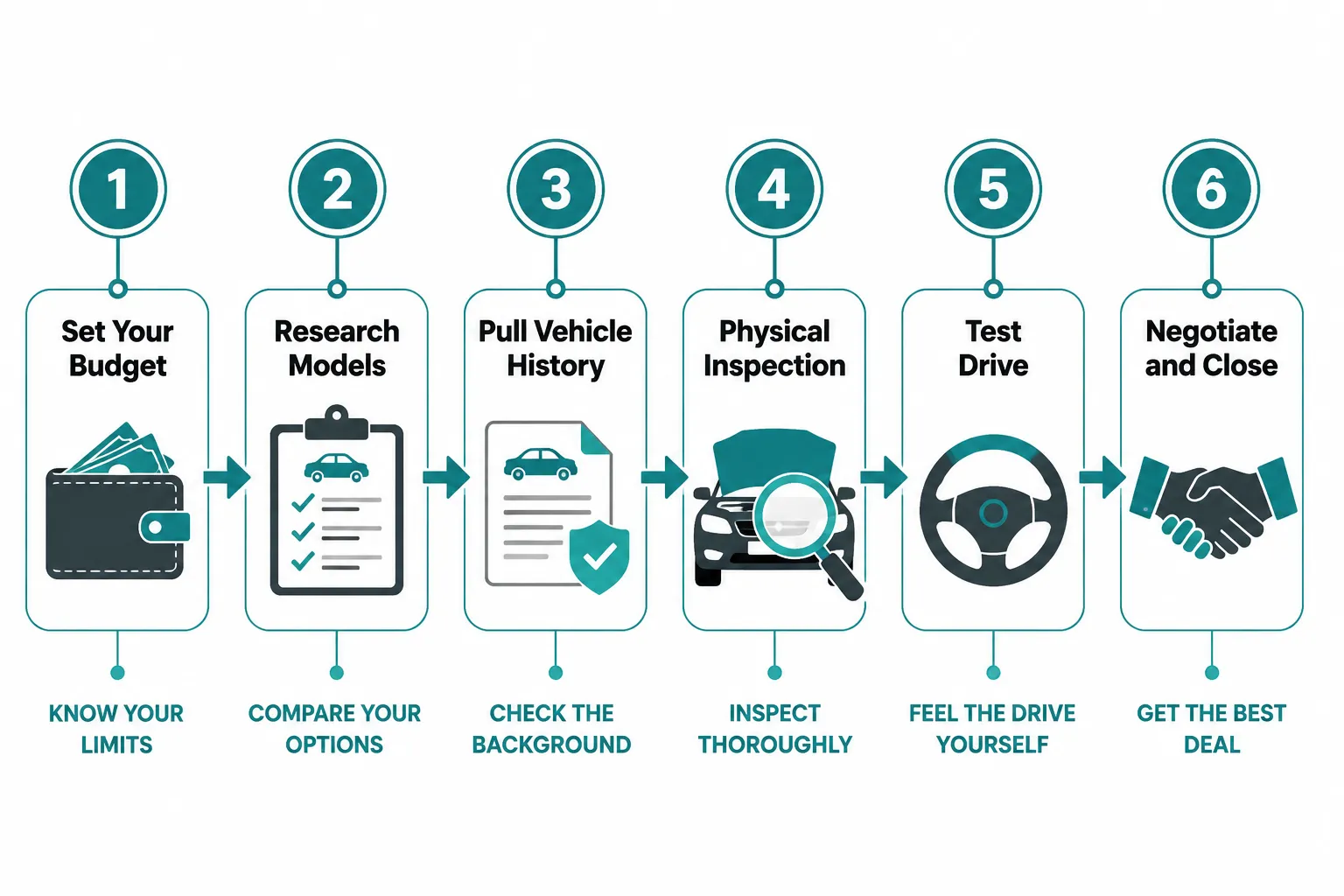
- Set your budget first. Decide on your total out-the-door spending limit, including insurance, registration, and first-year maintenance.
- Research models before shopping. Pick two or three reliable models that fit your needs and budget. Use NADA Guides and Kelley Blue Book to understand fair market prices.
- Run a history report on every car you seriously consider. Do not skip this step, even if the seller seems trustworthy.
- Inspect in person and test drive. Use the checklist in this guide. Bring a flashlight and check the car in daylight.
- Book a pre-purchase inspection. Spend $100 to $150 on an independent mechanic before you spend thousands on the car.
- Read the FTC Buyers Guide at any dealership. Know whether you are buying as-is or with a warranty before signing. [2]
- Negotiate the total price, not the monthly payment. Know your walk-away number and be willing to use it.
- Verify all documents before transferring money. Confirm the title is clean, the VIN matches, and the seller’s name matches the title.
The difference between a great used car purchase and a costly mistake almost always comes down to preparation. Take the time to do the research, and the right vehicle at the right price will be there.
References
[1] FTC Used Car Consumer Information – https://www.ftc.gov/media/70865
[2] Buying a Used Car from a Dealer – https://consumer.ftc.gov/articles/buying-used-car-dealer
[3] How to Buy a Used Car – Consumer Reports – https://www.consumerreports.org/cars/buying-a-car/how-to-buy-a-used-car-a5221672417/
[4] FTC Feature: Used Cars – https://consumer.ftc.gov/features/feature-0040-used-cars
[5] FTC CFR Buyers Guides English – https://www.ftc.gov/system/files/documents/plain-language/cfr_buyers_guides_english.pdf
[8] What to Know When Buying a Used Car Online – https://consumer.ftc.gov/consumer-alerts/2024/07/what-know-when-buying-used-car-online
[9] FTC Used Car Rule – https://www.ftc.gov/legal-library/browse/rules/used-car-rule