
Last Updated on August 26, 2026
More than 140 million people visit automotive museums worldwide each year, a figure that rivals attendance at major sporting events and signals just how deeply the car museum has embedded itself in global culture. These institutions are far more than storage spaces for old vehicles. They are living archives of engineering ambition, design philosophy, and social history, drawing families, collectors, historians, and casual enthusiasts alike.
In 2026, the car museum landscape is more dynamic than ever. New exhibitions are opening, historic institutions are relocating, and record visitor numbers are reshaping how curators think about the guest experience. Whether planning a road trip to a famous collection or simply curious about what these institutions offer, this guide covers everything worth knowing.
Key Takeaways
- Car museums worldwide are experiencing record visitor growth, with major new exhibitions launched in 2025 and 2026
- The National Motor Museum is relocating after approximately 60 years at Beaulieu in the UK, marking a significant shift in British automotive heritage
- Brooklands Museum is celebrating 100 years since Britain’s first Grand Prix, making 2026 a landmark year for motorsport history
- The United States hosts some of the world’s largest automotive collections, including the National Corvette Museum and the Gilmore Car Museum
- Visiting a car museum offers genuine educational value alongside entertainment, with many institutions expanding interactive and digital exhibits
What Makes a Car Museum Worth Visiting
A great car museum does more than park vintage cars behind velvet ropes. The best institutions combine curatorial depth with engaging storytelling, placing each vehicle in its historical and cultural context. Visitors leave understanding not just what a car looked like, but why it mattered.
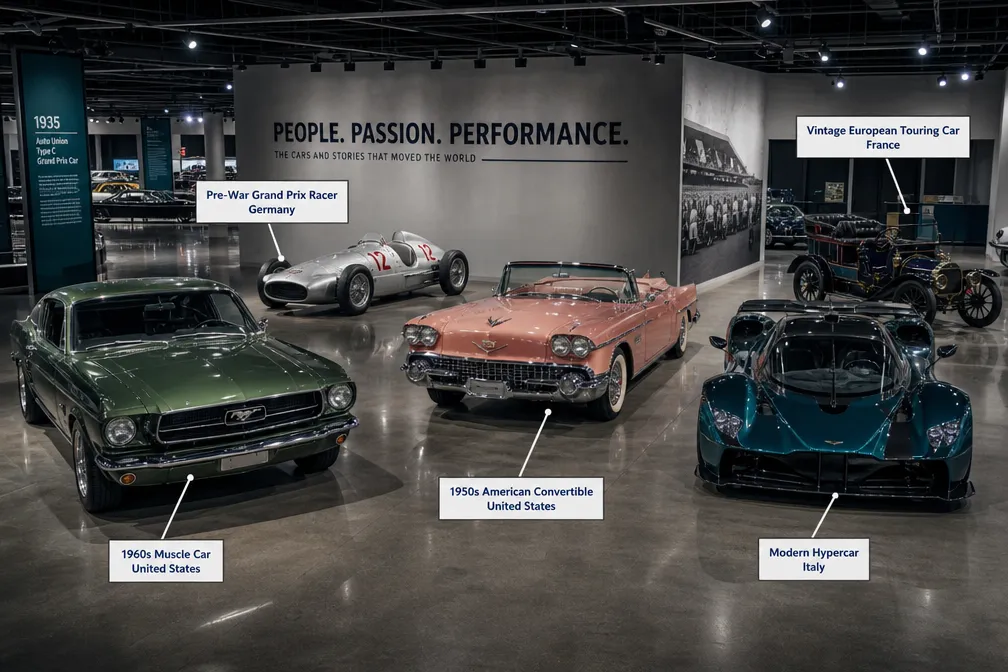
The distinction between a showroom and a genuine museum lies in interpretation. A curated automotive collection explains the social conditions that produced a particular design, the engineering breakthroughs it represented, and the legacy it left behind. For example, the Simeone Foundation Automotive Museum in Philadelphia frames its collection around the concept of “the American Dream,” using vehicles to narrate the story of aspiration, mobility, and industrial ambition in the United States. [2]
Several factors separate exceptional institutions from average ones:
- Curatorial depth: Are vehicles placed in historical context, or simply displayed?
- Condition and authenticity: Are cars restored to original specification or modified?
- Interactive elements: Can visitors sit in vehicles, use simulators, or access digital archives?
- Special exhibitions: Does the museum rotate new content to reward repeat visits?
- Campus experience: Some museums, like the Gilmore Car Museum in Michigan, operate across multiple buildings on a large campus, creating a full-day destination [8]
If you appreciate the history behind classic vehicles, you may also find value in understanding how many miles you can put on a classic car before major restoration becomes necessary, a question that connects directly to how museums maintain their collections.
Major Car Museum News in 2026
The automotive museum world is rarely static, and 2026 has already delivered several headline-making developments.
The National Motor Museum Leaves Beaulieu
Perhaps the most significant story in the UK automotive heritage world is the planned departure of the National Motor Museum from its long-standing home at Beaulieu in the New Forest. After approximately 60 years at the site, the museum is set to relocate following a funding dispute between the museum’s trustees and the Montagu family, who own the Beaulieu estate. [5] [6]
The disagreement centers on financial contributions and long-term operational responsibilities. The National Motor Museum Trust, which manages the collection, has indicated it needs a new home that can support the institution’s ambitions for the next generation of visitors. [1] The collection includes some of Britain’s most significant automotive artifacts, and the relocation will be one of the most complex moves in British museum history.
Despite the transition, the National Motor Museum continues its international program. In 2026, the museum is participating in events at the Pebble Beach Concours d’Elegance in California, celebrating the Sunbeam 1000hp land speed record car. [9]
Brooklands Museum Marks 100 Years of British Motorsport
Brooklands Museum in Surrey is celebrating a landmark anniversary in 2026: 100 years since Britain’s first Grand Prix was held at the circuit in 1926. [4] The museum, which occupies the original Brooklands racing circuit site, has organized a series of commemorative events and exhibitions to mark the centenary. The anniversary has drawn significant media attention and is expected to drive record visitor numbers to the Surrey site throughout the year.
BMW Art Cars Displayed Together
One of the most anticipated exhibitions in recent automotive museum history brought all 20 BMW Art Cars together in a single display for the first time. [2] The Art Car project, which began in 1975, has seen vehicles painted by artists including Andy Warhol, Roy Lichtenstein, and Jeff Koons. Seeing the complete series in sequence offers a unique lens on the intersection of automotive design and contemporary art.
New Exhibitions Across the Globe
The Savoy Automobile Museum in Cartersville, Georgia, launched its “National Treasures” exhibition, highlighting rare American vehicles of particular historical significance. [2] [3] Meanwhile, institutions including LeMay in Tacoma, the National Automobile Museum in Reno, the Caramulo Museum in Portugal, the Louwman Museum in the Netherlands, Autoworld in Brussels, and the Automobile Club de Monaco have all opened new exhibitions or expanded their permanent galleries in 2025 and 2026. [2] [3]
In Germany, the Nationales Automuseum, The Loh Collection, has continued to solidify its reputation as one of Europe’s premier private automotive collections, drawing visitors from across the continent. [10]
The World’s Most Celebrated Car Museums
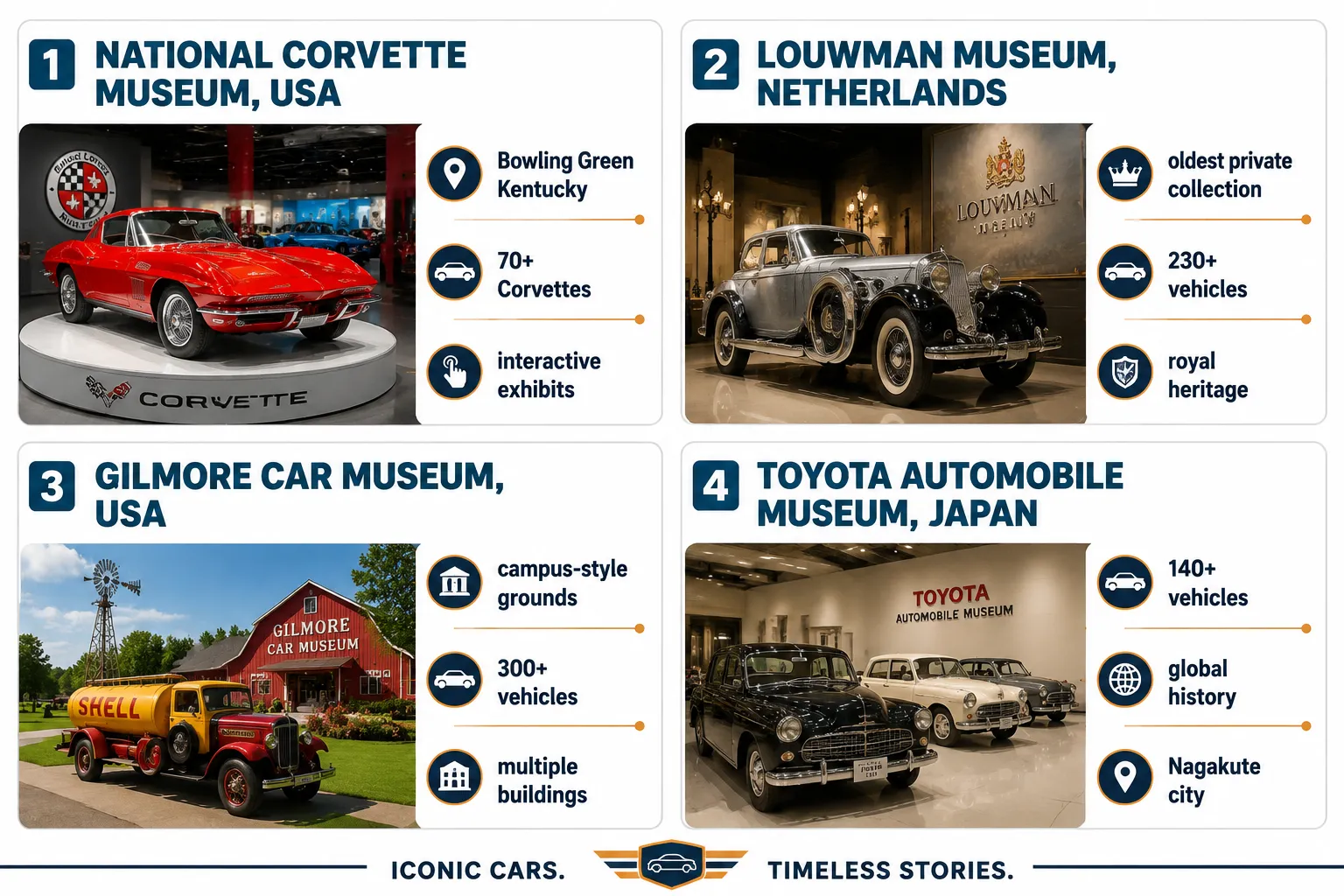
Choosing which car museum to visit depends on personal interests, geography, and the type of vehicles that resonate most. The following institutions consistently rank among the world’s finest.
United States
National Corvette Museum, Bowling Green, Kentucky The National Corvette Museum is both a shrine to America’s most iconic sports car and an active cultural center. Located adjacent to the General Motors assembly plant where Corvettes are built, the museum houses more than 70 vehicles spanning every generation of the model. Recent expansion projects have added new interactive galleries and a driving experience center. [2] [3]
Gilmore Car Museum, Hickory Corners, Michigan The Gilmore Car Museum operates across a sprawling campus of historic barns and purpose-built galleries, housing more than 300 vehicles. [8] The campus model creates a genuinely immersive experience, with multiple themed buildings dedicated to specific eras or marques. The museum regularly hosts car shows and special events that attract collectors from across the country.
LeMay, America’s Car Museum, Tacoma, Washington LeMay houses one of the largest automotive collections in the United States, with a particular strength in American vehicles from the postwar era. The museum’s recent exhibitions have focused on the cultural impact of the automobile on American identity.
Simeone Foundation Automotive Museum, Philadelphia, Pennsylvania The Simeone is notable for its “American Dream” exhibition concept and its collection of rare racing cars. The museum regularly conducts “Demo Days” in which vehicles are started and driven, giving visitors a sensory experience unavailable at most institutions. [2]
Europe
Louwman Museum, The Hague, Netherlands The Louwman Museum holds the distinction of being one of the oldest private automotive collections in the world, with more than 230 vehicles representing over 125 years of automotive history. The collection has strong royal connections and is housed in a purpose-built facility designed to showcase each vehicle to maximum effect.
Autoworld, Brussels, Belgium Autoworld occupies the Palais Mondial in Brussels’ Cinquantenaire park, a grand Belle Epoque building that provides a dramatic backdrop for more than 250 vehicles. The museum covers European automotive history from the earliest horseless carriages to contemporary supercars.
Nationales Automuseum, The Loh Collection, Herborn, Germany This private collection, opened in recent years, has quickly established itself as a major destination for automotive enthusiasts in central Europe. [10] The museum focuses on exceptional examples of automotive design and engineering, with particular strength in German and Italian marques.
National Motor Museum, Beaulieu, UK Despite its ongoing relocation plans, the National Motor Museum remains one of Britain’s most-visited heritage attractions. The collection includes land speed record cars, royal vehicles, and an extensive archive of automotive history. [1] [6]
Asia
Toyota Automobile Museum, Nagakute, Japan Located near Nagoya, the Toyota Automobile Museum houses more than 140 vehicles tracing the global history of the automobile from the 1880s to the present day. The collection deliberately extends beyond Toyota products to provide a comprehensive survey of automotive development worldwide.
Beijing Auto Museum, China The Beijing Auto Museum is one of Asia’s largest automotive institutions, with a collection that covers both international automotive history and the development of China’s own automobile industry. The museum has updated its operational approach in recent years to accommodate growing domestic tourism. [2]
How to Get the Most from a Car Museum Visit
A car museum visit rewards preparation. The following strategies help visitors extract maximum value from any automotive collection.
Research before you go. Most major museums publish their current exhibitions online. Checking the schedule in advance allows visitors to plan around special events, Demo Days, or temporary exhibitions that may not be available on every visit.
Allow more time than expected. Campus-style museums like the Gilmore can easily occupy a full day. Even focused collections like the Simeone benefit from unhurried browsing. Rushing through a car museum means missing the interpretive content that distinguishes a great institution from a simple display.
Engage with staff and docents. Many automotive museums employ or volunteer former industry professionals, racing drivers, and restoration specialists. Their knowledge often extends well beyond the printed labels.
Visit the archive and library. Many major museums maintain research archives that are accessible to the public by appointment. These resources are invaluable for collectors, historians, and journalists.
Check for membership programs. Regular visitors can often access significant discounts, early entry, and members-only events through annual membership programs.
If a car museum visit sparks broader interest in automotive valuation, perhaps after seeing a rare model on display, resources like determining used car value and NADA guides used car values can help translate museum enthusiasm into informed buying decisions.
Car Museums and the Collector Community
Car museums occupy a unique position in the collector ecosystem. Many institutions maintain active relationships with private collectors, borrowing significant vehicles for temporary exhibitions and occasionally accepting donations or bequests. This relationship benefits both parties: museums gain access to rare vehicles they could not otherwise afford, while collectors gain the prestige of public display and the security of professional conservation.
The muscle cars genre is particularly well represented across American automotive museums, reflecting the cultural significance of the muscle car era in postwar American identity. Institutions like the National Corvette Museum and LeMay regularly feature muscle car exhibitions that draw dedicated enthusiasts.
For collectors considering the financial dimension of their hobby, understanding value versus price is a useful framework, a concept that applies equally to purchasing a collector vehicle and to evaluating a museum’s acquisition strategy.
The Kelley Blue Book motorcycle value resource offers a parallel example of how valuation tools support collector decision-making, and many car museums now include motorcycle galleries alongside their automotive collections.
YouTube Resources for Car Museum Enthusiasts
Video content has become an essential companion to the physical museum experience. The following YouTube channels and videos offer high-quality coverage of major automotive collections and are worth bookmarking before planning a visit.
Recommended viewing:
Jay Leno’s Garage, Jay Leno’s personal collection is itself museum-quality, and his YouTube channel features in-depth tours of major automotive institutions alongside his own vehicles. Search “Jay Leno’s Garage museum tour” for a curated selection.
The Petersen Automotive Museum (official channel), The Petersen in Los Angeles maintains an active YouTube presence with vault tours, curator interviews, and exhibition previews. Their “Vault” series offers access to vehicles not on public display.
National Motor Museum Beaulieu (official channel), The National Motor Museum’s channel covers its collection highlights, special events, and behind-the-scenes conservation work.
Hagerty, Hagerty’s YouTube channel combines collector car content with museum visits, auction coverage, and restoration stories. Their “Barn Find Hunter” series occasionally uncovers vehicles of genuine museum quality.
DriveTribe, DriveTribe’s channel features visits to major European automotive museums, including Autoworld, the Louwman, and several German collections.
“A car museum is not simply a place where old cars go to rest. It is where the stories of engineering, culture, and human ambition are preserved for the next generation.”
These channels collectively offer hundreds of hours of high-quality automotive museum content, making them ideal for research before a visit or for experiencing collections that are geographically out of reach.
The Future of the Car Museum
The automotive museum sector is adapting to a rapidly changing cultural landscape. Several trends are shaping the next decade of institutional development.
Electric vehicle history is emerging as a curatorial priority. As the transition to electric mobility accelerates, museums are beginning to acquire early electric vehicles and document the history of battery technology. The solid state batteries revolution currently underway will itself become a chapter in automotive museum history within a generation.
Digital and augmented reality exhibits are becoming standard in newly opened or renovated facilities. These technologies allow visitors to experience vehicles in their original operating environment, a racing circuit, a mountain pass, a city street, without leaving the gallery floor.
Campus-style development is gaining traction as museums recognize that visitors want full-day experiences. The Gilmore Car Museum model, with its multiple buildings and outdoor spaces, is increasingly being cited as a template for new institutions. [8]
International collaboration is growing, with museums lending vehicles across borders for major exhibitions. The BMW Art Car display brought together vehicles from multiple continents, demonstrating the logistical ambition now possible in the sector. [2]
Community engagement programs are expanding to reach audiences beyond traditional car enthusiasts. School programs, family events, and community partnerships are helping museums justify their public funding and broaden their visitor base.
Conclusion
The car museum has never been more relevant. In 2026, these institutions are navigating major transitions, the National Motor Museum’s relocation, Brooklands’ centenary celebrations, and a wave of new exhibitions across three continents, while simultaneously investing in the digital and experiential innovations that will define the next generation of automotive heritage.
Actionable next steps for readers:
- Plan a visit to one of the institutions profiled above. Use the museum’s official website to check current exhibitions and book tickets in advance, particularly for popular events.
- Subscribe to automuseums.info newsletters for regular updates on new exhibitions, openings, and events at automotive museums worldwide. [7]
- Engage with YouTube content from official museum channels and automotive journalists before your visit to build context and identify must-see vehicles.
- Consider membership at your nearest automotive museum to support conservation work and access exclusive events.
- Connect with the collector community through museum events, car shows, and online forums to deepen your appreciation of the vehicles on display.
The stories preserved inside a car museum are ultimately stories about human ingenuity, ambition, and the relentless desire to move faster, more elegantly, and more efficiently. Every vehicle on display is a chapter in that ongoing story, and the best museums make sure visitors leave knowing exactly which chapter they just read.
References
[1] National Motor Museum To Leave New Forest After 60 Years – https://ground.news/article/national-motor-museum-to-leave-new-forest-after-60-years
[2] 8 August 2026 – https://automuseums.info/newsletters/8-august-2026/
[3] 1 August 2026 – https://automuseums.info/newsletters/1-august-2026/
[4] Brooklands Museum Celebrates 100 Years Since Britains First Grand Prix – https://www.itv.com/news/london/2026-08-08/brooklands-museum-celebrates-100-years-since-britains-first-grand-prix
[5] Beaulieu Exclusive Funding Feud Behind National Motor Museum Exit – https://autocar-prod.codeenigma.net/car-news/new-cars/beaulieu-exclusive-funding-feud-behind-national-motor-museum-exit
[6] National Motor Museum To Leave New Forest After 60 Years – https://ground.news/article/national-motor-museum-to-leave-new-forest-after-60-years
[7] Newsletters – https://automuseums.info/newsletters/
[8] Gilmore Car Museum – https://gilmorecarmuseum.org/
[9] National Motor Museum To Celebrate The Sunbeam 1000hp At California’s Pebble Beach Classic Car Forum – https://nationalmotormuseum.org.uk/news/national-motor-museum-to-celebrate-the-sunbeam-1000hp-at-california-s-pebble-beach-classic-car-forum/
[10] MCG Executive Briefing For August 14 2026 – https://macsmotorcitygarage.com/mcg-executive-briefing-for-august-14-2026/