Last Updated on October 3, 2026
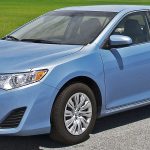
A used Toyota Camry with 120,000 miles on the odometer can realistically outlive a brand-new economy sedan from a weaker brand. That single fact explains why three automakers, Toyota, Honda, and Subaru, dominate used-car lots, auction blocks, and search queries from budget-minded shoppers every single year. But “dominate” does not mean “identical.” Each brand wins and loses in different categories, and the differences matter more the longer you plan to keep the car.
This guide breaks down Used Subaru vs Honda vs Toyota: Reliability, Resale Value, and Ownership Cost Compared using a consistent five-year ownership framework: maintenance, insurance, fuel economy, depreciation, common repairs, and the best used models at different budgets. The goal is not to crown one “best” brand, but to show which one fits your driving needs, climate, and wallet.
Key Takeaways
- Toyota currently holds the top reliability spot overall, with Subaru close behind and Honda trailing slightly but still ranking well above the industry average [2][3][4].
- Toyota and Honda generally hold resale value better across most segments, while Subaru leads in specific niches like all-wheel-drive wagons and outdoor-lifestyle SUVs.
- Five-year ownership cost differences come down more to insurance, repair parts, and AWD maintenance than to the sticker price of the used vehicle itself.
- Subaru’s CVT transmissions and head gasket history on older models represent the brand’s main repair risk, while Honda and Toyota’s biggest issues tend to be infotainment electronics and minor trim recalls.
- Matching the vehicle to your climate and driving style matters as much as the badge, a Subaru shines in snow, a Honda shines in commuting economy, and a Toyota shines in long-haul durability.
Reliability Rankings in 2026: Where Subaru, Honda, and Toyota Stand
Reliability data shifts every year, and the most recent Consumer Reports brand rankings show a notable reshuffling worth paying attention to if you are shopping used. Toyota reclaimed the top overall reliability position in the most recent annual survey, with Subaru landing in a tight second place, a result that even surprised some analysts given Subaru’s smaller lineup and heavier reliance on all-wheel-drive hardware [2][3][4][6].
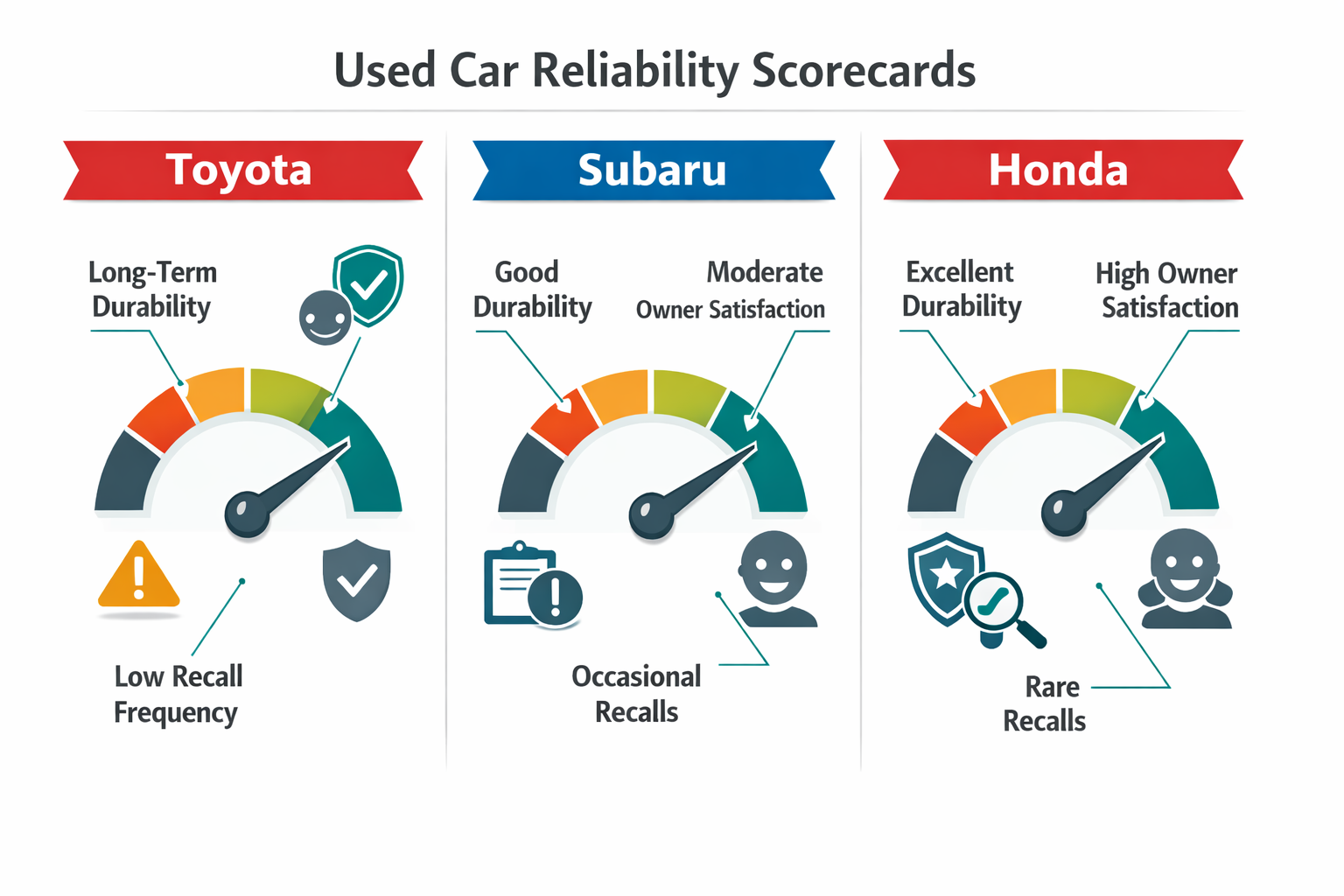
Honda, meanwhile, continues to post strong numbers but sits a notch behind both Toyota and Subaru in several recent rankings. That is not a knock against Honda, it still ranks well above the industry average, but it signals that Honda’s recent generations have carried slightly more infotainment glitches and minor electrical gremlins than its two rivals [1][2][9].
Here is how the three brands generally stack up on the metrics that matter most to used-car buyers:
| Factor | Toyota | Subaru | Honda |
|---|---|---|---|
| Long-term durability | Excellent, frequently cited in high-mileage studies | Very good, especially post-2015 models | Very good, strong engine longevity |
| Recent reliability trend | Regained the top spot [8] | Rising fast, slight recent dip [5][6] | Steady, slightly behind the top two [1] |
| Owner satisfaction | High | High, especially among active lifestyle buyers | High, especially among commuters |
| Risk profile on used fleet | Low | Moderate (CVT and older head gaskets) | Low to moderate (electronics) |
It is worth noting that brand-wide scores hide model-by-model variation. A Toyota Tacoma and a Toyota Prius Prime do not share a reliability profile just because they share a badge. Likewise, Subaru’s WRX and Outback are built on different engineering philosophies entirely. Independent reliability trackers like carVertical and CarGurus echo this pattern, showing that model-specific maintenance records matter more than brand loyalty alone when assessing a specific used vehicle [7][9].
Overall quality, not just raw reliability stats, also shapes the ownership experience. Consumer Reports’ broader quality and satisfaction research has consistently placed Toyota and Subaru near the top of “best overall brands,” with Honda just behind [10]. That broader quality score factors in things like dealer service experience, interior fit and finish durability, and how well the vehicle ages cosmetically, not just mechanically.
Used Subaru vs Honda vs Toyota: Resale Value and Depreciation Over Five Years
Resale value is where the three brands genuinely separate from one another, and it is arguably more important to a used-car buyer than a new-car buyer. When you buy used, you are stepping onto the depreciation curve partway through, which means understanding where that curve flattens out matters for your future trade-in or private sale.
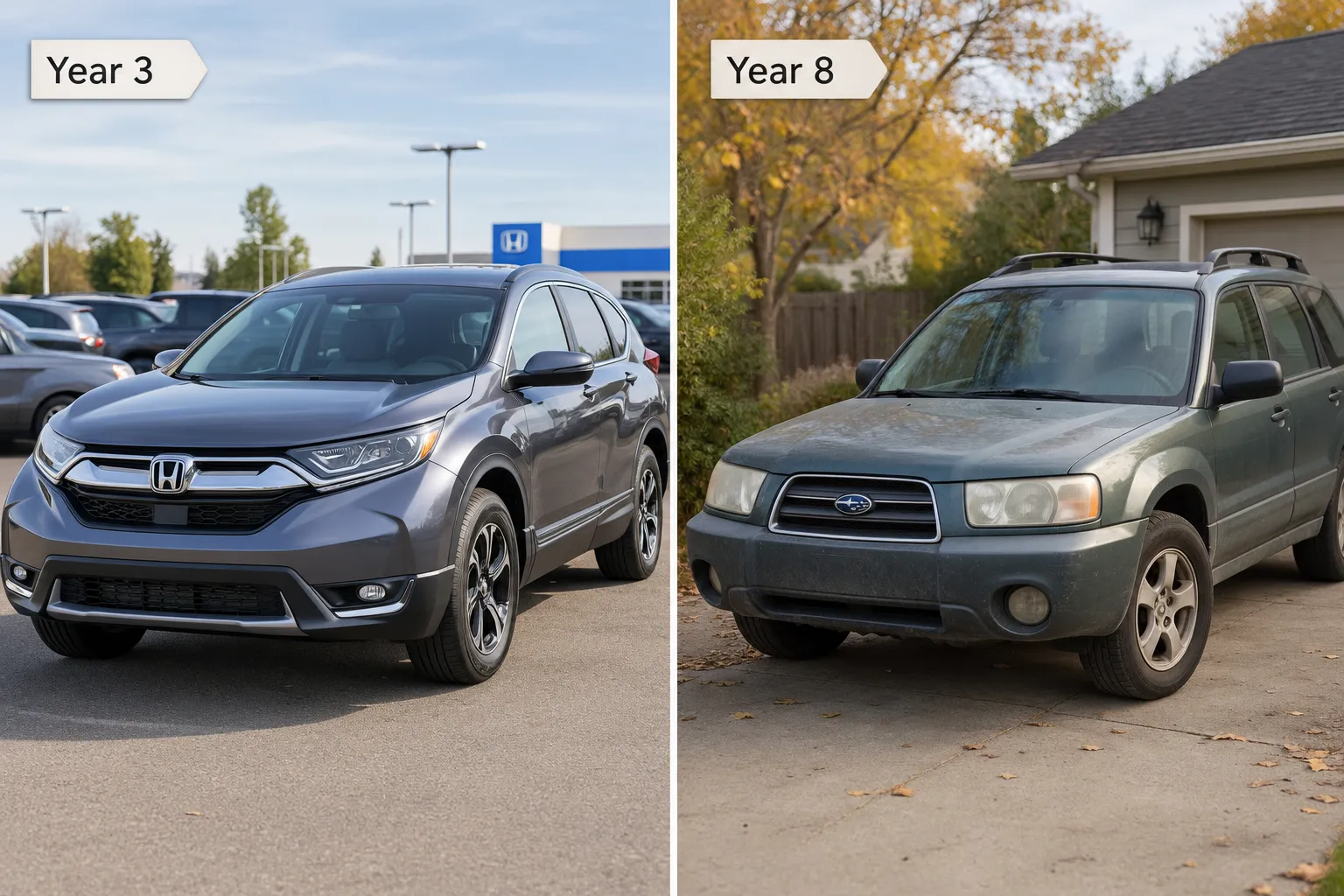
Toyota and Honda consistently top the resale-value charts industry-wide. Their combination of brand trust, parts availability, and perceived reliability keeps demand high even on vehicles with six-figure mileage. Subaru’s resale performance is strong but more segment-dependent: its AWD-equipped wagons and crossovers, the Outback, Forester, and Crosstrek, tend to hold value exceptionally well in snowbelt and mountain states, while sedans like the Legacy depreciate closer to the industry average.
A practical way to think about this: if you are buying a five-year-old vehicle planning to sell it again in year ten, the brand’s reputation for longevity directly protects your resale number. Vehicles widely known for high-mileage survivability simply attract more buyers at trade-in time, which pushes resale prices up [8][9]. This is also why shoppers researching the cars that hold their value and actually go up will almost always find Toyota and Subaru models near the top of those lists.
Before buying, it also pays to understand the difference between a car’s advertised price and its actual market value. Guides that explain the distinction between value vs price and the related concept of value vs worth are useful reading for anyone trying to avoid overpaying on a used Subaru, Honda, or Toyota that looks like a deal but is priced above its real market position. Pulling an independent valuation, such as through Edmunds True Market Value data, before negotiating can save hundreds of dollars on any of these three brands.
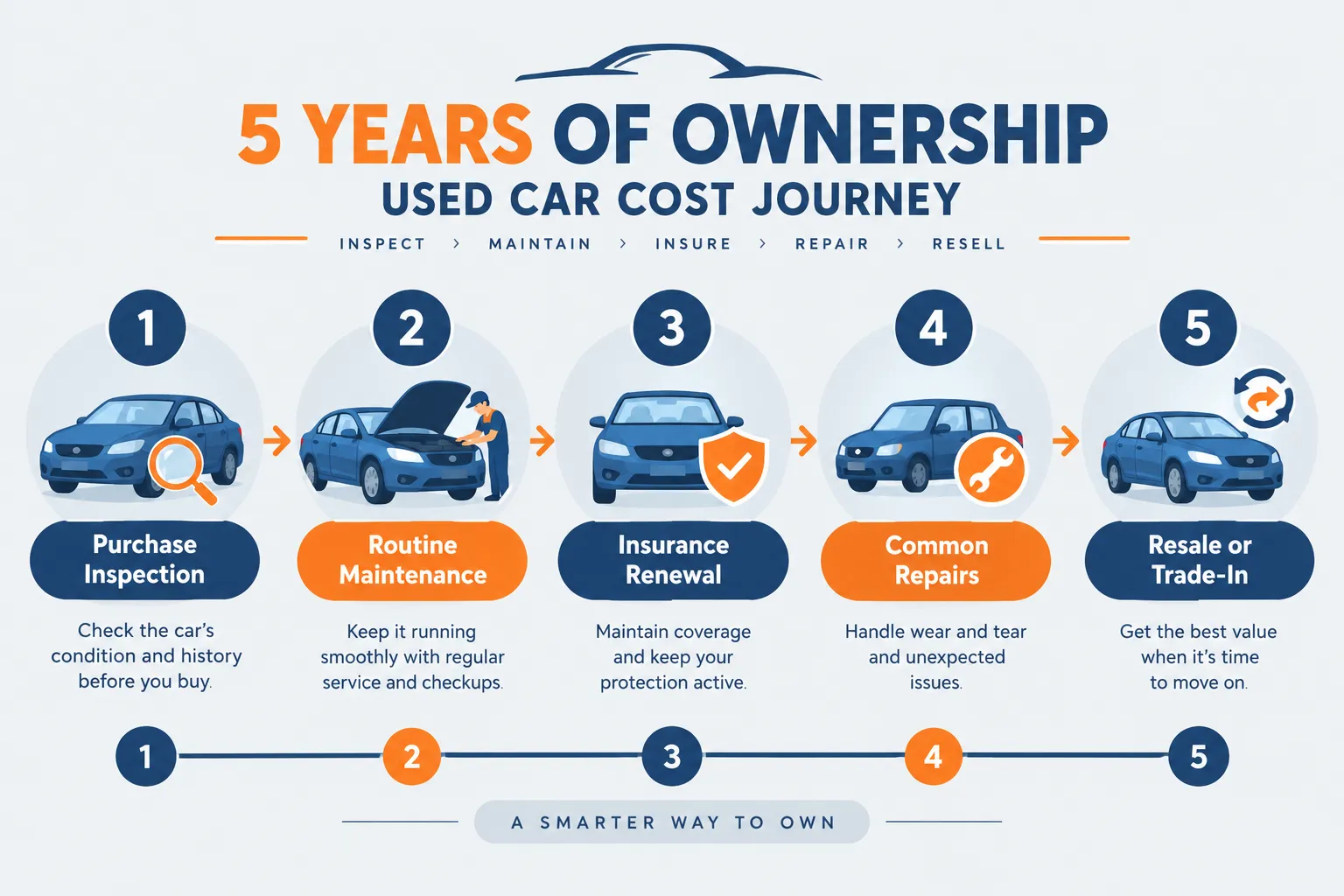
The Five-Year Ownership Cost Breakdown: Maintenance, Insurance, Fuel, and Repairs
Reliability and resale are only half the ownership cost story. The other half is the recurring expense of keeping the car on the road for five years. This section walks through each cost category using the consistent framework promised at the top of this guide.
Maintenance
Toyota and Honda both benefit from simple, well-documented maintenance schedules and a massive independent repair network. Parts are widely available and often cheaper than Subaru’s equivalents, partly because of sales volume and partly because Subaru’s symmetrical all-wheel-drive system adds extra components, differentials, transfer cases, and additional fluid services, that front-wheel-drive competitors simply do not have.
Insurance
Insurance costs track closely with repair cost, theft rates, and safety ratings. Honda and Toyota sedans and compact SUVs tend to post average-to-low insurance premiums thanks to high production volume and cheap replacement parts. Subaru models, especially performance trims like the WRX, can carry higher premiums due to a combination of driver demographics and all-wheel-drive repair costs.
Fuel Economy
This is one category where Honda typically edges ahead. Honda’s smaller four-cylinder engines and CVT-focused lineup (Civic, Accord, CR-V) often deliver slightly better fuel economy than comparable Subaru AWD models, which carry a permanent fuel penalty from driving all four wheels. Toyota sits in the middle, with hybrid variants of the Camry, Corolla, and RAV4 actually leapfrogging both competitors when hybrid powertrains are factored in.
Depreciation
As covered above, Toyota and Honda depreciate the slowest overall, while Subaru depreciates competitively in AWD-focused segments but slightly faster in sedans.
Common Repairs
This is where the real differentiation happens, and it deserves its own detailed section below.
Shoppers comparing these three brands against the broader used market should also review a complete guide to buying and selling cars to understand inspection steps, title checks, and negotiation tactics that apply no matter which brand you ultimately choose. If you are considering buying at auction instead of a traditional dealership, the guide to buying and selling vehicles at auction outlines what to expect from that process, including how reliability reputation affects final bid prices.
Common Repairs and Risk Profile by Brand
Every brand has a signature weak point, and knowing it before you buy used can save thousands in surprise repair bills.
Subaru:
- Older models (roughly pre-2015) are known for head gasket issues on the boxer engine.
- CVT transmissions in Outback, Forester, and Crosstrek models can require costly repairs if maintenance fluid changes were skipped by a previous owner.
- AWD components, axles, differentials, wear a bit faster than front-wheel-drive competitors simply due to the drivetrain design.
Honda:
- Infotainment and electrical glitches are the most common complaint on recent model years.
- Some V6 Accord and Odyssey engines have had reported oil dilution issues in certain climates.
- Transmission shudder on older Accord and CR-V automatic transmissions has been a recurring theme in owner forums.
Toyota:
- Water pump failures on certain V6 engines have been a known issue.
- Excessive oil consumption affected some four-cylinder engines in specific model years (notably Camry and RAV4 around the mid-2010s).
- Overall, Toyota’s issues tend to be isolated to specific engine families rather than brand-wide patterns, which helps explain its continued reputation for high-mileage survivability [1][8].
The pattern across all three brands supports a simple rule: a vehicle’s maintenance history matters more than the badge on the hood. A neglected Toyota can fail sooner than a well-maintained Subaru, and vice versa. Always request service records, and if buying from a private seller, treat a missing maintenance history as a red flag regardless of brand.
“A reliable brand reputation buys you better odds, not a guarantee. Maintenance records are still the single best predictor of how long a used car will last.”
Best Used Models by Budget for Used Subaru vs Honda vs Toyota: Reliability, Resale Value, and Ownership Cost Compared
Budget ultimately decides which model year and trim make sense. Here is a practical breakdown across three common used-car budget tiers.
Under $12,000
- Toyota Corolla (2015-2017): Known for extremely low ownership cost and strong fuel economy, even with higher mileage.
- Honda Civic (2014-2016): Cheap to insure, cheap to fix, and widely available.
- Subaru Impreza (2014-2016): A solid entry point into AWD if you need traction in snow or rain, though check CVT service history carefully.
$12,000 to $20,000
- Toyota RAV4 (2017-2019): Strong resale value and excellent long-term durability record.
- Honda CR-V (2017-2019): Comfortable, efficient, and widely trusted in the compact SUV segment.
- Subaru Outback (2016-2018): The strongest resale performer of the Subaru lineup, especially in regions with real winters.
$20,000 and up
- Toyota Highlander Hybrid (2019-2021): Excellent fuel economy for a three-row SUV with Toyota’s hybrid reliability track record.
- Honda Pilot (2019-2021): Family-friendly with strong V6 reliability and good resale retention.
- Subaru Forester (2019-2021): A top pick for buyers who prioritize standard AWD and strong safety ratings over raw horsepower.
Used Subaru vs Honda vs Toyota: Reliability, Resale Value, and Ownership Cost Compared, Which Should You Buy?
There is no universal winner here, and that is the honest, useful answer. Each brand is optimized for a slightly different buyer:
- Choose Toyota if long-term, high-mileage durability and strong resale value matter most, especially if you plan to drive the car well past 150,000 miles.
- Choose Honda if daily commuting economy, lower insurance costs, and a slightly sportier driving feel are priorities, and you are comfortable with occasional electronics quirks.
- Choose Subaru if you regularly drive in snow, rain, or rough terrain and value standard all-wheel drive enough to accept slightly higher fuel and maintenance costs in exchange.
Whichever brand you lean toward, always pull a vehicle history report, get a pre-purchase inspection from an independent mechanic, and compare the asking price against real market data rather than the sticker on the windshield. For a deeper look at how to avoid paying above fair market value on any used vehicle, revisit the Edmunds True Market Value breakdown and the explainer on value versus price referenced earlier in this guide.
Conclusion
The data is clear on one point: Toyota, Honda, and Subaru all represent lower-risk used-car purchases than most of their competitors, and recent reliability rankings confirm Toyota’s return to the top spot with Subaru close behind and Honda still performing well above average [2][3][4][8]. The real decision comes down to how you drive, where you live, and how long you intend to keep the vehicle.
As a next step, make a shortlist of two or three specific model years within your budget tier from the lists above, request maintenance records for each candidate, and get an independent inspection before signing anything. That single habit, checking the paperwork and the mechanic’s opinion before the price, will protect your investment far more than brand loyalty alone ever could.
References
[1] Most Reliable Car Brands Of 2025 2026 Ranked – https://www.autoblog.com/features/most-reliable-car-brands-of-2025-2026-ranked [2] Who Makes The Most Reliable Cars A7824554938 – https://www.consumerreports.org/cars/car-reliability-owner-satisfaction/who-makes-the-most-reliable-cars-a7824554938/ [3] usatoday – https://www.usatoday.com/story/cars/research/2025/12/17/consumer-reports-most-reliable-new-cars/87807645007/ [4] Consumer Reports Toyota Subaru Make The Most Reliable Cars – https://www.kbb.com/car-news/consumer-reports-toyota-subaru-make-the-most-reliable-cars/ [5] Cr Who Makes The Most Reliable New Cars 2025 – https://www.subaru.com/content/dam/subaru/downloads/pdf/consumer-reports/2025/CR_Who_Makes_the_Most_Reliable_New_Cars_2025.pdf [6] Subaru Beats Bmw 2025 Consumer Reports – https://www.bmwblog.com/2025/12/05/subaru-beats-bmw-2025-consumer-reports/ [7] The Most Reliable Car Brands According To Carvertical – https://www.carvertical.com/gb/blog/the-most-reliable-car-brands-according-to-carvertical [8] Toyota Again Tops Consumer Reports Annual Auto Reliability Survey 519312 – https://www.cars.com/articles/toyota-again-tops-consumer-reports-annual-auto-reliability-survey-519312/ [9] Most Reliable Car Brands – https://www.cargurus.com/research/articles/most-reliable-car-brands [10] Which Brands Make The Best Cars A6159221985 – https://www.consumerreports.org/cars/cars-driving/which-brands-make-the-best-cars-a6159221985/