Last Updated on October 17, 2026
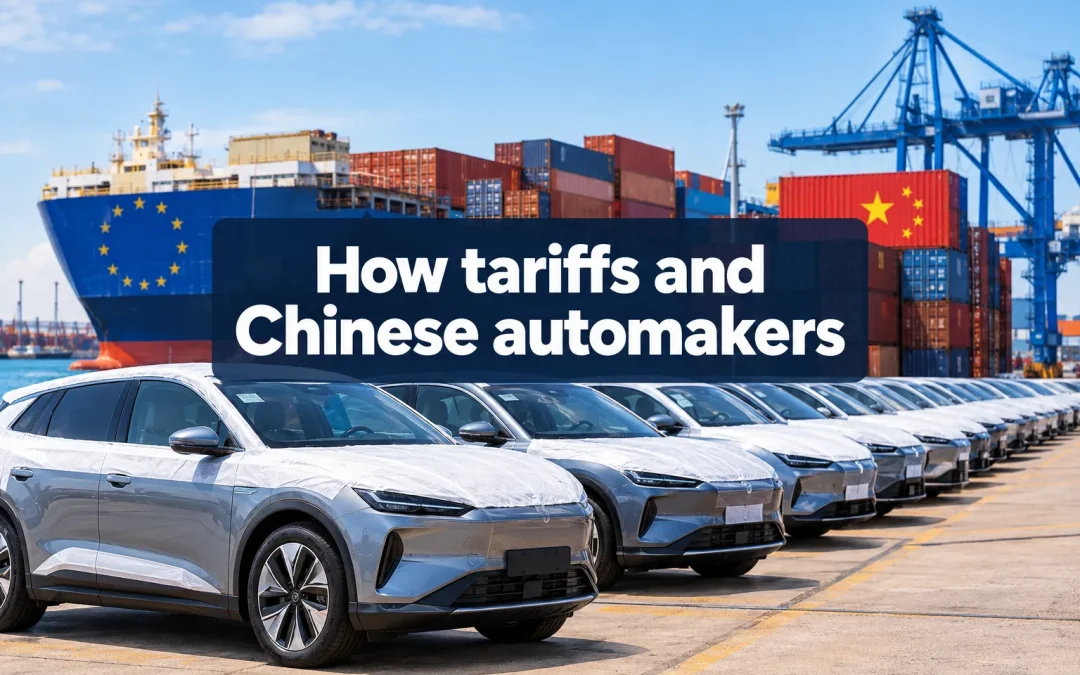
A single policy decision in Brussels can add thousands of dollars to the cost of an electric car before it ever reaches a dealership lot. That is exactly what has happened since late 2024, when the European Union slapped countervailing duties of up to 35.3% on Chinese-made battery-electric vehicles, stacking on top of the existing 10% import tariff [1]. Meanwhile, across the Atlantic, the United States has pushed total tariffs on Chinese EVs past 100%, effectively sealing the market shut [5]. Together, these moves are at the center of how tariffs and Chinese automakers are reshaping car prices and availability for ordinary buyers in 2026, and the ripple effects are far from finished.
This is not a simple story of tariffs winning or Chinese brands losing. BYD more than doubled its EV shipments into the EU even after absorbing a 17% extra duty [3][4]. That single fact should tell you how unusual this moment is. Tariffs, trade negotiations, and rapid Chinese brand expansion are colliding in ways that are already changing what cars cost, which models show up on dealer lots, and where automakers choose to build their factories.
Key Takeaways
- EU countervailing duties on Chinese-made EVs range from about 7.8% to 35.3% on top of a standard 10% tariff, with some firms facing a combined rate near 45.3% [1].
- Despite these duties, Chinese brands like BYD have kept growing in Europe, and Chinese EVs remain roughly 21% cheaper on average than European rivals [3][4].
- China-built EVs made up about 17% of EU battery-electric sales in early 2026, down from a 2024 peak of roughly 22%, showing tariffs slowed but did not stop the trend [4].
- A new October 2026 EU-China understanding could cut combined Chinese EV and plug-in hybrid imports by up to 50% as Beijing agrees to “self-limit” hybrid exports [2][10].
- In the United States, tariffs exceeding 100% and proposed bans on Chinese “connected cars” mean Chinese automakers have almost no direct role in setting U.S. car prices, though they still influence global competition [5][6][7].
The New Tariff Landscape in Europe
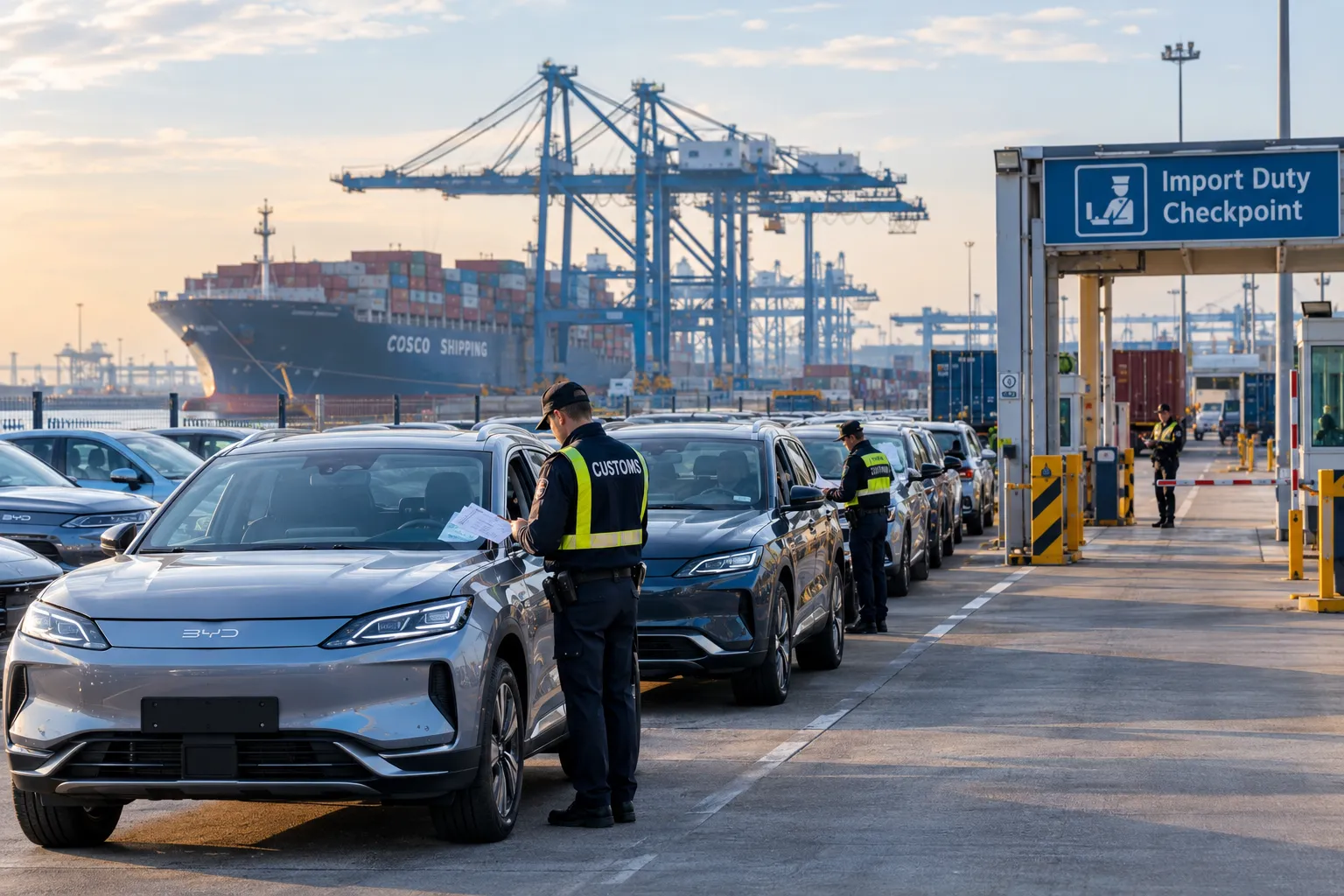
The European Commission finalized its tariff schedule after a lengthy anti-subsidy investigation, and the numbers are not uniform across the industry. This matters because how tariffs and Chinese automakers are reshaping car prices and availability depends heavily on which specific company built the car and where.
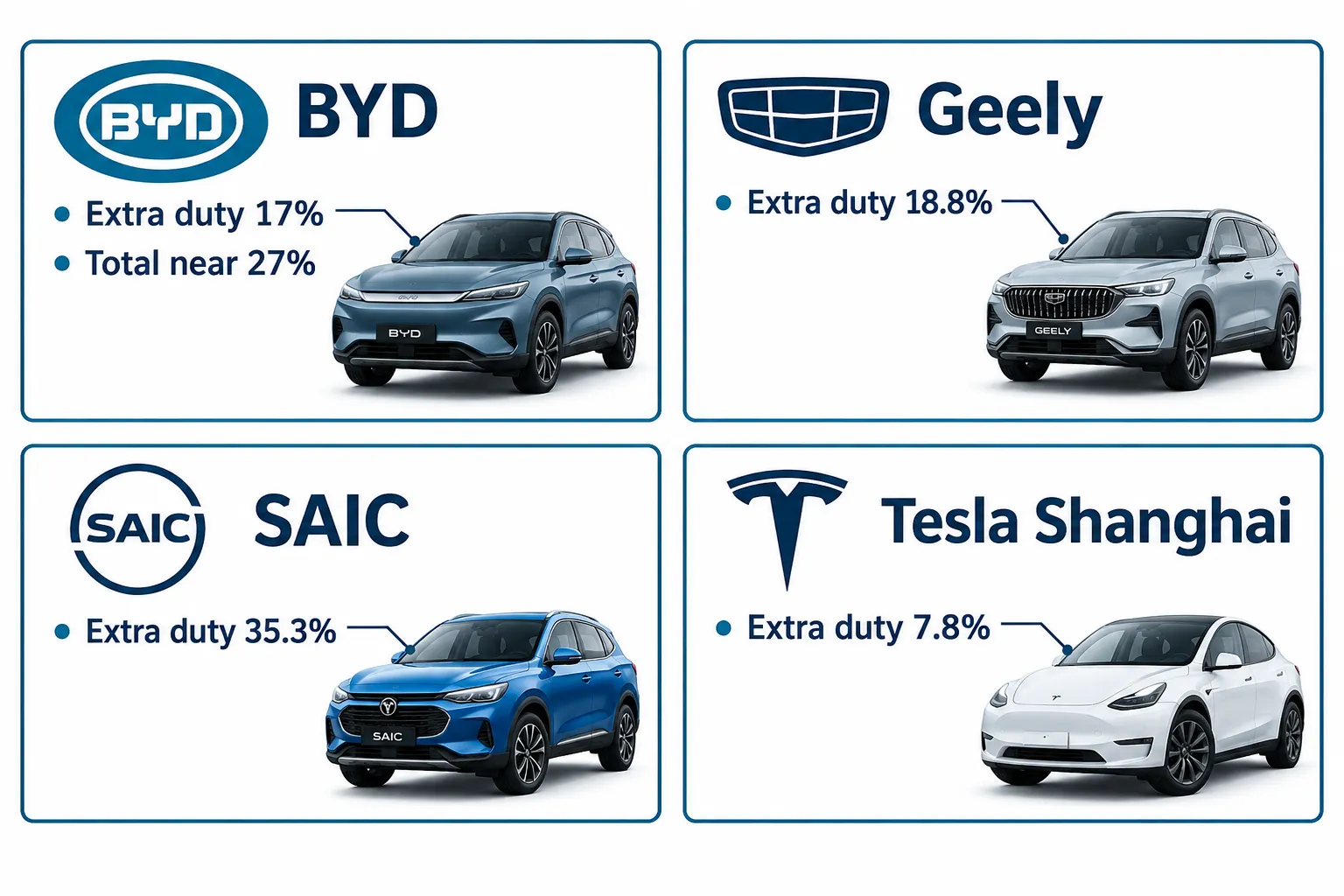
BYD pays an extra 17% duty, bringing its total rate to roughly 27% once the base 10% tariff is included. Geely sits at 18.8% extra, most other cooperating Chinese firms pay 20.7%, and SAIC, which the EU determined had received the largest state subsidies, faces a steep 35.3% surcharge [1][8]. Tesla’s Shanghai-built exports to Europe, by contrast, carry only a 7.8% additional duty, a reminder that these tariffs target company-specific subsidy findings rather than blanket country-of-origin rules [1].
One particularly telling exception is Volkswagen’s China-made Cupra Tavascan. It was exempted from the countervailing duties after Volkswagen agreed to minimum pricing and import quota commitments [1]. That single carve-out shows how granular this policy really is. Tariffs are not just a blunt instrument against “China” as a category; they are being used to negotiate deal-by-deal terms for individual models, which means availability of specific vehicles can hinge on backroom pricing agreements as much as on sticker shock at the border.
These duties are locked in for five years, meaning the higher landed costs on Chinese EVs will likely persist into the early 2030s unless renegotiated [1]. For shoppers comparing options today, this is a good moment to revisit guidance like the ultimate guide to the best cars to buy in 2026, since model availability and pricing tiers are shifting faster than usual.
Why Chinese Brands Keep Growing Despite EU Duties
Here is the part that surprises a lot of industry watchers. Tariffs were designed to slow Chinese EV penetration in Europe, and to some degree they have. But they have not reversed it.
Transport & Environment’s July 2026 analysis found that Chinese-brand battery-electric vehicles remain about 21% cheaper on average than their European competitors, even after the duties are baked into the price [4]. That gap is the whole story. When a car costs tens of thousands of dollars, a 17% or even 27% tariff still leaves plenty of room for a manufacturer with lower production costs to undercut rivals.
The data on market share tells a similar story of resilience mixed with deceleration:
| Metric | 2024 Peak | Early 2026 |
|---|---|---|
| Share of EU BEV sales built in China | About 22% | About 17% |
| BYD EV import volume into EU | Baseline | More than doubled [3][4] |
| Average price gap vs. European EVs | Wider | Still about 21% cheaper [4] |
That 17% figure in early 2026 is down from the roughly 22% peak seen when tariffs first took effect, which confirms the duties are having some dampening effect [4]. But a drop from 22% to 17% is a long way from Chinese brands disappearing. Meanwhile, Western automakers have responded by shifting more of their own China-based production back to Europe or other regions specifically to dodge these import duties, which is reshuffling global supply chains in ways that go well beyond any single brand [3][4].
For buyers trying to make sense of which brands currently offer the strongest value under these shifting conditions, the comparison in Volkswagen vs Kia vs Mazda: which brand offers the best value in 2026 is a useful companion read, since competitive pressure from Chinese pricing is pushing established brands to sharpen their own offers.
Hybrids Become the New Battleground
When tariffs made battery-electric exports less profitable, Chinese automakers did what any smart business would do: they pivoted. Plug-in hybrids (PHEVs) had only ever faced the EU’s standard 10% car tariff, not the heavier countervailing duties applied to BEVs [8][9]. That loophole was exploited quickly and effectively.
China’s hybrid exports to Europe surged to an estimated $7.5 billion, a jump large enough to trigger a fresh policy response from Brussels [9]. The European Commission is now preparing manufacturer-specific tariffs on Chinese hybrids that would mirror the EV regime, a move that would materially raise landed prices for Chinese PHEVs and narrow the cost advantage that made them so attractive in the first place [9].
Then, in October 2026, negotiators reached a broader understanding. China agreed to “self-limit” its hybrid exports to the EU, and officials involved in the talks say the arrangement could cut combined Chinese EV and plug-in hybrid imports by as much as 50%, while also easing some EU tariffs on exports heading into China [2][10]. This is a genuinely significant shift in how tariffs and Chinese automakers are reshaping car prices and availability, because it moves the conversation from unilateral duties to a negotiated quota system.
Analysts expect this hybrid squeeze to lift prices in the budget-friendly hybrid segment specifically, which may open space for Korean, Japanese, and European manufacturers to reclaim market share at slightly higher price points [6][10]. If you are weighing a hybrid purchase while this policy settles, it is worth reviewing the fundamentals in hybrid vs. gas car comparisons before committing, since the price calculus between the two is changing month to month.
“Tariffs have reduced but not erased the price gap that underpins Chinese EV competitiveness in Europe.”, Transport & Environment analysis, July 2026 [4]
The United States Takes a Completely Different Path
While Europe is negotiating quotas and crafting manufacturer-specific duty schedules, the U.S. approach looks almost nothing alike. Total tariffs on Chinese electric vehicles in the United States now exceed 100%, a level that effectively prices Chinese-brand cars out of the market entirely [5].
Reporting from October 2026 describes a bipartisan push in Congress for outright bans on Chinese vehicles, driven primarily by national security concerns rather than pure trade economics [5]. On top of the tariffs, Washington is preparing to prohibit the sale of “connected cars” built by Chinese firms or running Chinese-origin software starting with the 2027 model year [6][7]. That rule targets the data and connectivity layer of modern vehicles, not just the hardware, closing off another avenue Chinese automakers might have used to enter the U.S. market indirectly.
The practical result is a bifurcated global auto market. Chinese brands are focusing their growth on Europe, emerging markets, and their massive domestic base, while U.S. car prices are shaped only indirectly, through competitive pressure Chinese manufacturing puts on suppliers and automakers who sell globally [6][7]. If you are shopping in the U.S. market right now, Chinese brand names will not appear on your shortlist, but the global price war is still shaping what Toyota, Hyundai, and Ford choose to charge. Readers comparing established non-Chinese options might find it helpful to browse the 15 best used cars to buy in 2026 or the 15 most reliable cheap cars under $15,000 in 2026 for budget-focused alternatives that are actually available stateside.
What This Means for Prices and Availability Right Now
Pulling these threads together, a few clear patterns emerge about how tariffs and Chinese automakers are reshaping car prices and availability for everyday buyers:
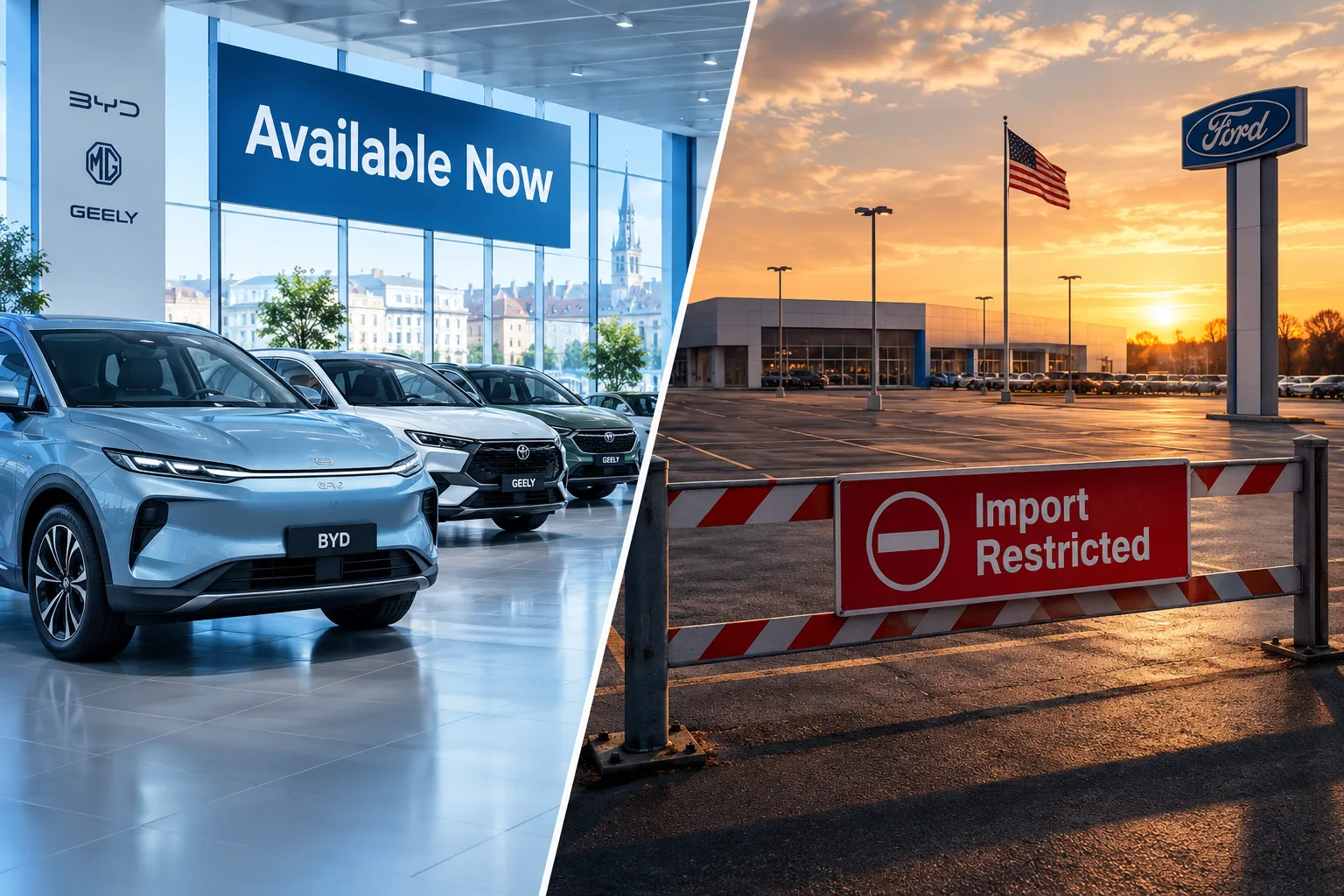
- European buyers still have access to cheaper Chinese EVs, just at a smaller discount than before tariffs. Environmental and consumer groups note Chinese EVs often remain the cheapest options in several EU markets even now [3][4].
- Hybrid shoppers in Europe should expect price increases soon. As new duties on Chinese PHEVs take shape and export quotas kick in, the budget hybrid segment will likely see fewer ultra-cheap Chinese options and more competition from Korean and Japanese brands [6][9][10].
- U.S. buyers are essentially unaffected directly, since Chinese brands cannot sell here under current tariff and proposed connectivity rules, but indirect price competition from Chinese manufacturing abroad still filters through global supply chains [5][6].
- Manufacturing location is becoming as important as brand origin. Western carmakers are shifting China-based production to Europe or elsewhere specifically to avoid duties, and policy researchers at Bruegel argue Chinese firms may eventually build factories inside the EU to sidestep tariffs altogether [3][4].
- Exceptions and quotas are reshaping specific model availability. The Cupra Tavascan carve-out shows that individual vehicle models can be negotiated around tariff rules through pricing and volume commitments [1].
Buyers evaluating used inventory while these supply shifts play out may also want a refresher on certified used cars and how their warranties work, since used-market pricing often reacts a step behind new-car tariff news. Those eyeing the premium end of the market, where tariff exposure plays out differently again, might find the Porsche and Mercedes-Benz used car buying guide a useful parallel resource.
Looking Ahead Through 2027 and Beyond
Policy research from Bruegel and similar think tanks argues that EU tariffs will modestly slow Chinese EV penetration but also raise purchase prices, which could work against the EU’s own decarbonization targets if it is not paired with a coherent industrial strategy. That tension is likely to define the next several years of negotiation.
Expect a transitional period running roughly through 2027 to 2030 in which Chinese automakers keep a meaningful price advantage while increasingly reorienting their production toward building inside tariff blocs such as the EU, ASEAN nations, and Latin America [2]. New duties on light commercial vehicles or even battery components are plausible next steps, and quotas or minimum-price deals for specific China-made models, similar to the Cupra Tavascan arrangement, could become more common as a negotiating tool [2][9].
For car shoppers, the practical takeaway is that where a vehicle is assembled will increasingly matter as much as which brand name is on the hood. A Chinese-owned company building cars inside the EU may face none of the duties that apply to the same car shipped directly from Shanghai. That is a subtle but important shift in how tariffs and Chinese automakers are reshaping car prices and availability, and it rewards buyers who pay attention to build location, not just badge.
It is also worth remembering that global vehicle pricing trends eventually touch every corner of the market, including the broader cars category, where new-vehicle tariff pressure often pushes more buyers toward the complete guide to buying used cars as a way to sidestep inflated new-car sticker prices altogether.
Conclusion
Tariffs have not stopped Chinese automakers from expanding into Europe, but they have changed the math enough to slow growth, shrink price gaps, and force a scramble toward hybrids and local manufacturing. In the United States, the story is far simpler: tariffs above 100% and looming connectivity bans keep Chinese brands almost entirely off the road, leaving American price competition to play out between established global automakers instead.
For buyers, the next two to three years call for close attention rather than guesswork. If you are shopping in Europe, compare both EV and hybrid pricing now, since hybrid duties are coming and today’s bargains may not last. If you are shopping in the U.S., focus your research on non-Chinese brands and keep an eye on how competitive pressure from abroad shapes pricing at dealerships near you. Either way, check where a vehicle is actually assembled, not just which logo is on it, before assuming you know its true landed cost. Revisit trusted buying guides regularly, since this is one corner of the auto market where policy news can change the best deal available almost overnight.
References
[1] Eu Tariffs Imports China Made Evs 2026 02 11 – https://www.reuters.com/world/china/eu-tariffs-imports-china-made-evs-2026-02-11/ [2] China Shock Eu Trade Deal Chinese Ev Plug In Hybrid Imports Tariffs – https://fortune.com/2026/10/10/china-shock-eu-trade-deal-chinese-ev-plug-in-hybrid-imports-tariffs/ [3] Are The Ev Tariffs Working Western Carmakers Shifted Production To Eu But Chinese Brands Continue To Grow Analysis – https://www.transportenvironment.org/articles/are-the-ev-tariffs-working-western-carmakers-shifted-production-to-eu-but-chinese-brands-continue-to-grow-analysis [4] Te Analysis Eu Tariffs Deter Western Producers From China But Byd And Others Gain Ground – https://www.electrive.com/2026/07/13/te-analysis-eu-tariffs-deter-western-producers-from-china-but-byd-and-others-gain-ground/ [5] The Global Battle Over Chinas Evs – https://www.usnews.com/news/u-s-news-decision-points/articles/2026-10-13/the-global-battle-over-chinas-evs [6] Jakcsdru2nhz5h23zrw655euzu – https://www.chosun.com/english/industry-en/2026/10/12/JAKCSDRU2NHZ5H23ZRW655EUZU/ [7] Lgnvop2mkja5vixy27m2imocae – https://www.chosun.com/english/industry-en/2026/10/12/LGNVOP2MKJA5VIXY27M2IMOCAE/ [8] China Eu Make Progress Hybrid Trade – https://cnevpost.com/2026/10/09/china-eu-make-progress-hybrid-trade/ [9] Eu Plans Additional Tariffs On Chinese Phevs – https://www.electrive.com/2026/06/19/eu-plans-additional-tariffs-on-chinese-phevs/ [10] China Eu Strike Deal Halve Chinese Hybrid Exports 4294931 – https://www.thedailystar.net/business/news/china-eu-strike-deal-halve-chinese-hybrid-exports-4294931