

Last Updated on October 12, 2026
An Audi owner visits a repair shop almost twice as often as the average driver, according to RepairPal’s brand-wide data: 0.8 unscheduled visits per year compared with 0.4 across all vehicles [1]. That single statistic explains why so many shoppers hesitate before buying a used Audi, even when the price looks like a bargain. Yet not every model carries the same exposure. Choosing among Audi used cars under $25,000 means understanding which models have the lowest repair and maintenance risk, because the gap between the cheapest sedan and the priciest SUV in this price band can mean thousands of dollars in long-term ownership cost.
This guide ranks practical used Audi choices by age, powertrain, documented failure points, and realistic ownership budget, using the most current reliability and repair-cost data available.
Key Takeaways
- Audi’s brand-wide Reliability Rating sits at 3.0 out of 5.0, ranking 28th out of 32 brands, with an average annual repair cost near $987, above typical non-luxury brands [1][2].
- The Audi A3 has one of the lowest annual maintenance costs in the lineup at about $741, though Consumer Reports flags below-average owner-reported reliability for the 2024 model [3][6].
- The 2019 Audi A4 scores a 3.5 out of 5.0 Reliability Rating with an average annual repair cost of about $739, better than the brand average on both counts [14][1].
- The Audi Q3 lands at “about average” reliability per Consumer Reports, making it a reasonable middle-ground compact SUV pick, provided all recall work is confirmed complete [5].
- Larger, more complex models such as the Q7, Q8, and e-tron variants carry meaningfully higher repair and maintenance risk and are generally poor fits for budget-conscious buyers [7][9].
What $25,000 Actually Buys You in the Used Audi Market
A $25,000 budget on the used market typically lands shoppers in a narrow but important window of the Audi lineup: compact sedans from recent model years, slightly older midsize sedans, and entry-level compact SUVs with moderate mileage. It generally excludes newer Q7s, Q8s, and anything wearing an S or RS badge, since those models hold their value more aggressively and cost more to maintain once the warranty expires.
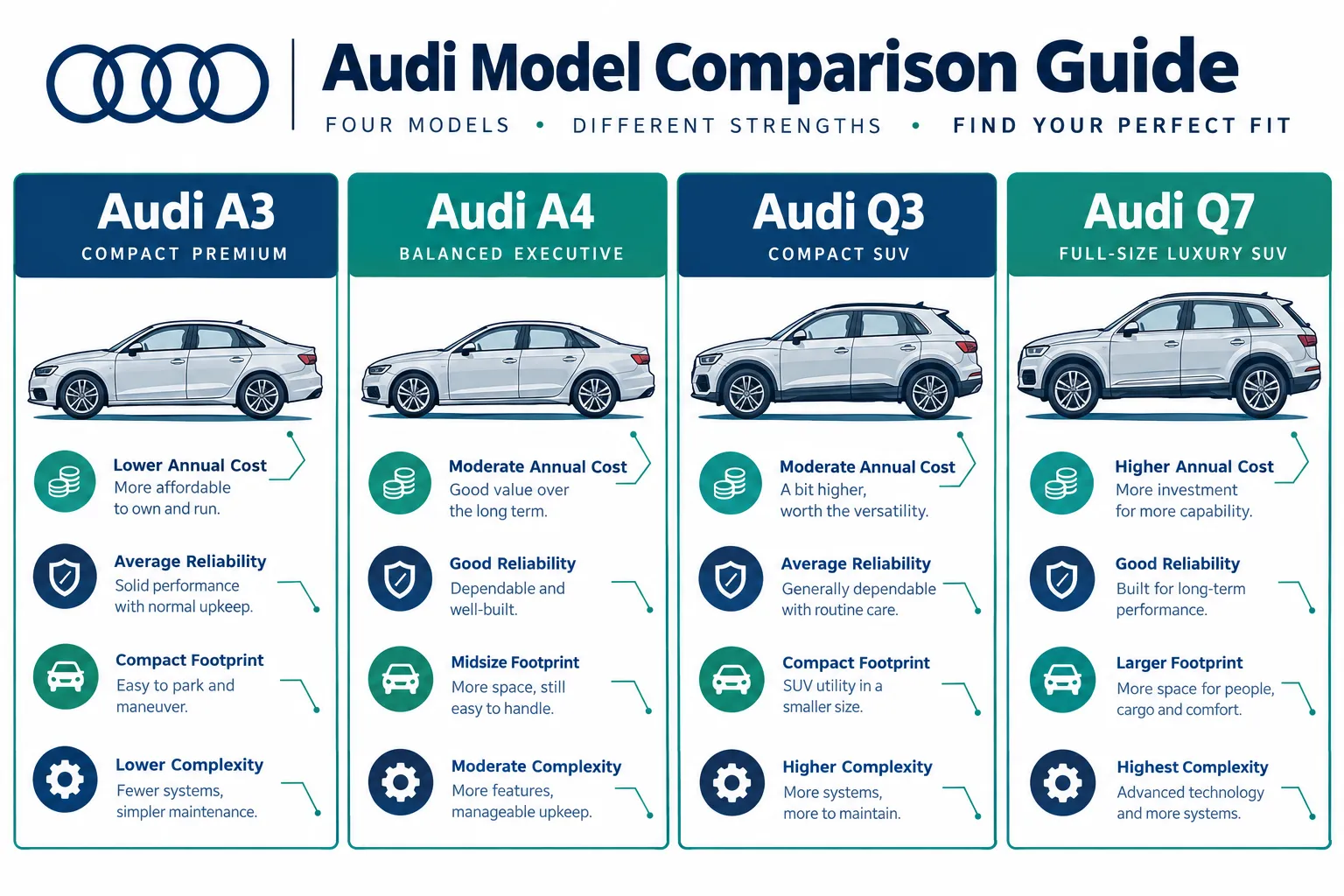
This matters because Audi, as a brand, does not score well on broad reliability metrics. RepairPal ranks Audi 28th out of 32 car brands overall, with an average annual repair cost of roughly $987, well above the industry norm [1][2]. That number is not evenly distributed across the lineup. Smaller, simpler models with fewer complex systems tend to pull the average down, while larger SUVs and performance trims pull it up. Shoppers who understand this distribution can use a $25,000 budget far more strategically than those who simply shop by trim level or styling.
It also helps to compare Audi’s position against the broader used-car market before committing. For context on how German luxury brands stack up against more conservative, lower-risk alternatives, the Complete Guide to the Most Reliable Cars in 2026: Brands, Models & Ratings breaks down brand-level dependability trends that apply directly to this kind of budget decision. Buyers weighing an Audi against a Lexus, Toyota, or Honda in the same price range may also find the Used Subaru vs Honda vs Toyota reliability comparison useful as a benchmark for what “low maintenance risk” looks like outside the luxury segment.
Audi Used Cars Under $25,000: Which Models Have the Lowest Repair and Maintenance Risk, Ranked
The following ranking orders practical sub-$25,000 Audi options from lowest risk to highest risk, based on documented reliability ratings, average annual repair costs, recall history, and known mechanical complexity.
1. Audi A3, Lowest Annual Cost, Moderate Reliability Caveats
The Audi A3 posts an estimated average annual maintenance cost of $741, noticeably below the brand-wide average of $987 [3][1]. For a shopper trying to stretch a $25,000 budget without taking on a heavy maintenance burden, that gap is meaningful over a five- or six-year ownership period.
There is a caveat worth taking seriously. Consumer Reports rates the 2024 A3 as less reliable than other vehicles from the same model year, pointing to specific owner-reported trouble spots that pull its overall reliability score below the segment average [6]. Road testers generally praise the A3’s cabin quality, sharp handling, and roughly 30 mpg EPA rating, but note some clunkiness and hesitation from the dual-clutch transmission, a detail that affects daily drivability more than it affects long-term repair cost, but it is still worth test-driving carefully before purchase.
Bottom line: the A3 is the strongest cost-based pick in this price range, but buyers should budget time for a thorough pre-purchase inspection focused on the transmission and electronics.
2. Audi A4 (2019 and Similar Model Years), Best Overall Balance
Among the models with available data, the 2019 Audi A4 offers the most balanced risk profile. RepairPal assigns it a 3.5 out of 5.0 Reliability Rating, ranking 14th out of 31 luxury midsize cars, with an average annual repair cost of $739 [14]. Both figures beat Audi’s brand-wide averages by a comfortable margin [1].
RepairPal also describes the frequency and severity of A4 repairs as “fairly average” compared with all vehicles on the road, not just luxury competitors [14]. That is an important distinction. It means a well-kept A4 does not just look good next to other Audis, it looks reasonable next to mainstream sedans too. For a used-car shopper trying to avoid budget surprises, that kind of predictability is worth more than a slightly newer model year with an unproven track record.
| Model | Avg. Annual Repair Cost | RepairPal Rating | Relative Risk Level |
|---|---|---|---|
| Audi A3 | ~$741 | Below brand avg. in cost; CR flags reliability concerns | Low-to-moderate |
| Audi A4 (2019) | ~$739 | 3.5 / 5.0 (14th of 31 luxury midsize cars) | Lowest overall |
| Audi Q3 | Not separately broken out; brand avg. ~$987 | “About average” per Consumer Reports | Moderate |
| Audi Q7 | Elevated vs. brand avg. | Rated less reliable by Consumer Reports | High |
3. Audi Q3, Acceptable Middle Ground for SUV Shoppers
Buyers who specifically want a compact SUV rather than a sedan have a reasonable option in the Q3. Consumer Reports describes the 2024 Q3 as having “about average” reliability compared with other vehicles from the same model year, not a standout, but not a model to avoid either [5].
The caveat here is recall history. NHTSA has issued two recalls against the 2024 Q3, and anyone shopping for a used example should confirm, through the vehicle’s VIN, that all recall-related service work has actually been completed by a dealer [5]. An unresolved recall on a used purchase is effectively a deferred repair bill, and it should factor into negotiation even if the car otherwise drives well.
Models to Avoid Near the $25,000 Price Point
Not every Audi that happens to fall into this price band is a good idea. The 2024 Audi Q7 is rated less reliable than other vehicles from its model year by Consumer Reports, and it carries three separate NHTSA recalls, suggesting multiple distinct problem areas rather than a single isolated issue [7]. Larger and more technically complex models, the Q7, Q8, and e-tron electric and hybrid variants, tend to combine Audi’s already above-average brand-wide repair costs with additional systems (air suspension, advanced all-wheel-drive hardware, high-voltage components) that add further points of failure [1][9].
Performance-oriented trims carry a similar warning. RS and S variants share the same underlying brand reliability context as mainstream Audis, but their high-output engines, performance suspensions, and larger brakes add expensive components that increase both the likelihood and the cost of future repairs [1]. A used RS4 or S4 that happens to price out under $25,000 is almost always a car that has already depreciated hard because of looming maintenance costs, not a hidden bargain.
Known Failure Points and Service History Red Flags Before You Buy
Reliability ratings describe averages across thousands of vehicles. Individual cars still live or die by how well they were maintained. Before signing paperwork on any used Audi under $25,000, a buyer should treat the service history as seriously as the price tag.
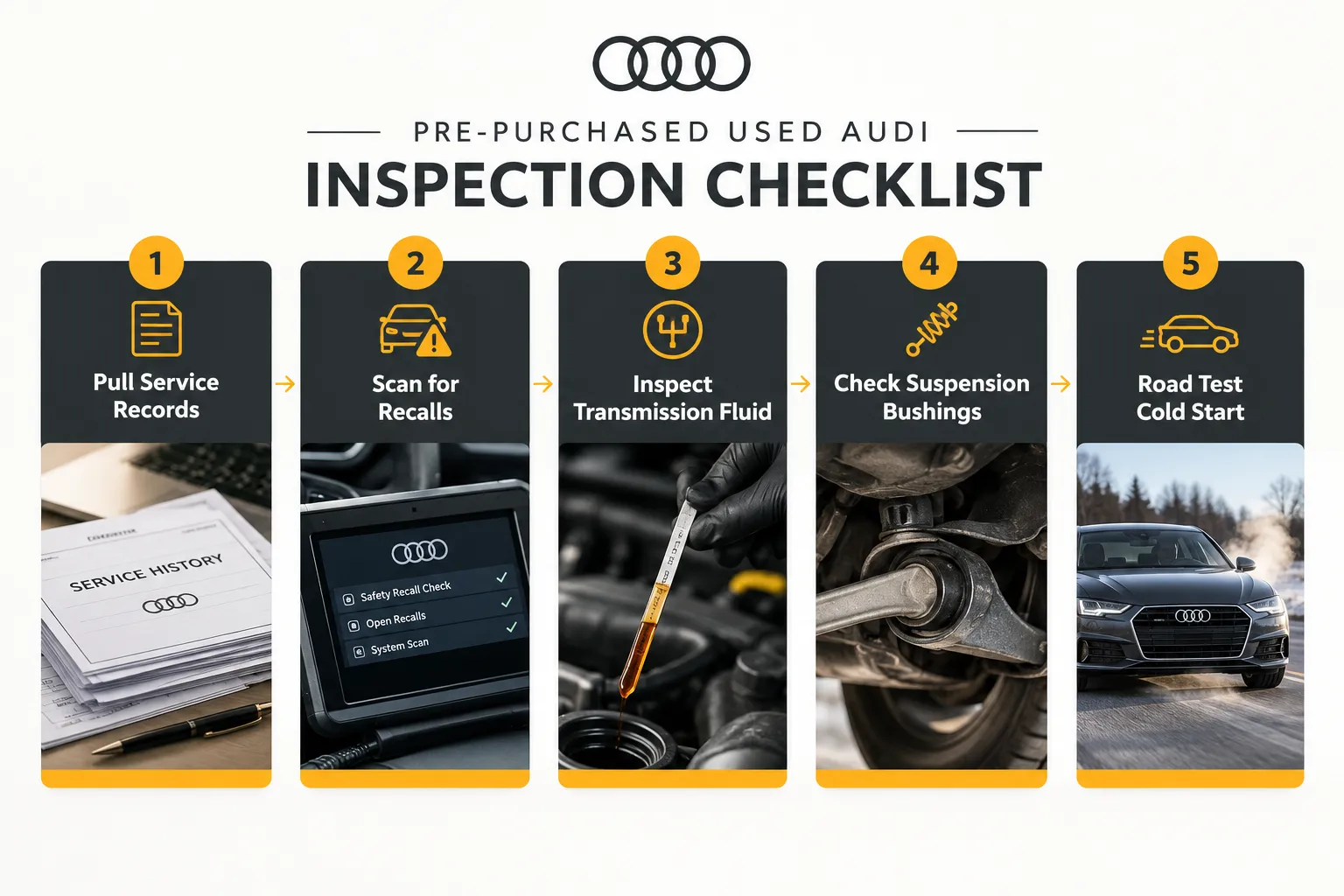
Several patterns show up consistently across Audi’s lineup and should guide a pre-purchase inspection:
- Carbon buildup on intake valves. Audi’s direct-injection engines are prone to carbon accumulation over time, which can cause rough idle and reduced power. Ask whether an intake cleaning has ever been performed.
- Dual-clutch transmission behavior. The A3’s transmission has been noted for occasional clunkiness and hesitation during testing; a test drive should include stop-and-go traffic and low-speed maneuvering, not just highway cruising.
- Timing chain and tensioner wear on certain four-cylinder and V6 engines, which can be expensive to address if ignored past the recommended inspection interval.
- Electrical and infotainment glitches, which tend to be the kinds of owner-reported issues Consumer Reports references when scoring newer A3 and Q3 model years below segment averages [6][5].
- Oil consumption and minor seal leaks, which are common enough across the brand that a cold-start inspection and a look under the car for fresh stains is worthwhile on any used example.
Because Audi vehicles see roughly double the unscheduled repair-shop visits of the average car, and about 13% of those repairs are classified as severe versus 12% industry-wide, the margin for skipping an inspection is thin [1]. A full pre-purchase inspection, combined with a pull of service records and an NHTSA recall check by VIN, is the single most effective way to lower risk on any of the models discussed here.
For readers who want a broader framework on how to evaluate a used vehicle’s history and negotiate based on condition rather than just mileage, the Complete Guide to Buying and Selling Cars: Tips, Process & Legal Requirements covers the documentation and inspection steps that apply to any used luxury purchase, Audi included.
Budgeting for Ownership: What Lower Repair Risk Actually Costs
Even the lowest-risk Audi models on this list still cost more to maintain than a comparable Toyota or Honda. The A3 and the 2019-era A4 both post annual maintenance estimates around $740, compared with Audi’s brand-wide average near $987, a real savings, but still a premium over most mainstream brands [3][14][1].
“Lower annual maintenance costs can offset the premium pricing of a used Audi compared with non-luxury alternatives, but only if the savings are real and not just a favorable average.”
That distinction matters because averages hide variation. A used A4 with full dealer service records and a clean recall history will almost always underperform the brand average in repair frequency. A neglected example with gaps in its maintenance log can easily exceed it, regardless of what the model-wide statistics suggest.
Practical budgeting steps for anyone buying an Audi under $25,000:
- Set aside a dedicated maintenance reserve, ideally 1.5 to 2 times the model’s documented annual average, to absorb at least one unexpected repair without financial stress.
- Get an independent pre-purchase inspection from a mechanic familiar with European vehicles, not just a general inspection.
- Factor in parts and labor rates, which run higher for Audi than for mainstream brands even on routine items like brake pads and filters.
- Confirm the asking price against current market data rather than relying on the seller’s number alone; resources like the Complete Guide to Used Car Valuation: NADA, KBB & Fair Market Pricing and Edmunds Car Value: Determining a Used Car’s Value help confirm whether a listed price already accounts for the car’s maintenance risk profile.
- Use quality fluids and parts going forward, since engine longevity and repair frequency are closely tied to maintenance discipline; the Mobil vs Castrol vs Valvoline motor oil comparison is a useful reference for choosing the right oil for a turbocharged Audi engine.
Buyers who are still undecided between an Audi and a non-luxury alternative at the same price point should also review broader market comparisons. The Most Reliable Used Cars to Buy in 2026: Data-Backed Picks Across Every Budget places Audi’s reliability figures in context against brands that consistently score better on cost of ownership, which can be a useful gut check before finalizing a purchase decision.
Conclusion
Audi used cars under $25,000 are not a uniform category, and treating them that way is the fastest way to end up with a car that costs more to keep running than it did to buy. The data points in one clear direction: the A3 and the 2019-era A4 offer the lowest documented annual maintenance costs in the lineup, with the A4 also carrying the stronger overall reliability rating [3][14][1]. The Q3 is a workable middle-ground SUV choice as long as recall work is confirmed complete [5]. Larger, more complex models like the Q7, along with RS and S performance trims, carry meaningfully higher repair and maintenance risk and are generally better avoided at this price point [7][1].
The practical next step for any serious buyer is straightforward: shortlist an A3 or A4 first, pull its full service history, confirm its recall status by VIN, and pay for an independent pre-purchase inspection before negotiating on price. That sequence, not the sticker price alone, is what actually determines whether a sub-$25,000 Audi turns out to be a smart buy or an expensive lesson.
References
[1] Audi – https://repairpal.com/reliability/audi [2] Audi – https://repairpal.com/audi [3] repairpal – https://repairpal.com/audi/a3 [5] Reliability – https://www.consumerreports.org/cars/audi/q3/2024/reliability/ [6] Reliability – https://www.consumerreports.org/cars/audi/a3/2024/reliability [7] Reliability – https://www.consumerreports.org/cars/audi/q7/2024/reliability/ [9] repairpal – https://repairpal.com/audi/q7 [14] repairpal – https://repairpal.com/audi/a4
Audi used cars, used Audi reliability, Audi A3 maintenance cost, Audi A4 reliability, Audi Q3 reliability, Audi Q7 problems, used car buying guide, luxury car maintenance cost, Audi repair risk, budget luxury cars, used car inspection checklist, Audi ownership cost