Last Updated on November 8, 2026
A single neglected wheel bearing can turn a $40 repack into a $600 roadside disaster. That is not an exaggeration, once a bearing runs dry, it can seize, overheat the spindle, and destroy the hub in the time it takes to drive from the ramp to the highway. Understanding boat trailer bearing replacement cost before that happens is the cheapest insurance a boat owner can buy.
This guide breaks down the real numbers: parts, labor, grease, seals, and the decision points that separate a quick repack from a full hub swap. Whether the trailer sits in fresh water all summer or gets dunked in salt every weekend, the maintenance clock runs differently, and knowing that difference protects both the trailer and the tow vehicle.
Key Takeaways
- A standard bearing repack typically runs $20 to $60 in parts per hub and $75 to $200 in labor per axle at a shop, depending on region and trailer size.
- Grease should be checked every outing on saltwater trailers and at minimum once a season on freshwater trailers, with a full repack every 1,000-12,000 miles or annually, whichever comes first [1].
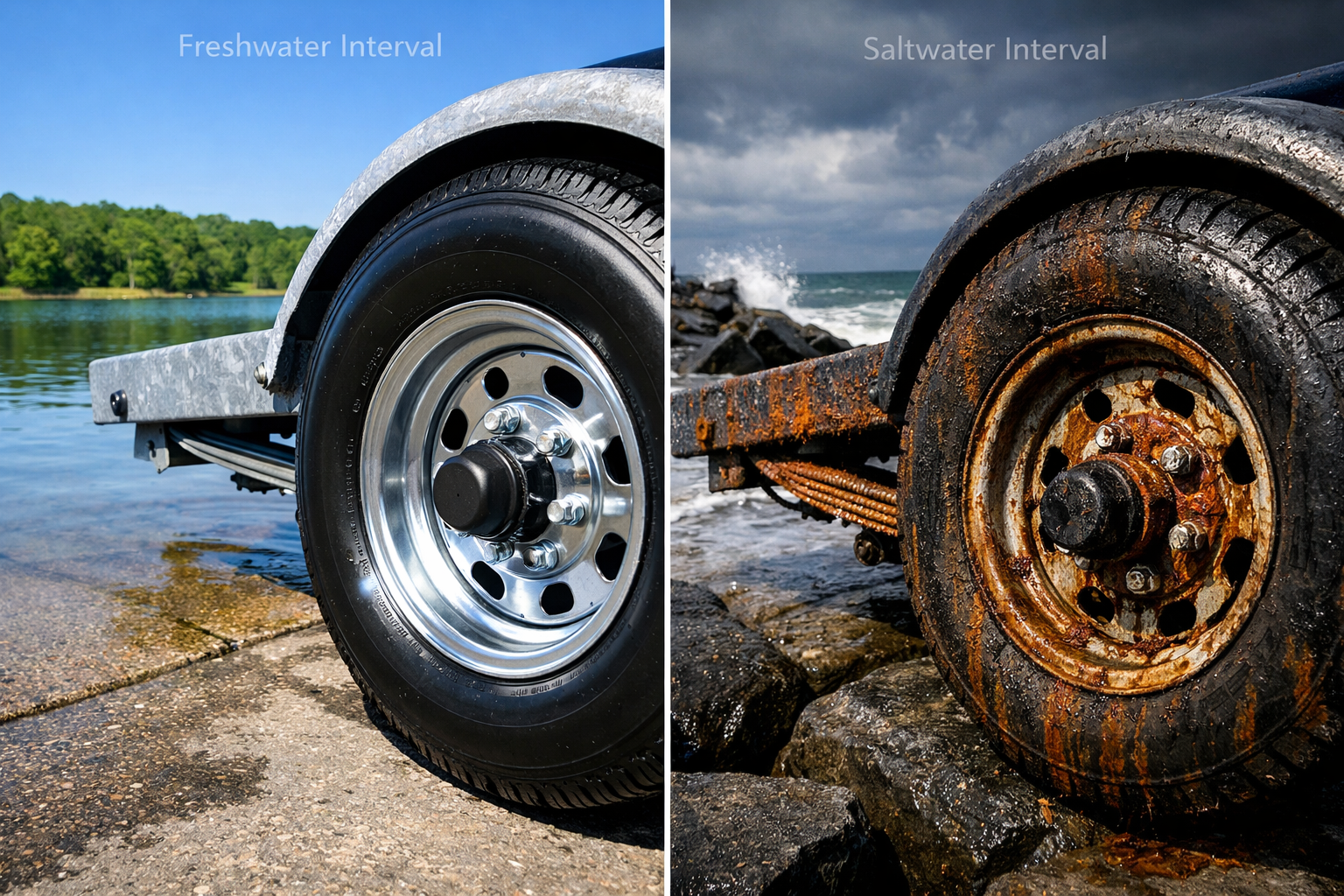
- Saltwater exposure accelerates corrosion dramatically, often cutting the safe service interval in half compared to freshwater use [2][3].
- If races are pitted, the spindle is scored, or the hub shows rust-through, replacing the whole hub assembly is usually cheaper than piecing it together.
- First-year service on a new or newly rebuilt trailer matters, manufacturers recommend an early check to catch seating issues before they become expensive.
Understanding Boat Trailer Bearing Replacement Cost: Parts, Labor, Grease, Seals, and Hub Basics
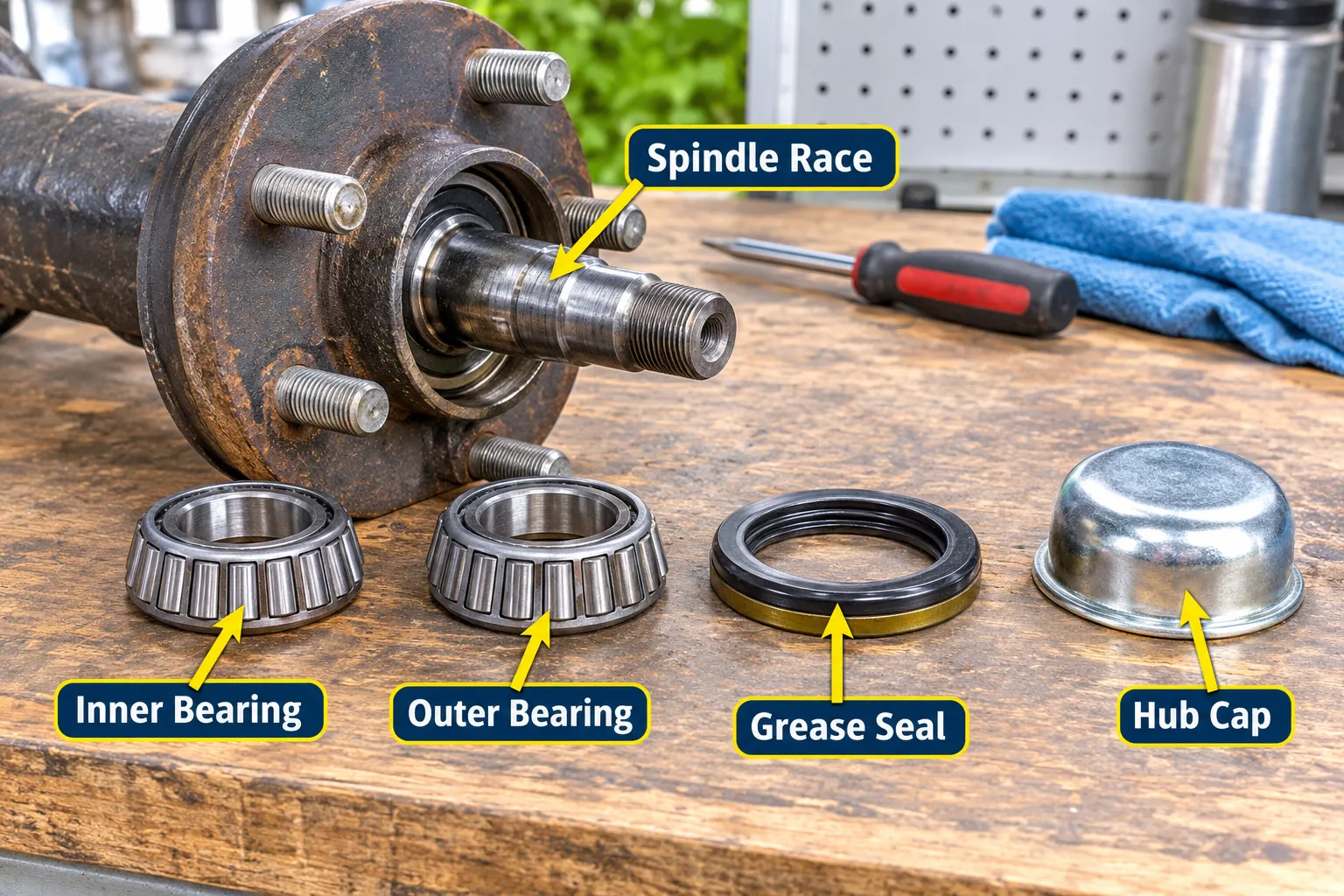
Boat trailer bearing replacement cost is not one number, it is a stack of smaller costs that depend on what actually needs fixing. At the most basic level, a trailer axle has two hubs, each containing an inner and outer bearing, a grease seal, and a race pressed into the hub itself. When a shop quotes a “bearing job,” they are usually talking about pulling the hub, cleaning the old grease, inspecting the races, repacking with fresh grease, and installing a new seal.
Here is a realistic cost breakdown per hub, based on current marine retailer pricing and typical shop labor rates [4][5]:
| Item | Typical Cost Range |
|---|---|
| Bearing/seal kit (both bearings + seal) | $15, $45 per hub |
| Marine wheel bearing grease (tube or cartridge) | $8, $20 |
| Replacement grease seal only | $5, $15 |
| Complete hub assembly (bearings, races, seal, hub) | $40, $120 per hub |
| Hub with integrated brake assembly | $150, $400 per hub |
| Shop labor, per axle (two hubs) | $75, $200 |
| DIY repack kit (bearings, seal, grease, tool) | $25, $70 for the pair |
For a typical single-axle trailer, a shop-performed full repack, parts and labor, lands somewhere between $150 and $350. Double-axle trailers roughly double that, though some shops offer a discount for doing all four hubs in one visit. Trailers with surge brakes or electric brakes cost more because the hub assembly is more complex and brake components may need bleeding or adjustment afterward.
DIY repacking cuts the cost dramatically. A bearing kit, a tube of marine grease, and a basic bearing packer tool can service an entire axle for under $70, with no labor charge beyond time and a jack stand. This is one reason boat owners who tow often compare total ownership costs the way shoppers compare DIY repair costs for cars across different parts retailers, the labor markup on simple maintenance is often the biggest line item.
Grease Intervals, Inspection Schedules, and When Boat Trailer Bearing Replacement Cost Jumps
The single biggest driver of boat trailer bearing replacement cost is neglect, not bad luck. Bearings fail for two reasons: grease breaks down or washes out, or water gets past a worn seal and causes internal corrosion. Both are preventable with a predictable schedule.
Industry guidance generally agrees on these benchmarks:
- Freshwater trailers, light use: Inspect and repack annually or every 1,000 to 3,000 miles towed, whichever comes first [1][3].
- Saltwater trailers, regular use: Inspect before every launch for hub temperature and grease color, and plan a full repack every 6 to 12 months or sooner if the hub ever feels hot after a drive [2][3].
- Heavy-use or commercial trailers: Some operators repack every trip or every few launches, especially if the trailer is backed deep into salt water repeatedly [6].
- First-year check on new or rebuilt trailers: Many manufacturers, including Dexter, recommend an early inspection within the first few hundred miles to confirm bearings seated correctly after initial installation [4][7].
Internationally, guidance for frequently used boat trailers in places like Australia echoes the same pattern, trailers that are dunked often in salt water need shorter intervals than those used occasionally on lakes, sometimes recommending a check after every few launches rather than a fixed mileage number.
A simple rule many boaters use: if you can smell burning grease, see smoke, or the hub is too hot to touch comfortably after towing, stop immediately. That heat means the bearing is already failing, and continuing to drive risks total bearing collapse, which can score the spindle and force a much more expensive repair.
Signs You Need a Repack vs. Full Bearing Replacement vs. New Hub
Not every service call ends the same way. There is a clear decision ladder, and understanding it keeps boat trailer bearing replacement cost as low as possible.
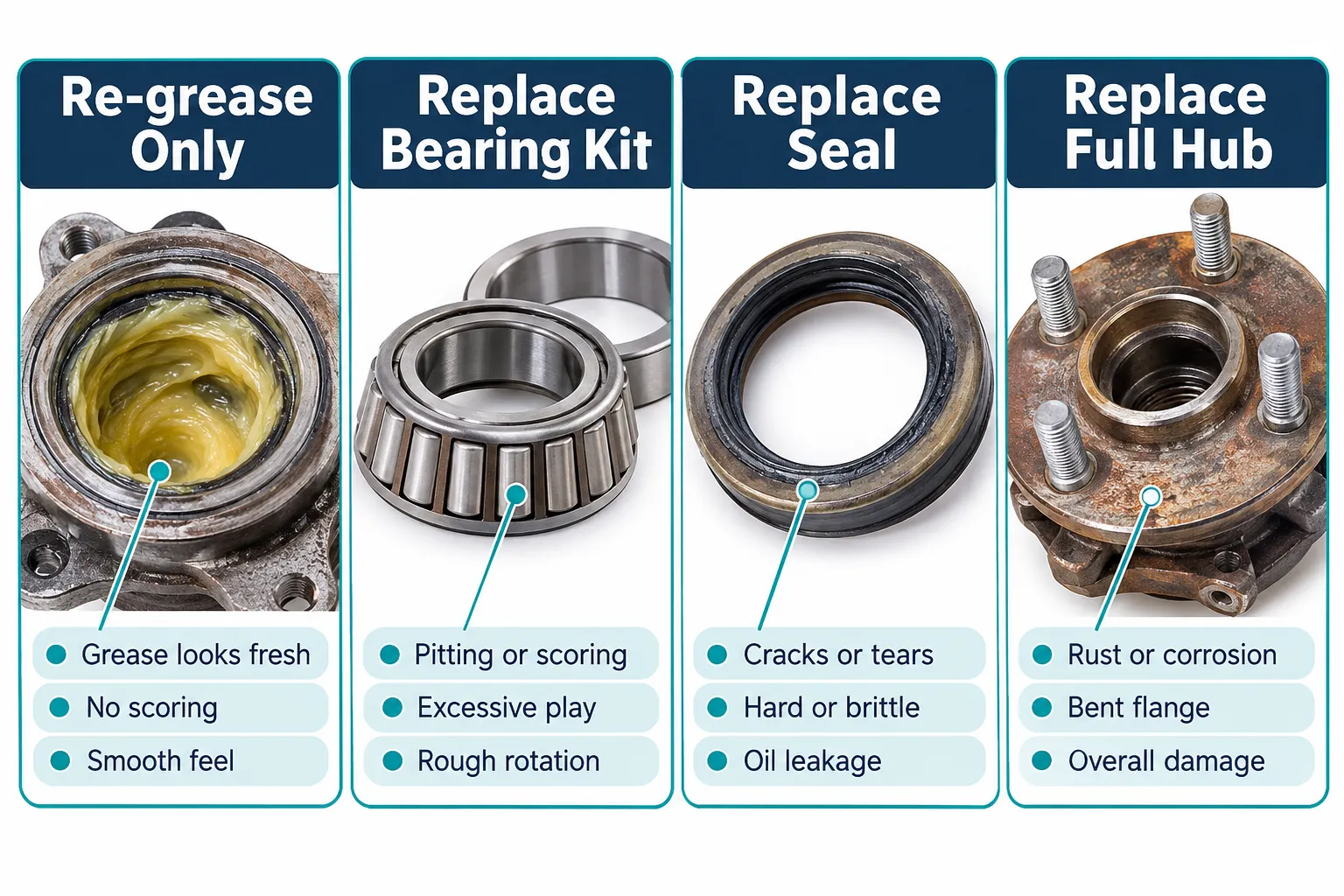
Re-grease only is appropriate when bearings look clean, roll smoothly with no grit or play, and the seal is intact with no sign of water intrusion. This is routine maintenance, not repair.
Replace the bearing and seal kit when:
- Grease looks milky, gray, or gritty, a sign water has gotten in [6][7]
- There is slight play in the hub when wiggled by hand, but the race surface still looks smooth
- The old seal is cracked, hardened, or was removed during disassembly (seals should never be reused)
Replace the entire hub assembly when:
- The race (the bearing’s track inside the hub) is pitted, scored, or shows a blue heat-discoloration from past overheating
- Rust has eaten into the hub metal itself, especially common on saltwater trailers with poor seals
- The hub has cracked or shows stress fractures near the lug studs
- A brake-equipped hub has worn or damaged internal brake surfaces beyond simple adjustment
A practical rule of thumb from trailer technicians: if the cost to source and press new races plus new bearings and seal approaches 70 percent of a complete replacement hub’s price, just buy the new hub. Pressing races in and out requires a hydraulic press and precise alignment, a task many home mechanics cannot safely do, which pushes the labor portion of the bill up fast if a shop has to do it piece by piece.
Severely neglected axles sometimes need more than a hub. If a bearing seizes entirely while towing, the heat generated can warp or snap the spindle itself, requiring axle replacement, a repair that can run several hundred dollars per axle and may mean a day or more of downtime before a launch. This is the worst-case scenario the maintenance schedule above is designed to prevent.
Saltwater vs. Freshwater: Why the Same Trailer Needs Different Schedules
Saltwater is corrosive and conductive in ways freshwater is not. Salt accelerates rust on exposed metal, and salt residue left on seals and hub surfaces attracts moisture even between launches, slowly degrading rubber seals faster than fresh water ever would [2][3].
This is why the same bearing kit on two identical trailers can last three times longer on a lake boat than on an ocean-going rig. Saltwater boaters should also:
- Rinse hubs and the entire trailer frame with fresh water after every saltwater launch
- Check for the “bubble test”, dunk the hub briefly, pull it out, and watch for air bubbles escaping past the seal, which indicate a seal already letting water in [6]
- Consider upgrading to marine-grade sealed or Bearing Buddy-style spring-loaded hub covers, which maintain slight positive grease pressure to resist water intrusion
- Budget for shorter service intervals as a fixed cost of saltwater boating, not an occasional surprise
Owners comparing larger boats and trailer setups, such as those researching how much a pontoon boat costs, should factor ongoing trailer maintenance into the total cost of ownership, since heavier boats put more load-related stress on bearings and seals over time.
DIY Repack vs. Professional Service: Which Lowers Boat Trailer Bearing Replacement Cost More
For boat owners comfortable with basic tools, a DIY repack is the single best way to cut ongoing maintenance expense. The process involves jacking up the trailer, removing the dust cap and cotter pin, pulling the hub, cleaning out old grease, inspecting the races and bearings, repacking with fresh marine grease, and reinstalling with a new seal [8][9].
The tradeoffs:
DIY advantages:
- Total cost often under $70 for an entire axle
- Full control over grease quality and inspection thoroughness
- No scheduling wait at a shop before a launch
Professional service advantages:
- Proper torque specs and bearing preload are applied consistently
- Shops often spot early-stage issues (hairline cracks, early rust) during teardown
- Warranty coverage on parts if something fails shortly after service
- Faster for owners who tow multiple trailers or lack a safe place to jack up a trailer
Many boat owners land on a hybrid approach: DIY grease checks and Bearing Buddy top-offs between trips, with a full professional teardown and inspection once a year or at the start of boating season. This matches general guidance for pre-season trailer inspection, which typically bundles bearing checks with tire, light, and coupler inspections in a single service visit [10].
For those weighing DIY tool costs against shop convenience on other vehicle maintenance too, the same logic used in comparing auto parts retailers for DIY repairs applies directly here, buying quality parts once beats repeated cheap fixes.
Hidden Costs: Corrosion, Brakes, and Axle Damage From Neglect
The quoted boat trailer bearing replacement cost on a receipt rarely tells the full story of what neglect actually costs. Consider the downstream expenses that follow a bearing failure on the road:
- Towing fees if a wheel locks up or a hub separates mid-trip
- Tire damage from a wobbling or seized hub scrubbing against the sidewall
- Brake system damage on trailers with integrated hydraulic or electric brakes, since overheated hubs can warp brake drums
- Axle replacement, which can run $150 to $500 per axle depending on capacity and whether brakes are integrated
- Lost boating time waiting for parts, especially specialty marine hubs that smaller auto parts stores do not stock
Manufacturers like Dexter design trailer axles with defined load ratings and service intervals precisely because the hub, bearing, and spindle work as one system [4][7]. Push past those intervals, especially in saltwater, and small problems compound into system-wide failures. A missed $40 repack easily becomes a $600 roadside repair plus a wasted boating weekend.
Conclusion: Protecting Your Trailer and Your Budget
Boat trailer bearing replacement cost stays low when maintenance stays ahead of failure. A routine repack costs a fraction of what a seized bearing, scored spindle, or cracked hub will cost after a breakdown on the highway. The math is simple: $20 to $60 in parts and a bit of grease now, or several hundred dollars and a ruined weekend later.
Next steps for any boat owner:
- Check the trailer’s service history, if nobody remembers the last repack, assume it is overdue.
- Inspect grease color and hub temperature after the next tow, especially on saltwater trailers.
- Schedule a full bearing inspection before the next boating season, bundling it with tire and light checks.
- Decide now whether DIY repacking fits the garage setup, or whether a trusted trailer shop handles it annually.
- Keep a spare bearing kit and seal in the tow vehicle for long trips, a flat tire is annoying, but a seized bearing stranded far from home is worse.
A well-maintained hub is one of the cheapest parts of boat ownership to keep in good shape. Treat it that way, and the trailer will keep rolling reliably for years.
References
- Regularly Scheduled Maintenance Interval for Wheel Bearings on a Boat Trailer. venturetrailers.com.
- Diy Safe and Trouble Free Trailering. westmarine.com.
- Boat Trailer Maintenance. boatcarewise.com.
- Wheel Bearings. fisheriessupply.com.
- Trailer Wheel Bearing Repack. nctrailers.com.
- Wheel Bearing Grease for Boat Trailers. betterboat.com.
- How to Maintain Boat Trailer Hubs. betterboat.com.
- Keep That Trailer Rollin. goodoldboat.com.
- Repack Trailer Wheel Bearings. teamam.org.
- Pre Season Boat Trailer Inspection a Complete Checklist. nctrailers.com.
boat trailer bearings, trailer bearing replacement cost, trailer hub repair, marine grease, wheel bearing seal, boat trailer maintenance, saltwater trailer corrosion, DIY bearing repack, trailer axle replacement, Dexter trailer parts, boat towing tips, trailer hub inspection