
Last Updated on October 29, 2026
A boat that gets a $12,000 trade-in quote from one guide and a $9,500 offer from a dealer isn’t being scammed. It’s running into a basic truth of vehicle pricing: no two valuation guides use the same math. If you have ever typed your car, RV, or boat into two different pricing tools and gotten two different numbers, you already know the frustration. Understanding Kelley Blue Book Car Value vs NADA Value: Why Appraisals Differ for Cars, RVs, and Boats is the first step toward getting a fair deal instead of a guess.
This article breaks down exactly why these two valuation giants disagree, how each one builds its numbers, and what you can do to land on a realistic price before you sell, trade, insure, or finance anything with wheels or a hull.
Key Takeaways
- KBB leans on consumer-facing data like private listings and dealer retail prices, while NADA (now published by J.D. Power) leans on dealer transaction and wholesale auction data, which is why NADA figures often run higher.[1][2]
- KBB does not officially value RVs, motorhomes, or travel trailers; NADA/J.D. Power RV Guides are the industry’s closest thing to an RV “Blue Book.”[3][4][5]
- For boats, KBB only covers personal watercraft back to model year 2000, while NADA/J.D. Power offers standardized retail and trade-in values across many boat types.[2][5][6]
- Industry critics note J.D. Power RV values can run 20-30% above real sale prices because they’re built from MSRP and depreciation formulas rather than actual closed sales.[4]
- The fix is never to trust one number. Average multiple sources, adjust for your region and condition, and use the result as a negotiating floor, not a final price.
Why Kelley Blue Book Car Value vs NADA Value Produces Different Numbers for the Same Vehicle
Both guides are trying to answer the same question: what is this vehicle worth right now? But they ask different data sets to answer it, and that is the root of every disagreement you’ll see between Kelley Blue Book car value vs NADA value.
KBB builds its pricing from a wide pool of sources, including wholesale auction results, dealership sales records, private-party listings, and real consumer transactions, then layers in ZIP-code-specific market data so a truck in Phoenix doesn’t get the same number as the identical truck in Seattle.[1][2][7] NADA, now operating under J.D. Power, pulls more heavily from dealer-centric transaction data, wholesale auction results, and retail pricing feeds from partners like AutoTrader.[1][7] That trade-focused data mix is the single biggest reason NADA tends to land higher than KBB on the same car.[1][2]
There’s also a philosophical difference baked into each tool’s assumptions. KBB factors in actual vehicle condition, local market conditions, and how popular a model is in a given area, which tends to produce more conservative, buyer-realistic numbers.[1][2][8] NADA has historically assumed a “good condition” baseline that skews more optimistic, nudging its values upward compared to KBB’s more cautious estimate for the same car.[1][2][8]
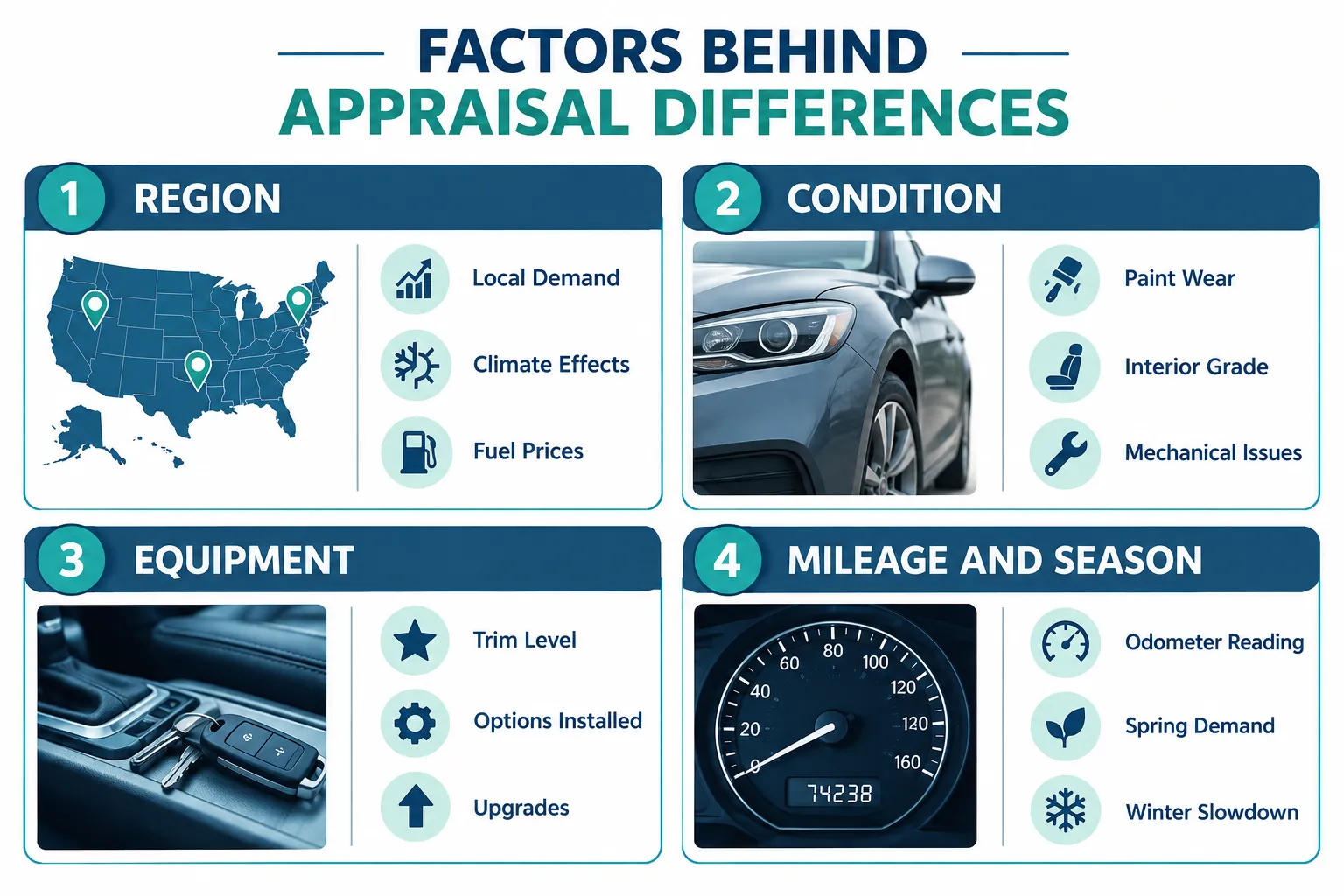
Seven factors consistently drive the gap wider or narrower, no matter what kind of vehicle you’re pricing:
- Region: Local supply and demand, climate, and even fuel prices shift what a vehicle sells for in one state versus another.[1][2]
- Condition: A guide that assumes “good” condition by default will price higher than one that lets you self-report dents, worn upholstery, or mechanical issues.[2][8]
- Equipment and trim: Heated seats, upgraded wheels, or a tow package can swing value by hundreds or thousands of dollars depending on which options each tool assumes are standard.[2][8]
- Mileage: Both guides adjust for mileage, but the curve and penalty per extra 1,000 miles can differ between data sets.[2][8]
- Seasonality: Convertibles climb in spring, trucks and 4x4s climb before winter, and boats see price swings tied to boating season.[1][2]
- Dealer demand: A hot-selling model on a dealer’s lot might get valued higher by dealer-sourced data than by private listings.[1]
- Vehicle type: Cars, motorcycles, RVs, and boats each pull from different, sometimes thinner, data pools, which affects how confident any single number really is.
If you’re trying to find the value of your car before a sale, treating one guide’s number as gospel is a mistake. Pull multiple estimates and look at the pattern, not just one figure.
How Kelley Blue Book Car Value vs NADA Value Methodology Diverges for RVs and Manufactured Housing
RVs are where the gap between these guides becomes less about “different numbers” and more about “different guides entirely.” KBB simply does not provide official valuations for RVs, motorhomes, or travel trailers.[3][4][5] That leaves NADA, through J.D. Power’s RV Guides, as the de facto industry standard, offering structured pricing tiers: low retail for a quick sale, average retail for fair market value, and high retail for excellent condition, all calculated from year, make, model, length, mileage, and installed options.[3][4][5]
That doesn’t mean RV owners should treat the NADA/J.D. Power number as final. A specialized RV valuation resource updated in October 2026 argues that J.D. Power RV figures are frequently 20 to 30 percent too high, because they’re derived from original MSRP and standardized depreciation curves rather than actual closed sale prices.[4] The recommendation from that analysis is blunt: use the guide number as a starting point only, then adjust downward based on regional demand, aftermarket modifications, and what similar units are actually selling for in classified listings.[4][5]
Manufactured and mobile housing follows a similar pattern. There’s no KBB equivalent here either. Instead, the NADA Manufactured Housing Appraisal Guide, now published under J.D. Power, has served as the industry benchmark for decades, playing the same baseline role for financing and resale that NADA’s RV and boat guides play in their categories.[2][9]
This single-guide reality for RVs matters most when you’re negotiating a trade-in or settling a loan payoff. If you’re comparing trade-in offers against book value for any vehicle type, it’s worth reviewing what dealers won’t tell you about trade-in value before you sign anything.
Appraising Boats and Cars: Kelley Blue Book Car Value vs NADA Value in Practice
Boats sit in an odd middle ground. There is no single universal “Blue Book” for watercraft, but KBB does publish values for personal watercraft going back to model year 2000.[2][6] NADA, through J.D. Power, goes further, publishing standardized values across many boat categories, including average retail, average trade-in, and low retail figures organized by year, make, model, and length.[2][5][6] Those NADA/J.D. Power numbers are frequently cited in appraisals, insurance claims, and even legal settlements because courts and attorneys treat them as an authoritative starting point for dividing property in situations like divorce.[5]
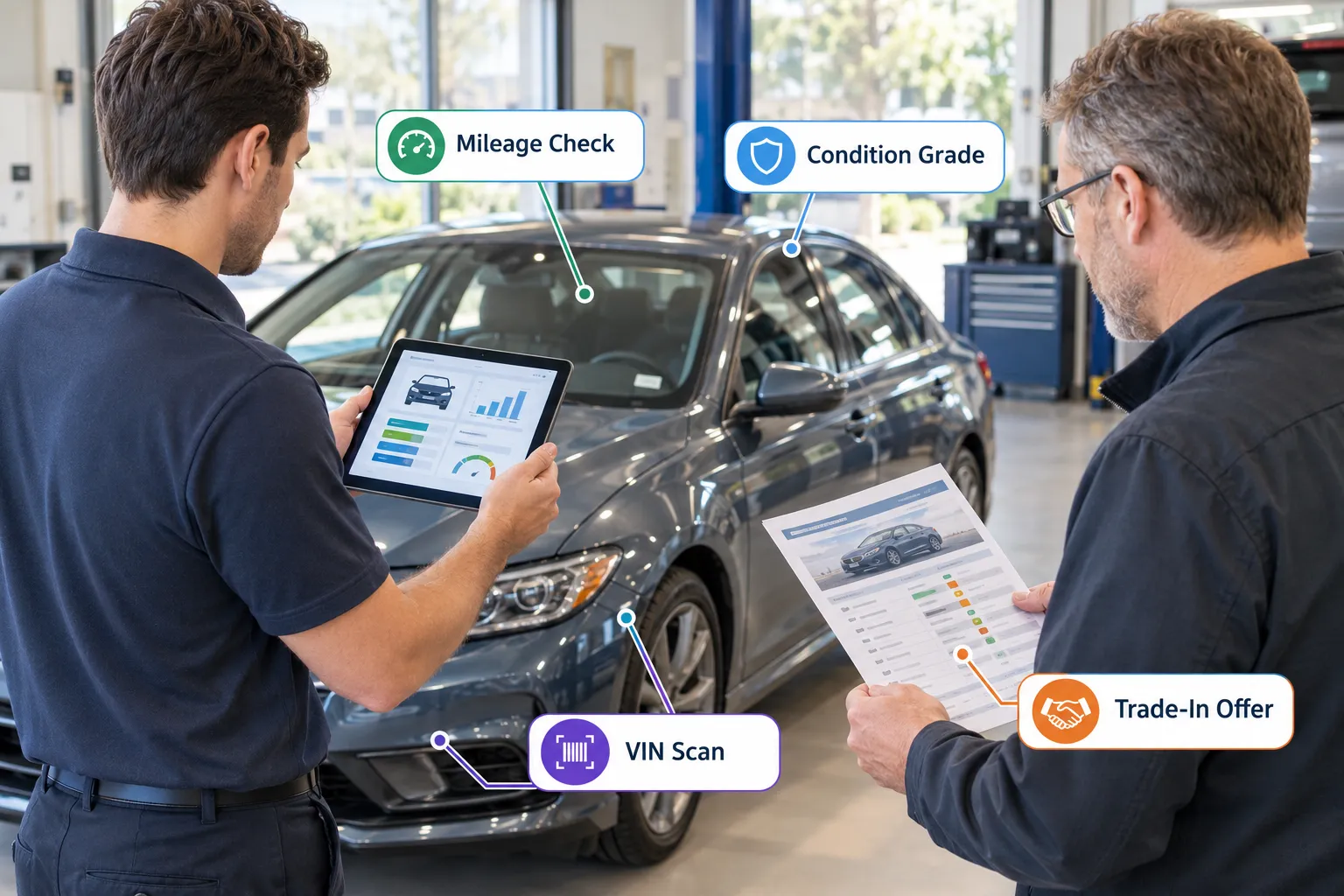
For cars, the divergence plays out a little differently in day-to-day buying and selling. KBB’s pricing leans heavily on asking prices and self-reported condition from consumers, which often anchors closer to what a buyer will actually pay in a private-party deal.[1][2] NADA/J.D. Power leans on dealer transaction data and wholesale metrics, producing higher book values that can overstate what a car is worth in a softer local private market.[1][2]
This distinction traces back to who each tool is really built for. KBB is designed primarily for consumers negotiating purchases and trade-ins, which is why its numbers tend to sit in the middle of the road.[1][2] NADA/J.D. Power values are built for the trade side of the business, particularly lenders deciding how much to advance on a loan and insurers setting coverage limits, so they skew more conservative from a lender’s risk perspective while still landing higher than what a private buyer might actually pay.[1][2][7]
If you want a broader view of how valuation philosophy differs across tools, it helps to also look at how Edmunds True Market Value compares, and to understand the deeper distinction between guideline value and market value before accepting any single quote as final.
A Quick Reference Table
| Category | KBB Approach | NADA/J.D. Power Approach |
|---|---|---|
| Cars | Consumer listings, condition-adjusted, ZIP-code based[1][2] | Dealer transaction and wholesale data[1][7] |
| RVs | Not officially valued[3][4] | Low/average/high retail by year, make, model[4][5] |
| Boats | Personal watercraft from year 2000 only[2][6] | Average retail, trade-in, low retail across most boat types[5][6] |
| Manufactured housing | Not covered[9] | NADA Manufactured Housing Appraisal Guide[2][9] |
| Primary audience | Consumers, buyers, sellers[1][2] | Lenders, insurers, the trade[1][7] |
How to Reconcile Multiple Valuation Estimates Before You Sell or Trade
Once you understand why the numbers disagree, the next step is turning that knowledge into a practical pricing strategy. Here’s a simple method that works whether you’re pricing a sedan, a fifth-wheel trailer, or a fishing boat.
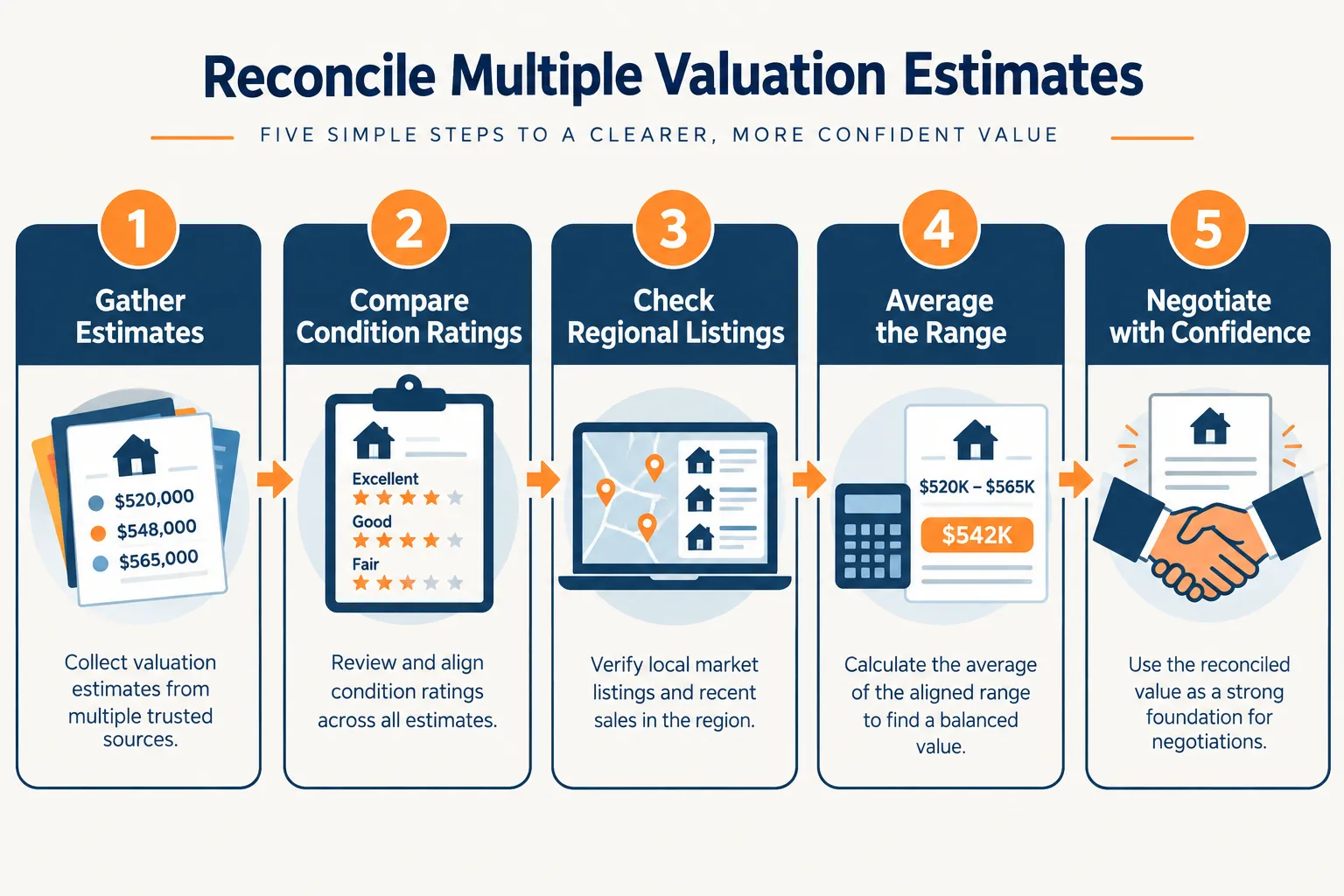
- Pull at least two independent estimates. Check both KBB and NADA/J.D. Power where available, and add a third consumer source like Edmunds if your vehicle type is covered.[1][7]
- Note the condition assumptions each guide used. If a tool defaults to “good” condition and your vehicle is more worn, mentally discount the number.[2][8]
- Check real local listings. Search for your exact year, make, model, and trim in your area to see what similar units are actually asking and selling for.[1][2]
- Adjust for season and demand. A convertible priced in January or a pontoon boat priced in November will undersell its summer value, and vice versa.[1][2]
- Average the adjusted range, not the raw numbers. Take your condition-adjusted and season-adjusted figures and find a realistic midpoint rather than averaging the raw guide outputs.
- Use the final range as a floor in negotiation, not a ceiling. Dealers and private buyers will often anchor to whichever number benefits them, so know your range before you talk price.
This approach matters even more for vehicle types where KBB’s boat values or NADA figures have thinner data behind them, and it’s just as relevant if you’re researching a motorcycle’s Kelley Blue Book value ahead of a sale.
It’s also worth separating two concepts that get confused constantly: what something is officially “worth” on paper versus what it’s genuinely valued at in a real transaction. Reading up on value versus worth can sharpen how you interpret any guide’s number before you act on it.
Where This Is Heading for Buyers, Sellers, and the Trade
J.D. Power’s continued integration of NADA guides into lending and insurance platforms suggests that NADA-based figures will stay the primary benchmark for finance and insurance decisions across cars, RVs, and boats for the foreseeable future.[1][2][4] At the same time, consumers are increasingly expected to cross-check those numbers against KBB, Edmunds, and real dealer offers, specifically to avoid overpaying relative to what vehicles are actually selling for in the current market.[1][2][4]
That expectation isn’t theoretical. Current analysis already documents gaps of 20 to 30 percent between NADA/J.D. Power book values and actual RV sale prices when buyers rely on the guide alone.[1][2][4] The practical takeaway: book values are a starting conversation, not a closing argument, no matter which guide you’re reading.
Pull quote: “A book value is a starting point for a negotiation, not a verdict on what your vehicle is actually worth.”
Conclusion
The disagreement between Kelley Blue Book car value vs NADA value isn’t a glitch, it’s a reflection of two different data philosophies: one built around consumer listings and real-world condition, the other built around dealer and wholesale transactions aimed at lenders and insurers. For cars, expect KBB to run closer to what private buyers will pay and NADA to run a bit higher. For RVs, lean on NADA/J.D. Power since KBB doesn’t cover the category, but discount the figure for real-world market softness. For boats, blend KBB’s limited personal watercraft data with NADA’s broader retail and trade-in figures.
Before you list, trade, or insure any vehicle, pull estimates from at least two sources, adjust for your region, condition, equipment, and the season, and settle on a realistic range rather than a single number. That range, not any one guide’s figure, is what will actually protect your wallet at the negotiating table.
References
- Kbb vs. Nada Which Used Car Value Is Accurate. armotorsportsny.com.
- Nadaguides. kbb.com.
- Does Kelley Blue Book Do Rvs What You Need to Know. outdoorsy.com.
- Is There an Rv Blue Book a Guide to Pricing My Rv. rvtrader.com.
- How to Handle a Boat or Rv in a Divorce Settlement. divorceclear.com.
- Nada Guides. edmunds.com.
- How to Check Used Car Value Before Buying the Complete Nada Guide. nadabookinfo.com.
- Nadaguides. kbb.com.
- Mobile Home Blue Book Guide. localmobilehomebuyers.com.