
Last Updated on November 15, 2026
A ten-year ownership gap of nearly $3,500 separates these two German badges, and most shoppers never see it coming until the first big repair bill lands. Volkswagen and Audi share engines, platforms, and even parts bins, yet their used-car economics diverge sharply once the factory warranty expires. Understanding Volkswagen vs Audi used cars: maintenance costs, reliability, performance, and depreciation before signing a title transfer can save thousands over a typical ownership period.
This guide breaks down where the two brands overlap mechanically and where they split financially, so you can match your budget and driving goals to the right badge.
Key Takeaways
- Audi’s 10-year maintenance total averages about $10,213 versus $6,780 for Volkswagen, a difference of roughly 50 percent[1].
- Audi carries a higher major-repair probability over 10 years (30.97%) compared to Volkswagen (20.9%)[1].
- Consumer Reports’ used-car reliability scores give VW a slight edge over Audi (41 vs 39 points), though both sit in the lower half of all brands[2].
- Audi depreciates fast early, about 35.6% by year three, but some shared-platform EVs like the Audi Q4 e-tron now beat their VW siblings on reliability[3][4].
- Specific model years matter more than brand badge; a well-rated used Audi A3 can outperform a poorly-rated VW, and vice versa[3][5].
Engines, Transmissions, and Electronics: Where the Overlap Really Lives
Volkswagen and Audi belong to the same corporate family, and that shows under the hood. Many Audi models use the same turbocharged four-cylinder engines, dual-clutch transmissions, and infotainment architecture found in comparable Volkswagens. This shared engineering means both brands inherit similar failure points, carbon buildup on direct-injection engines, DSG transmission wear, and water pump or timing chain issues that tend to surface in the 60,000 to 100,000 mile range.
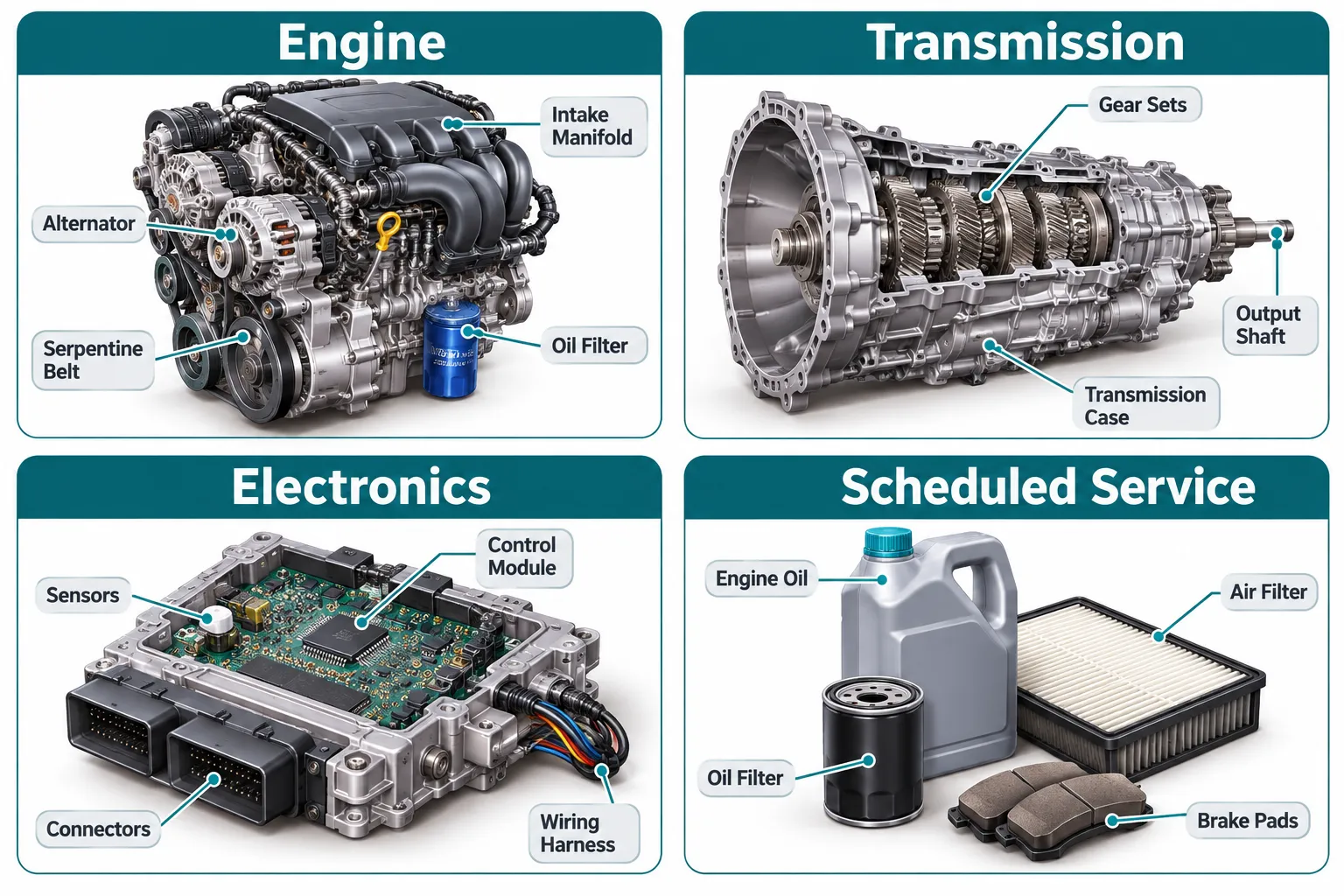
The difference shows up in execution, not design. Audi tends to layer in more sensors, additional electronic modules, and premium trim materials, which adds complexity and, eventually, more things that can fail or need recalibration. Volkswagen’s cabins and electronics are simpler, which keeps diagnostic time, and therefore labor cost, lower when something does go wrong.
For buyers cross-shopping other vehicle categories, it’s worth comparing how different brand philosophies play out elsewhere, such as in the Honda Pilot vs Toyota Highlander vs Subaru Ascent comparison, where mainstream brands trade some luxury polish for lower long-term complexity, much like VW does against Audi.
Volkswagen vs Audi Used Cars: Maintenance Costs Compared
This is where the two brands separate most clearly. A recent ownership-cost analysis built on RepairPal data estimates 5-year maintenance totals of $2,202 for Volkswagen versus $3,349 for Audi. Stretch that to 10 years and the gap widens further: $6,780 for VW against $10,213 for Audi[1].
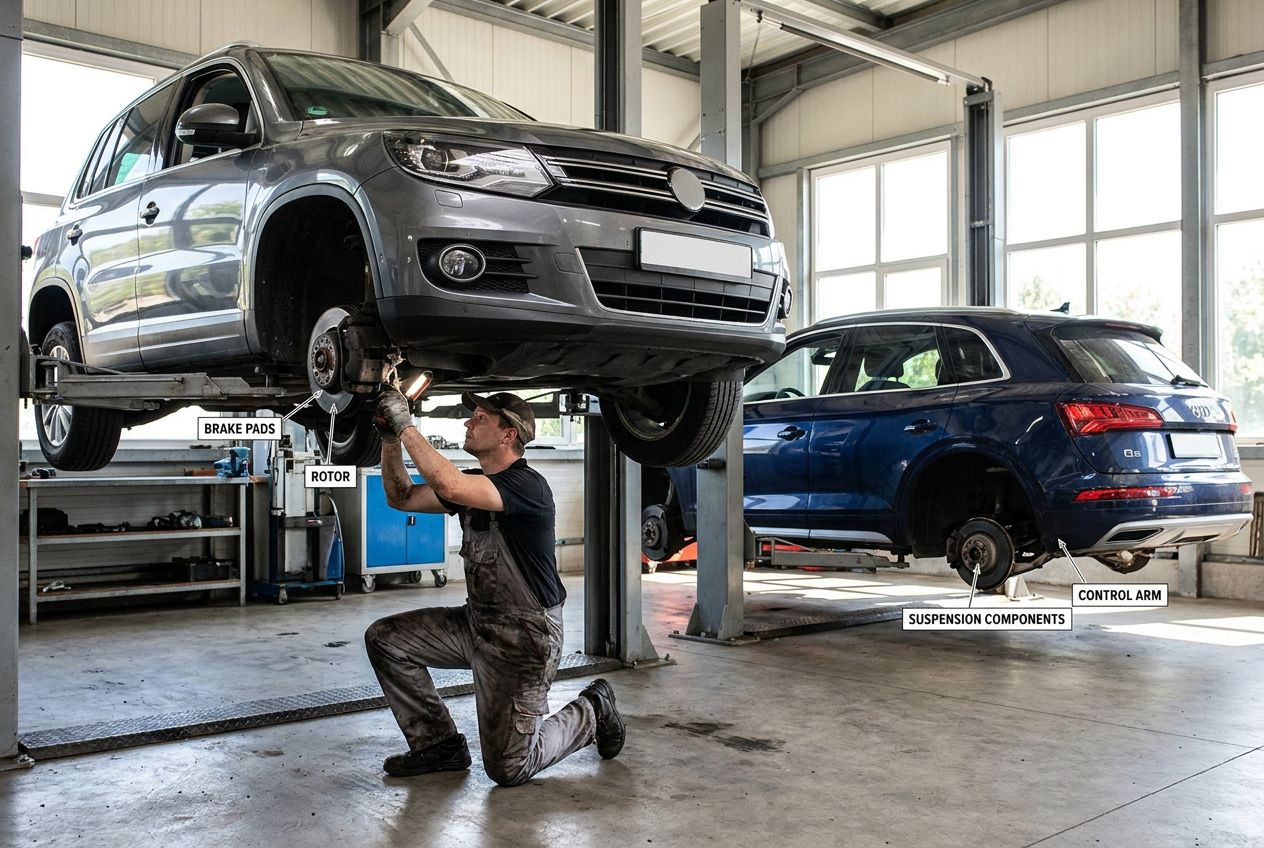
Shop-level data collected between 2024 and 2026 confirms the pattern in day-to-day terms. Typical annual maintenance for an out-of-warranty Audi runs around $800 to $1,200, while a comparable Volkswagen averages $500 to $800. Major services at the 80,000 to 100,000 mile mark, timing components, suspension overhauls, transmission service, often land between $2,000 and $4,000 on Audi, compared with $1,200 to $2,500 on Volkswagen[6].
Even routine jobs show the gap. An identical brake job can run about 70% more on an Audi Q5 than a Volkswagen Tiguan, with front pad replacement costing $536 to $601 on the Audi versus $262 to $319 on the VW[6].
A broader RepairPal-based figure cited in an October 2026 review pegs annual repair and maintenance costs at about $676 for Volkswagen and $987 for Audi, against an all-vehicle average of $652. Both brands sit above the industry norm, but Audi carries a noticeably heavier bill[5].
| Cost Metric | Volkswagen | Audi |
|---|---|---|
| 5-Year Maintenance Total | $2,202 | $3,349 |
| 10-Year Maintenance Total | $6,780 | $10,213 |
| Annual Repair/Maintenance Average | $676 | $987 |
| 10-Year Major Repair Probability | 20.9% | 30.97% |
“Stepping from a mainstream VW into a comparable Audi typically increases servicing bills by half again”, a pattern consistent with the 10-year cost spread between the two brands.[1][4]
Reliability, Performance, and Depreciation for Used Volkswagen and Audi Models
Reliability scores tell a more nuanced story than cost alone. Consumer Reports’ 2024 used-car brand scores, covering model years 2014 through 2019, give Volkswagen 41 points and Audi 39, both below average overall, but VW holds a slight lead[2]. J.D. Power’s 2024 U.S. Vehicle Dependability Study ranks Volkswagen 27th out of 30 brands for problems per 100 vehicles after three years, a reminder that lower repair costs don’t automatically mean fewer issues[1].
What Car?’s latest reliability survey, updated through late 2026, scores Audi at 89% overall, ranking 24th of 31 brands, but model-level variation is enormous. The Audi TT scores 98.4% and ranks fourth among 13 sports cars, with only 8% of owners reporting problems, making it a standout for buyers chasing performance and dependability together[7]. The Q7 SUV sits at the other extreme, scoring just 80.8%, with roughly a third of surveyed cars developing faults and a quarter of affected owners paying more than £1,500 to fix them[7].
Electrification adds another twist. A 2026 What Car? comparison shows the Audi Q4 e-tron scoring 90.4% for reliability versus 79.6% for its closely related sibling, the Volkswagen ID.4, proof that shared platforms don’t guarantee shared reliability outcomes[3].
On performance, Audi used cars generally feel sportier and more tech-forward, particularly in coupes and premium sedans. The TT’s blend of sports-car dynamics and strong reliability makes it a rare case where Audi beats expectations on both fronts[7]. Meanwhile, standout model years like the 2015 Audi A5 (87/100 for quality and reliability) and the 2023 Audi A3 (84/100) show that targeting specific generations can land buyers a dependable, well-performing Audi rather than relying on brand-wide averages[3].
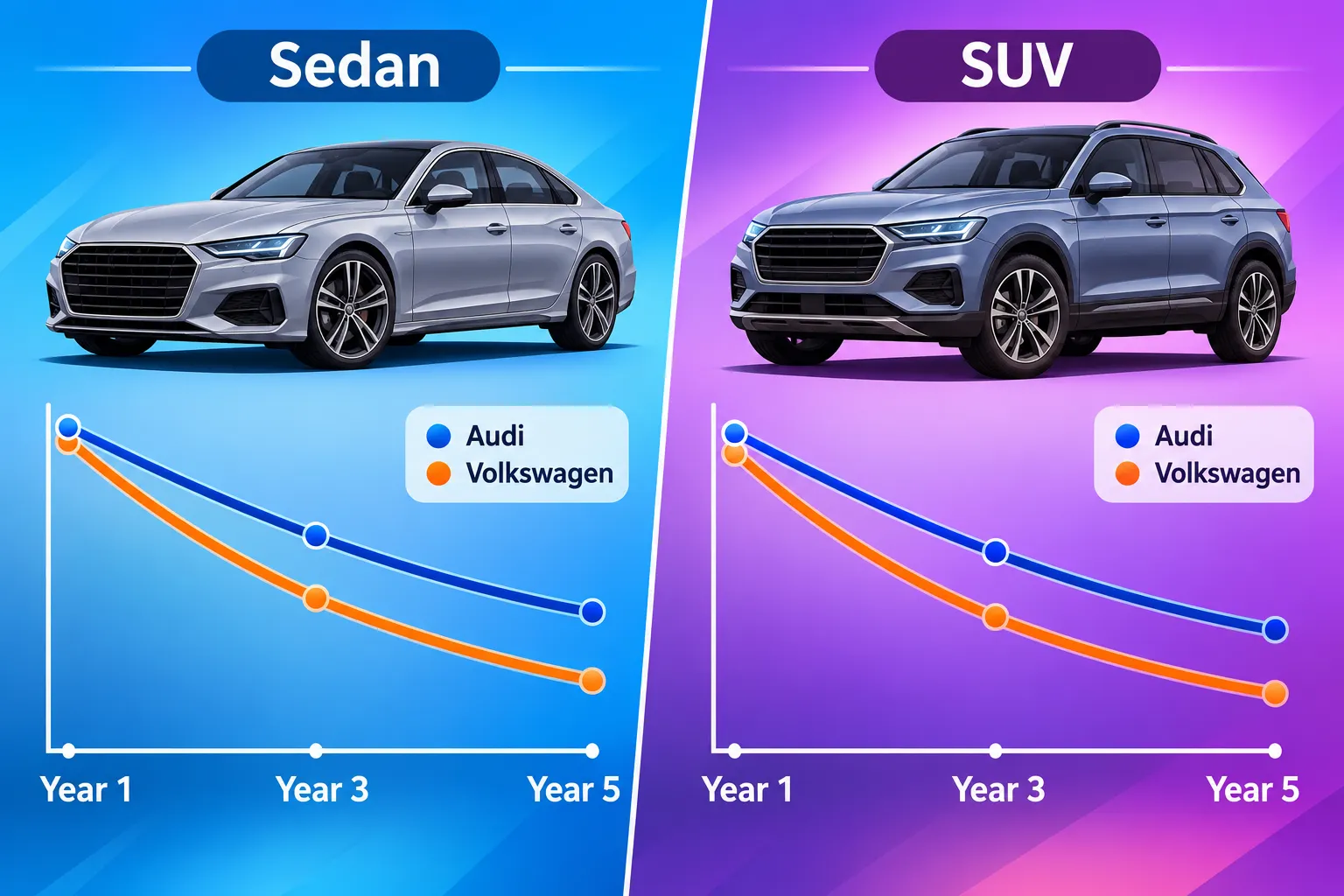
Depreciation follows the classic luxury-brand curve. CarEdge data updated in 2026 shows Audi vehicles losing about 20.0% of value after one year, 29.1% after two years, and 35.6% after three, with residual values of 80.0%, 70.9%, and 64.4% respectively. By year five, the average Audi has shed roughly 47.7% of its original value[4]. That steep early drop is actually good news for used-car shoppers: it means a lightly used Audi can be bought at a meaningful discount while much of its mechanical life remains ahead.
For buyers who want added peace of mind against these reliability unknowns, exploring certified used car programs and their warranty benefits is a smart next step, since CPO coverage can offset some of the repair risk highlighted above.
Narrowing the Gap: Smart Model Selection
Brand-wide statistics hide a lot of variation. A 2026 rundown of lowest-cost VW and Audi models to own found specific Volkswagen compacts and crossovers scoring 4.0 out of 5.0 for reliability with only a 10% chance of a severe repair, below the 12% market average. Select Audi compact luxury models posted 3.5 out of 5.0 reliability with annual costs near or below the luxury-segment average[5]. The takeaway: picking the right generation and trim matters more than picking the right logo.
Buyers should also weigh how resale value tracks against regional markets. Tools like the Canadian Black Book value guide can help confirm whether a specific used VW or Audi is priced fairly relative to its depreciation curve before committing to a purchase.
If performance and long-term value retention matter beyond the German luxury segment, it’s also worth reading how enthusiasts evaluate other performance-oriented vehicle categories, such as the complete guide to Italian cars, which shares similar tradeoffs between flair and ownership cost.
Volkswagen vs Audi Used Cars: Maintenance Costs, Reliability, Performance, and Depreciation, Buyer Checklist
Before buying either brand used, run through this short checklist:
- Pull the service history. Confirm timing components, water pumps, and transmission fluid services were done on schedule.
- Check the specific model year’s reliability score, not just the brand average, variation between Audi models like the TT and Q7 is massive[7].
- Budget for brake and suspension work early. Audi parts and labor routinely cost 50-70% more than equivalent VW jobs[6].
- Factor in depreciation timing. Buying an Audi after its steepest 3-year drop can capture better value retention going forward[4].
- Get a pre-purchase inspection from an independent European-car specialist, since dealership quotes can vary widely on both brands.
Conclusion
Volkswagen and Audi used cars share more mechanical DNA than most buyers realize, but the ownership experience splits sharply once the factory warranty ends. Volkswagen wins on raw maintenance economics, with roughly 50% lower 10-year costs and a smaller chance of a major repair. Audi counters with sharper performance, more premium technology, and, in select models like the TT or Q4 e-tron, genuinely strong reliability scores that rival or beat its VW siblings[3][7].
The smartest approach is not choosing a badge, but choosing a specific model and year backed by verified service records and realistic repair budgeting. Shoppers prioritizing low running costs should lean Volkswagen; those wanting more performance and willing to budget an extra $150 to $300 per year for upkeep can find real value in a well-chosen used Audi. Either way, a pre-purchase inspection and a clear-eyed look at depreciation timing will do more for your wallet than brand loyalty ever will.
References
- Volkswagen Service Costs. axleaddict.com.
- Article316835675. kansas.com.
- N29165. whatcar.com.
- What German Luxury Suv Maintenance Really Costs After the Warranty Ends. roadethos.com.
- 11 Volkswagens and Audis That Cost the Least to Own. daxstreet.com.
- Audi vs. Vw Maintenance Costs Compared. germanautocenter.com.
- N26108. whatcar.com.
volkswagen vs audi, used car reliability, car maintenance costs, luxury car depreciation, German car ownership, Audi reliability score, VW maintenance cost, used luxury SUV, certified used cars, car repair costs, vehicle dependability, car buying guide