Last Updated on August 26, 2026
Last updated: August 26, 2026
Quick Answer
The best used cars to buy in 2026 combine proven reliability, low ownership costs, and strong resale value. Top picks include the Toyota Camry, Honda CR-V, Mazda3, Subaru Forester, and Honda Civic, all of which consistently earn high marks from Consumer Reports, J.D. Power, and AAA. Mid-2026 market conditions, with wholesale prices cooling slightly while retail prices remain elevated, mean buyers who do their homework can find genuine value in 2- to 4-year-old off-lease vehicles [1][3].
Key Takeaways
- Toyota, Honda, Mazda, and Subaru dominate reliability rankings from J.D. Power, Consumer Reports, and AAA for 2026.
- Used car retail prices remain near record highs in mid-2026, but wholesale cooling signals modest relief ahead for buyers [3][10].
- The 2- to 4-year-old off-lease sweet spot offers near-new quality at a significant discount versus new car sticker prices.
- Always pull a vehicle history report (Carfax or AutoCheck), get a pre-purchase inspection, and verify the VIN before buying.
- The best used cars under $10,000 include older Honda Civics, Toyota Corollas, and Mazda3 models from the 2017-2019 range.
- Certified Pre-Owned (CPO) programs from Toyota and Honda offer manufacturer-backed warranties that reduce risk for first-time buyers.
- Avoid high-mileage luxury European vehicles, first-generation EVs with degraded battery packs, and any car with an open safety recall.
- Getting pre-approved for financing before visiting a dealership gives buyers significant negotiating leverage.
- Families should prioritize the Honda Pilot, Toyota Highlander, or Kia Telluride for space, safety scores, and reliability.
- Understanding a vehicle’s true market value before negotiating is the single most important step in the buying process.
What Makes a Used Car Reliable and Worth Buying
A used car is reliable and worth buying when it has a documented service history, a powertrain with a proven track record, and ownership costs that stay predictable over time. Reliability is not a guess, it is measurable through J.D. Power Vehicle Dependability Study (VDS) scores, Consumer Reports owner surveys, and third-party indices like the Warrantywise Reliability Index.
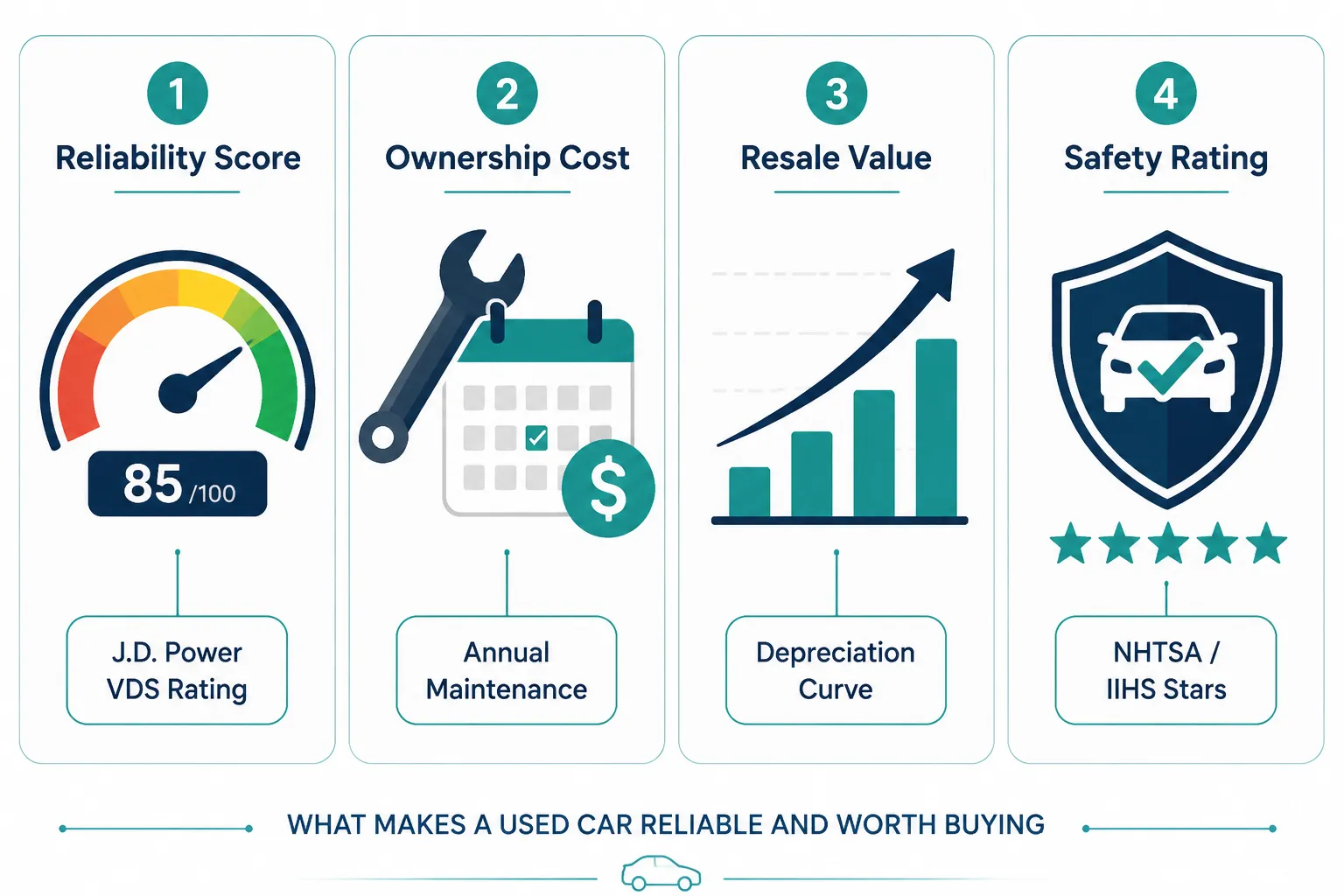
The J.D. Power 2026 VDS, which surveys owners of 3-year-old vehicles, consistently places Toyota, Lexus, Honda, and Mazda at the top of its rankings. These brands have fewer reported problems per 100 vehicles than the industry average, which translates directly into lower repair bills and fewer unexpected breakdowns.
Key factors that define a reliable used car:
- Powertrain simplicity: Naturally aspirated engines with fewer turbos and complex systems tend to age better than turbocharged or dual-clutch setups.
- Parts availability: High-volume models like the Toyota Camry or Honda Civic have abundant, affordable parts nationwide.
- Owner community: Popular models have large DIY communities and independent mechanics who specialize in them, keeping labor costs down.
- Recall history: A car with resolved recalls is fine; one with open, unaddressed recalls is a liability.
- Depreciation curve: A car that holds value well is one the market trusts, and that trust is usually earned through reliability.
Choose a model with at least three years of owner survey data behind it. Avoid first-year production runs of entirely new platforms, where early build-quality issues are most common.
The 15 Best Used Cars to Buy in 2026
These models represent the strongest combination of reliability, value retention, safety, and ownership cost across multiple vehicle categories. Prices reflect typical retail ranges for 2021-2023 model years as of mid-2026 [1][7].
| Model | Category | Typical Price Range | Reliability Tier |
|---|---|---|---|
| Toyota Camry | Midsize Sedan | $22,000-$30,000 | Excellent |
| Honda CR-V | Compact SUV | $24,000-$33,000 | Excellent |
| Honda Civic | Compact Sedan/Hatch | $18,000-$26,000 | Excellent |
| Mazda3 | Compact Sedan/Hatch | $17,000-$24,000 | Excellent |
| Toyota RAV4 | Compact SUV | $26,000-$35,000 | Excellent |
| Subaru Forester | Compact SUV | $21,000-$29,000 | Very Good |
| Toyota Corolla | Compact Sedan | $17,000-$23,000 | Excellent |
| Kia Telluride | Midsize SUV | $32,000-$42,000 | Very Good |
| Mazda CX-5 | Compact SUV | $23,000-$31,000 | Excellent |
| Honda Pilot | Midsize SUV | $29,000-$40,000 | Very Good |
| Toyota Prius | Hybrid Sedan | $20,000-$28,000 | Excellent |
| Hyundai Tucson | Compact SUV | $20,000-$28,000 | Good |
| Subaru Outback | Midsize Wagon/SUV | $24,000-$32,000 | Very Good |
| Mazda CX-50 | Compact SUV | $26,000-$34,000 | Very Good |
| Toyota Highlander | Midsize SUV | $33,000-$44,000 | Very Good |
Top three picks explained:
- Toyota Camry (2021-2023): The benchmark for midsize sedan reliability. The 2.5L four-cylinder hybrid variant delivers exceptional fuel economy and has one of the lowest 5-year ownership cost profiles in its class according to Consumer Reports data.
- Honda CR-V (2020-2023): Consistently tops compact SUV reliability surveys. The 1.5T engine had early oil dilution issues in 2017-2018 models, so stick to 2020 and newer for the revised calibration.
- Mazda3 (2019-2023): Often overlooked, the Mazda3 offers near-luxury interior quality at a fraction of the price. Mazda’s reliability scores rival Toyota’s in recent J.D. Power data.
How to Check a Used Car’s History Before Purchasing
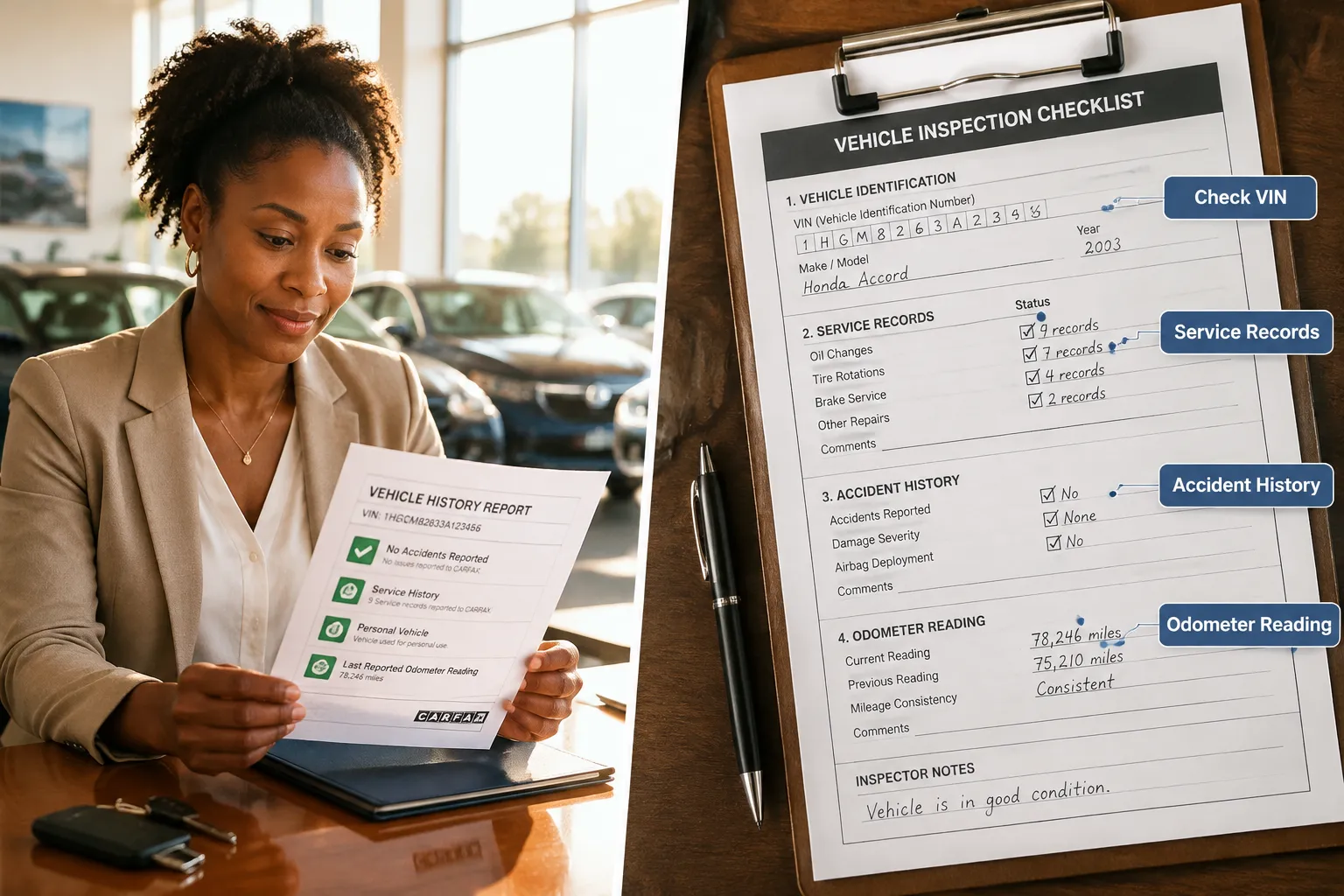
Before buying any used car, always run a vehicle history report using the VIN (Vehicle Identification Number). Services like Carfax and AutoCheck aggregate title records, accident reports, odometer readings, and service history from thousands of sources.
A clean Carfax report does not guarantee a perfect car, but it eliminates the most common red flags: salvage titles, flood damage, odometer rollbacks, and undisclosed accidents. Pair the report with a pre-purchase inspection (PPI) from an independent mechanic, budget $100-$150 for this step. It is the best money spent in any used car transaction.
Step-by-step history check process:
- Locate the VIN on the dashboard (driver’s side, visible through the windshield) or on the door jamb sticker.
- Run a Carfax or AutoCheck report using the VIN.
- Check NHTSA’s recall database (nhtsa.gov) to confirm all open recalls have been completed.
- Request the dealer’s or seller’s maintenance records.
- Cross-reference the odometer reading against service records for consistency.
- Schedule a PPI at a trusted independent shop before signing anything.
For a deeper look at how to determine what a used vehicle is actually worth before you negotiate, the Determining Used Car Value guide walks through the key valuation inputs step by step.
Common mistake: Trusting a “one-owner” claim without verifying it through the title history. Fleet vehicles and rental cars often show single-owner title records despite heavy use.
Best Used Cars Under $10,000
The best used cars under $10,000 in 2026 are older high-volume models from reliable brands, typically 2015-2019 model years with 80,000-120,000 miles. At this price point, the goal shifts from finding the newest car to finding the most mechanically sound car with the lowest remaining ownership risk.
Best picks under $10,000:
- 2017-2019 Honda Civic: One of the most reliable compact cars ever built. The 1.5T engine in this generation is well-sorted by the 2017 model year. Expect 90,000-130,000 miles at this price.
- 2016-2018 Toyota Corolla: The 1.8L naturally aspirated engine is virtually bulletproof. Lower performance ceiling than the Civic but potentially lower repair costs over time.
- 2017-2019 Mazda3: Punches above its price class in interior quality and handling. The 2.0L and 2.5L naturally aspirated engines are strong choices.
- 2015-2017 Toyota Camry: A 4-cylinder Camry with documented service history at this price range is one of the safest bets in the used market.
- 2016-2018 Honda Fit: Exceptional cargo flexibility for a subcompact. The 1.5L engine routinely crosses 200,000 miles with basic maintenance.
At this budget, condition and service history matter more than model year. A 2017 Civic with 95,000 miles and full service records beats a 2019 Civic with 110,000 miles and no paperwork every time.
Edge case: In high-cost-of-living metro areas, sub-$10,000 inventory is thin. Expanding the search radius by 50-100 miles or considering private-party sales can unlock significantly better options.
Used Cars vs. New Cars: Which Is Better Value
For most buyers, a 2- to 4-year-old used car offers better overall value than a new car. New vehicles lose roughly 15-25% of their value in the first year of ownership (a widely cited industry estimate based on depreciation modeling). Buying used means someone else absorbs that initial drop.
That said, new cars in 2026 come with better financing rates, full manufacturer warranties, and the latest safety technology. The right answer depends on the buyer’s financial situation and how long they plan to keep the vehicle.
Choose used if:
- Budget is the primary constraint.
- The target model has a strong reliability record in the 2-4 year age range.
- Financing rates on used cars are within 1-2 percentage points of new car rates.
- The buyer plans to own the car for 5+ years (maximizing the depreciation savings).
Choose new if:
- The buyer wants the latest driver-assistance technology (lane-keeping, automatic emergency braking).
- Manufacturer incentives or 0% APR financing close the gap with used pricing.
- The specific model has known early-production reliability issues that have since been resolved.
Mid-2026 used car retail prices remain near record levels [3][10], which has narrowed the value gap somewhat. For buyers considering whether the used market timing is right, the Kelley Blue Book car advice on buying, selling, or trading in provides current market context.
Most Reliable Used Car Brands in 2026
Toyota, Honda, and Mazda are the most reliable used car brands in 2026 based on J.D. Power VDS scores, Consumer Reports reliability ratings, and the Warrantywise Reliability Index. These three brands have held top positions consistently across multiple independent studies.
Brand reliability tier summary:
- Tier 1 (Excellent): Toyota, Lexus, Honda, Mazda, Acura
- Tier 2 (Very Good): Subaru, Kia, Hyundai, Buick
- Tier 3 (Average): Ford, Chevrolet, Nissan, Volkswagen
- Tier 4 (Below Average): Stellantis brands (Chrysler, Dodge, Jeep), Land Rover, Alfa Romeo
Toyota’s reliability advantage is particularly strong in hybrid powertrains. The Prius, Camry Hybrid, and RAV4 Hybrid all use a proven hybrid system that has been in production for over two decades with minimal fundamental changes, resulting in exceptional long-term durability.
Kia and Hyundai have made substantial reliability gains over the past five years and now sit firmly in the “Very Good” tier for most models. However, avoid 2020-2021 Kia Sportage and Hyundai Tucson models with the 2.4L GDI engine, which had documented engine failure issues under a class-action settlement.
For buyers interested in used commercial vehicles rather than passenger cars, the guide to buying a used commercial truck covers brand reliability in the work vehicle segment.
What to Look for When Inspecting a Used Car
A thorough physical inspection catches problems that no history report can reveal. The inspection covers four main areas: exterior condition, interior condition, under the hood, and a test drive.
Exterior checklist:
- Check panel gaps for consistency (uneven gaps suggest accident repair).
- Look for paint overspray on rubber trim, which indicates repainting.
- Inspect the undercarriage for rust, particularly on frame rails and suspension components.
- Check all four tires for even tread wear (uneven wear signals alignment or suspension issues).
Under the hood:
- Look for oil leaks on the engine block, valve cover, and oil pan.
- Check coolant color (should be bright green, orange, or pink, not brown or rusty).
- Inspect belts and hoses for cracking or fraying.
- Pull the oil dipstick: milky or foamy oil indicates a head gasket problem.
Test drive must-dos:
- Accelerate hard from a stop to check for transmission hesitation or slipping.
- Brake firmly from 40 mph to check for pulling or pulsation.
- Turn the steering wheel lock-to-lock at low speed to check for CV joint clicking.
- Listen for any rattles, clunks, or whines at highway speed.
If anything feels off during the test drive, trust that instinct and get the independent PPI before proceeding.
Best Used Cars for Families with Kids
The best used cars for families prioritize three things: passenger capacity, safety ratings, and reliability. The Honda Pilot, Toyota Highlander, and Kia Telluride are the top three family picks for 2026, all offering three-row seating, strong IIHS safety scores, and proven reliability.
Top family picks by size:
- Compact SUV (2-row): Mazda CX-5, Honda CR-V, Toyota RAV4, ideal for families of four with occasional cargo needs.
- Midsize SUV (3-row): Honda Pilot, Toyota Highlander, the best balance of space, fuel economy, and reliability.
- Full-size SUV: Toyota Sequoia (2022+), Chevrolet Tahoe, maximum space but significantly higher fuel costs.
- Minivan: Toyota Sienna (2021+ hybrid), Honda Odyssey, the most practical family vehicle per dollar, often undervalued in the used market.
The Toyota Sienna is a particularly strong value in 2026. The 2021-2023 hybrid Sienna gets an estimated 35-36 mpg combined (Toyota’s stated figure), making it cheaper to run than most midsize SUVs while offering more interior space.
Safety note: Prioritize models with standard automatic emergency braking (AEB) and lane departure warning. These features became standard on most vehicles from 2020 onward. For pre-2020 models, verify that the specific trim level includes these features.
Used Cars with the Lowest Maintenance Costs
Toyota and Honda models consistently post the lowest 5-year maintenance costs among used vehicles. According to Consumer Reports cost data, Toyota Corolla and Honda Civic owners spend significantly less on repairs over five years than the average vehicle owner.
Lowest maintenance cost models (estimated 5-year ownership):
- Toyota Corolla: Among the lowest in its class
- Honda Civic: Comparable to Corolla, slightly higher parts costs
- Toyota Camry (4-cylinder): Low repair frequency, affordable parts
- Mazda3: Slightly higher than Toyota/Honda but well below average
- Toyota Prius: Hybrid system adds complexity but brake wear is dramatically reduced via regenerative braking
What drives maintenance costs up:
- Turbocharged engines require premium fuel and more frequent oil changes in some cases.
- Dual-clutch transmissions (common in Ford, Volkswagen, and some Hyundai/Kia models) are more expensive to service than traditional automatics.
- European luxury brands (BMW, Mercedes-Benz, Audi) carry parts and labor costs 2-3x higher than Japanese mainstream brands.
- AWD systems add drivetrain complexity and require periodic fluid changes.
For buyers tracking ongoing vehicle values and maintenance cost context, the 7 steps to Nadaguides used car values explains how to factor condition and cost history into your valuation.
What Used Cars Hold Their Value Best
Toyota RAV4, Honda CR-V, and Toyota Tacoma hold their value best among used vehicles in 2026. Strong resale value reflects sustained buyer demand, which is itself a proxy for reliability and owner satisfaction.
Trucks and SUVs generally depreciate more slowly than sedans. The Toyota Tacoma is the standout example, used Tacomas from 2018-2020 often sell for 70-80% of their original MSRP, an unusually high retention rate for a 5-6 year old vehicle.
Best resale value models by category:
- Compact SUV: Toyota RAV4, Honda CR-V, Mazda CX-5
- Midsize Sedan: Toyota Camry, Honda Accord
- Compact Sedan: Honda Civic, Toyota Corolla
- Pickup Truck: Toyota Tacoma, Toyota Tundra
- Hybrid: Toyota Prius, Toyota RAV4 Hybrid
High resale value is a double-edged sword for buyers: it means you pay more upfront but lose less if you sell within 3-5 years. For buyers who plan to keep a vehicle for 10+ years, resale value matters less than reliability and maintenance cost.
Common Problems to Avoid When Buying Used
The biggest mistakes used car buyers make are skipping the pre-purchase inspection, ignoring open recalls, and buying based on price alone rather than total ownership cost. These three errors account for the majority of buyer regret in the used car market.
Specific problems to watch for by model type:
- Turbocharged engines (2017-2020 Honda CR-V, Ford EcoBoost): Oil dilution issues in cold climates. Check for milky residue on the oil cap.
- CVT transmissions (Nissan Altima, Rogue, pre-2021): Nissan’s CVTs have a documented failure history. Budget for replacement if buying these models.
- Timing chain issues (2011-2017 Ford 1.6L EcoBoost): Stretched timing chains cause expensive repairs. Listen for rattling on cold start.
- Panoramic sunroof leaks: Common on many brands. Check headliner for water stains.
- Early EV battery degradation: First-generation Nissan Leaf (2011-2017) batteries degrade significantly. Check remaining battery capacity before buying.
Overpriced segments to avoid in mid-2026:
Used pickup trucks and full-size SUVs are currently the most overpriced segment relative to their actual utility for average buyers [3][10]. Wholesale prices in these segments are softening faster than retail, suggesting dealers are holding margins artificially high. Buyers who wait or negotiate firmly have more room here than in compact cars or sedans.
Best Used Cars for First-Time Buyers
First-time buyers should prioritize simplicity, affordability, and low repair risk over features or status. The Honda Civic, Toyota Corolla, and Mazda3 are the three best used cars for first-time buyers in 2026 because they are easy to insure, cheap to maintain, and have abundant independent mechanic support nationwide.
Why these three work for first-time buyers:
- Insurance costs are lower for compact cars than SUVs or trucks.
- Parts are widely available at AutoZone, O’Reilly, and independent shops.
- The owner communities are large, so troubleshooting information is easy to find.
- All three hold value reasonably well, protecting the buyer if they need to sell within 2-3 years.
First-time buyer checklist:
- Set a total budget including insurance, registration, and 3 months of maintenance reserve.
- Get pre-approved for financing before shopping (see the next section).
- Target 2018-2021 model years with under 80,000 miles.
- Run a Carfax report and schedule a PPI on any serious candidate.
- Consider Certified Pre-Owned (CPO) if budget allows, the extended warranty reduces financial risk significantly.
CPO programs from Toyota and Honda are among the most comprehensive in the industry, covering powertrain components for up to 7 years/100,000 miles from the original sale date. For a first-time buyer, that warranty backstop is worth the modest price premium.
How to Negotiate Used Car Prices
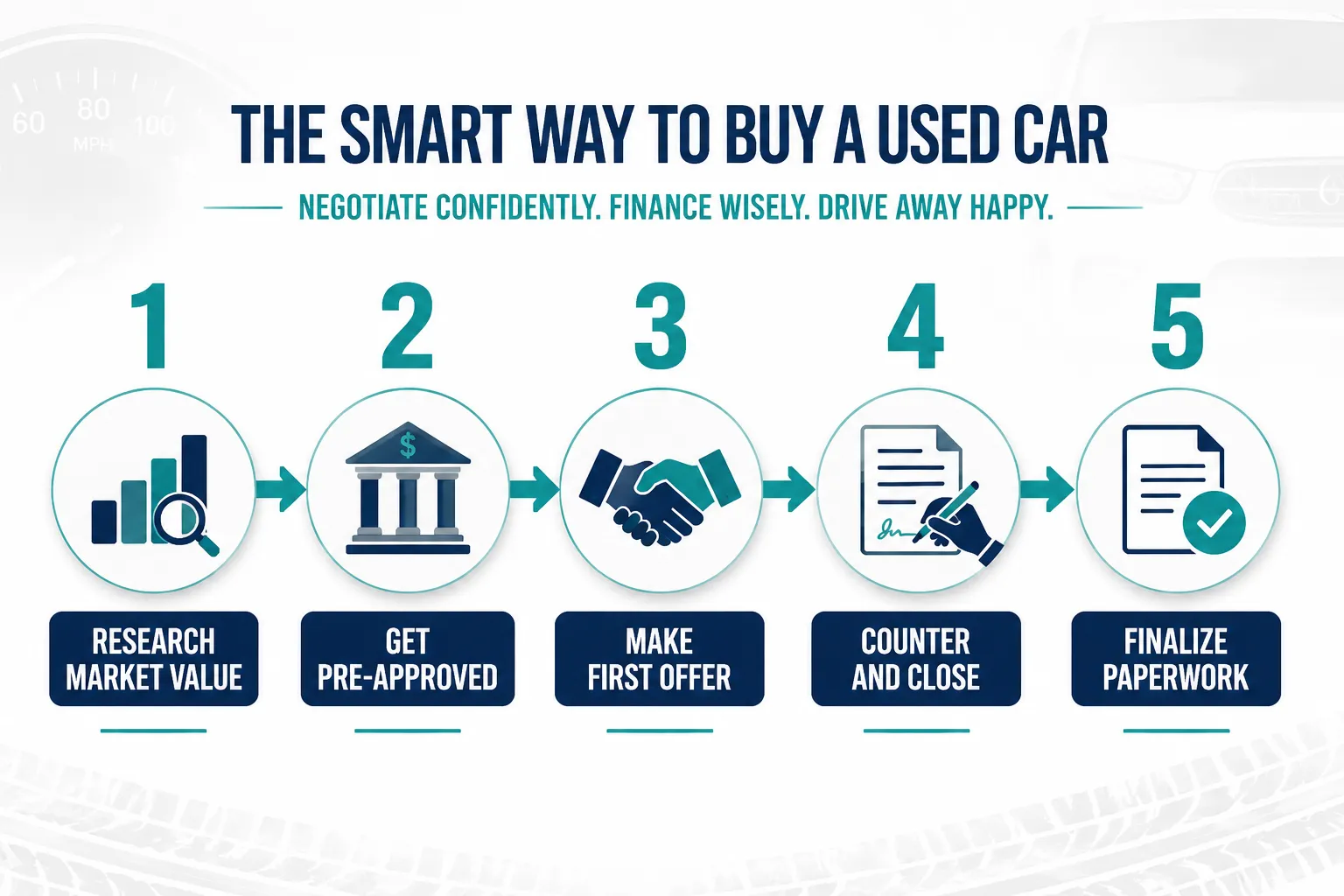
The most effective negotiation strategy starts before setting foot in a dealership: know the market value of the specific vehicle before making any offer. Buyers who walk in without this knowledge consistently overpay.
Use NADAguides, Kelley Blue Book, and Edmunds’ True Market Value to establish a fair price range for the exact year, mileage, trim, and condition of the target vehicle. The Blue Book Car Value Guide is a useful starting point for understanding how these valuations are constructed.
Negotiation framework:
- Anchor below market: Open with an offer 5-8% below the fair market value figure. This gives room to move while staying credible.
- Negotiate the total price, not the monthly payment: Dealers can manipulate monthly payments by extending loan terms. Always focus on the out-the-door price.
- Use competing offers: A written offer from another dealer or a private-party listing at a lower price is the most powerful negotiating tool available.
- Time your visit: End-of-month visits often yield better deals, as salespeople are working toward monthly quotas.
- Be willing to walk away: The single most effective negotiating tactic. A buyer who is not emotionally attached to one specific car has all the leverage.
Mid-2026 wholesale prices are cooling while retail prices remain elevated [10], which means there is genuine room to negotiate, especially on vehicles that have been sitting on a lot for more than 30 days.
How to Get Financing for a Used Car
Getting pre-approved for a used car loan before shopping is the single most important financial step in the buying process. Pre-approval establishes a clear budget ceiling and prevents dealers from using financing as a negotiating tool against the buyer.
For a detailed breakdown of how used car loans work, including interest calculation and loan term tradeoffs, the how does a used car loan work guide covers the mechanics clearly.
Financing options ranked by typical rate:
- Credit union loans: Usually the lowest rates available. Members of federal credit unions often access rates 1-2 percentage points below bank rates.
- Bank loans (pre-approval): Competitive rates, especially for buyers with credit scores above 720.
- Online lenders (LightStream, PenFed, Autopay): Convenient and often competitive, particularly for well-qualified buyers.
- Dealer financing: Convenient but often carries a markup over the rate the dealer actually secured. Always compare against a pre-approval.
- Buy-here-pay-here lots: Last resort only. Rates are typically very high and vehicle quality is inconsistent.
Key financing rules:
- Keep loan terms at 48-60 months maximum. Longer terms lower monthly payments but increase total interest paid and create negative equity risk.
- A down payment of 10-20% reduces the loan amount and improves the rate offered by most lenders.
- Check your credit report before applying to catch and dispute any errors that could lower your score.
Used car loan rates in mid-2026 remain elevated compared to the 2019-2021 period, reflecting the broader interest rate environment. Buyers with strong credit scores (740+) are in the best position to access competitive rates [1][2].
Used Cars That Are Overpriced Right Now
Full-size pickup trucks, luxury SUVs, and high-demand compact SUVs like the Toyota RAV4 are currently the most overpriced segments in the used market as of mid-2026. Retail prices in these categories remain stubbornly high even as wholesale values begin to soften [3][10].
According to Black Book’s mid-2026 market analysis, wholesale used car values have been declining modestly while retail prices have not followed at the same pace, creating an unusually wide dealer margin in certain segments [3].
Segments where buyers are likely overpaying in 2026:
- Full-size pickup trucks (Ford F-150, Chevy Silverado, Ram 1500): Demand remains high but wholesale prices are cooling. Dealers are holding retail prices firm. Buyers should negotiate harder here or wait for Q4 2026.
- Luxury SUVs (BMW X5, Mercedes GLE, Audi Q7): These were already expensive to own; inflated used prices make the value proposition even weaker.
- Toyota RAV4 (2021-2023): Demand is so high that some dealers are pricing above comparable new RAV4 inventory. Compare carefully before buying used over new in this case.
- Toyota Tacoma: Resale value is exceptional, which means buyers pay a premium. The value is there long-term, but short-term buyers may find better alternatives.
Better value alternatives right now:
- Honda CR-V instead of RAV4 (similar reliability, lower price premium)
- Ford Maverick instead of full-size trucks (better fuel economy, lower price)
- Kia Telluride instead of luxury SUVs (comparable features at a fraction of the maintenance cost)
The Carfax used car price growth data confirms that prices in high-demand segments have outpaced the broader market [4], reinforcing the case for considering alternatives in overpriced categories.
FAQ
What is the most reliable used car brand in 2026? Toyota is the most reliable used car brand in 2026, followed closely by Honda and Mazda. These three brands consistently top J.D. Power VDS scores and Consumer Reports reliability surveys across multiple vehicle categories.
What mileage should I avoid when buying a used car? There is no universal cutoff, but most mechanics recommend caution above 100,000-120,000 miles on vehicles without documented maintenance history. A well-maintained Toyota or Honda at 130,000 miles can be a better buy than a neglected vehicle at 60,000 miles.
Is it better to buy from a dealer or a private seller? Dealers offer CPO programs, financing, and some legal protections. Private sellers typically offer lower prices but no warranty. For first-time buyers, a dealer CPO purchase reduces risk. Experienced buyers comfortable with inspections can find excellent value through private sales.
How much should I spend on a used car? A common guideline is to keep total vehicle costs (payment, insurance, fuel, maintenance) below 15-20% of monthly take-home pay. As a rough rule, avoid financing a vehicle worth more than 35% of your annual gross income.
What year used cars offer the best value in 2026? The 2020-2022 model year range offers the best balance of modern safety features, low remaining depreciation, and manageable mileage. These vehicles are past the steepest part of the depreciation curve but still have significant useful life ahead.
Should I buy a used hybrid or a used gas car? For high-mileage drivers (15,000+ miles per year), a used Toyota hybrid (Camry Hybrid, RAV4 Hybrid, Prius) typically delivers lower total ownership costs despite a higher purchase price. For low-mileage drivers, a reliable gas model may be more cost-effective. For more context on the electric and hybrid market trajectory, the electric cars cheaper than ICE within five years study provides useful long-term perspective.
What is a Certified Pre-Owned (CPO) car? A CPO vehicle has been inspected and reconditioned to meet manufacturer standards, then sold with an extended manufacturer-backed warranty. Toyota and Honda CPO programs are among the most comprehensive, offering powertrain coverage up to 7 years/100,000 miles from the original sale date.
How do I know if a used car price is fair? Cross-reference the asking price against NADAguides, Kelley Blue Book, and Edmunds’ True Market Value for the exact year, mileage, trim, and condition. If the asking price is more than 5-8% above all three sources, negotiate down or walk away.
Are used EVs a good buy in 2026? Used EVs from established brands (Tesla Model 3, Chevrolet Bolt, Hyundai Ioniq 5) can be excellent value in 2026, particularly as off-lease inventory increases. Key concern: battery health. Always request a battery health report and factor in replacement cost if capacity is below 80%.
What documents should I receive when buying a used car? Title (or lien release if financed), bill of sale, odometer disclosure statement, emissions/inspection certificate (where required), and any remaining warranty documentation. Never take delivery without a clear title.
Conclusion
Finding the best used cars in 2026 comes down to three fundamentals: choosing a model with a proven reliability record, verifying its history and condition before committing, and paying a price grounded in current market data rather than dealer asking price.
Toyota, Honda, and Mazda remain the safest bets across nearly every category. The 2020-2022 model year range sits in the value sweet spot, past peak depreciation, equipped with modern safety features, and still well within a long useful service life. For families, the Honda Pilot, Toyota Highlander, and Kia Telluride offer the best combination of space, safety, and reliability. For budget buyers, a 2017-2019 Honda Civic or Toyota Corolla with documented service history remains one of the smartest purchases in any market condition.
Actionable next steps:
- Decide on your total budget, including insurance, registration, and a maintenance reserve.
- Narrow your list to 2-3 target models using the reliability tiers in this guide.
- Get pre-approved for financing from a credit union or bank before visiting any dealership.
- Use NADAguides or Kelley Blue Book to establish fair market value for each candidate.
- Run a Carfax report and schedule a pre-purchase inspection on any vehicle before signing.
- Negotiate the out-the-door price, not the monthly payment.
Mid-2026 market conditions favor patient, prepared buyers. Wholesale prices are cooling [3][10], off-lease inventory is growing [1], and dealers in slower-moving segments have more room to negotiate than they have in several years. The buyers who do the work upfront consistently get the best deals.
References
[1] Q1 2026 Edmunds Insights Used Car Report – https://www.edmunds.com/car-news/q1-2026-edmunds-insights-used-car-report.html
[2] Is Now The Time To Buy Sell Or Trade In A Used Car – https://www.kbb.com/car-advice/is-now-the-time-to-buy-sell-or-trade-in-a-used-car/
[3] Used Car Market 2026 Where Values Stand At The Halfway Point – https://www.blackbook.com/used-car-market-2026-where-values-stand-at-the-halfway-point/
[4] Carfax Used Car Price Growth – https://finance.yahoo.com/real-estate/articles/carfax-used-car-price-growth-120000014.html
[7] Used Car Inventory Pricing – https://www.carscoops.com/2026/08/used-car-inventory-pricing/
[10] Used Car Prices Wholesale Cooling Retail Record July 2026 – https://zilocar.com/vehicle-news/used-car-prices-wholesale-cooling-retail-record-july-2026