
Last Updated on November 21, 2026
A Class C motorhome owner who uses their rig just 21 nights a year can face an effective cost of over $500 per night once fixed ownership expenses are divided across actual usage.[1] That number alone explains why so many new RV owners feel blindsided. The purchase price was never the real question. The real question is how much does an RV cost to own per year, once fuel, insurance, storage, repairs, tires, and campground fees are added together.
The honest answer: somewhere between $16,000 and $42,000 annually for a typical owner, not counting the RV payment itself. Where you land in that range depends almost entirely on how often you travel, where you store the rig, and what class of RV you own.
Key Takeaways
- Total annual RV ownership costs (excluding purchase price) typically run $16,000 to $42,000 per year, depending on RV class and usage frequency.
- Insurance averages roughly $594/year for travel trailers and $1,052/year for motorhomes, though full-timers pay more.[2][3]
- Storage ranges from free (home storage) to $3,600/year at paid facilities.
- Campground fees span $0 for boondocking to $150+ per night at luxury resorts, with private parks averaging $50-$90/night.
- Low-usage owners face the highest per-night costs because fixed expenses get spread across fewer travel nights.[1]
Breaking Down Fixed Costs vs Trip-Based Costs
Not every RV expense behaves the same way. Fixed costs show up whether the RV leaves the driveway or not. Trip-based costs only appear when you actually travel. Understanding this split is the foundation of any realistic answer to how much does an RV cost to own per year.
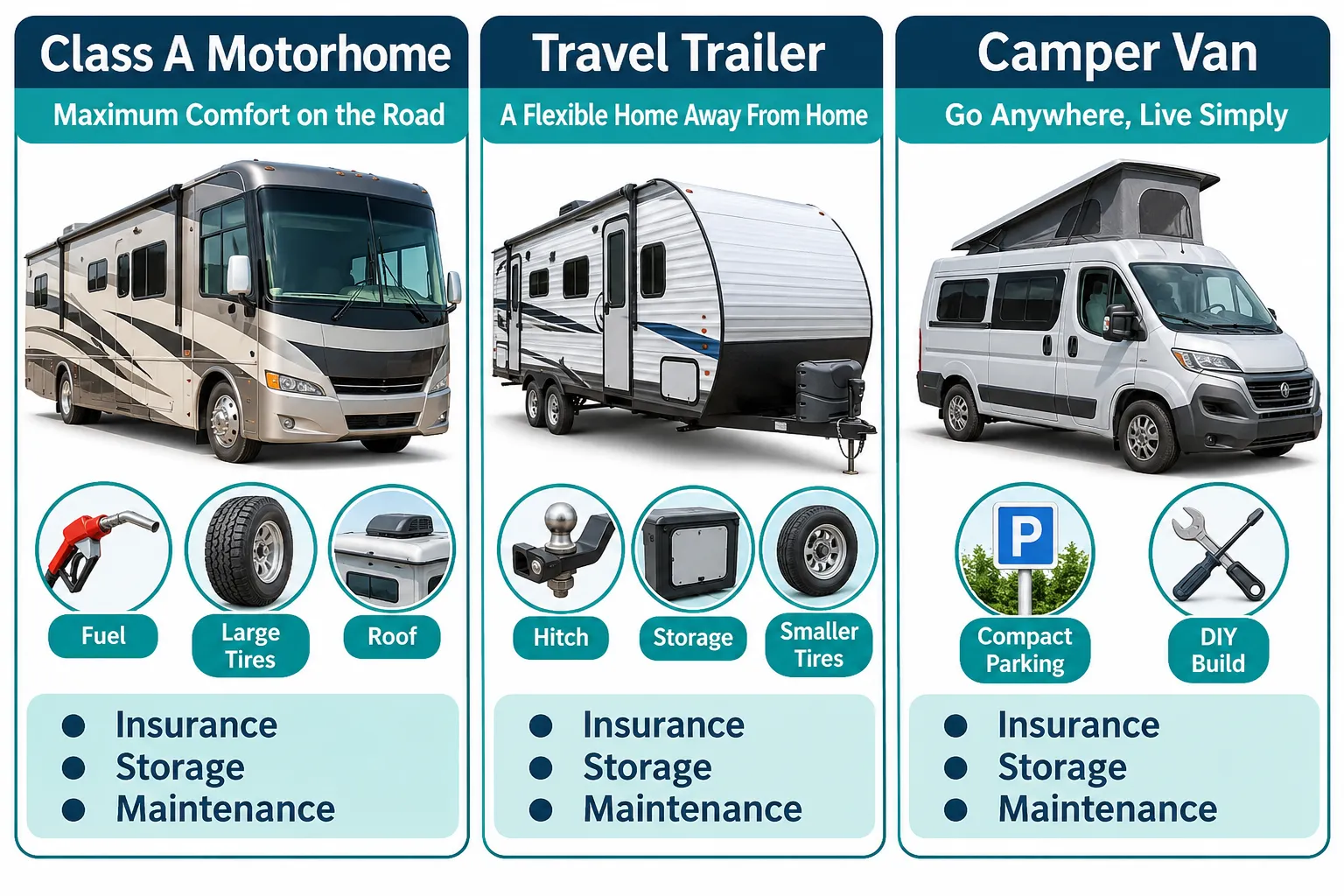
Fixed, recurring costs include:
- Insurance, $600 to $1,500+ per year for recreational use, more for full-time living[2][3][4][5]
- Storage, $0 (home storage) to $3,600 per year at a paid facility
- Maintenance reserve, $1,000 to $3,000 per year, even on newer units
Trip-based costs include:
- Fuel, highly variable based on miles driven and RV class[1]
- Campground fees, $0 to $150+ per night depending on site type
One 2026 cost analysis deliberately excluded fuel and campgrounds from the “ownership” category, isolating payments, insurance, maintenance, and storage as the true fixed cost of simply possessing the RV.[1] That same analysis found annual fixed ownership costs of $12,050 and $11,280 for two motorized RV setups, and $4,935 for a towable trailer.[1] Because the median Class C owner only used their RV 21 nights per year in 2025, the effective nightly cost worked out to $574 and $537 for the motorized units and $165 for the towable.[1] Heavier use dramatically improves that math, it is purely a function of nights traveled.
If you are weighing an RV against another big-ticket recreational purchase, it is worth comparing against the real cost of owning a pontoon boat, which carries its own storage and maintenance math.
Insurance, Storage, and Maintenance Reserves by RV Class
Insurance costs scale with the RV’s size, value, and how it is used. Allstate data posted in November 2026 put average annual premiums at about $876 for motorhomes and $624 for travel trailers.[4] Other aggregated nationwide data shows averages of $1,052/year for motorhomes and $594/year for travel trailers.[2][3] Broader 2025-2026 guides list motorhome insurance ranging from $504 to $3,000 per year and towable RV coverage from $180 to $600 per year.[5] Some liability-only motorhome policies start as low as $125 per year.[2][6]
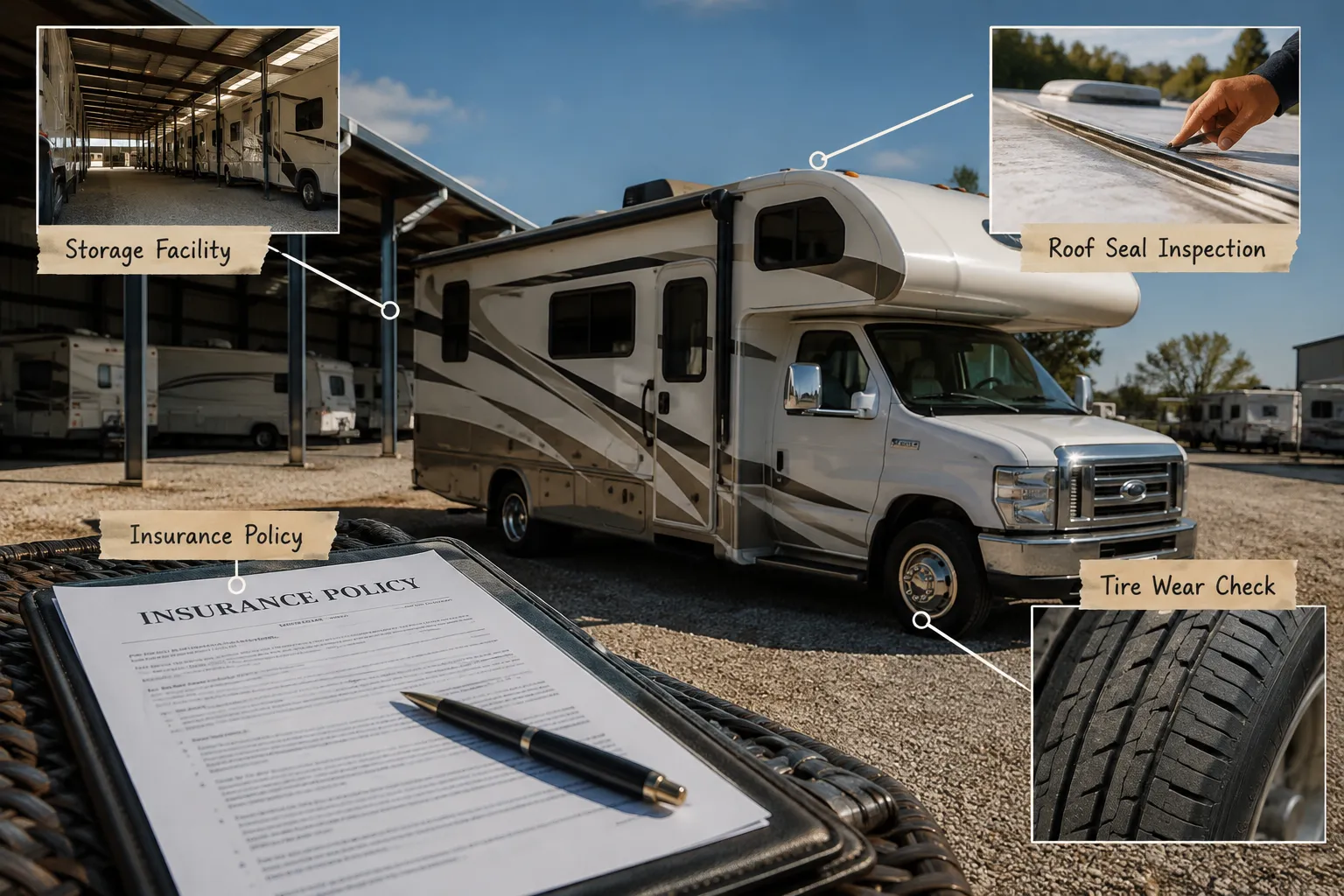
"The purchase price was never the real question. The real question is how much does an RV cost to own per year once every recurring expense is added together."
| RV Class | Typical Insurance/Year | Typical Storage/Year | Maintenance Reserve/Year |
|---|---|---|---|
| Class A Motorhome | $876 – $3,000 | $1,200 – $3,600 | $1,500 – $3,000 |
| Travel Trailer | $180 – $624 | $600 – $2,400 | $1,000 – $2,000 |
| Camper Van/Class B | $600 – $1,500 | $0 (often drivable storage) | $1,000 – $2,500 |
Storage is one of the most controllable line items. Owners with enough property to store the RV at home sidestep the $600-$3,600 annual fee entirely. Analysis of usage patterns shows rural owners who can store at home and travel 60+ nights per year make ownership financially work far better than urban owners paying for storage while using the rig only a handful of weekends a year.[1] If you’re building out a home storage setup, ideas from enclosed trailer storage and camping projects and small garage designs that maximize space can help you avoid paying a facility.
Maintenance deserves its own reserve fund, separate from insurance and storage. Industry research aggregated by RVShowoff and Cruise America in early 2026 recommends setting aside $1,000 to $3,000 annually, even for newer rigs, because tire replacement, seal resealing, and appliance repairs tend to arrive in lumpy, unpredictable waves rather than evenly each year. Owners should also understand common coverage gaps, see mistakes people make with RV insurance before assuming a cheap policy covers everything. Tires and suspension are frequent surprise expenses too; it’s worth reading whether disc brake and suspension upgrades are worth the money before budgeting those repairs. Roof and seam maintenance is another frequent line item, see this guide on how to reseal your RV for a sense of what that task involves.
Campground Fees, Fuel, and Total Annual Cost Scenarios
Campground and RV park rates have climbed into a wide $30-$150+ per night band by 2025.[7][8][9] Late 2026 travel reporting pegs typical U.S. campground fees at $30-$100 per night.[8] RoverPass industry data shows average daily rates of $64.85 at small parks, $83.00 at medium parks, and $95.00 at large parks.[9] Private RV parks with full hookups now average roughly $50-$80 per night.
A 2025 Harvest Hosts breakdown lays out the spread clearly:
- Dry camping/boondocking: $0 – $20/night
- Basic electric/water sites: $30 – $55/night
- Full-hookup private parks: $55 – $90/night
- Luxury RV resorts: $90 – $150+/night
Do the math on moderate use: 30 nights a year at a mid-range $70 site comes to roughly $2,100 annually. RVShowoff’s broader budgeting table places typical annual campground spending anywhere from $2,400 to $12,000+ for frequent travelers or resort-heavy itineraries. For long-term stays, Sun Communities reported an average monthly base rent of $682 per annual RV site at the end of 2025 (about $8,184 per year), up 4.6% from the prior year.[7] Other RV park living guides cite monthly site fees ranging from roughly $200 to $1,000+ depending on park type and how much the resident boondocks in between.
Fuel is often treated as a trip cost rather than a core ownership expense, since it depends entirely on how many miles you drive.[1] Active travelers putting on thousands of miles per year can see fuel rival or exceed their campground spending, while seasonal or stationary owners spend comparatively little. This is also where RV class matters most, a large Class A motorhome towing a vehicle burns dramatically more fuel than a camper van. For those spending extended time off-grid, connectivity costs matter too; many full-timers evaluate whether Starlink is worth the cost for staying connected at remote sites.
Putting it all together, annualized scenarios look roughly like this:
- Light use (10-15 nights/year, home storage): insurance + minimal storage + maintenance reserve + modest fuel/camping = around $4,900-$8,000/year[1]
- Moderate use (30-45 nights/year, paid storage): $16,000-$25,000/year once campground fees and fuel scale up
- Heavy/full-time use: $25,000-$42,000+/year, driven by resort-style campground fees, higher fuel consumption, and elevated insurance for full-time living[2][4][5]
Full-timers in particular should review lessons from full-time RV living mistakes and realistic downsides covered in the bad things about RVing before committing to that end of the spectrum. Budget-conscious buyers may also want to start with the best budget-friendly RVs to keep every recurring cost category smaller from day one.
Conclusion
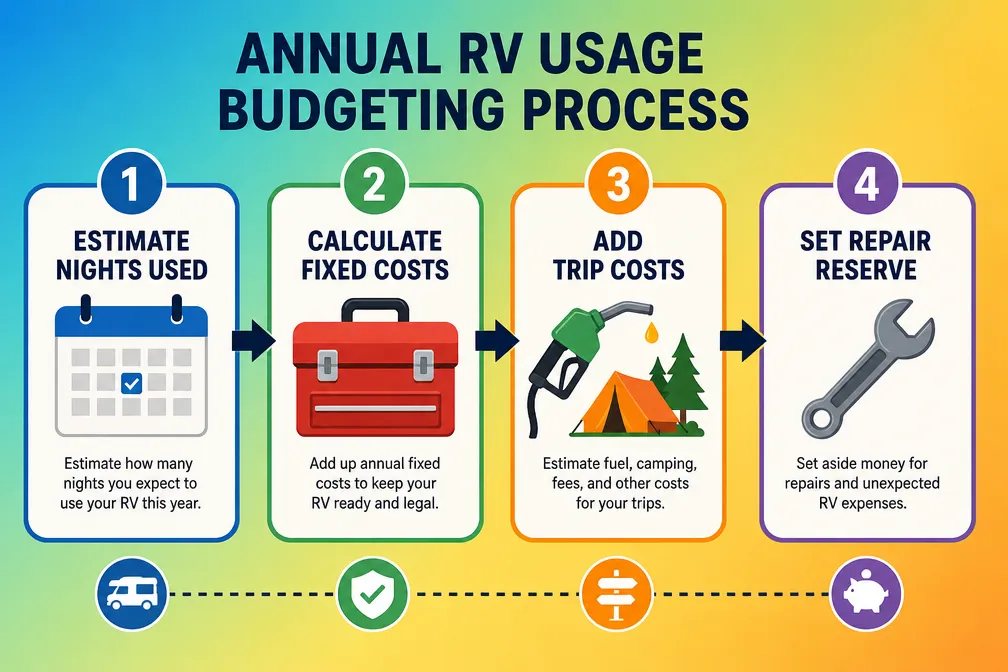
There is no single figure that answers how much does an RV cost to own per year, because the real driver is usage pattern, not sticker price. A rig stored at home and driven often will always cost less per night than an identical rig paying for storage and sitting unused most weekends. Before buying, build a written annual budget covering insurance, storage, a maintenance reserve, expected campground nights, and realistic fuel mileage. Then stress-test it against your actual travel habits, not your aspirational ones. For deeper prep, review a cleaning and prepping RV checklist and browse the full RV resources hub before your next trip.
References
- Article315584755. tri-cityherald.com.
- Travel Trailer Insurance. travelstatisticsbureau.com.
- Rv Insurance Guide. 1800insurance.com.
- Rv Insurance. allstate.com.
- Cost to Insure a Camper. mitchelljoseph.com.
- Rv Insurance. progressive.com.
- Campground Rv Industry Statistics. axiobench.com.
- The One Thing First Time Rv Renters Wish Someone Had Explained. tripjaunt.com.
- Hidden Costs of Rv Living. boondockorbust.com.