Last Updated on October 31, 2026
Touring motorcycle sales fell 13% and cruiser sales dropped 6% in 2025, while smaller adventure bikes under 600cc grew roughly 10% the same year [1]. That is not a minor blip. It is a signal that the way people choose motorcycles has fundamentally shifted, and understanding that shift is central to how to choose a motorcycle: cruiser, standard, sport, adventure, dual-sport, or touring that actually fits your life rather than your Instagram feed.
Most buying guides start with styling. This one starts with math: your height, your commute, your passenger plans, your tolerance for wrenching, and your actual riding terrain. Those five variables predict satisfaction far better than engine badges or paint schemes.
Key Takeaways
- Standard (naked) motorcycles now hold about 42.73% of the market and are the safest default for most new riders [2].
- Adventure and dual-sport bikes are the fastest-growing category, driven by riders who want one bike for commuting, light touring, and gravel roads [2][3][4].
- Touring and cruiser sales are shrinking as buyers shift toward smaller, more versatile, tech-equipped models [1].
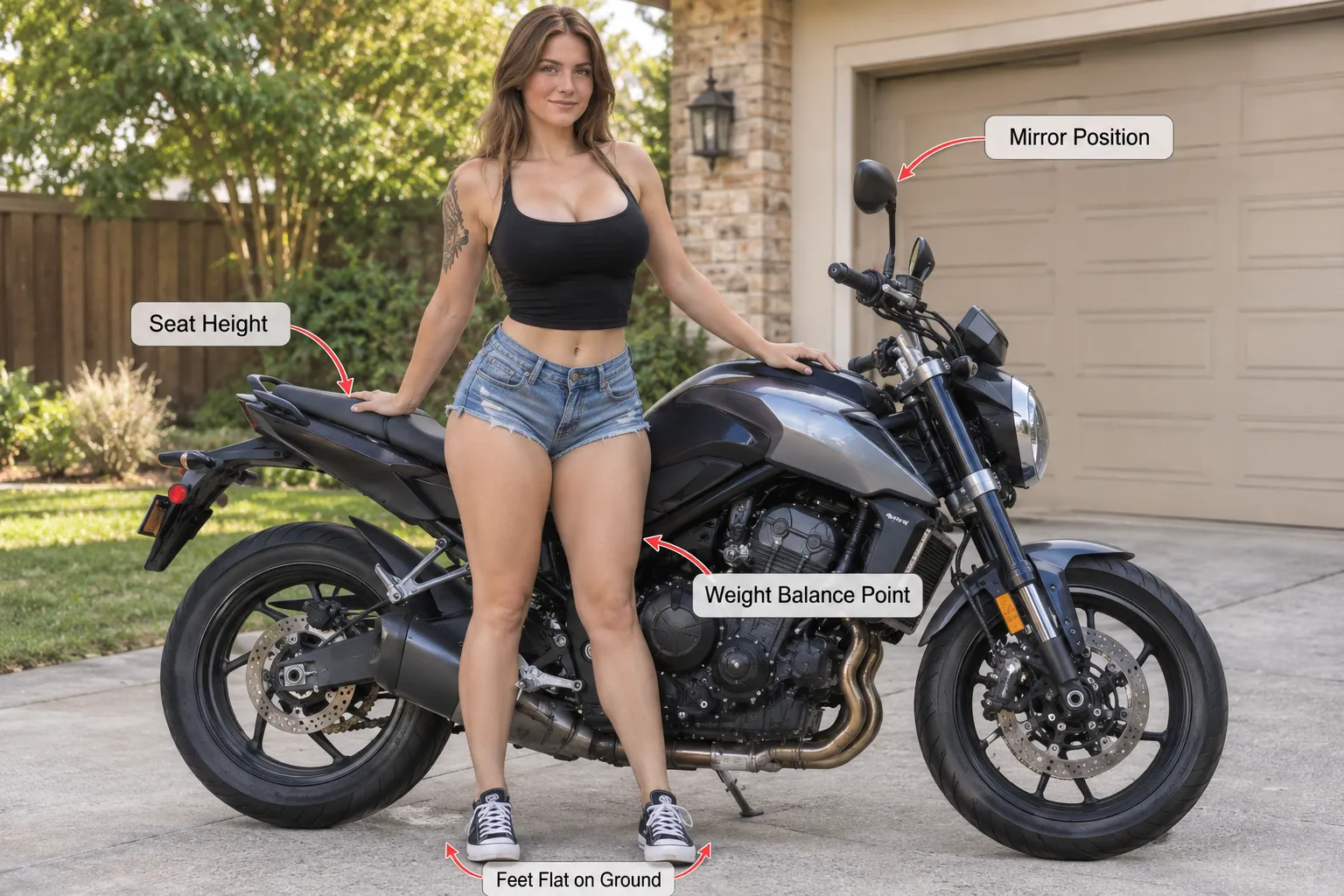
- Seat height, weight distribution, and your flat-footed reach matter more than horsepower for comfort and confidence.
- A simple decision tree based on height, experience, commute distance, passenger needs, terrain, and maintenance tolerance can narrow six categories down to one in minutes.
How to Choose a Motorcycle Based on Rider Height and Experience
Seat height and bike weight are the two specs that end more new-rider shopping trips than any price tag. If your feet cannot comfortably reach the ground, even a technically “easy” bike feels frightening in parking lots and traffic stops.
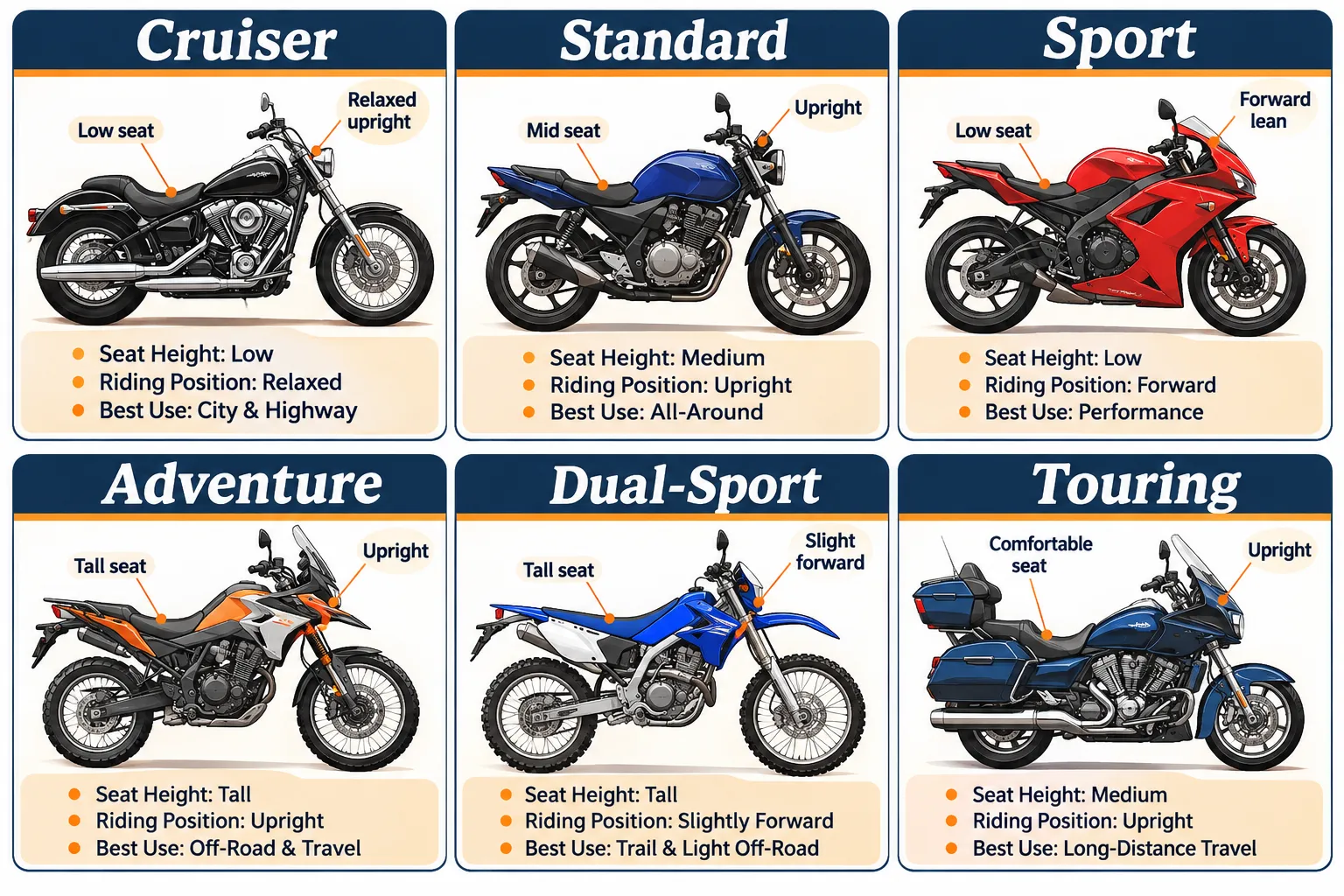
Riders under 5’6″ generally feel most confident on cruisers (low seat heights, often 26-27 inches) or standard naked bikes designed with accessible ergonomics. Taller riders have more flexibility across categories, including adventure bikes, which tend to run tall (33-35 inches) for ground clearance.
Beginner guidance consistently points first-time riders toward lightweight machines in the 250-500cc range, ideally used, with a modest power curve and neutral, upright ergonomics rather than aggressive sportbike geometry [5]. Harley-Davidson’s own category breakdown echoes this: the manufacturer explicitly tells shoppers that “how you want to ride and where you’d like to ride” should drive the category choice, not looks alone [6].
A quick gut-check for new riders:
- Can you flat-foot the bike with knees slightly bent? If not, look at a lower trim or different category.
- Can you pick the bike up off its side stand without straining? Weight matters as much as seat height.
- Does the throttle response feel twitchy at idle? If yes, it may be tuned for experienced hands.
How to Choose a Motorcycle for Your Commute, Passengers, and Luggage
This is where lifestyle, not fantasy, should drive the decision. Ask three blunt questions: How many highway miles per week? Do you regularly carry a passenger? How much gear do you need to haul?
Short urban commute, solo rider, minimal highway: A standard or naked bike is the practical answer. Standards sit at the center of the market for a reason, upright seating, moderate power, and enough versatility to handle a weekend trip with soft luggage [2][7].
Long highway miles, frequent passenger, heavy gear: Touring motorcycles remain purpose-built for this job, with large fairings, windscreens, hard saddlebags, and comfort amenities like heated seats and integrated navigation [7]. Despite declining sales, touring bikes still solve real problems for riders who log serious interstate miles. Market research links this demand to older, more affluent riders in North America and Europe who prioritize comfort over agility [8].
Mixed commuting plus occasional long trips with some unpaved roads: Adventure bikes are built exactly for this blend. More than 42% of adventure motorcycle buyers cite long-distance touring as their main reason for purchase, while 34% want mixed on-road and off-road capability [4]. That dual-purpose design, bigger fuel tanks, long-travel suspension, integrated luggage mounts, explains why adventure is now the fastest-growing segment globally [2][3].
Relaxed solo cruising, classic styling, mostly paved roads: Cruisers still deliver a laid-back riding position and torque-forward feel that many riders love, even as the category’s overall sales soften [1][6][7].
How to Choose a Motorcycle: Cruiser, Standard, Sport, Adventure, Dual-Sport, or Touring Decision Tree
Here is a condensed decision path. Walk through it in order; stop as soon as one answer fits clearly.
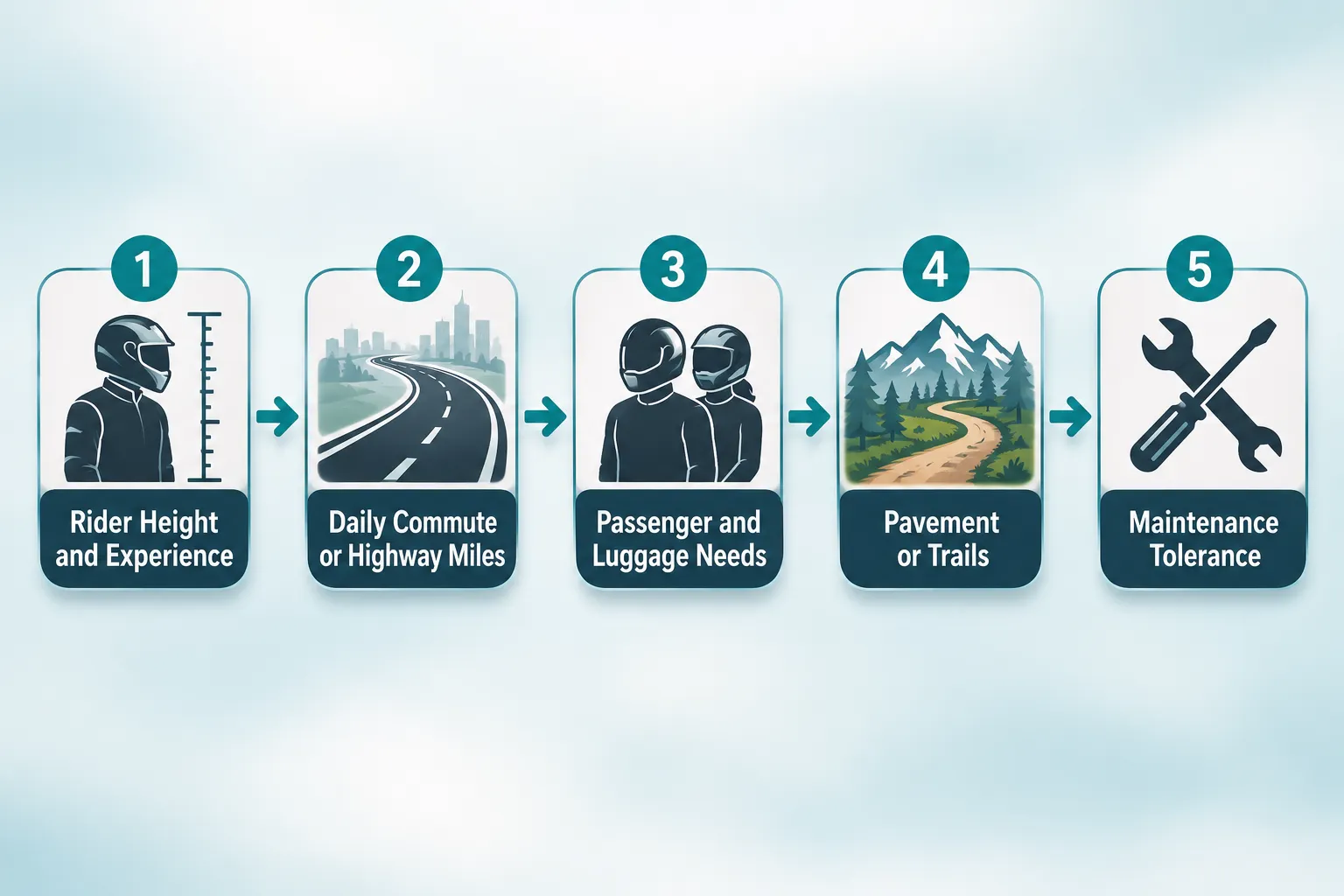
- Are you brand new to riding? If yes, lean toward a standard or light adventure bike in the 250-500cc range. Skip sportbikes and large touring rigs for now [5].
- Will most of your riding be city streets and short trips? Standard or cruiser, depending on preferred seating position.
- Do you need to cover long highway distances in comfort, often with a passenger? Touring or sport-touring.
- Do you want one bike for commuting and weekend gravel or trail exploring? Adventure bike, the fastest-growing category for a reason [2][3].
- Is your riding mostly dirt, single-track, or rough backcountry roads with some pavement to get there? Dual-sport, which trades highway comfort for lighter weight and better off-road control [7]. 6** Do you care primarily about cornering speed, track days, or aggressive pavement performance, and can you accept a forward-leaning posture and minimal storage?** Sportbike [7].
If you are still torn between two categories, the tiebreaker is almost always maintenance tolerance and storage.
Maintenance Tolerance and Storage Reality
Sportbikes and high-performance adventure bikes tend to demand more frequent tire changes, chain maintenance, and specialized service. Standards and cruisers are typically simpler and cheaper to maintain long-term. Before buying, think honestly about where you will store and service the bike, garage space, tools, and seasonal storage all matter. If winter lay-up is part of your plan, review motorcycle winter storage solutions and consider seasonal garage organization ideas or garage bike storage ideas to keep your investment protected year-round.
Category Snapshot Table
| Category | Best For | Seat Height | Maintenance | Market Trend |
|---|---|---|---|---|
| Cruiser | Relaxed street/highway riding | Low | Moderate | Down 6% in 2025 [1] |
| Standard | Commuting, all-around use | Moderate | Low | Largest share, ~42.73% [2] |
| Sport | Performance, twisty roads, track | High, aggressive | High | Niche, performance-focused [7] |
| Adventure | Mixed commuting, light off-road, touring | High | Moderate-High | Fastest growing segment [2][3] |
| Dual-Sport | Trail riding with road capability | High, light chassis | Moderate | Growing with ADV demand [4][7] |
| Touring | Long-distance comfort, passengers | Moderate | High | Down 13% in 2025 [1] |
Beginner Mistakes to Avoid When Choosing a Motorcycle
Even with a clear decision tree, new buyers repeat the same errors.
- Buying for looks over fit. A bike that looks right in photos but feels unstable at a stoplight will erode confidence fast.
- Starting on a high-powered sportbike. Beginner guides consistently warn against this; the aggressive ergonomics and sharp throttle response overwhelm new riders [5][7].
- Ignoring passenger and luggage needs until after purchase. If weekend trips with a partner are part of the plan, factor that in before, not after, buying.
- Underestimating weight. A bike that feels fine on a showroom floor can feel very different after a U-turn in a parking lot or a tip-over at low speed.
- Overlooking technology that improves safety. Modern adventure, touring, and standard bikes increasingly include cornering ABS, traction control, multiple ride modes, and connected TFT displays as near-standard features, which matter more for a new rider’s confidence than raw horsepower [3][9]. Pairing any bike with smart AR motorcycle helmets and safety tech adds another layer of protection.
- Forgetting resale realities. Touring and cruiser segments are contracting [1], so resale value and parts availability deserve a second look before committing to a niche category.
- Skipping test rides across categories. A naked standard and an adventure bike can feel completely different even with similar specs on paper.
Where the Market Is Heading
The data points in one direction: versatility wins. Adventure motorcycles are projected to grow from roughly USD 12.3 billion in 2025 to USD 13.6 billion in 2026, and eventually USD 29.5 billion by 2034 [3]. Standard bikes already dominate overall market share [2]. Meanwhile, lighter chassis construction, a reported 22% increase in aluminum subframes and composite panels, is pushing adventure bikes below 220 kg, making them more approachable for a wider range of riders [4].
Electric options are still early-stage; electric adventure bikes made up less than 2% of segment sales in 2025, but improving battery density and charging infrastructure suggest this will shift over the next several years [9]. If you are curious about where electric power sports are headed more broadly, electric dirt motorcycles in 2026 offers a useful parallel view, and riders comparing lightweight commuter alternatives may also want to read about electric e-scooters vs e-bikes for urban riders.
Conclusion
Choosing between cruiser, standard, sport, adventure, dual-sport, and touring motorcycles comes down to an honest audit of your body, your roads, and your routine, not the loudest exhaust note or the sharpest paint job. Standards remain the safest, most versatile starting point for most riders. Adventure and dual-sport bikes make sense if your week mixes pavement with dirt or gravel. Touring and cruiser categories still serve riders who prioritize comfort and classic feel over agility, even as their market share shrinks. Sportbikes belong to riders chasing performance who accept the tradeoffs in comfort and storage.
Before you buy, test ride at least two categories, confirm you can flat-foot and lift the bike confidently, and map your realistic weekly mileage and passenger needs. Then revisit the decision tree above, it will point you to the right machine faster than any spec sheet. For storage and setup after purchase, check garage car show display ideas and spring garage cleaning and organization hacks to keep your new ride protected and ready.
References
- Mic Reports 2025 Motorcycle Atv Retail Sales Decline as Buyers Shift to Smaller Models. powersportsbusiness.com.
- Motorcycle Market Global Industry Size Share. researchandmarkets.com.
- Adventure Motorcycle Market 104082. fortunebusinessinsights.com.
- Global Adventure Touring Motorcycle Market. dataintelo.com.
- How to Buy Your First Motorcycle. vikingbags.com.
- Types of Motorcycles. harley-davidson.com.
- What Kind of Motorcycle Is Best for You. motorcycles.autotrader.com.
- Touring Motorcycle Market. dataintelo.com.
- Adventure Touring Motorcycle Market. verifiedmarketresearch.com.
motorcycle buying guide, cruiser motorcycle, standard motorcycle, sportbike, adventure motorcycle, dual-sport motorcycle, touring motorcycle, beginner motorcycle tips, motorcycle categories, riding ergonomics, motorcycle decision tree, powersports market trends