Last Updated on November 1, 2026
Three-row SUVs lose value faster than almost any other vehicle class, which means a four-year-old Pilot, Highlander, or Ascent can often be had for 40 to 50 percent less than its original sticker price. That depreciation curve is good news for budget-conscious families, but it also means buyers are choosing between very different mechanical philosophies, V6, hybrid four-cylinder, and turbocharged flat-four, each with its own failure points and towing ceilings.
This guide breaks down Honda Pilot vs Toyota Highlander vs Subaru Ascent: Best Used Three-Row SUV for Families and Towing using real-world towing numbers, third-row usability, car-seat access, fuel economy, and the repair bills that tend to show up after 60,000 miles.
Key Takeaways
- The Honda Pilot leads in towing capacity, pulling up to 5,000 pounds with the tow package, making it the strongest pick for boats, campers, or small trailers [1][2].
- The Subaru Ascent offers the best standard all-wheel drive and solid turbo power, but owners report more transmission and engine-related complaints than Honda or Toyota buyers [3][4].
- The Toyota Highlander’s hybrid trims deliver the best fuel economy of the three, though its tow rating trails the Pilot.
- Third-row space and car-seat access vary significantly; the Pilot’s removable second-row seats and Ascent’s wide-opening doors both earn praise from families.
- Used shoppers should prioritize specific model years over trim level, since reliability and recall history shift noticeably year to year.
Honda Pilot vs Toyota Highlander vs Subaru Ascent: Best Used Three-Row SUV for Families and Towing, Overall Verdict
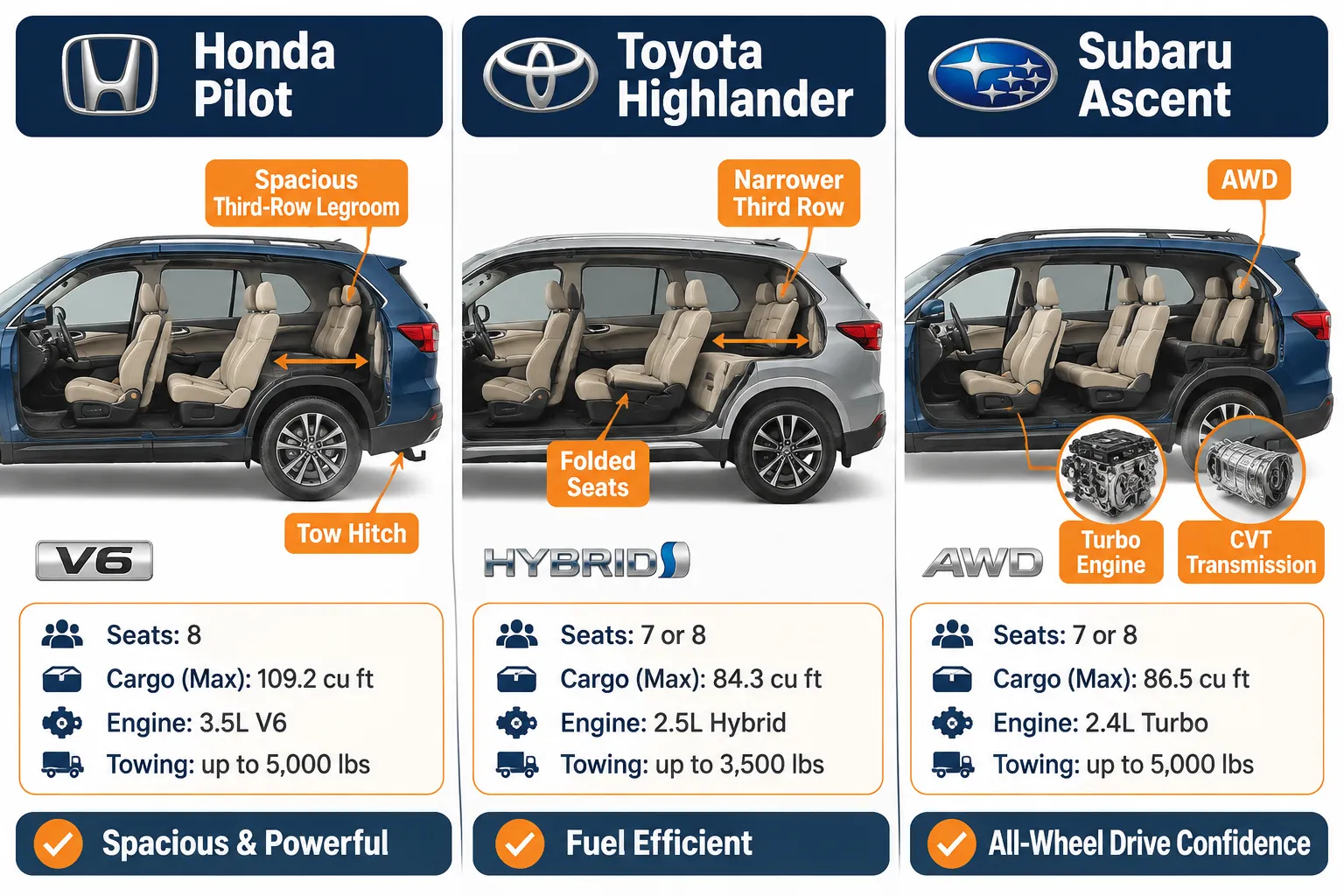
For families who split their time between carpool duty and weekend towing, the Honda Pilot is the most balanced used buy. It combines a proven V6, the highest tow rating of the group, and a cabin that Honda engineers specifically widened for easier third-row entry [1]. The Toyota Highlander answers back with better fuel economy and a reputation for long-term durability, while the Subaru Ascent wins on standard all-wheel drive and a roomier-feeling cabin for its price point.
None of these three is a bad choice. The right one depends on whether towing capacity, fuel costs, or all-weather traction matters most to your household. If you’re still narrowing down your shortlist, the complete guide to buying used cars covers inspection steps that apply to any three-row SUV purchase.
Towing Capacity and Hardware: The Pilot’s Key Advantage
Towing is where the Pilot separates itself from the pack. Properly equipped Pilots are rated to tow up to 5,000 pounds, thanks to a 3.5-liter V6 producing 280 horsepower paired with a nine-speed automatic and an available factory tow package with a transmission cooler [1][2]. That rating covers mid-size travel trailers, pop-up campers, and most boats in the 20-foot range.
The Subaru Ascent, by contrast, tops out around 5,000 pounds on paper in some trims but relies on a smaller turbocharged 2.4-liter flat-four and a continuously variable transmission (CVT) to get there, a combination that works fine for light loads but runs hotter and under more strain during sustained climbs with a loaded trailer. The Toyota Highlander’s gas V6 trims tow up to roughly 5,000 pounds as well, but many used Highlanders on the market are four-cylinder or hybrid models rated closer to 1,500 to 3,500 pounds, so shoppers need to check the specific trim and powertrain before assuming towing capability.
If towing is a top priority and you’re also considering the Subaru lineup more broadly, this breakdown of best used Subaru models for towing, snow, and light off-road travel under $25,000 is worth a look before you commit to the Ascent specifically.
Quick towing comparison:
| Model | Max Tow Rating (properly equipped) | Typical Engine |
|---|---|---|
| Honda Pilot | Up to 5,000 lbs | 3.5L V6 |
| Toyota Highlander (V6 trims) | Up to 5,000 lbs | 3.5L V6 |
| Toyota Highlander (hybrid) | ~1,500-3,500 lbs | 2.5L hybrid four-cylinder |
| Subaru Ascent | Up to 5,000 lbs | 2.4L turbo flat-four |
Powertrains and Fuel-Economy Trade-Offs
Every towing advantage comes with a fuel-economy cost, and this trio illustrates that trade-off clearly. The Pilot’s V6 is thirstier around town, typically landing in the high teens to low 20s for combined mpg, but it rewards that fuel use with smoother, more confident highway pulling power [5].
The Highlander hybrid is the efficiency champion of the group, often reaching the high 30s combined, excellent for daily school runs and errands, but not the vehicle you want hitched to a loaded trailer on a mountain grade. Non-hybrid Highlander V6 trims sit closer to the Pilot in both fuel economy and towing muscle.
The Ascent’s turbocharged flat-four tries to split the difference: reasonable mid-20s fuel economy with enough low-end torque for moderate towing, though the CVT can feel strained under heavy loads over long distances. For families cross-shopping brands more broadly, the used Subaru vs Honda vs Toyota reliability, resale value, and ownership cost comparison digs deeper into how these fuel and maintenance differences add up over five years of ownership.
“The best used three-row SUV is the one that matches your actual towing load, not the one with the highest number on the spec sheet.”
Reliability Snapshots and Segment Rankings
Consumer Reports’ reliability data for the 2024 model year places the Toyota Highlander and Honda Pilot ahead of the Subaru Ascent in overall predicted reliability, with the Ascent receiving below-average marks driven largely by engine and transmission complaints [4]. That said, reliability scores vary by model year, and some Ascent model years perform noticeably better than others.
Kelley Blue Book listings for the 2024 Pilot and 2024 Ascent show a clear price gap once depreciation kicks in on the used market, with the Pilot generally commanding a slightly higher resale value thanks to its stronger reliability reputation [6][7]. Edmunds’ feature and specification data on the 2024 Pilot also highlights a longer list of standard driver-assistance features compared to the base Ascent trims [8].
For shoppers trying to decide which brand historically holds value best after five years of ownership, the earlier-mentioned reliability, resale value, and ownership cost comparison is a useful companion read.
Owner Sentiment and Common Problem Areas: A Closer Look at the Ascent
Subaru’s own Consumer Reports data packet for the Ascent acknowledges owner-reported concerns clustered around engine performance and transmission behavior, particularly shuddering or hesitation under load in early production years [3][9]. This matters directly for towing buyers, since a CVT under thermal stress is more likely to show these symptoms than a traditional automatic.
Cars.com’s research page on the 2024 Ascent notes that owners generally praise the interior space, ride comfort, and standard safety suite, even while flagging the drivetrain concerns [10]. In practice, this means a well-maintained, later-model-year Ascent can still be a satisfying family vehicle, the key is avoiding early build years and verifying service records before buying.
Recalls and the Best Model Years for the Subaru Ascent
Because the Ascent’s known weak points center on engine and CVT durability, shoppers hunting for a used Ascent should lean toward later production years where Subaru made running changes to engine components and software calibration. Checking a vehicle’s specific recall history through the VIN before purchase is non-negotiable, this applies equally to any used SUV, not just the Ascent, and the other costs when buying a used car guide covers how unresolved recalls and deferred maintenance can turn into expensive surprises after the sale.
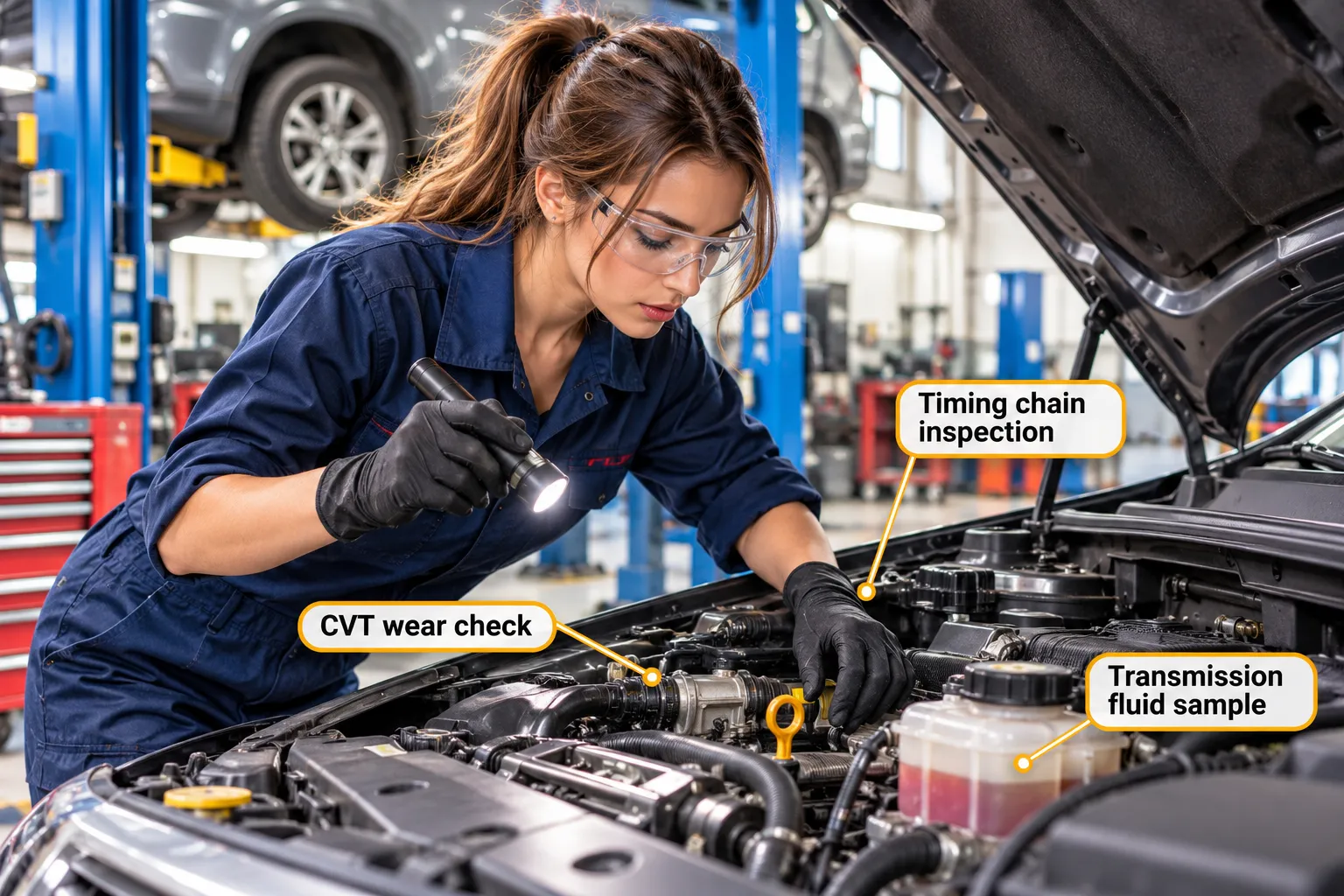
A pre-purchase inspection that specifically checks transmission fluid condition and looks for any history of engine oil consumption complaints will tell you more than the Carfax report alone. If the seller can’t produce service records showing regular fluid changes, treat that as a red flag regardless of how clean the vehicle looks.
Safety, AWD, and Family-Friendly Features
All three SUVs come standard with a strong suite of driver-assistance technology, including forward collision warning, lane-keeping assist, and adaptive cruise control on most trims from recent model years. The Subaru Ascent’s biggest structural advantage is that all-wheel drive is standard across every trim, while the Pilot and Highlander often require stepping up to AWD as an option on lower trims [1][8].
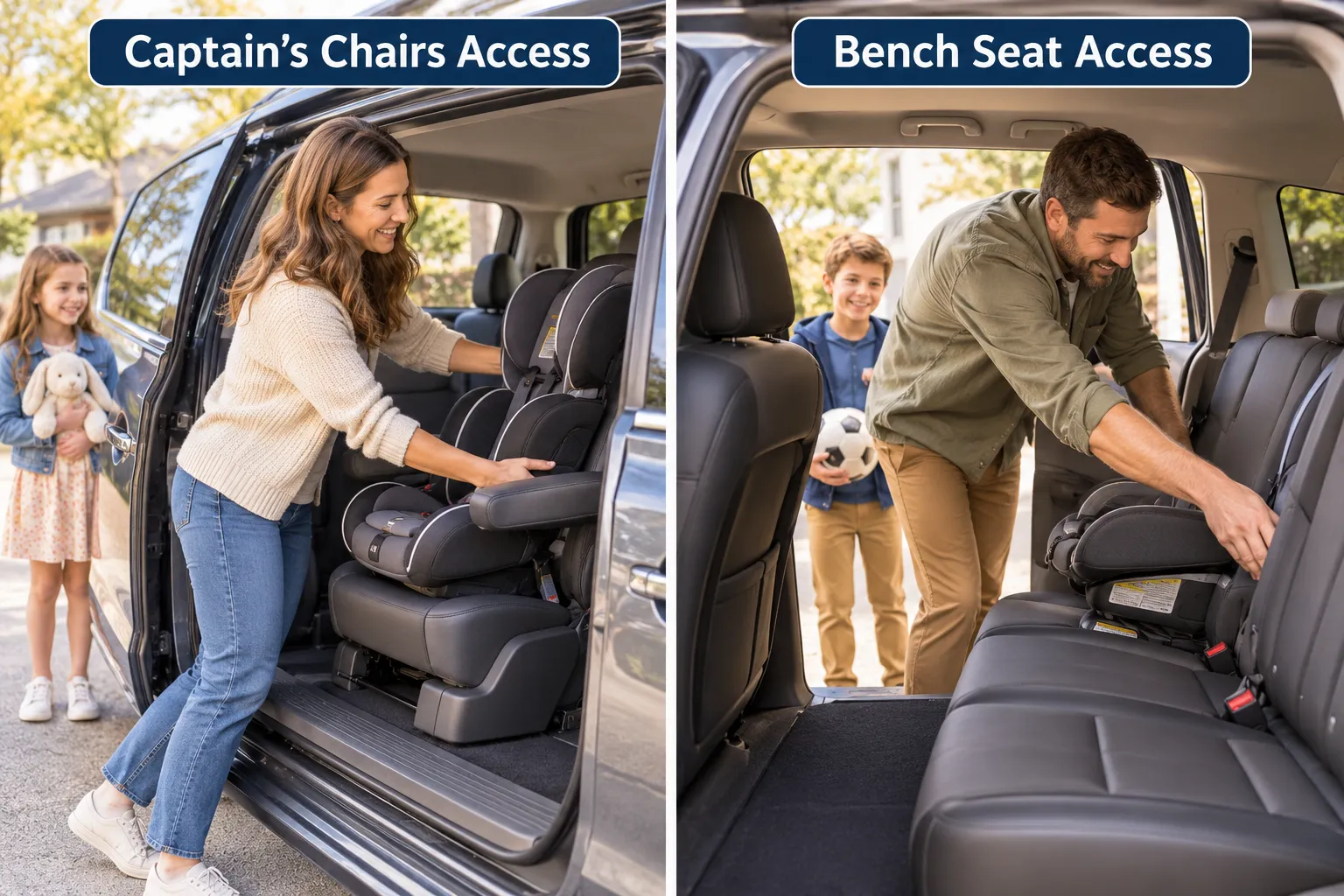
For families who live somewhere with regular snow or frequently drive mountain roads, that standard AWD can matter more than a few extra pounds of tow rating. Real-world access matters too: the Pilot’s second-row seats are easier to remove and reposition for larger child seats, while the Ascent’s wide rear doors and low step-in height make life easier for parents buckling toddlers. The Highlander sits in the middle on both counts, solid but not class-leading in either third-row room or car-seat ergonomics.
Cargo space behind the third row is tightest on the Highlander, moderate on the Ascent, and roomiest on the Pilot, which matters for families who regularly haul strollers, sports gear, and luggage simultaneously.
How to Choose Based on Your Towing and Family Needs
Use this simple framework when narrowing your decision between these three used SUVs:
- Choose the Honda Pilot if you regularly tow a boat, camper, or trailer near the 4,000 to 5,000-pound range and want the most third-row and cargo room.
- Choose the Toyota Highlander if daily fuel economy matters more than towing, and you only tow occasionally or not at all.
- Choose the Subaru Ascent if you need standard all-wheel drive for snow or rough weather and are comfortable verifying transmission maintenance history before buying.
Before finalizing a purchase, always confirm pricing against multiple valuation tools rather than trusting a single listing. The complete guide to used car valuation covering NADA, KBB, and fair market pricing is a solid next step, and comparing listings across platforms using the CarMax vs CarGurus vs AutoTrader breakdown can help you spot a fair deal versus an overpriced one.
Conclusion
Choosing between the Honda Pilot, Toyota Highlander, and Subaru Ascent ultimately comes down to how you’ll use the vehicle week to week. The Pilot earns its reputation as the strongest all-around towing and family hauler thanks to its higher tow rating and roomier third row. The Highlander remains the smarter pick for fuel-conscious families who rarely tow heavy loads. The Ascent rewards buyers who value standard all-wheel drive and are willing to do extra diligence on transmission and engine history.
Whichever direction you lean, get a pre-purchase inspection, pull the full service history, and confirm the exact trim’s tow rating before signing anything, the difference between a 3,500-pound and 5,000-pound rating can make or break your towing plans.
References
- Pilot. automobiles.honda.com.
- Specifications. hondainfocenter.com.
- 2024 Ascent Consumer Reports. subaru.com.
- Reliability. consumerreports.org.
- Pilot 2024. caranddriver.com.
- Ascent. kbb.com.
- Pilot. kbb.com.
- Features Specs. edmunds.com.
- 2024 Ascent Consumerreports. subaru.com.
- Subaru Ascent 2024. cars.com.