
Last Updated on November 23, 2026
The average new car in America now costs more than $50,000. That is not a typo, and it is not a luxury-brand outlier, it is the plain transaction price tracked by Edmunds for October 2026, up roughly $500 from the month before.[1][2] Car prices were supposed to cool off once supply chains untangled. They did not.[3]
This is the backdrop for the vehicle affordability crisis and smart buying strategies conversation that has taken over dealership lots, finance departments, and kitchen-table budgets alike. Record sticker prices, stubborn interest rates near 7.3% in cities like Los Angeles, and monthly payments pushing past $800 are forcing buyers to rethink everything about how they shop for a car.[2][4] Understanding the vehicle affordability crisis and smart buying strategies that actually work is no longer optional, it is the difference between a manageable purchase and years of financial strain.
Key Takeaways
- New-vehicle transaction prices crossed $50,087 in October 2026, and average finance payments hit a record $808 that July.[1][4]
- A record 25.5% of financed new-car purchases in Q3 2026 used loans of 84 months or longer, a sign buyers are stretching terms to make payments look affordable.[1]
- Auto loan delinquencies are climbing, with 90-day-plus delinquencies at 5.60% in Q1 2026, well above the 3.59% long-term average.
- Subprime borrowers are especially strained, with 6.23% at least 60 days behind as of September 2026.
- Smart buyers can protect themselves with pre-approved financing, larger down payments, and realistic budgeting before ever stepping onto a lot.[5]
Understanding the Vehicle Affordability Crisis and Smart Buying Strategies Buyers Need Now
The numbers tell a blunt story. Average transaction prices for new vehicles have surpassed $50,000, and Marketplace reporting confirms this is not a temporary spike tied to leftover pandemic shortages, it is a structural shift in how much cars simply cost today.[1][3] At the same time, financing has become more punishing. NADA cites J.D. Power data showing the average new-vehicle finance payment reached $808 in July 2026, a 3.3% jump from the year before and a record for that month.[4] Other analysts put typical payments in the $776 to $800 range, language stark enough that some now openly call this an affordability crisis rather than a rough patch.[4]
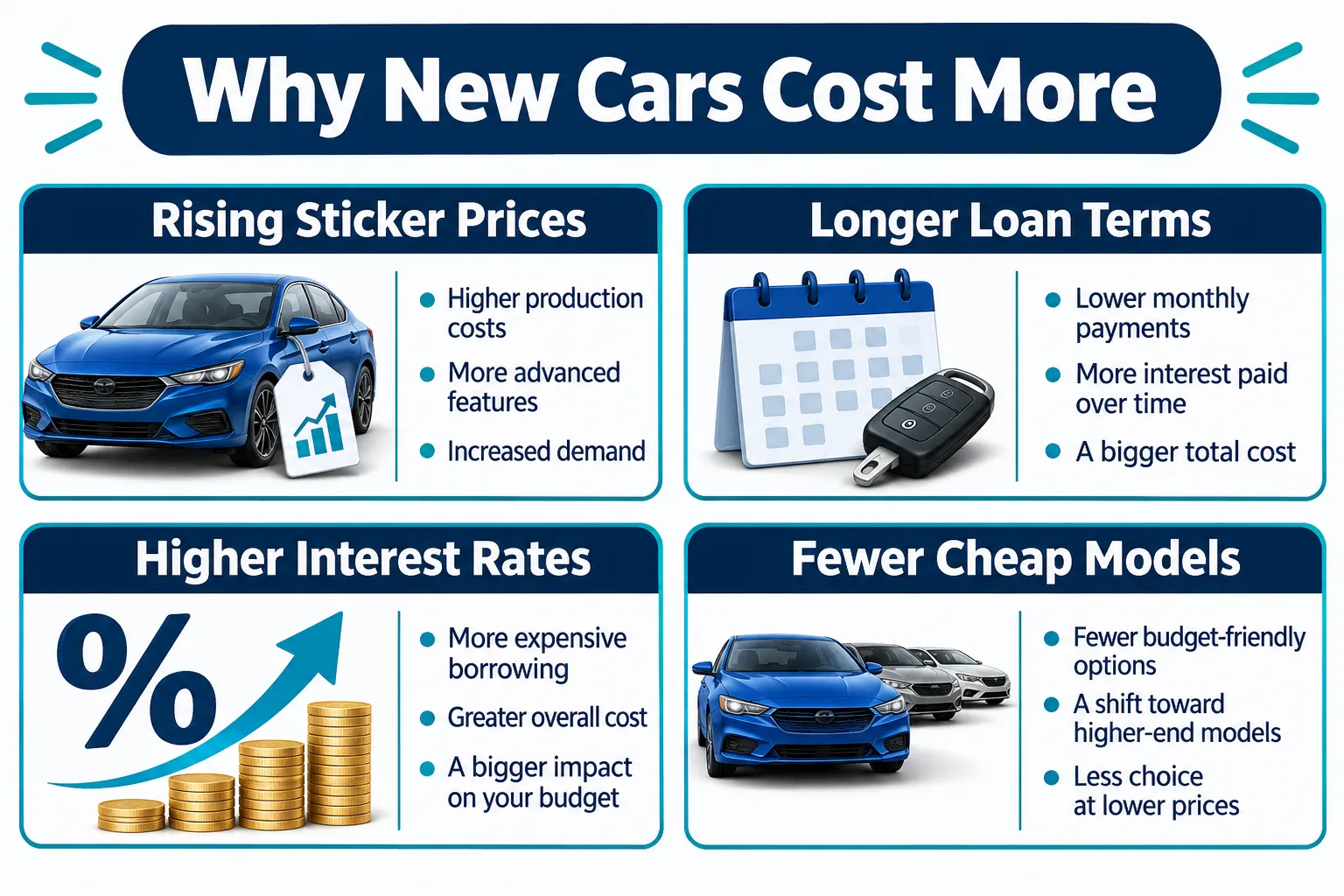
Several forces are colliding at once. High vehicle prices, elevated interest rates, and three straight years of cost-of-living inflation have “changed the math on every transaction,” according to one auto finance review, making old affordability benchmarks irrelevant. A separate November 2026 analysis points out that automakers once offered about 75 models under $30,000 back in the 2017 model year. That number has shrunk dramatically as manufacturers chase higher margins on trucks and SUVs, leaving fewer genuinely cheap options on the lot.[6] Shoppers who once could count on a basic sedan under $25,000 now find themselves priced into bigger loans for bigger vehicles, whether they wanted the upgrade or not.[3][6]
For readers comparing domestic options against imports, our complete guide to foreign car brands, benefits, and buying tips breaks down where value still exists across different manufacturers.
Why Longer Loans Are Masking the Real Cost
To keep monthly payments looking survivable, more buyers are stretching loan terms far beyond the traditional five or six years. Edmunds reports that a record 25.5% of financed new-vehicle purchases in Q3 2026 used terms of 84 months or longer, essentially seven years or more.[1] Marketplace confirms this trend, noting more than a quarter of new-car buyers now take seven-year-plus loans.[3]
This strategy lowers the monthly number but raises the total cost dramatically. Stretching a loan to 84 months means paying far more interest over time, and it keeps buyers “underwater”, owing more than the car is worth, for much longer. A vehicle depreciates fastest in its first few years, while an 84-month loan balance shrinks slowly. That gap is where negative equity lives, and it is a trap that smart buying strategies are specifically designed to avoid.
How High Interest Rates Are Deepening the Vehicle Affordability Crisis
Interest rates are doing as much damage to affordability as sticker prices. In the Los Angeles market, average APRs on new-vehicle loans reached about 7.3% in October 2026, pushing typical monthly payments toward $800.[2] Compare that to pre-pandemic rates, often in the 4 to 5% range, and the difference adds up to hundreds of extra dollars every single month for the same car.

“High vehicle prices, still-elevated interest rates, and three years of cost-of-living inflation have changed the math on every transaction.”
The strain shows up most clearly in delinquency data. New York Fed figures summarized in mid-2026 show 90-day-or-more auto loan delinquencies climbing to 5.60% in Q1 2026, up from 5.21% the previous quarter and far above the long-term average of 3.59%. That rate has been rising steadily since Q1 2024, when it sat at 4.41%. A Q2 2026 update adds more detail: the annualized share of auto loan balances moving into serious delinquency hit 3.00%, up from 2.93% a year earlier, while 5.49% of all outstanding auto loan balances were already 90-plus days past due.[7]
Subprime borrowers are feeling this hardest. Fitch data show the share of subprime auto borrowers at least 60 days behind climbed to 6.23% in September 2026, one of the highest readings in recent memory. WardsAuto reports that by Q3 2026, loans 90-plus days delinquent made up about 5.7% of total outstanding auto debt, up from roughly 5.0% a year prior, though some analysts hope pandemic-era “echo” effects will fade over time.[8]
Is This a Full-Blown Crisis or Just a Rough Market?
Analysts are careful with their language, and that nuance matters. A mid-2026 legal and regulatory review for auto lenders concluded the market “is not in crisis, but it is undeniably under pressure,” citing steadily rising delinquencies and tighter lender margins. A September 2026 auto finance review takes a firmer stance, describing delinquencies at or near record levels and framing the combination of high prices, high rates, and persistent inflation as a structural affordability problem, not a short-term blip.
Public conversation reflects the same tension. A WBUR “On Point” episode from November 2026 frames the situation as an “auto debt crisis,” pointing out that roughly 86 million Americans, about 28% of consumers, carry auto debt, with rising repossessions and uneven regional distress.[9] The discussion even draws comparisons between current lending patterns and the run-up to the 2008 financial crisis, flagging subprime segments and auto asset-backed securities as areas investors are watching closely.[9]
There is also a strategic warning buried in this data for automakers themselves. A November 2026 market commentary calls a typical $776 monthly payment a “warning for Ford and General Motors,” arguing that when the sales pitch collides with the household budget, even loyal customers defer purchases or shift to cheaper alternatives, a real threat to sales volume and profit margins.
For shoppers weighing new versus used as a way to dodge some of this pressure, our guide on certified used cars, warranties, and how to find the best deals is a useful starting point, and our broader tag archive on buying a used car covers related strategies.
Smart Buying Strategies to Beat the Vehicle Affordability Crisis
None of this means car buyers are powerless. There are concrete, proven moves that reduce risk and cost, even in a market this tight. Here are the strategies experts recommend most consistently.

1. Get Pre-Approved Before You Shop
Consumer Reports advises determining a realistic monthly budget and down payment first, then shopping for a loan through a bank or credit union before ever stepping into a dealership finance office. Local consumer advocates echo this, noting that pre-approval gives buyers real negotiating leverage on the vehicle’s price and protects against surprise rate markups once sales teams sense a motivated, unprepared buyer.[5]
Pre-arranging financing also prevents dealers from steering shoppers into longer, higher-rate loans disguised as “affordable” monthly payments.[5]
2. Put Down as Much as You Reasonably Can
With average new-car APRs above 7% in many markets, every dollar financed costs more in interest than it did a few years ago.[2] Consumer Reports recommends a minimum 15% down payment on a new vehicle, and 20 to 25% if possible, to create a buffer against depreciation and negative equity. This single step dramatically lowers the odds of owing more than the car is worth if it is totaled or needs to be sold early.[1]
3. Resist the Pull of Ultra-Long Loan Terms
An 84-month loan might make a $50,000 car feel like a $600-a-month decision, but the math catches up. Longer terms mean more total interest, more years of being underwater on the loan, and less flexibility to trade in or sell. Given that a record 25.5% of buyers are already using these extended terms, resisting them is one of the clearest ways to separate a smart purchase from a risky one.[1]
4. Consider the Full Range of Vehicle Options
With fewer sub-$30,000 models on the market than a decade ago, buyers may need to widen their search.[6] This can include:
- Certified pre-owned vehicles with manufacturer-backed warranties
- Smaller trims or base models instead of loaded packages
- Reliable off-road vehicles that hold value well for buyers who need capability without luxury pricing
- Comparing depreciation curves on near-luxury used vehicles, as covered in our Porsche and Mercedes-Benz used car buying guide
- Electric vehicles, which one analysis suggests could become cheaper than gas-powered cars within five years, potentially shifting the long-term affordability equation
5. Know the True Cost Before You Sign
It helps to separate sticker price from total cost of ownership. The table below summarizes the core pressure points shoppers face right now, based on the data already discussed.
| Pressure Point | What’s Happening |
|---|---|
| Sticker prices | Average new car price crossed $50,000 in late 2026[1] |
| Monthly payments | Record average finance payment of $808 reported mid-2026[4] |
| Loan terms | Over a quarter of buyers now choose 84-month-plus loans[1] |
| Interest rates | Average APRs near 7.3% in major markets like Los Angeles[2] |
| Delinquencies | 90+ day delinquencies at 5.60%, above the 3.59% historical average |
Buyers thinking beyond cars should also remember that affordability pressure extends across other big purchases, from RVs to boats. If you are weighing a recreational vehicle alongside a car, our rundown of common RV buying mistakes applies many of the same financing lessons.
Conclusion
The vehicle affordability crisis and smart buying strategies that respond to it are now inseparable topics for anyone shopping for a car in 2026. Prices above $50,000, record monthly payments near $800, climbing delinquencies, and a shrinking pool of budget-friendly models have reshaped what it means to buy a car responsibly.[1][4] None of these pressures are going away soon, but they are manageable with the right approach.
Before your next purchase, take these concrete steps: get pre-approved financing from a bank or credit union, save for the largest down payment you can manage, avoid stretching loans beyond six years even if the shorter-term payment feels tighter, and widen your search to include certified pre-owned or alternative vehicle types. These habits will not eliminate the pressure of today’s market, but they will keep you from becoming one of the delinquency statistics climbing across the industry.
References
- New Vehicle Affordability Squeezed Record Prices High Interest Rates Hit Buyers. foxbusiness.com.
- Why Car Prices Just Keep Climbing. marketplace.org.
- Article316984701. heraldonline.com.
- Car Buying Double Whammy High Prices High Rates What You Can Do. wcpo.com.
- What Happened to Affordable Car. ajc.com.
- Auto Loan Delinquency Statistics. defisolutions.com.
- Auto Loan Delinquency Stats Could Begin to Lessen as Pandemic Echo Fades. wardsauto.com.
- Cars Expensive Payment Auto Loan Debt. wbur.org.
car buying tips, vehicle affordability crisis, auto loan rates, new car prices 2026, smart buying strategies, auto loan delinquency, car financing tips, down payment strategy, certified used cars, car shopping guide