Last Updated on August 31, 2026
Nearly 40 million used cars change hands in the United States every year, yet many buyers still walk onto a lot without knowing if the asking price is fair. Overpaying by even a few thousand dollars is easy when you skip one critical step: knowing how to check used car value before you negotiate. The NADA Guide, now integrated into J.D. Power’s consumer platform, is the most widely trusted starting point for that research. This guide walks through every step, explains what the numbers mean, and shows how to combine NADA data with other tools so no seller can catch you off guard.
Key Takeaways
- The NADA Guide lives inside J.D. Power’s consumer site and provides trade-in, private-party, and retail values for new and used vehicles.
- Kelley Blue Book reported the average used car sold for $27,028 in July 2026, signaling a still-elevated but stabilizing market. [8]
- Edmunds found the average transaction price for a 3-year-old used vehicle hit $32,461 in Q2 2026, a new second-quarter record. [7]
- Always compare NADA values against at least two other tools (Kelley Blue Book, Edmunds, Carfax) to build a realistic price range.
- Vehicle condition, mileage, location, and current market trends all affect whether a NADA number is the right benchmark for a specific car.
What Is the NADA Guide and Why Does It Matter
For decades, car dealers, banks, and insurance companies relied on the NADA Official Used Car Guide as the gold standard for vehicle pricing. Today, those same values are available to everyday shoppers through J.D. Power’s consumer vehicle portal, which markets itself as the home for “New Car Prices & Used Car Values | NADA Car Value.” [5] The platform lets anyone research used car book values, trade-in values, ratings, specs, and photos in one place. [5]
Understanding why this matters starts with knowing what a “book value” actually is. A book value is not a random number. It is a calculated estimate based on real transaction data, regional demand, vehicle age, mileage, and condition. Lenders use NADA values to decide how much to finance. Dealers use them to set trade-in offers. Buyers who know how to check used car value using these same tools enter every negotiation from a position of knowledge rather than guesswork.
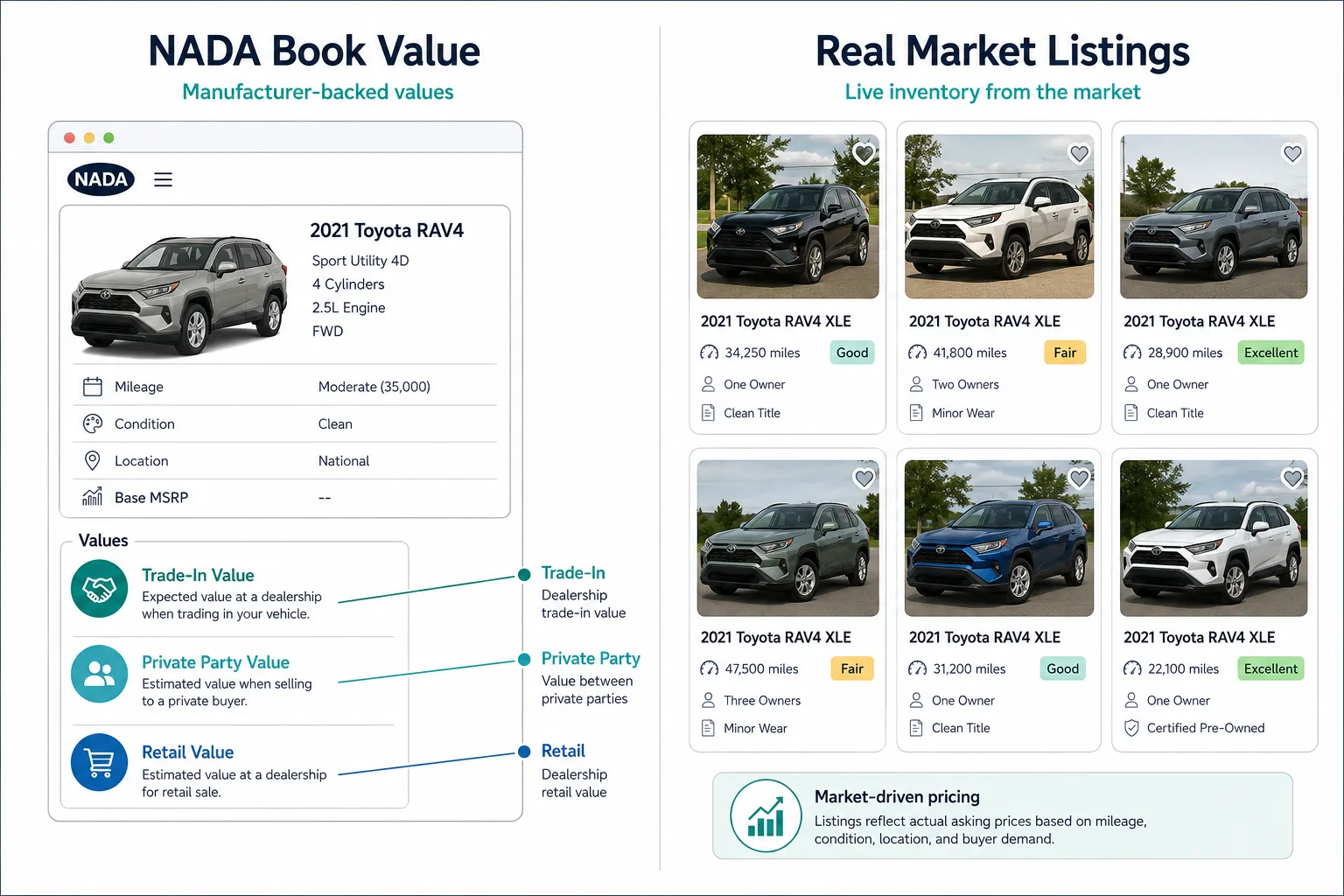
Three types of NADA values every buyer should know:
| Value Type | What It Means | When to Use It |
|---|---|---|
| Trade-In Value | What a dealer will pay you for your old car | When trading in a vehicle |
| Private-Party Value | Fair price between two private individuals | Buying or selling without a dealer |
| Retail Value | What a dealer charges on the lot | Comparing against a dealer’s asking price |
Each number is different. A trade-in value is always lower than a retail value because dealers need room to resell the car at a profit. Knowing which number applies to your situation is the first step toward a fair deal.
How to Check Used Car Value Using the NADA Platform
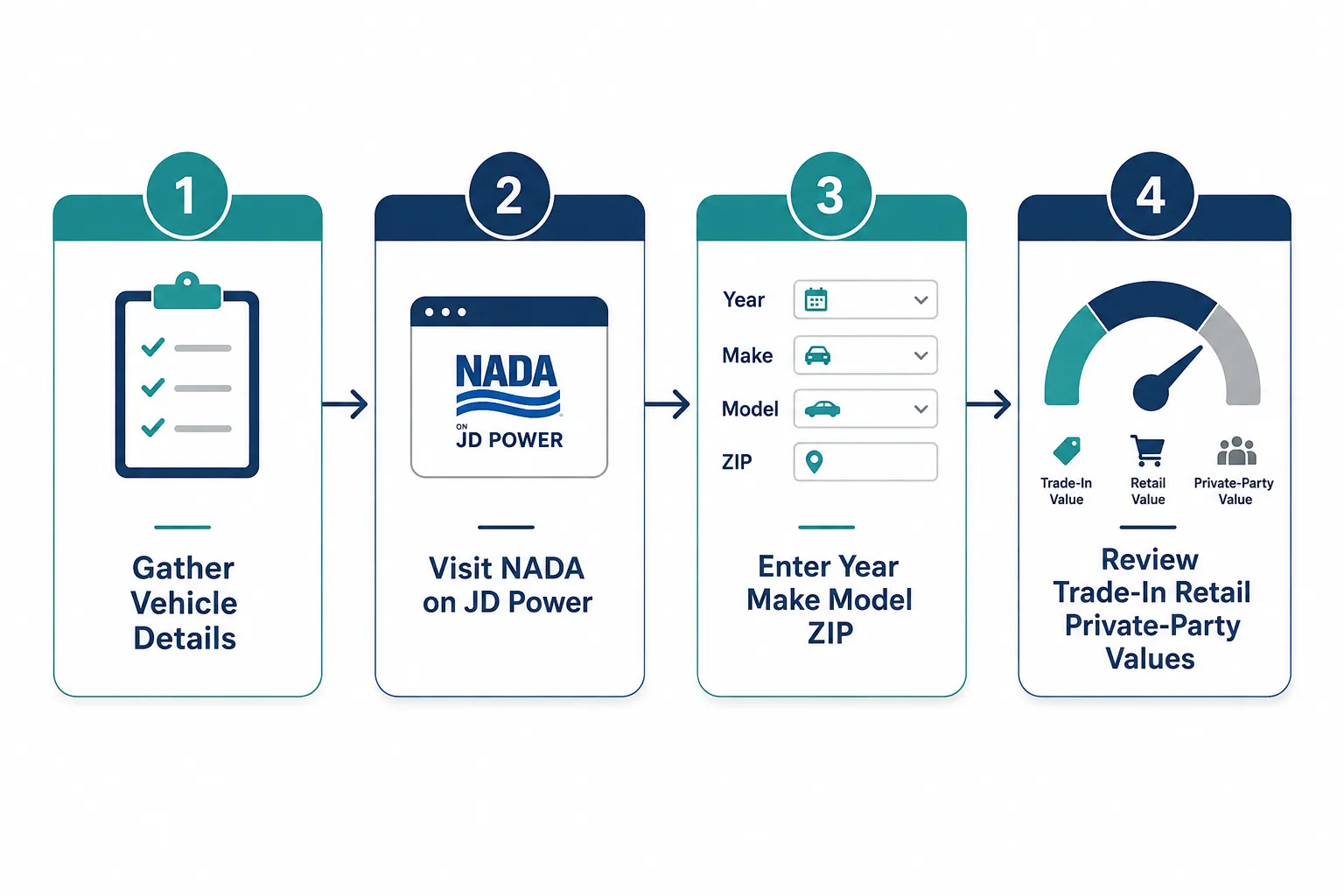
The process is straightforward. The NADA consumer lookup, hosted on J.D. Power’s site, asks for a few key details and returns a set of values in seconds. [5] Here is a step-by-step walkthrough.
Step 1: Gather the vehicle’s details
Before visiting any valuation tool, collect the following:
- Year, make, and model
- Trim level (for example, “LT” vs. “LTZ” on a Chevrolet)
- Mileage
- ZIP code (values vary by region)
- VIN number (optional but more precise)
Step 2: Go to the NADA consumer lookup
Navigate to the J.D. Power consumer vehicle values page at nada.org or through the J.D. Power portal. [5] The site is free to use and requires no account.
Step 3: Enter the vehicle information
Type in the year, make, and model. The tool will ask about the trim level and any optional equipment. Be honest here. Adding features the car does not actually have will inflate the value unfairly.
Step 4: Enter mileage and ZIP code
Mileage is one of the biggest factors in used car pricing. A car with 30,000 miles is worth significantly more than the same model with 100,000 miles. ZIP code matters because demand for certain vehicles differs by region. Trucks tend to be worth more in rural areas; fuel-efficient sedans often command higher prices in urban markets.
Step 5: Review the three value types
The results page will show trade-in, private-party, and retail values. Compare the retail value to the dealer’s asking price. If you are buying from a private seller, compare their price to the private-party value.
“Knowing the difference between trade-in, private-party, and retail values is the single most important thing a used car buyer can learn before stepping onto a lot.”
For a broader look at the entire car-buying process, the Complete Guide to Buying Used Cars: Tips, Inspection Checklist & Best Models covers every stage from research to signing the paperwork.
How to Check Used Car Value With Multiple Tools
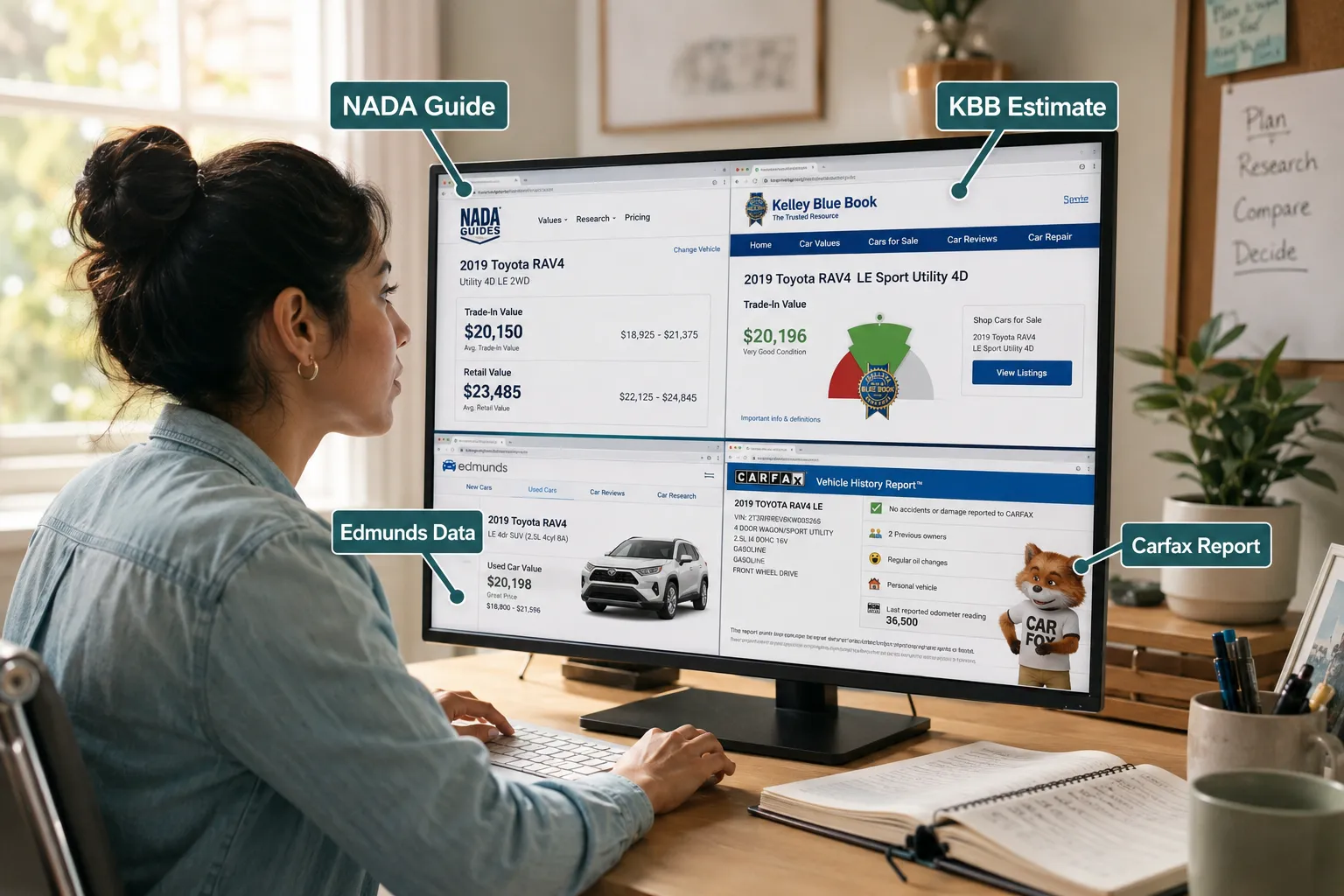
NADA is an excellent starting point, but no single tool tells the whole story. Smart buyers cross-reference at least three sources before deciding what a car is worth. [9]
Kelley Blue Book
Kelley Blue Book (KBB) is the most recognized name in used car pricing among consumers. KBB uses a slightly different methodology than NADA, which means the numbers sometimes differ. That difference is actually useful. If both tools return similar values, confidence in the estimate goes up. If they differ by a large amount, it signals a need to dig deeper.
For a detailed comparison of how the two tools stack up, the NADA vs Kelley Blue Book: What You Should Know breakdown explains the key differences and when to trust each source.
Edmunds
Edmunds publishes its own True Market Value (TMV) data based on actual transaction prices rather than asking prices. This is a critical distinction. Asking prices reflect what sellers want; transaction prices reflect what buyers actually paid. Edmunds also maintains a dedicated resource that explains how NADA values relate to real market conditions and how to read different value types correctly. [9]
For more on how Edmunds approaches used car pricing, see the guide to Used Car Prices Using Edmunds TMV.
Carfax Used Car Price Index
Carfax tracks monthly price trends across vehicle segments including cars, SUVs, trucks, and vans. [1] Comparing these segment-level movements against NADA values for a specific vehicle type adds another layer of context. If Carfax data shows truck prices rising in a particular month and the car being considered is a truck, that trend affects what a fair price looks like right now.
Building a Price Range
Rather than looking for a single “correct” number, the goal is to build a range. Here is a simple method:
- Pull the NADA retail value.
- Pull the KBB fair market range.
- Pull the Edmunds TMV.
- Average the three numbers or note the low and high ends.
- Use that range as the negotiation target.
If the seller’s price falls within or below that range, the deal is likely fair. If it is significantly above the top of the range, there is room to negotiate or walk away.
For additional perspective on the difference between a car’s value and its price tag, the article on Value vs. Price is worth reading before any negotiation.
Understanding the 2026 Used Car Market
Knowing how to check used car value also means understanding the market those values exist in. The 2026 used car market is unlike anything seen a decade ago, and old rules of thumb no longer apply.
Prices Are Near Record Highs
Edmunds’ Q2 2026 report found that the average transaction price for a 3-year-old used vehicle reached $32,461, a new second-quarter record. [7] That number reflects a structural shift in the market. Since Q2 2019, the share of used vehicles priced under $20,000 fell from 55.2% to just 31.8%. Meanwhile, the share priced above $30,000 more than doubled, rising from 16.8% to 35.8%. [7]
This means a NADA book value that looks high compared to what used cars cost five years ago may actually be accurate for today’s market. Comparing today’s prices to pre-2020 norms will lead to frustration and missed deals.
The Market Is Stabilizing, Not Dropping
Kelley Blue Book data shows the average used car sold for $27,028 in July 2026, just $1 higher than June. [8] That near-flat movement suggests the market is plateauing rather than declining sharply. Buyers hoping for a major price correction before purchasing may be waiting longer than expected.
What This Means for Buyers
- A NADA value that seems high is not necessarily wrong; it may simply reflect current market reality.
- Checking values against current listings on sites like Autotrader or Cars.com confirms whether book values match what is actually for sale.
- Waiting for prices to fall is a strategy, but it carries risk if the needed vehicle is in short supply.
For buyers looking at specific models that hold their value well in this market, the 15 Best Used Cars to Buy in 2026 provides expert-reviewed options across different budgets.
Factors That Affect Used Car Value Beyond the Book Number
A NADA value is a baseline, not a final answer. Several factors can push the real-world value of a specific car above or below what the guide shows.
Condition
NADA and other guides typically define condition on a scale:
- Excellent: Looks and runs like new, no visible wear, full service history
- Good: Minor wear, all systems working, clean history
- Fair: Visible wear, may need minor repairs, some service gaps
- Poor: Major mechanical or cosmetic issues
Most used cars fall into the “good” or “fair” category. A car listed at “excellent” condition pricing should be verified carefully. Ask for service records and get an independent inspection.
Mileage
Average annual mileage in the United States is roughly 12,000 to 15,000 miles per year. A car with significantly fewer miles than average for its age is worth more than the standard book value. A car with much higher mileage is worth less.
Accident and Title History
A vehicle with a clean title and no accident history is worth more than one with a salvage or rebuilt title. Always run a vehicle history report through Carfax or AutoCheck before finalizing any purchase. A single reported accident can reduce a car’s value by 10% to 25% depending on severity.
Location and Seasonality
Regional demand affects price. Convertibles sell for more in warm climates. Four-wheel-drive trucks command premiums in snowy regions. Time of year matters too. Convertibles peak in spring; four-wheel-drive vehicles peak in fall.
Optional Equipment and Packages
Sunroofs, leather seats, navigation systems, and towing packages all add value. When using NADA or any other tool, add the specific options the vehicle actually has. Leaving them out underestimates the car’s value; adding options it does not have inflates it.
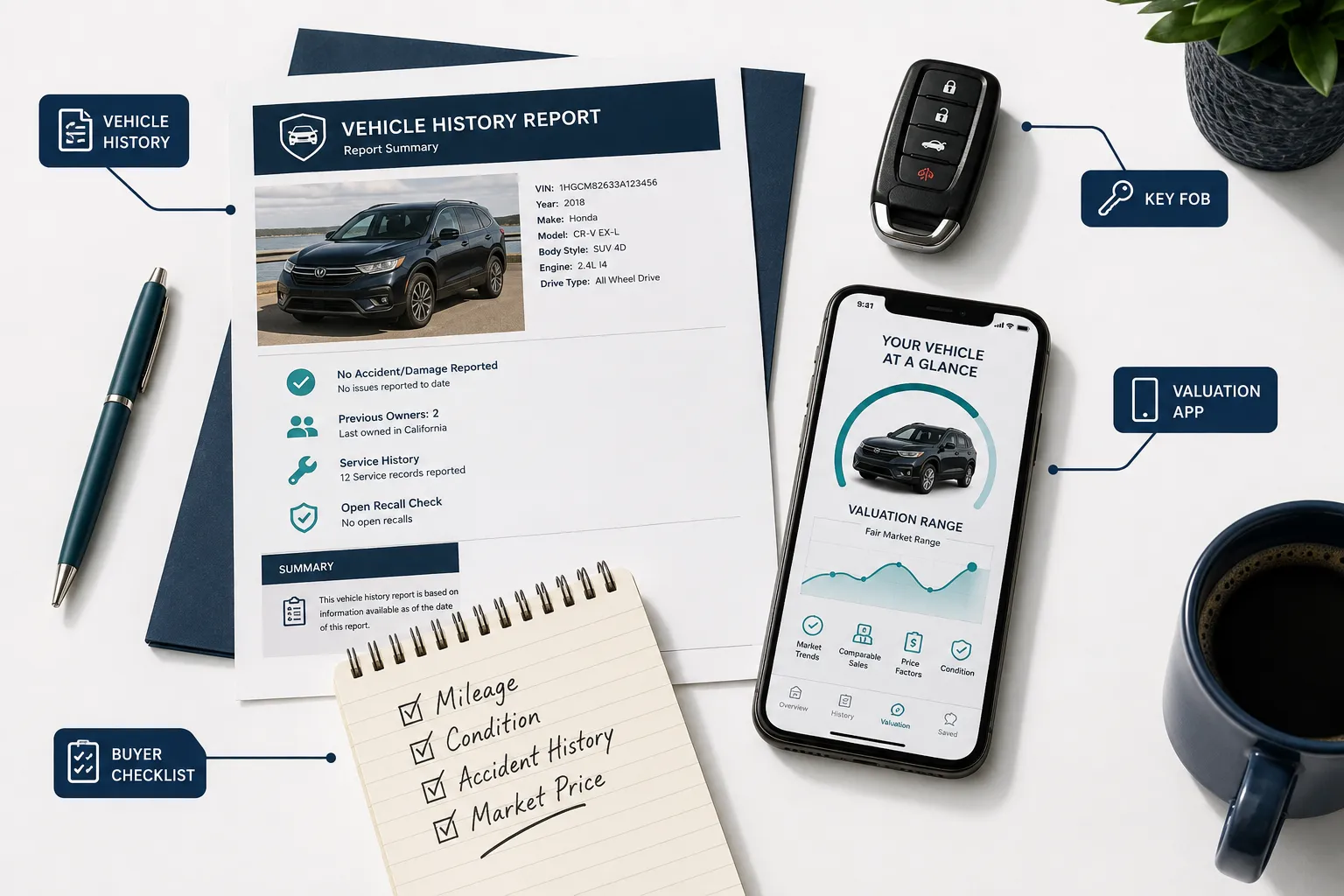
Quick checklist before finalizing any used car purchase:
- Run the VIN through a vehicle history service
- Compare the asking price to NADA, KBB, and Edmunds values
- Check current local listings for similar vehicles
- Get an independent pre-purchase inspection from a trusted mechanic
- Verify the title is clean and matches the seller’s name
For buyers considering certified pre-owned options, which often come with verified condition ratings already built in, the Certified Used Cars: Complete Guide to Benefits, Warranties, and How to Find the Best Deals explains how CPO pricing compares to standard used car book values.
Common Mistakes When Checking Used Car Value
Even buyers who use valuation tools make avoidable errors. Here are the most common ones and how to avoid them.
Mistake 1: Using only one source
Relying on a single tool gives a single perspective. Markets move fast. One tool may update its data more frequently than another. Using three sources and building a range is always more reliable than trusting one number.
Mistake 2: Ignoring regional differences
A ZIP code field exists in these tools for a reason. Entering the wrong location, or skipping it entirely, can produce values that do not reflect local supply and demand.
Mistake 3: Choosing the wrong condition grade
Buyers often grade a car too generously when they want it. A car with a dented bumper and worn seats is not in “excellent” condition, no matter how much the buyer likes it. Be objective.
Mistake 4: Comparing today’s prices to old norms
As the Edmunds Q2 2026 data makes clear, the used car market has fundamentally shifted. [7] Expecting to find a reliable 3-year-old SUV for $18,000 because that was normal in 2018 will lead to disappointment. Use current data.
Mistake 5: Skipping the vehicle history report
Book values assume a clean history. A car with undisclosed accident damage or a title problem is worth less than any guide will show. The history report closes that gap.
For buyers who want to understand how dealers think about pricing and where negotiation room actually exists, the Car Buying Tips Dealerships Don’t Want You to Know is a practical companion read.
Conclusion
Knowing how to check used car value is not complicated, but it does require using the right tools in the right order. Start with the NADA consumer lookup on J.D. Power’s platform to get trade-in, private-party, and retail baselines. [5] Cross-reference those numbers with Kelley Blue Book and Edmunds to build a realistic price range. Factor in the vehicle’s actual condition, mileage, history, and location. Then compare everything against current local listings to confirm the range reflects what is actually selling in the market today.
In 2026, used car prices remain near record highs. [7][8] A book value that looks high compared to old norms may simply be accurate. The goal is not to find a bargain below book value at all costs; it is to pay a fair price for a car that meets real needs. Armed with NADA data and a multi-source approach, any buyer can walk into a negotiation with confidence.
Actionable next steps:
- Visit the NADA consumer lookup and enter the target vehicle’s details before contacting any seller.
- Pull KBB and Edmunds values for the same vehicle and build a price range.
- Run a Carfax or AutoCheck report on the VIN.
- Schedule a pre-purchase inspection with an independent mechanic.
- Use the range, not a single number, as the basis for every price conversation.
References
[1] Used Car Index – https://www.carfax.com/used-car-index
[2] Q1 2026 Edmunds Insights Used Car Report – https://www.edmunds.com/car-news/q1-2026-edmunds-insights-used-car-report.html
[3] Used Car Prices 2026 – https://curbsold.com/blog/used-car-prices-2026
[4] Used Vehicle Prices 2026 Cox Forecast – https://www.cnbc.com/2026/01/08/used-vehicle-prices-2026-cox-forecast.html
[5] Consumer Vehicle Values – https://www.nada.org/nada/consumer-vehicle-values
[6] 2026 Q1 Autotrader Price Index – https://assets.ctfassets.net/uaddx06iwzdz/bHKDmWMsZ3H5cXWPo6KAF/6034dc2cd494d9bd4dde77a23603e588/2026-Q1_AutoTrader_Price_Index.pdf
[7] Insights Q2 2026 Used Car Report – https://www.edmunds.com/car-news/insights-q2-2026-used-car-report.html
[8] Is Now The Time To Buy Sell Or Trade In A Used Car – https://www.kbb.com/car-advice/is-now-the-time-to-buy-sell-or-trade-in-a-used-car/
[9] Nada Guides – https://www.edmunds.com/appraisal/nada-guides/
[10] Used Vehicle Prices – https://www.cnbc.com/2026/03/06/used-vehicle-prices.html